![]()
1 Jevons and economics
Biography and overview1
(with Michael V. White, Monash University, Australia)
Introduction
William Stanley Jevons was one of the great Victorian polymaths, his published work encompassing political economy (economics), logic, statistics and the epistemology and methodology of science. Jevons’ training and work in aspects of physics, and especially chemistry and meteorology, was used in generating new concepts and frameworks of analysis, two aspects of which can be noted here. The first was in the Theory of Political Economy, where Jevons presented a new approach to value and distribution using metaphors from mechanics. That text, in conjunction with the work of Léon Walras, laid the analytical groundwork for what was subsequently termed microeconomics. The second aspect was in his analyses of commercial fluctuations (today: business cycles). Here, Jevons used his training in meteorology in both graphing complex groups of economic variables and using statistical techniques to analyse them.
While Jevons’ work encompasses texts of a theoretical and applied form, it is also important to note that he wrote for a wider audience than those interested in some of the more technical work referred to above. This includes his collection of essays, Methods of Social Reform, in which Jevons discussed questions of political economy in a far broader framework than that considered, for example, in the Theory of Political Economy. The general theory that he used in all his work, to both analyse and suggest policies for social phenomena, was a particular version of utilitarianism. The Methods uses this approach in considering a number of contemporary policy questions while not restricting it to political economy questions. Perhaps the most detailed explanation of Jevons’ utilitarianism as applied to policy questions can be found in The State in Relation to Labour, first published in 1882. Here, although specifically concerned with questions regarding labour (working conditions and the distribution of income and wealth), Jevons provided a detailed rationale for his use of utilitarianism both to analyse issues and to prescribe associated policies.
Jevons’ attempts to discuss issues of political economy for a wider audience can also be seen in two other texts. The first is in his Political Economy (1878), a rather rare text today, which was composed for teachers and pupils in secondary schools. This little book was also important because it explained a number of concepts that he used but did not explain in his Theory of Political Economy. The second is his Principles of Economics, which was incomplete at the time of Jevons’ death. Because of difficulties with assembling the text and problems associated with the first editor, this text was not published until 1905, edited by Henry Higgs. There has sometimes been a tendency to characterize the Principles as unimportant because of its incomplete form. It does, however, contain some valuable information regarding Jevons’ initial work in political economy from the 1860s and his later work. The volume is also important because it reprints a number of pamphlets and talks by Jevons, which both amplify his theoretical approach and provide a clear illustration of how he thought that approach should be applied to policy questions.
Jevons’ life2
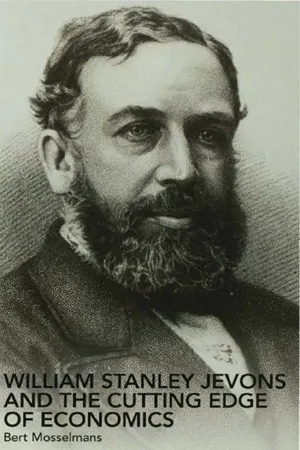
William Stanley Jevons was born in Liverpool on 1 September 1835. His family was Unitarian and part of a large group of intellectual and progressive families knotted together by intermarriage. His father Thomas Jevons (1791–1855) was an iron merchant who combined the practical sense of a man of business with much intellectual curiosity and a flair for invention. His mother, Mary Anne Roscoe (1795–1845), grew up in an intellectual and artistic milieu and showed much interest in poetry, chemistry, logic, botany and political economy. She died in 1845, when Jevons was ten years old. His older sister, Lucy Jevons (1830–1910), became a substitute mother, supporting Jevons morally and encouraging him in his intellectual development. He was, however, much closer to his younger sister Henrietta (1839–1909): they both loved music, exchanged their ideas about religion and shared their emotions. Henrietta (Henny) lost her mental balance in 1869, a few months after the death of Jevons’ oldest brother Roscoe Jevons (1829–1869). Roscoe was interested in poetry, chemistry and mathematics and should be seen as a major intellectual influence on young William Stanley. Unfortunately, he became insane shortly after his mother’s death. Another brother was Herbert Jevons (1831–1874). Herbert had bad health, was unable to settle to a career for many years and finally became employed in New Zealand, where he died at the early age of forty-two. Jevons’ youngest brother Thomas or Tommy (1841–1917) is portrayed as a very intelligent but somewhat lazy young student. He migrated to America and became a successful businessman.
The early death of his mother and the mental and physical illnesses of his brothers and sisters left their mark on the development of the young Jevons. The so-called railway boom crisis of 1847 should also be seen as an important event in his life, as it caused the bankruptcy of his father’s firm. The railway crisis resulted from the pressure of increasingly vast accumulations of capital for investment; the capital glut encouraged bad investments and, therefore, the production of capital-absorbing railways was growing at a high rate. When profits remained absent, railway production was checked, and the demand for iron, which had grown during the ‘railway boom’, fell dramatically. The Jevonses were some of the unfortunate iron merchants driven into bankruptcy.
William Stanley Jevons went to University College School in London in 1850, at the age of fifteen, and in 1851, he became a student at the University College. He remained there until 1852, but did not finish his education. Instead, he accepted a position as an assayer at the Australian Mint (see below). He studied chemistry under Graham and Williamson, two pioneers in the development of atomic theory and the theory of molecular motion. Chemistry remained important during Jevons’ life, and he even published two papers on Brownian Motion in 1870 and 1878. Another major influence at University College was Augustus De Morgan (1806–1871), with his courses on mathematics and logic. Jevons’ own approaches to scientific method, probability, logic and mathematics were influenced by De Morgan. Jevons also had a lively interest in botany, which probably stemmed from his mother. Jevons’ interest in political economy is not surprising, given his non-conformist intellectual and family background, but it can also be explained by the context of economic development in which he lived, with both its dark and its good sides. We have already mentioned Jevons’ ‘hereditary reasons’ for not overlooking business fluctuations, as many members of his family had been bankrupted. But London’s situation in the early 1850s already encouraged an interest in social and economic life. Outbreaks of cholera and bad sanitary conditions came to light as major social problems. Könekamp writes about the ‘sanitary age’ and states that Dickens’ propaganda for sanitary and social reform influenced Jevons, who was brought up in Unitarian circles concerned with social improvement. Jevons undertook long walks through the poor and manufacturing parts of London. But the 1850s were years of rising British economic power as well, reflected in the Great Exhibition of the Works of All Nations, held in 1851. This exhibition quickened the pride of everyone, and Jevons visited it several times. It probably aroused Jevons’ interest in ‘the industrial mechanism of society’, which also dates from 1851 (see Jevons’ remark in Jevons 1905: vii). All those contextual elements help to explain why much of Jevons’ economic work is concerned with business cycles, economic growth and decline, and improvement of social conditions and education.
Jevons left University College without taking his degree. He planned to go into business in Liverpool at the end of the 1853 session. In his diary entry for 16 January 1853, he elaborates on his willingness to pursue a business career and to continue his education in his spare time (Black and Könekamp 1972: 77–80). His dream was to collect financial means in his business career, and then to retire and to devote the rest of his life to scientific enquiries. His father regarded these aspirations as somewhat illusory. In this context, the lucrative job offer as an assayer came up. Jevons was not at all keen to leave for Australia, but the interesting salary of an assayer would lighten the financial burdens of his family.
Jevons sailed from Liverpool on 29 June 1854 and arrived in Melbourne on 6 October. At first, his financial position was rather tight, but this changed in January 1855 when he was offered full-time employment at the Mint. Initially, Jevons found the assaying business exciting: he experimented and even wrote an article on ‘Gold Assay’, which appeared in Watt’s Dictionary of Chemistry (1864). However, after April 1855, it became a sinecure, and he devoted much more time to other scientific investigations. Jevons’ ‘science of man’ project entailed an interdisciplinary utilitarian approach to different aspects of individual and social life. His work covered many different areas, as is shown by the bibliography collected by Inoue and White (1993): railway policy, meteorology, protection, land policy, cloud formation, gunpowder and lightning, geology, etc. Jevons established a detailed meteorological account of Australia and studied the city of Sydney and, not surprisingly, the problem of sanitation received a central place in these investigations. Another study in this context is Jevons’ work on ‘division of labour’ and ‘classification of occupations’: Jevons wanted to investigate how the interaction of different kinds of labour resulted in ‘the industrial mechanism of society’. Much has been written about Jevons’ early influences in Australia. An important road to Jevons’ political economy may be the ‘railway discussion’ to which he devoted three articles. According to Jevons, the extension of railways is acceptable only if the gains are in accordance with the outlays, and this should be measured by people’s willingness to pay higher fares. It is clear that this applies to the case of direct benefits, but Jevons states that the same must hold true for so-called indirect benefits. If people are not willing to pay higher fares, then it proves that they do not see possible indirect effects in the future that would justify higher expenses in the present. Insolvent railways would mean ‘unproductive expenditure’ and a public debt, and this would limit the productive powers of the country.3 Jevons’ ‘science of man’ project not only included his surveys on the mechanism of society, the division of labour and social and moral improvement through the establishment of sanitation, but also an investigation of the role of art and especially of music in a person’s life (see Chapter 7).
Jevons left Australia in 1859 and returned to University College in London to complete his education. The justification for his departure home is couched in economic terms regarding ‘preparation’ and ‘performance’ or even (human) ‘capital’ and ‘labour’. It is better to spend some years in acquiring skills than to start hammering at once, and Jevons would like to continue his education in order to receive a higher social position in the future (Black 1973: 359–60). The early 1860s are important for Jevons’ intellectual development, and he reports in his diary that he received significant insights in both economics and logic: a ‘true comprehension of value’ (La Nauze 1953; Black 1981: 120) and the ‘substitution of similars’ (Black 1972a: 179, see Chapter 6).
Jevons received his MA degree in 1862 and was awarded the gold medal ‘in the third branch’, which included logic, moral philosophy, political philosophy, history of philosophy and political economy. He became a member of the Volunteer Movement, a ‘home guard’ formed to oppose the French armies of Napoleon III in case of an invasion. Jevons wanted to be a publicist and earn his living by writing and publishing articles; he must have had in mind the ease with which he contributed to the Australian press. It proved to be more difficult than Jevons expected: most of his contributions were rejected. All his articles appearing in journals in 1862 were concerned exclusively with meteorology and natural science (see Inoue and White 1993: 128–9). He published two diagrams at his own expense, but they did not receive much attention. The first diagram shows ‘all the Weekly Accounts of the Bank of England, since the passing of the Bank Act of 1844’, and the second diagram depicts ‘the Price of English Funds, the Price of Wheat, the Number of Bankruptcies, and the Rate of Discount, Monthly, since 1731’. Both diagrams were updated and reprinted in Investigations in Currency and Finance. Jevons presented two papers at the 1862 meeting of the Economic Science and Statistics Section of the British Association: On the Study of Periodic Commercial Fluctuations’ and his famous paper ‘Notice of a General Mathematical Theory of Political Economy’. This latter paper can be seen as a summary of his later work, The Theory of Political Economy, first published nine years later. Neither paper received much attention, and Jevons was very disappointed by this lack of interest (see Black 1962).
In 1863, Jevons was appointed as a tutor at Owens College, Manchester, and finally his financial worries came to an end. It must have been a rather difficult job, as it included giving tuition to backward students, and the general standard of the students was rather low. At first, Jevons did not like Manchester’s smoky environment at all, but he could appreciate the city’s ‘distinguished literary position’.4 Jevons visited many libraries, started an impressive collection of private books and undertook much bibliographical work.5 1863 was not only the year of his appointment to Owens College, it was also the starting point of his successful publication career. In 1863, A Serious Fall in the Value of Gold was published (reprinted in Investigations in Currency and Finance) and, for the first time, Jevons became recognized as a political economist. In 1865, The Coal Question appeared, a work that was quoted by John Stuart Mill in the House of Commons. Jevons was appointed lecturer in political economy and logic for the 1865–6 session at Owens College, and could therefore resign his tutorship.6 He disliked teaching in Manchester, but it served as a means of overcoming his fear of speaking in public. The evening classes were especially hard, and they took place in unhealthy conditions. Moreover, Jevons seriously damaged his health because he would not let his teaching interfere with his research. Black (1993: 175–6) argues that precisely Jevons’ attitude towards research should be seen as an improvement regarding the institutionalization of economics at British universities. Like his cousin, H. E. Roscoe, Jevons pursued the ‘new academic policy of research’, which resulted in the conception of a university as something more than simply a teaching institution.7 Jevons’ research resulted in two important works in the history of science: The Theory of Political Economy (1871) and The Principles of Science (1874).
In 1867, Jevons married Harriet A. Taylor, and they subsequently had one son and two daughters. He and his family moved to London in 1876, on his taking up a chair at University College. The fact that Jevons accepted a loss of income as a result of this move indicates that he did not take the new job in London out of professional ambition. On the contrary, for health reasons, Jevons wanted less responsibility (Black 1993: 180). Moreover, he had always wanted to live the life of a ‘literary man’, and this was only possible through a reduction in his teaching responsibilities. London was also a literary centre, and Jevons liked having libraries and publishers within reach. In 1878, Jevons published two works written for a larger audience: Money and the Mechanism of Exchange and Political Economy. In the last period of his short life, Jevons focused on his well-known sunspot theory (several articles are published in Investigations in Currency and Finance) and on social reform (e.g. The State in Relation to Labour, 1882). Rosamond Könekamp describes the circumstances of his death:
Jevons’ life was ended by a tragic accident; he was drowned near Hastings on 13th August, 1882, when nearly 47. […] He was drowned on almost the last day of his stay at the seaside with his family. He had loved swimming since childhood, but his health was not good at this time and he knew he should not bathe. […] However, as the last day drew near he could no longer resist, and he did go for a bathe without telling his wife. No one saw what happened, but the sea was quite rough at the time, and his strength cannot have been equal to it.
(Könekamp 1962: 272–3)
Methods of Social Reform (1883) and Investigations in Currency in Finance (1884) are posthumously published collections of earlier essays. In 1905, Jevons’ unfinished manuscript The Principles of Economics appeared.
The Theory of Political Economy
Although Jevons published a good deal of work on applied economics (see below), he is still best known to economists for his Theory of Political Economy (TPE, 1871, 1879a). This sets out his basic theoretical explanation for the relative prices of commodities (involving the question of ‘value’) and the distribution of output as income. While the analysis showed some degree of theoretical continuity with the work of his predecessors, such as John Stuart Mill, it rested on four components that together constituted an analytical break with preceding discussions of value and distribution. The four components were characteristic of what subsequently became known as ‘neo-classical’ or ‘marginalist’ economics.
The first was to represent economic behaviour as a type of mechanics. In formulating the theory as ‘the mechanics of utility and self-interest’ (Jevons 1879a: XX), Jevons drew on his training and work in particular aspects of the natural sciences. The nub of TPE was formulated between 1860 and 1862, when Jevons made behaviour analogous to ‘forces’ in physics, such as those of gravity. By 1871, he regarded his approach as broadly consistent with the new physics of ‘energy’, which had been developed since the 1850s (Mirowski 1989; Schabas 1990).
The second component was the extensive use of mathematics which, for Jevons, meant the calculus and the mid-Victorian representation of Euclidean geometry. The mathematics were necessary for the third component, which was the representation of behaviour and market activity in functional forms. The functional approach was consistent with the underlying stimulus-response ‘model’ of behaviour. Adapting the utilitarian theory of Jeremy Bentham, Jevons argued that all behaviour was driven by the pursuit of pleasure (utility) and the avoidance of pain (disutility). Given the assumption of wealth maximization, economic activity was depicted in terms of equilibrium positions in which there was a ‘balance’ of marginal utility and disutility. While the motive ‘forces’ referred to individual behaviour, individuals per se played no part in the analysis, as the theory depicted ‘representative’ or ‘average’ economic actors who did not actually exist. However, Jevons claimed that, statistically, an average of aggregate behaviour – the ‘fictitious mean’ – would mirror the behaviour depicted in the theoretical model (see Chapter 3). It should be noted that, while TPE assumed that actors were dr...