- 320 pages
- English
- ePUB (mobile friendly)
- Available on iOS & Android
eBook - ePub
About this book
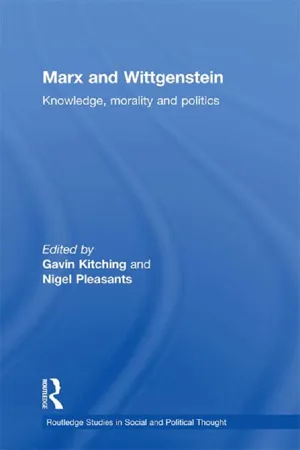
At first sight, Karl Marx and Ludwig Wittgenstein may well seem to be as different from each other as it is possible for the ideas of two major intellectuals to be.
Despite this standard conception, however, a small number of scholars have long suggested that there are deeper philosophical commonalities between Marx and Wittgenstein. They have argued that, once grasped, these commonalities can radically change and enrich understanding both of Marxism and of Wittgensteinian philosophy. This book develops and extends this unorthodox view, emphasising the mutual enrichment that comes from bringing Marx's and Wittgenstein's ideas into dialogue with one another.
Essential reading for all scholars and philosophers interested in the Marxist philosophy and the philosophy of Wittgenstein, this book will also be of vital interest to those studying and researching in the fields of social philosophy, political philosophy, philosophy of social science and political economy.
Information
Part I
Conventional wisdoms
1
Ernest Gellner's criticisms of Wittgenstein and ordinary language philosophy
Introduction
Which book criticising post-war analytic philosophy won favours from both Karl Popper and the Soviet Union, moved I.A. Richards to write a poem, inspired situation comedy, caused a month-long correspondence in The Times, was the subject of concerned editorials in both that newspaper and The Economist, and still strikes sparks today? The Structure of Scientific Revolutions? Naming and Necessity? Philosophy and the Mirror of Nature? No: it was Words and Things by the Czech anthropologist Ernest Gellner (1925–95) which caused world-wide controversy on its publication in 1959 but is practically forgotten nowadays. Words and Things is a vehement attack on the style of philosophising known as ‘linguistic philosophy’, ‘Oxford analysis’ or, most often, ‘ordinary language philosophy’ (OLP) – the style of philosophising associated with Wittgenstein along with Oxford philosophers of the last mid-century, such as Gilbert Ryle and J.L. Austin. The way in which OLP has been written out of history in recent decades is largely the result of Gellner's influence, and I want to reassess the background, nature and scope of his impact.
I think that Words and Things is a very bad book and that its influence has been almost totally deleterious. I agree with Antony Flew's assessment that it is not only a ‘juvenile work’ displaying ‘fundamental frivolousness and irresponsibility’ (1984: 77), but also ‘the immediate or ultimate source of innumerable slick and ignorant put-downs in the subsequent literature’ (1986: 95). Gellner's criticisms of OLP are for the most part unjustified, and even when this isn't so the point would have been better made without the sensationalism. Stephen Mulhall has suggested that ‘the need to reject or transcend [OLP] far outweighed the capacity to provide good grounds for so doing, and so resulted in a form of collective projection coupled with collective amnesia’ (1994: 445). Even if the chances of reviving OLP are slim, by curing part of that amnesia I hope to take some steps to clean the name of a period in which ‘the gains and advances in philosophical understanding … were probably as great as any that have been made in a comparably short time in the history of the subject’ (Strawson, 1998: 12).
Today, familiarity with the influence of Words and Things is especially important if one wants to understand the history of the reception of Wittgenstein, the one philosopher attacked by Gellner who is still generally considered one of the all-time greats. Even if, per impossibile, all the writings of all other practitioners of OLP turned out to be worthless (which is hardly believable), it would still be interesting to demonstrate how the reception of Wittgenstein reflects Gellner's influence. An instantly recognisable style of Wittgensteinian misreading, exploited by thinkers as diverse as Marcuse, Popper, Habermas and Deleuze, can be seen to trace back to Gellner. It is also a key source of a rhetorical style of arguing against Wittgenstein that almost every Wittgensteinian thinker regularly finds himself confronted with.
The reception of Gellner's arguments
The widespread influence of Words and Things is primarily a function of the way in which a large non-academic public was made aware of it shortly after it was published. The book became a succès de scandale when Ryle wrote to its publishers, Victor Gollancz, in his capacity as editor of Mind:
You recently sent me a review copy of Words and Things by Ernest Gellner. I am returning it to you (separately) since I shall not have a review of the book in Mind. Abusiveness may make a book saleable, but it disqualifies it from being treated as a contribution to an academic subject.
(quoted in Russell, 1997: 607)
Bertrand Russell, who had written a laudatory introduction to the book, protested against this in a letter to The Times. Ryle replied, and the exchange started a controversy finally involving nineteen different correspondents, both the merits of the book and the rightness of Ryle's decision being contested with equal vigour.1 The controversy culminated a few weeks later in a solicitous Times leading article (Anonymous 1959c) critical of both sides, although slightly favourable to Gellner. About a month later, The Economist devoted a similarly worried and seemingly impartial editorial to ‘The hatreds of philosophers’ the affair had brought to light (Anonymous 1960). For a while, Gellner's assault seemingly became ‘the most discussed work of English philosophy since A.J. Ayer's Language, Truth and Logic’ (Cohen, 1960: 178); even in Oxford itself, it ‘was chic … to claim that one had enormously enjoyed this piece of intellectual slapstick’ (Anonymous, 1973b: 8).
Although Mind did not review Words and Things, many other periodicals did. Most reviewers were of the opinion Mind’s would undoubtedly have been. The most negative estimate was probably Michael Dummett's view that the book didn't even have ‘the smell of honest or seriously intentioned work’ ([1960] 1978: 436). Many other leading philosophers of the day expressed similar sentiments in their reviews, although a few degrees milder in form (Anonymous 1959b; MacIntyre 1959; Warnock 1959; Cohen 1960; Falck 1960; Mayo 1960; White 1960; Isenberg 1961; Körner 1961; Nuchelmans 1961; Quinton 1961; Doney 1962). Even philosophers who personally disliked OLP were less than commendatory (Ayer 1959; Copleston 1960; Watkins 1960; Findlay 1961). The few completely laudatory reviews were by non-philosophers (e.g. Crick 1960; Meyerhoff and Main 1960). I.A. Richards wrote to Gellner expressing his ‘very substantial agreement’, enclosing ‘The Strayed Poet’, a poem about Wittgenstein which, he said in another letter, was prompted by his reading Words and Things (Richards, 1990: 159–62). What was the minority view among reviewers, however, became the norm quite quickly: Words and Things was a success, and established Gellner's name internationally. He even achieved theatrical fame when Jonathan Miller and Alan Bennett wrote the sketch ‘Words … and Things’ for the 1961 comedy revue Beyond the Fringe. In it, an Oxford philosopher claims that he can ‘quite easily’ establish the relevance of OLP to everyday life, but is quickly rendered a laughing stock (Bennett et al. [1963] 1987: 51–2). In 1961 and 1962, translations of Words and Things came out in Italy, Spain and the Soviet Union; in 1968 it appeared as a Penguin paperback; and 1979 saw the publication of a second edition with a new introduction.
By then Gellner's views were established almost as facts of nature. Many philosophical schools that oppose each other implacably – Popperians, positivists, Marxists, poststructuralists and so on – agree on one thing: OLP was wrong and its disappearance was a good thing indeed. As the years passed, Gellner's estimate of OLP and Wittgenstein's work got lower and lower. In the 1980s the falsity of Wittgenstein's ideas was, to him, ‘probably the single most important fact about the intellectual life of mankind’ (1984: 263); by the 1990s it had grown to ‘the single most important fact about the human condition’ (1996: 670), and Wittgenstein now ‘condemns and ignores everything that is important in the history of human intellectual life’ (1998: 162), recommending ‘a collective infantile regression for all mankind’ (1992: 123).
It is only in his recently published posthumous book, Language and Solitude, that Gellner's dislike of Wittgenstein and OLP goes beyond mere sensationalism and takes on the contours of a complete Weltanschauung. It includes a seventy-page section on Wittgenstein intended as a definitive statement on the matter of his influence. In the 1960s, Gellner claimed that Durkheim had already thought of everything worth preserving in Wittgenstein (1964: 63–6); a decade later, the thinker with whom Gellner proposed to replace OLP was Collingwood (Anonymous, 1973a: 338). In Language and Solitude, it is Malinowski who serves as the good guy in a scheme in which the bad guy is invariably Wittgenstein. Shortly before his death, Gellner wrote: ‘A man does not necessarily have the last word on the interpretation of his own thought: his views may imply or presuppose ideas he repudiates, and he may be blind to it. Others must judge whether this has happened to me’ (1996: 672). I believe that it has happened to him, and in the following discussion I try to demonstrate this.
The content of Gellner's book
According to Gellner, the ‘four pillars’ on which OLP stands are:
1 The paradigm case argument: language proves, for example, that tables must exist, since we use the word ‘table’ often and with apparent success. In its paradigm actual usage a concept must be correctly applied, for what else could it mean? (1959: 30–7).
2 The generalised version of the naturalistic fallacy : linguistic norms and recommendations can legitimately be inferred from currently accepted usage (1959: 37–40).
3 The contrast theory of meaning: any meaningful term must have both a possible example and a possible counterexample. There must be something a term does not cover. Contrastless concepts are meaningless, because nothing could conceivably count as their refutation (1959: 40–4).
4 Polymorphism : a logically homogeneous ‘ideal language’ is impossible, since every language includes concepts subject to family resemblance and other aspects of the irreducible diversity of language. What were thought to be homonyms are actually different meanings of the same concept. Any general models of languages are impossible (1959: 44–50).
Gellner's most famous objection to OLP, which he claims must follow from the pillars, is that OLP is deeply conservative. It defers to the linguistic habits of the boorish common man; it preserves the social status quo by belittling the significance of social problems; and it can only exist in a closed world like that of Oxford University, ‘being of its essence an ivory tower pursuit’ (Gellner, 1959: 235). OLP is diagnosed as ‘conservative in the values which it in fact insinuates … not specifically conservative … but conservative in a general, unspecific way. It … concentrates on showing that the reasons underlying criticisms of accepted habits are in general mistaken’ (Gellner, 1959: 224–5). Furthermore, Gellner argues that ‘in terms of its own account of its nature and purposes’ OLP is ‘unintelligible to anyone of a practical orientation’ (1959: 246). Its practitioners are accordingly portrayed by him as ‘smug, unintelligent, upper class, superciliously apolitical, unhistorical and anti-scientific’ (Cohen, 1960: 180; cf. Anonymous, 1973b: 8).2
The paradigm case argument
Gellner claims that the paradigm case argument is ‘absolutely essential to Linguistic Philosophy: it pervades it and it is presupposed without qualification’ (1959: 30–1). He selects a tendentious example: Antony Flew's claim that if someone denies the reality of free will, the paradigm case argument supposedly refutes the claim by invoking the fact that ‘of one's free will’ is meaningful in ordinary language (Gellner, 1959: 31; 1998: 161). Gellner gives the impression that all paradigm case arguments are of this kind. Now Flew undeniably uses the paradigm case argument and thinks that it solves the problem of determinism. But this hardly proves that it is ‘absolutely essential’ to OLP. For example, we have lengthy records of both Wittgenstein's and Ryle's lectures on the freedom of the will, and neither of them invokes the paradigm case argument (Wittgenstein [1989] 1993; Ryle, 1993: 111–45). I, in turn, disagree with all of what Flew says and with most of what Ryle and Wittgenstein say.3 Gellner's claim about the pervasiveness of the paradigm case argument is thus refuted; that he ‘devotes only seven unbuttoned pages in an extremely repetitious book to the argument he thinks so crucial’ (Cohen, 1960: 179) does not help his case either.
Another objection he does present against paradigm cases, which has become a stock response, is the case of witches: a certain type of unattractive old woman would once have been a paradigm case of a witch, but nobody believes in witchcraft any more. The problem with this kind of objection is that the paradigm case argument is paradigmatically (sic) used in conjunction with invoking conversational implicature. To deny that witches exist is to commit oneself to a debate on whether witches exist; and to claim that witches exist is to make the same commitment; it is ‘to make one liable to questions … that call for at least some sort of answer’ (Leiber, 1999: 208; cf. Hanfl...
Table of contents
- Front Cover
- Marx and Wittgenstein
- Routledge Studies in Social and Political Thought
- Title Page
- Copyright
- Dedication
- Contents
- Notes on contributors
- Preface
- Introduction
- Part I Conventional wisdoms
- Part II Commonalities
- Part III Wittgenstein and Sraffa
- Part IV Disjunctions
- Part V Forerunners
- Part VI Knowledge, morality and politics
- Index
Trusted by 375,005 students
Access to over 1.5 million titles for a fair monthly price.
Study more efficiently using our study tools.
Frequently asked questions
Yes, you can cancel anytime from the Subscription tab in your account settings on the Perlego website. Your subscription will stay active until the end of your current billing period. Learn how to cancel your subscription
No, books cannot be downloaded as external files, such as PDFs, for use outside of Perlego. However, you can download books within the Perlego app for offline reading on mobile or tablet. Learn how to download books offline
Perlego offers two plans: Essential and Complete
- Essential is ideal for learners and professionals who enjoy exploring a wide range of subjects. Access the Essential Library with 800,000+ trusted titles and best-sellers across business, personal growth, and the humanities. Includes unlimited reading time and Standard Read Aloud voice.
- Complete: Perfect for advanced learners and researchers needing full, unrestricted access. Unlock 1.5M+ books across hundreds of subjects, including academic and specialized titles. The Complete Plan also includes advanced features like Premium Read Aloud and Research Assistant.
We are an online textbook subscription service, where you can get access to an entire online library for less than the price of a single book per month. With over 1.5 million books across 990+ topics, we’ve got you covered! Learn about our mission
Look out for the read-aloud symbol on your next book to see if you can listen to it. The read-aloud tool reads text aloud for you, highlighting the text as it is being read. You can pause it, speed it up and slow it down. Learn more about Read Aloud
Yes! You can use the Perlego app on both iOS and Android devices to read anytime, anywhere — even offline. Perfect for commutes or when you’re on the go.
Please note we cannot support devices running on iOS 13 and Android 7 or earlier. Learn more about using the app
Please note we cannot support devices running on iOS 13 and Android 7 or earlier. Learn more about using the app
Yes, you can access Marx and Wittgenstein by Gavin Kitching,Nigel Pleasants in PDF and/or ePUB format, as well as other popular books in Philosophy & Philosophy History & Theory. We have over 1.5 million books available in our catalogue for you to explore.