In this exceptional study, Christian Fuchs discusses how the internet has transformed the lives of human beings and social relationships in contemporary society. By outlining a social theory of the internet and the information society, he demonstrates how the ecological, economic, political, and cultural systems of contemporary society have been transformed by new ICTs. Fuchs highlights how new forms of cooperation and competition are advanced and supported by the internet in subsystems of society and also discusses opportunities and risks of the information society.

- 408 pages
- English
- ePUB (mobile friendly)
- Available on iOS & Android
eBook - ePub
About this book
Information
1 Introduction
The Internet is ubiquitous in everyday life. On the Internet, we search for information, plan trips, read newspapers, articles, communicate with others by making use of e-mail, instant messaging, chat rooms, Internet phone, discussion boards, mailing lists, video conferencing; we listen to music and radio, watch videos, order or purchase by auction different goods, write our own blogs, and contribute to the blogs of others; we meet others, discuss with others, learn to know other people, fall in love, become friends, or develop intimate relations; we maintain contact with others; we protest, access government sites, learn, play games, create knowledge together with others in wikis, share ideas, images, videos; we download software and other digital data, and so forth. On the Internet, we also can feel being lost, disoriented, dissatisfied, scared, bored, stressed, alienated, lonesome, and so forth.
The Internet obviously is here to stay. How has this system transformed our lives and our society? What are the positive effects? What are the negative ones? Which opportunities and risks for the development of society and social systems are there? This book tries to contribute in helping people to find their own answers to such questions. Its main goal is to work out a theoretical understanding of the relationship of Internet and society. The problem that it addresses is the question of how society and the Internet need to be shaped by humans in order to avoid risks and maximize human happiness.
The study on Internet and society undertaken here takes place within a larger framework that has during the last years been labeled with categories like Internet research, ICTs and society, social informatics, informatics and society, new media research, information society theory, information society research/studies, Internet studies, Web research, etc.
Social informatics is a widely used term for this feld of research. It was defined as “the interdisciplinary study of the design, uses, and consequences of ICTs that takes into account their interaction with institutional and cultural contexts” (Kling, Rosenbaum, and Sawyer 2005, 6). This definition implies that both the social design processes of ICTs and social ICT usage are important.
The terms Internet and new media are understood as technological concepts by many (although they are frequently described as techno-social systems by social scientists); hence my contention is that Internet research or new media research are not wisely chosen terms because they can convey the impression of a technological determinist understanding. I therefore consider the term information and communication technologies & society research (ICT&S) more suitable (Fuchs/Hofkirchner 2006).
ICT&S is also short for the Center for Advanced Studies and Research in Information and Communication Technologies & Society (ICT&S Center, http://www.icts.uni-salzburg.at.) at the University of Salzburg. Its opening took place in March 2004; the idea for such a research center was created by Ursula Maier-Rabler, who is now the ICT&S Center's academic director. One of the center's units of competence is the eTheory unit, headed by Wolfgang Hofkirchner, who became professor at the center in October 2004. I joined the Center and the eTheory unit in October 2005 as assistant professor for Internet and society. It is the vivid atmosphere at the ICT&S Center—with all ups and downs attached to it—and at the University of Salzburg that has provided me with the intellectual climate for writing this book. Hence, I want to thank all the people at the ICT&S Center, my students, and my colleagues at the Department of Communication Science for giving me the opportunity for my own continuous learning and intellectual growth.
ICTs is a term that is used for technologies of cognition, communication, and cooperation that are computerized (i.e., work with digital logic) and networked. The term Internet frequently is used for a specific type of ICTs, the global network of computer networks that is based on the TCP/IP protocol and has developed from the ARPANET. Much of the analysis in this book is devoted to the Internet in this understanding; however, the category Internet is not only seen as one specific network but as the general phenomenon of the interconnection of networked knowledge-based technologies and networked social systems.
The research feld of ICT&S deals with the interplay of new information and communication technologies (ICTs) and society. Two interconnected aspects of ICT&S research are:
•The social shaping/social design of ICTs.
•The impacts of ICT usage on society.
The task is the analysis of these relationships and the contribution to the design of society and ICTs so that a participatory knowledge society can emerge. ICT&S research deals with opportunities and risks of the knowledge society and the shaping of technology and social systems.
ICT&S research is a double process, consisting of (1) a process in which human actors design ICTs and in which it is analyzed how society shapes ICTs, and (2) of a process in which it is assessed how the usage of ICTs
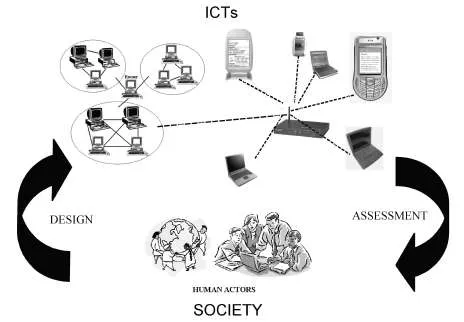
Figure 1.1 ICT&S Research.
transforms society (fig. 1.1). That ICTs are shown at another level than society here doesn't mean that they exist outside of it. Rather, ICTs are an immanent part of society.
Conceiving ICT&S as a double process of design and assessment implies that the relation of the two levels is inherently dynamic, they are mutually connected to each other, and they have constructive effects onto each other. Such dynamic thinking in philosophy can be found in the dialectical tradition. In dialectics, two separate entities become connected and form a higher-level unity that feeds back onto its parts. Dialectical development is a dynamic process of unity in diversity. In contemporary social science, dialectics has played a role, for example, in conceiving the relationship between social structures and human practices, as Anthony Giddens's structuration theory or Pierre Bourdieu's theory of habitus have exemplified.
Technological determinist accounts see technology as the driving force of society, as an independent factor outside of society that has linear effects on social systems. Social shaping approaches (such as social constructivism, actor network theory, neo-Marxist technology critique, cultural studies; for this distinction cf. Mackay 1995) consider technology as being invented, designed, changed, and used by humans and influenced by an overall societal context. The dialectical view advanced in this book, which conceives the relationship of ICTs and society as dynamic process, allows escaping the techno-deterministic view that only technology shapes society and the socioconstructivist view that only society shapes technology. The endless dynamic loop involved in this approach is based on the idea that humans in society shape (i.e., design and use) ICTs and that in this process technology conditions, that is, enables and constrains, human cognition, communication, and cooperation. Such a self-referential loop has been described as the approach of mutual shaping of society and ICTs (Lievrouw and Livingstone 2006; Herdin, Hofkirchner, and Maier-Rabler 2007).
What sort of science is ICT&S? Some argue that it is a transdiscipline (Hunsinger 2005; Lamb and Sawyer 2005; Sawyer and Tyworth 2006) because it would approach its object of study beyond and across disciplinary and interdisciplinary perspectives, there would be no single perspective, and researchers from different disciplines would cooperate in order to construct a common ground. Some say it is an interdisciplinary feld of research (Duff 2000: 180). For others it is an emerging new discipline with its own journals, institutions, departments, studies, curricula, conferences, associations, projects, students, researchers, grants, a unified object of research, specific research methods, and so forth (Vehovar 2006). Wesley Shrum (2005) argues that Internet research is an indiscipline because it crosses the boundaries between traditional disciplines. No matter which position one takes here, it is obvious that ICT&S transgresses the traditional boundaries between the social and the engineering sciences. It is a boundary-deconstructing science.
Computerized network technologies change all areas of society; they pose challenges and opportunities in a networked globalizing world. Analyzing networks and networked social systems requires networking science. Transdisciplinarity means a higher-level system of research with a shared language, a unity in diversity of disciplines, approaches, methods, categories, theories, and so on. It emerges from the communication of scientists who have different backgrounds but share an interest in a common topic of research from different angles.
Some argue that Internet and society can be researched with traditional social science methods, whereas others argue that new methods are needed. My contention is that old methods are needed but that, due to the emergence of cyberspace, transformations of methods are also needed, as is shown by the emergence of methods of online social research (cf., e.g., Batinic, Reips, and Bosnjak 2002; Johns, Chen, and Hall 2004). The methods of ICT&S research are based on a dialectic of the new and the old: ICT&S needs all methods employed for designing and engineering ICTs, and it needs all methods employed for conceptualizing and analyzing society. Hence, a mix of methods from informatics and the social sciences forms a precondition for the existence of ICT&S. By their interplay, all of these methods can form a higher-level unity in diversity so that new cooperative methods emerge. Design produces applications; the latter's usage by humans changes society and social system. These changes need to be assessed, so that new design requirements emerge that again result in new applications, and so on. This dynamic process is at the heart of the methodological level of ICT&S.
ICT&S is not yet a fully developed feld of research. There are many interacting parts that try to form a joint whole. The novelty of this feld brings along excitement and openness as well as uncertainty about its future.
Kling, Rosenbaum, and Sawyer (2005, 6sq.) argue first that social informatics is empirically focused but then say that analytically it refers to studies that develop theories or to empirical studies that contribute to theorizing. If a theory is understood as a logically interconnected set of systematic hypotheses that describe worldly phenomena and the latter's foundation, structure, causes, effects, and dynamics; and empiricism as the observation and collection of data for constructing systematic and refected knowledge, then one arrives at two levels of science. There is no theory that isn't grounded in empirical observations and no empirical research that doesn't make some theoretical assumptions. However, there can be a different stress of the two factors, and hence one can distinguish between theoretical research (primarily theoretically informed) and empirical research (primarily empirically informed). The work undertaken in this book is understood as a contribution to a theory of Internet and society. Why is social theory important in this context? The emergence of the Internet has transformed society. In research this has resulted in a plurality of concepts such as Internet economy, digital democracy, cyberculture, virtual community, cyberlove, eParticipation, eGovernment, eGovernance, online journalism, social software, Web 2.0, and so forth. There is no clear meaning of these terms; some of them remain very vague or contradictory. One of the goals of the work at hand is to contribute to the theoretical clarification of concepts that arise in the context of the relation of Internet and society. It is a theoretical approach grounded in a multitude of other theories and concepts that to a certain extent are dialectically synthesized so that a complex, multidimensional analysis that avoids deterministic understandings can emerge.
There are microlevel (individual), middle-range (organizational), and wide-range (society) theories and research designs in ICT&S research (Rice 2005). The approach undertaken in this work is predominantly located at the societal level; it is a wide-range theory of Internet and society that focuses on how society as a whole and its subsystems interact with Internet technologies.
Steve Sawyer and Michael Tyworth (2006) argue that social informatics is critical, but not in the sense of emancipation as advanced by crit...
Table of contents
- Cover
- Half Title
- Routledge Research in Information Technology and Society
- Full Title
- Copyright
- Contents
- Preface
- 1 Introduction
- 2 Self-Organization and Cooperation
- 3 Society and Dynamic Social Theory
- 4 The Rise of Transnational Informational Capitalism
- 5 Social Internet Dynamics
- 6 Competition and Cooperation in the Informational Ecology
- 7 Competition and Cooperation in the Internet Economy
- 8 Competition and Cooperation in Online Politics
- 9 Competition and Cooperation in Cyberculture
- 10 Conclusion
- Notes
- References
- Index
Trusted by 375,005 students
Access to over 1.5 million titles for a fair monthly price.
Study more efficiently using our study tools.
Frequently asked questions
Yes, you can cancel anytime from the Subscription tab in your account settings on the Perlego website. Your subscription will stay active until the end of your current billing period. Learn how to cancel your subscription
No, books cannot be downloaded as external files, such as PDFs, for use outside of Perlego. However, you can download books within the Perlego app for offline reading on mobile or tablet. Learn how to download books offline
Perlego offers two plans: Essential and Complete
- Essential is ideal for learners and professionals who enjoy exploring a wide range of subjects. Access the Essential Library with 800,000+ trusted titles and best-sellers across business, personal growth, and the humanities. Includes unlimited reading time and Standard Read Aloud voice.
- Complete: Perfect for advanced learners and researchers needing full, unrestricted access. Unlock 1.5M+ books across hundreds of subjects, including academic and specialized titles. The Complete Plan also includes advanced features like Premium Read Aloud and Research Assistant.
We are an online textbook subscription service, where you can get access to an entire online library for less than the price of a single book per month. With over 1.5 million books across 990+ topics, we’ve got you covered! Learn about our mission
Look out for the read-aloud symbol on your next book to see if you can listen to it. The read-aloud tool reads text aloud for you, highlighting the text as it is being read. You can pause it, speed it up and slow it down. Learn more about Read Aloud
Yes! You can use the Perlego app on both iOS and Android devices to read anytime, anywhere — even offline. Perfect for commutes or when you’re on the go.
Please note we cannot support devices running on iOS 13 and Android 7 or earlier. Learn more about using the app
Please note we cannot support devices running on iOS 13 and Android 7 or earlier. Learn more about using the app
Yes, you can access Internet and Society by Christian Fuchs in PDF and/or ePUB format, as well as other popular books in Ciencias sociales & Ciencias computacionales general. We have over 1.5 million books available in our catalogue for you to explore.