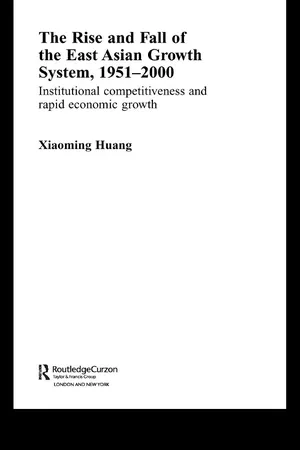
Huang examines a recurring pattern of rapid economic growth in East Asia from 1951 to the present and explores how far a single East Asian Growth model can be said to exist. Assessing the various theories put forward to explain the phenomenon and supported by the most comprehensive data, the book finds that methods of institutional enhancement were at the core of the growth. This institutional enhancement affected state structure and functions, economic policy, corporate arrangements, social structure and relations, individual behaviour, and domestic and international interaction. Each of these elements was a critical aspect of the growth system that defined and propelled the rapid growth.
eBook - ePub
The Rise and Fall of the East Asian Growth System, 1951-2000
Institutional Competitiveness and Rapid Economic Growth
- 304 pages
- English
- ePUB (mobile friendly)
- Available on iOS & Android
eBook - ePub
The Rise and Fall of the East Asian Growth System, 1951-2000
Institutional Competitiveness and Rapid Economic Growth
1 Making sense of the 50-year growth
Theories and evidence
Remarkable economic growth and social development in East Asia has been a phenomenon for decades. Similarly, the debates inspired by these social and economic transformations – regarding what was done, how it was done, and the permissibility and replicability (or otherwise) of the transformations – have become commonplace in the social sciences (Amsden 1994; Bienefeld 1989; Evans 1998; Cline 1982). Along with much-celebrated challenges to mainstream theories and models in political science, development studies, economics, and international relations (Ruttan 1998; Evans and Stephens 1988; Barrel and Whyte 1982; Hicks and Redding 1982), myths and misunderstandings have also been prevalent (Wade 1992; Friedman 1988; Bradford 1986; Lim 1983). It would be prudent therefore to start our depiction of the pattern and general characteristics of East Asian Growth with a brief survey of what has already been said in debates about East Asian Growth. The purposes of this review are threefold. First, to assess the state of the field and thus lay out the scholarly context in which this study is undertaken; second, to identify and clarify those theoretical claims and prepare them for empirical test in the subsequent section; third, to demonstrate the contentiousness among existing theories, driven by their reductionist pursuit of singular independent variables, and why a new theoretical thinking on East Asian Growth is necessary. In doing so, it helps to make the case for this study.
Theories and debates
Major works on the subject can be summarized in six theories or issues of debate. This critical review will succinctly identify and examine the principal arguments of each theory. Space and the purposes of the review will not allow a comprehensive collection and detailed recount of all the theories and their variations, which readers can access easily from existing studies.1
Developmental state theory
Ever since Chalmers Johnson’s ground-breaking work in the late 1970s and early 1980s on Japan’s Ministry of International Trade and Industry (MITI) (Johnson 1982), the developmental state theory has become a leading contender in explaining rapid economic growth in East Asia (White 1988; Amsden 1989; Wade 1990; Moon and Prasad 1994; Chan et al. 1998; Woo-Cumings 1999).
However, as with many other popular theories, the developmental state theory has been debated and interpreted, so much so that only one or two catchphrases (“interventionist state,” or “industrial policy”) are still remembered and their alleged link with rapid economic growth is still heavily contested. So, to understand this critical theory, one needs to know what Johnson essentially says and what his “admirers” and “challengers” have left with us.
Meredith Woo-Cumings goes to great lengths to interpret Johnson’s original work not as “an analytical account in search of causal arrows” (1999: 2), but rather as an effort to investigate how the modern economic rationale envisaged in Weber’s theory of the modern state can be achieved in a non-Western cultural environment, through means other than market or state ownership and management. Thus, it is more about “the history of economic growth and the context in which such growth occurred.”
While the theoretical and historical underpinnings of the work are often missed in debates and discussions surrounding it, and thus Woo-Cumings’ effort should be applauded, a reading of Johnson’s work still gives the reader a dominant impression of a causal link, though not on the basis of a well-developed analytical framework: it is essentially a historical account of how the MITI worked from 1925 to 1975, and, through the MITI, how the Japanese developmental state worked. Second, it offers a model, or the “Japanese model” in Johnson’s own words, the “essential features” of which, much smaller in scale than what Woo-Cumings summarizes,2 include a small, but powerful, elite bureaucracy staffed by the best managerial talent available in the system; a political system in which the bureaucracy is given sufficient power to take initiatives and operate effectively; the perfection of market-conforming methods by the state in the economy; and a pilot organization like MITI to lead and coordinate the process of policy formulation and implementation (Johnson 1982: 305–24).
Third, on the basis of the historical observation, the study makes a central claim that the Japanese developmental state, in the context of the world’s contending political economic systems of the time, can do a better job than the Soviet-style “fully bureaucratized command economy” or the Anglo- Saxon market economy, as – in Johnson’s words – it manages “to find ways to intrude politically determined priorities into their market systems without catching a bad case of the ‘English disease’ or being frustrated by the American-type legal sprawl” (Johnson 1982: viii).
The original notion of the developmental state focuses narrowly, which is certainly justifiable, on the role, effectiveness, and efficiency of state agencies in national growth activity. The notion of “developmental” defines the vision and purpose of the state, and its relationships with various participants, primarily with industrial elites, in the growth process. The state’s “developmental” vision is transformed – through industrial policy and various other functions of the state – into prioritizing mechanisms in the economy, which often endures limited allocable resources. It is this “developmental purpose and function” that distinguishes this type of state from others, especially from the one perceived by many mainstream theorists that does not normally claim responsibility for promoting the nation’s economic activities.
At the same time, it is the effectiveness of the developmental state that matters the most. Such effectiveness is the result of the clear and consistent priority the state accords to high-speed growth; the solutions sought by the state to the fundamental problem of “the relationship between the state bureaucracy and privately owned business” through “self-control, state-control and cooperation”; and the “developmental, strategic quality of economic policy,” which “is reflected within the government in the high position of the so-called economic bureaucrats.” The elite bureaucracy “makes most major decisions, drafts virtually all legislation, controls the national budget, and is the source of all major policy innovations in the system” (Johnson 1982: 17–18). While the working of the developmental state involves various large factors envisaged in Woo-Cumings’ broad interpretation of Johnson’s argument, Johnson’s original work did not cover that much. This is perhaps one of the reasons why Johnson’s original thesis has been challenged.
From this original work, there have been at least three major lines of further study which have together contributed to the emergence of the developmental state “research program” (Lakatos 1970). Those following the first line endorsed the notion of the developmental state and worked hard to prove the power of the model beyond Japan, both in theory and in empirical evidence. On the theoretical front, the word “Japanese” is often omitted from Johnson’s original term. A general theory of the developmental state has been attempted by many. In his “economic theory of the developmental state,” for example, Ha-Joon Chang sees the developmental state as one that “can create and regulate the economic and political relationships that can support sustained industrialization,” and that
takes the goals of long-term growth and structural change seriously, “politically” manages the economy to ease the conflicts inevitable during the process of such change (but with a firm eye on the long-term goals), and engages in institutional adaptation and innovation to achieve those goals.
(Chang 1999: 183)
(Chang 1999: 183)
Chang declares that “the idea that state can be developmental was at the heart of the writing of early development economists, such as Gunnar Myrdal, Paul Baran, P. N. Rosenstein-Rodan, and Simon Kuznets” (1999: 192).
To substantiate empirically the developmental state theory beyond Japan, a great number of works have emerged. Notable among those successfully doing so are Alice Amsden (1989) and Robert Wade (1990). Their works find working examples of the developmental state in Korea and Taiwan respectively. Echoing the view of Alexander Gerschenkron in the 1960s that economically “backward” countries require a unique role of the state for growth and catching up (Gerschenkron 1962), Amsden demonstrates how this has been the case with South Korea. Wade’s study follows a style similar to Johnson’s 1982 work, but in a more substantive way, and investigates how an MITI equivalent evolved and worked in Taiwan’s industrialization drive.
In the second group of researchers are those who agree with Johnson that the developmental state played a critical role in rapid economic growth in East Asia, but are uneasy with his over-, or single-factored, emphasis on the role of the state, and ignorance of the institutional, social, and historical context in which the developmental state worked (Moon and Prasad 1994; Chan et al. 1998; Evans 1995). They wanted to put the state in a larger context. Here the state is seen as “embedded” in networks, society, political processes, and relations with social forces, particularly the business, the military, etc. This institutional context not only defines what the state is and what it can be. It is these aspects that made the state work, and thus made rapid growth possible. The developmental state theory only sees the surface of the growth experiences, and misses out what really made growth possible behind the up-front state. Moreover, as the institutional context is culturally and historically specific, there is a limit on how a successful growth story can go beyond its original context and be used as a broadly applicable development model.
To these challenges, there have been efforts in the debates, best represented in Woo-Cumings’ recent collection (1999), to (re)interpret Johnson’s original work, so much so that it is seen as a comprehensive account of Japan’s, and perhaps East Asia’s, rapid economic growth: its history, institutional context, ideology, society, government operations, political system, international environment, etc. This version of Johnson’s work makes the critics in the second group seem to have not only misinterpreted the work (the social, institutional, historical context is well addressed in the work), but also missed the whole point (the work is not about causal relations).
Then, there is a third group of researchers who dismiss the whole case that Japan was, or is, a developmental state as defined by Johnson, and who thus argue that the successful economic growth had to do with something else. There is a whole range of theories in this group. Some see the Japanese state as a “societal state” (Okimoto and Rohlen 1988, 1989), or a “political market” (Ramseyer and Rosenbluth 1993), where a resolute, determined, unitary, capable, and national interest-minded developmental state does not exist. In its place are active voters, or interest groups. Others see that the private sector instead of the government has a more decisive role (Calder 1993).
There are even those who think that Johnson might have been right for that period of time, but that things have changed, and that the “paradigm has shifted” after 20–30 years of rapid growth (Pempel 1999; Calder 1993). T. J. Pempel, for example, argues in his recent study that, if one defines the Japanese developmental state, or what he calls “the regime” in the 1960s, as a web of a highly concentrated political and economic institutions with a policy of “embedded mercantilism” and a socio-economic coalition resting on agriculture and business, the regime in the 1980s and 1990s was already different. There have been significant changes in the public policy profile, the conservative-dominated political and economic institutions, and the support base of the socio-economic coalition.
The challenges against the notion of Japan as a developmental state point to a clear gap in Johnson’s 1982 work between its Weberian conception of the Japanese state and the reality in Japan where the state and society are so closely intertwined with each other that a clear depiction of the state as a unitary actor would have to be achieved at a cost. While one can argue that it was Johnson’s intention to reflect the cultural and social conditions under which the Japanese state worked, his very Weberian treatment of the Japanese state seems to have prevented him from doing so.
Exports-as-engine theory
Just as the developmental state theory has caused great debate, so too a debate has arisen regarding the role of exports in East Asian Growth. In what might be called the alternative engines debate, concerning whether East Asian Growth is generated primarily by production at home, or by demands from international markets, the exports-as-engine theory argues that East Asian Growth has been driven primarily by exports (Chow and Kellman 1993; Evans and Alizadeh 1984; Mathews and Ravenhill 1994; Chu, Wan-wen 1989; Haggard and Chien-kuo Pang 1994; Keeing 1988; Leudde-Neurath 1988).
At the core of the exports-as-engine theory is a chain reaction which links world market demands to exports expansion in the EAEs, and ultimately to their economic growth. Such demands led to a particular growth strategy that focused upon competitive export products. This growth strategy further necessitated the restructuring of national industries, forced the government to engage in a growth drive, and ...
Table of contents
- Cover Page
- Title Page
- Copyright Page
- Figures
- Tables
- Abbreviations
- Preface
- Introduction
- 1. Making Sense of the 50-Year Growth: Theories and Evidence
- 2. Initial Conditions: Growth Imperatives and Alternative Scenarios
- 3. Striving for Sustainable International Competitiveness
- 4. Cultural and Social Setting
- 5. Crafting the National Growth System
- 6. The Dynamism and Consequences of East Asian Growth
- 7. Conclusion: Institutional Competitiveness and East Asian Growth
- Notes On Data and Appendices
- Appendix A: Individual EAE Datasets
- Appendix B: EAE and Oecde Comparative Data
- Appendix C: East Asian Growth Timelines (1951–2000)
- Notes
- Bibliography
Trusted by 375,005 students
Access to over 1.5 million titles for a fair monthly price.
Study more efficiently using our study tools.
Frequently asked questions
Yes, you can cancel anytime from the Subscription tab in your account settings on the Perlego website. Your subscription will stay active until the end of your current billing period. Learn how to cancel your subscription
No, books cannot be downloaded as external files, such as PDFs, for use outside of Perlego. However, you can download books within the Perlego app for offline reading on mobile or tablet. Learn how to download books offline
Perlego offers two plans: Essential and Complete
- Essential is ideal for learners and professionals who enjoy exploring a wide range of subjects. Access the Essential Library with 800,000+ trusted titles and best-sellers across business, personal growth, and the humanities. Includes unlimited reading time and Standard Read Aloud voice.
- Complete: Perfect for advanced learners and researchers needing full, unrestricted access. Unlock 1.5M+ books across hundreds of subjects, including academic and specialized titles. The Complete Plan also includes advanced features like Premium Read Aloud and Research Assistant.
We are an online textbook subscription service, where you can get access to an entire online library for less than the price of a single book per month. With over 1.5 million books across 990+ topics, we’ve got you covered! Learn about our mission
Look out for the read-aloud symbol on your next book to see if you can listen to it. The read-aloud tool reads text aloud for you, highlighting the text as it is being read. You can pause it, speed it up and slow it down. Learn more about Read Aloud
Yes! You can use the Perlego app on both iOS and Android devices to read anytime, anywhere — even offline. Perfect for commutes or when you’re on the go.
Please note we cannot support devices running on iOS 13 and Android 7 or earlier. Learn more about using the app
Please note we cannot support devices running on iOS 13 and Android 7 or earlier. Learn more about using the app
Yes, you can access The Rise and Fall of the East Asian Growth System, 1951-2000 by Huang Xiaoming in PDF and/or ePUB format, as well as other popular books in Economics & Economic Theory. We have over 1.5 million books available in our catalogue for you to explore.