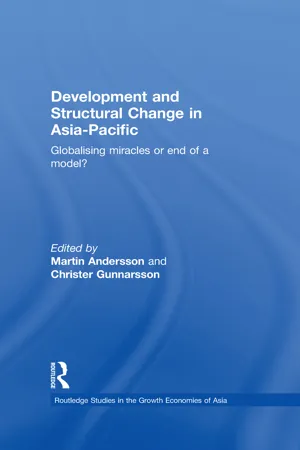
The authors consider how the Asia-Pacific economies have developed since the financial crises and highlight two inter-related themes: the effect of global forces on the national Asian economies and the different development paths of these economies as they jointly enter this new phase. Questions raised by the book include:
* is globalization a threat to development and prosperity in the Asia-Pacific or did globalization rather facilitate and accelerate the pace of industrialization among late industrializers in the region?
* is there a single Asia-Pacific development model or did the crisis show this to be false?
* did the financial crisis reveal structural weaknesses in an Asia-Pacific state-led model or was state leadership already in demise?
Development and Structural Change in Asia-Pacific provides a useful and relevant account of how the global economy has led to structural changes within Asian economies
eBook - ePub
Development and Structural Change in Asia-Pacific
Globalising Miracles or the end of a Model?
- 240 pages
- English
- ePUB (mobile friendly)
- Available on iOS & Android
eBook - ePub
Development and Structural Change in Asia-Pacific
Globalising Miracles or the end of a Model?
About this book
Trusted by 375,005 students
Access to over 1.5 million titles for a fair monthly price.
Study more efficiently using our study tools.
Information
| 1 | Introduction |
| Perspectives on development in Asia-Pacific | |
| Martin Andersson and Christer Gunnarsson |
The economic miracle in Asia-Pacific was perhaps the most spectacular development experience of the entire world economy during the second half of the twentieth century. The astonishing transformation of a number of countries from agrarian and typically underdeveloped economies into industrial and modern societies has attracted enormous attention and provoked development economists and policy-makers into rethinking their theories and strategies of economic development. The growth experience of the Asia-Pacific region has rightly been held forth as a case of development worth studying and learning from. It has been the case in point for numerous empirical studies and it has generated an abundance of theorising, not least about state–market relations in economic development. The financial crisis that hit the emerging miracle economies of the region during 1997 and 1998 was therefore particularly noteworthy, not only because it challenged the notion of eternal high growth rates, but also because it raised questions about the viability of an East Asian development model.
The chapters in this volume were, in one way or another, occasioned by the financial crisis. The dramatic, and indeed unexpected, economic slowdown in the region not only made the headlines but also had a great impact in turning the course of both academic and policy debates on Asian development. The actual causes behind the crisis have been discussed in terms of either too much or too little supra-market regulation and the resulting analysis has turned out to be an outright clash between divergent explanations and policy recommendations. While some have welcomed the alleged demise of an Asian development model (Alan Greenspan, quoted in Wade 1998), others have lamented the occurrence of the crisis and blamed it on the forces of globalisation (see Wade 1998 and Singh 1999) or the interventions by the International Monetary Fund (IMF) (Sachs 1998 and Stiglitz 1997). The way the origins of the crisis are analysed has obvious implications for the debate on the prospects of development for open economies in an increasingly globalised environment. In our context, the most interesting aspect of the crisis is not what caused the financial turmoil per se, but whether any lessons can be drawn from its occurrence with regard to the mechanisms of growth and structural transformation within the Asian development ‘model’. We wish to contribute to this discussion by elaborating upon the circumstances in which the crisis erupted, i.e. the context of both globalisation and specific historical development processes in the Asia-Pacific region.
The aim of this volume is thus to highlight two inter-related themes on the ongoing development experience in Asia-Pacific: the effect of global forces on the national Asian economies and the different development paths of these economies as they collectively entered this new phase. It is a well-established fact that up to the 1980s the economic miracle in Asia-Pacific to a large degree rested on strong government–business ties and various forms of state regulation of national markets. This is why controversies over explanations for the economic miracle have tended to be centred so much on the role in the economy played by the state. However, since the mid-1980s the pressure of globalisation has been signified by a process of integration of markets for goods and capital, fundamentally altering the scope and content of government–market relations. In the last decade and a half the tendency has been to dismantle existing national regulatory frameworks and to open up to free capital movements. In this sense the governments in Asia-Pacific have been forced to play according to the new rules of the game, rules set by international markets. This marks a great change for governments that used to be more or less in a position to set their own rules. The challenge is then how to establish a proper balance between state and market in this new global era and how to mitigate the side effects of globalisation. Future economic development in Asia-Pacific will depend immensely on the ways in which these new conditions are managed. In this sense the financial crisis does mark a watershed in the economic performance of the region. These are questions that will be discussed in part one of this volume.
In part two a related set of issues will be discussed. These deal with the tendency to over-simplify explanations for the development experiences in the region. As the processes of recovery are currently unfolding, the economies are displaying divergences regarding economic strength, political repercussions and social stability. These differences signal non-uniformity in terms of underlying structures and process-sequencing that need to be elucidated. The NICs (South Korea, Taiwan, Hong Kong and Singapore) and the ASEAN economies (in this context we refer to Malaysia, Indonesia, Philippines and Thailand) started their industrialisation processes in different periods and under different global conditions and therefore became competitive on the world markets for different reasons. To be more specific, the globalisation forces after the mid-1980s not only threatened the government– business balance in the NICs, but also provided latecomers in the region (first the ASEAN countries and thereafter China and Vietnam) with alternative development paths. This means that if there was indeed something called a development model practised by the Asian NICs in the period 1960 to 1980, it was of little relevance in the speeding up of the process of industrialisation in the ASEAN countries in the 1980s and in China in the 1990s. To acknowledge these differences should be a first step in an attempt to answer the question of what can be learned from the development experience in Asia-Pacific. However, let us first recapitulate the paradigms that have dominated the controversy about how to explain the Asian miracle and what lessons can be drawn from the debate.
The market-friendly approach
The economic miracle in East and Southeast Asia began in the 1950s and accelerated in the 1960s, but it was not until the middle of the 1970s that it attracted any greater attention outside the specialists’ camps. With some noticeable exceptions (e.g. Lee 1981), the first forcible attempts to offer a grand explanation for the economic miracle were carried out by scholars affiliated with the World Bank (World Bank 1983). According to their studies, the countries in the region had followed a market-friendly strategy with limited state intervention and a high degree of openness to trade and capital movements. South Korea and Taiwan were put forward as evidence of the superiority of export-led growth vis-à-vis the model of industrialisation through import-substitution behind high tariff protection, which had been the norm in developing countries since the 1950s. With the East Asian experience as evidence, an alternative model could now be presented to Third World countries, a new way out of poverty and economic backwardness. The launching of this growth recipe was quite opportune since it was at about this time that Africa’s development crisis had been set off by falling export earnings, mounting foreign debts and failed industrialisation projects. It was also the time of Latin America’s debt crisis, which was to put a definite end to a model of industrialisation that had been practised with some success for several decades, but seemed to run out of steam. The East Asian example was therefore actively used as a policy device to prompt structural adjustment programmes in Africa and a reform programme in Latin America. It was also to have an immense bearing on the Indian liberalisation programme after the mid-1980s.
The export-led growth success of East Asia was not only good news for the world’s poor, but also for development research. Development economics was advised to follow a completely new path after having been associated with less successful models of import-substitution and state-controlled forms of industrialisation, often under socialist political regimes (Little, Scitovsky and Scott 1970). Development economics, which by the early 1980s was said to be in the doldrums (Lewis 1984), could now regain strength and confidence, not least in its policy agenda. Although the structural adjustment policy was heavily attacked right from the start for being formulated as market-economic shock therapy with painful social effects, it could retain its legitimacy with the East Asian miracle as an analytical alibi and a policy promise. In a number of tone-setting academic studies (e.g. Balassa 1971, 1981, 1988, Little 1981, Riedel 1984) the East Asian success story was attributed to economic openness; in particular, to the fact that the countries of the region had successfully exploited their comparative advantages. While the NICs were not in possession of abundant natural resources of their own, they did have a comparative advantage in a hard-working, relatively well-educated, disciplined and low-paid workforce. Japan had by this time long been an established ‘exportled’ industrial nation, and Taiwan, South Korea, Hong Kong and Singapore appeared to be successfully following in the trail of Japan’s success. This success story could be contrasted against the relative failure of a majority of developing countries where industries had been nurtured behind protectionist barriers.
The look-east recipe for development appeared all the more relevant as other countries in the region (Malaysia, Thailand and Indonesia) also started to exhibit high growth rates during the 1980s. In common with their predecessors, they had competitive export industries and governments which, unlike other Third World governments, kept a close eye on their macroeconomic fundamentals, but did not interfere with markets or get directly involved in production. From this perspective, the role of the state was crucial for creating suitable conditions for economic growth but this role was secondary, the primary task being to maintain the working of a largely self-generating free-market dynamism. ‘Getting prices right’ was surely a suitable slogan for this approach.
The state-led approach
The end of the 1980s saw the emergence of an alternative type of approach, one that raised doubts about and sometimes rejected the prevailing market explanation (Johnson 1982, White 1988, Amsden 1989, Wade 1990). This approach, proffered by what was to be called the revisionist school, pointed to the fact that the state had not only been efficient in macroeconomic management but had also, and more importantly, taken the lead by adopting selective industrial policies and protectionist trade regimes. The revealed comparative advantages, therefore, had not existed initially but had largely been created by state interference in the market, an intervention sometimes referred to under the slogan ‘getting prices wrong’ (Amsden 1989). The state intervened in industrial policy with the objective of encouraging the export sector through tax exemptions, credits, import tariffs, and rebates on import duties on industrial intermediary goods. Initially, the export industry was concentrated on simple consumption goods, but gradually production became more sophisticated and directed towards capital goods as national capabilities were being built. New technologies were adopted with surprising ease. The East Asian state apparatus, and, above all, its bureaucracies, were considered unusually enlightened and insulated from influential interest groups. Instead, they represented a national economic interest vis-à-vis the world at large and they were in a position to ‘discipline’ their own capitalists. It is this argumentation that established the idea of a specific ‘East Asian model’ with the developmental state as a core ingredient. Developmental states were initially identified in Singapore, Taiwan and South Korea, but the concept was later to be applied in studies of the industrialising ASEAN countries as well. So, from this perspective, the East Asian model was not identical to a reliance on free market principles and Western-style institutions and forms of governance, but was rather a case of state dirigisme, in which some free market principles were rejected and Western institutions had been replaced.
The strife between miracle explanations
In its extreme forms this controversy reflects a fundamental conflict between, on the one hand, a sceptical attitude towards the market, with roots in the dependency paradigm, and, on the other hand, a neo-liberal market fundamentalism, which sees the state as the root of inefficiency and development failure. During the heydays of the dependency paradigm in the 1970s, underdevelopment was thought to have its origin in the prevailing capitalistic world order. The only way to pull off a process of economic development was to break away from an unfair and uneven world trade order and resort to self-reliance. The state was thereby given a completely decisive role in the building of all kinds of capacities associated with economic development, from basic needs provision to technological capabilities. The Asia-Pacific economic miracle was of course highly cumbersome for this paradigm. Reality effectively demolished all ideas of the Third World forever being doomed to underdevelopment as long as it relied on integration into the world economy. The Asia-Pacific region thus represented the antithesis of the dependency paradigm. Integration into world trade and more private initiative were better choices than protectionism and state control.
On the other hand, empirical evidence demonstrated that state intervention had been extensive and significant in the fast-growing economies of East Asia, which gradually weakened the simplistic market explanation and made its policy recommendations obsolete. So the challenge by the revisionists had to be taken seriously. In a seminal study instigated by the World Bank (World Bank 1993), the explanation proffered was that the East Asian miracle had been the result of a successful mix of market forces and state policy. Investments in human capital and infrastructure had been an important government contribution, added to which the governments had created prerequisites for the market by setting up regulatory frameworks favourable to private investments, by developing forms of co-operation between the governments and industry, and by maintaining macroeconomic stability. The role of industrial policy, accorded decisive importance for the economic miracle by the revisionist school, was thereby downplayed. A foremost conclusion was that successful state intervention could, in principle, only be observed for Japan, South Korea and Taiwan, while the state’s efforts in the Southeast Asian miracle countries were regarded as being more marginal and mostly directed towards maintaining macroeconomic stability and fundamental institutions. Countries such as Malaysia, Thailand and Indonesia were said to have availed themselves less of selective measures and more of general stimulation measures, mainly with the aim of attracting foreign direct investments. In fact, it was now this ‘model’ and not the East Asian experience that was said to set an example for other developing countries. The reluctance to attribute a decisive, positive role to the state provoked a new wave of criticism from the revisionists, and again the argument about the fundamental role of state intervention was brought to the fore; in particular, the importance of industrial policies for building national capabilities (Fishlow et al. 1994). Such was the state of the debate around the mid-1990s.
The controversy takes a new turn
In 1997 the Asian financial crisis struck the world like a bolt from the blue. Decades of unbroken and even accelerating economic growth had fostered the belief that the Asian miracle was practically unlimited. Only a month or so before the crisis began, the Asian Development Bank had published a study, under the leadership of Jeffrey Sachs, extolling the virtues of the Asian growth model and expressing unbounded optimism for the future. (Asian Development Bank 1997). Similar positive assessments were made at the same time by such leading credit evaluation institutes as Standard & Poor’s and Moody’s. It was in this atmosphere of euphoria that the Thai government devalued the baht in response to the flight of capital and currency speculation, and in which panic suddenly spread throughout the capital and currency markets in the region. The effects, in the form of increased outflows of capital, an escalating external debt and bankruptcies, soon became evident. Investment volumes sank drastically, unemployment shot up and real incomes shrank. In some of the countries of the region the number of poor increased at record speed, with social and political unrest following soon after. The crisis was particularly hard on the urban economy, affecting, in particular, jobs in the manufacturing industries and construction sector. Prices rose dramatically, largely affecting the import-dependent urban sector, while the rural population as a rule was more lightly affected as the relative prices of agricultural products rose.
The financial crisis instantaneously gave rise to a lively debate. As with many other economic crises in history, the first reaction to the unexpected and apparently inexplicable events was one of amazement and confusion. Within the course of a few months, however, a multitude of seemingly rational and logical explanations for the crisis had come forth. It was now seen by many leading analysts as an inevitable consequence of inherent weaknesses and distortions in the Asian economies. It was even considered a natural outcome of an obsolete political– economic system. The obituaries of the Asian mode...
Table of contents
- Cover
- Half Title
- Full Title
- Copyright
- Dedication
- Contents
- List of figures
- List of tables
- List of contributors
- Preface
- List of abbreviations
- 1 Introduction — Perspectives on development in Asia-Pacific
- PART I Global institutions and the state in Asia-Pacific
- PART II Divergent development paths among the Asian miracles
- Index
Frequently asked questions
Yes, you can cancel anytime from the Subscription tab in your account settings on the Perlego website. Your subscription will stay active until the end of your current billing period. Learn how to cancel your subscription
No, books cannot be downloaded as external files, such as PDFs, for use outside of Perlego. However, you can download books within the Perlego app for offline reading on mobile or tablet. Learn how to download books offline
Perlego offers two plans: Essential and Complete
- Essential is ideal for learners and professionals who enjoy exploring a wide range of subjects. Access the Essential Library with 800,000+ trusted titles and best-sellers across business, personal growth, and the humanities. Includes unlimited reading time and Standard Read Aloud voice.
- Complete: Perfect for advanced learners and researchers needing full, unrestricted access. Unlock 1.5M+ books across hundreds of subjects, including academic and specialized titles. The Complete Plan also includes advanced features like Premium Read Aloud and Research Assistant.
We are an online textbook subscription service, where you can get access to an entire online library for less than the price of a single book per month. With over 1.5 million books across 990+ topics, we’ve got you covered! Learn about our mission
Look out for the read-aloud symbol on your next book to see if you can listen to it. The read-aloud tool reads text aloud for you, highlighting the text as it is being read. You can pause it, speed it up and slow it down. Learn more about Read Aloud
Yes! You can use the Perlego app on both iOS and Android devices to read anytime, anywhere — even offline. Perfect for commutes or when you’re on the go.
Please note we cannot support devices running on iOS 13 and Android 7 or earlier. Learn more about using the app
Please note we cannot support devices running on iOS 13 and Android 7 or earlier. Learn more about using the app
Yes, you can access Development and Structural Change in Asia-Pacific by Martin Andersson,Christer Gunnarsson in PDF and/or ePUB format, as well as other popular books in Business & Business Development. We have over 1.5 million books available in our catalogue for you to explore.