eBook - ePub
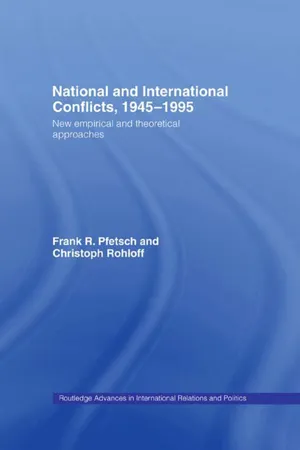
National and International Conflicts, 1945-1995
New Empirical and Theoretical Approaches
- 304 pages
- English
- ePUB (mobile friendly)
- Available on iOS & Android
eBook - ePub
National and International Conflicts, 1945-1995
New Empirical and Theoretical Approaches
About this book
The information flow about crises and conflicts is highly selective, the media only focus on a few major conflicts at a time. Many conflicts are neglected, others soon forgotten after the fighting ends. This book fills the gaps and offers a systematic overview of all crises and conflicts in and among states since 1945 and traces the global trends of conflict development.
Based on the broad empirical basis of the Conflict Simulation Model KOSIMO, Pfetsch and Rohloff use an integrated approach to cover many forms and types of political conflicts, both peaceful and violent.
Information
1 Introduction
At the doorstep to the third millennium, political violence and wars are still threatening and killing people in numerous countries. This fact serves as the most obvious justification for our critical and systematic analysis of the major trends and patterns of political conflict over the second half of the twentieth century. The underlying and crucial question for such an endeavor is old and still unchanged: How can people organize and maintain peaceful relations among and within modernizing pluralistic societies? Our underlying assumption is that in and among societies, where this question is not properly addressed and answered, the risk of violent conflicts will not diminish. Whereas many Western, Latin American and Asian states have successfully managed to build a modern nation state, other countries are still struggling along the dangerous road from traditional societal structures to political, economic and cultural modernization.
For our empirical project, the trends and patterns of political conflicts since 1945 are observed and interpreted in the light of continuously changing international and domestic constellations and conditions. The global political map has in effect changed dramatically throughout the twentieth century. These changes had in turn far-reaching effects on the actors, issues and structures of political conflicts. What are these major changes in the international system and how are these changes related more specifically to the field of political conflict research?
Global changes since 1945
From a global viewpoint, the international relations among states in the twentieth century can be divided into three major periods. In the first period, which lasted until the Second World War, states competed for the maximization of power, prestige and influence. It was the period of classic realpolitik which continued from the nineteenth century. The second period was dominated by the United States and the Soviet Union who had reached an uncontested status as superpowers after the Second World War. Most of the states in the northern hemisphere, including Central America and the Middle East, were allies to one or the other bloc in a bipolar world. The non- aligned movement, prominent as it was, lacked the bases of power to challenge the superpowers. In the third period, that began in the early 1970s, multinational corporations and non-governmental organizations entered the international arena. The appearance of politically influential non-state actors reflects a world of increasing interdependence. Until now and for the foreseeable future, the traditional geopolitical state-centric and power-dominated international system is evolving into a geo-economic societal system of coordinated regional politics. Within these three major epochs of a dynamic international system several more specific changes with significant positive or negative affects on conflict patterns can be observed. We will highlight those changes which we believe to have the most influential impact on conflicts and conflict analysis. Among these changes are the decline of power- and prestige-politics that was typical of nineteenth-century foreign-policy styles, the decline of territorial expansionism, the multiplication of the number of states, the population growth, the spread in number and scope of international and transnational organizations, the growth of economic production and world trade leading to globalization and regionalization and the consequences of the end of the East-West conflict.
Decline of power and prestige-politics
When compared to the period between the Westphalian Peace treaty until the end of the Second World War, the foreign policies of most states since 1945 have obviously undergone a fundamental change in their political behavior and style. Foreign policies of many mostly Western states have moved away from self-centered prestige- and power-politics, from colonial and imperial politics and from zero-sum games; they are now moving towards an increasingly multilateral and cooperative disposition. A collective insight into the regional and global interdependencies on virtually all fields of modern human existence has led to an unprecedented appreciation of cooperative patterns of behavior and of relative gains and comparative advantages. The underlying mood and motivation for the evolution of reliable multilateral cooperative patterns in the second half of twentieth century Europe can be found to a large extent in the experience of two World Wars.
The most apparent effect of this fundamental structural change in foreign policy conduct on political conflicts since 1945 is a steady decrease in the number of international wars initiated by states. By today, we must consider international wars initiated by governments and directed against other governments as exceptionally rare phenomena. The Iraqi invasion into Kuwait in 1991, Eritrea's 1998 invasion into Ethiopia and the internationalization of the Congo regime crisis since 1997 face the univocal opposition of the international community. Nevertheless, the conflicts between India and Pakistan since 1947, between the two Yemens in 1964 and 1991/94, between Yemen and Saudi Arabia in 1998, between the two Koreas since 1950, between Israel, Syria and Lebanon since 1948, between Iraq and Iran between 1980 and 1998, between Peru and Ecuador since 1942 or between Great Britain and Argentina in 1982 illustrate the destructive potential that will continue to reside within inter-state relations.
The point here is to underline the steady trend against overt aggressive international behavior among states. Although states will obviously continue to weigh the costs and benefits of cooperative against conflictive international behavior in the future, wars in the nineteenth century were a more or less calculable risk with limited scope and effects. At the beginning of the twentieth century, this picture began to change. Weapons capable of mass destruction on the one hand, and, on the other hand, the formulation of the principle of collective self defense changed the cost-benefit rationale of international aggression. The institutionalization of this principle in the United Nations Charter in 1945 and the empowerment of the Security Council and regional organizations to sanction malicious states can be considered as the epochal safeguard against a general fallback into the aggressive patterns of the nineteenth and first part of the twentieth century.
Decline of territorial expansionism
In the era of European hegemony, territories within and outside Europe were continuously subject to occupations, annexations, conquests and colonization until this practice and the underlying ideologies and worldviews culminated in the disastrous experience of two World Wars. Hence, rivalries among states about territories have become significantly less frequent. Within the European Union, for example, territories and frontiers have almost completely lost their former significance. This is not to say that there will be eventually no more conflicts about national boundaries — it is the objective that has changed. By today, the economic, political and human costs of violent territorial conflict have become exorbitantly higher than the gains that could ever be expected from the aggressively acquired additional resources, people or territory. Most border conflicts today arise about uncertainties and disagreement over a specific delineation rather than about threats of annexation and conquest. Ironically the new Law of the Sea which went into effect in 1994 has caused a number of new conflicts to erupt despite the intention ultimately to clarify the delineation of maritime borders. Hence, the size of territories has, on the one hand, lost its former significance as an object of national prestige. On the other hand, borders will remain objects of conflicts. Yet, for the reasons mentioned above, they will be carried out in a more legalistic and civilized manner than before.
The multiplication of the number of states
A further change on the political map is the increase in the number of states. In 1945 fifty states signed the United Nations Charter. By 2000, this number had increased to 188 member states. Two waves of decolonization, immediately after the Second World War and during the 1960s, were mainly responsible for this increase. A third group of states joined the international community with the dissolution of the USSR and the former Yugoslavia. The arithmetic increase in states is coupled with an increase in national interests and, in consequence, an exponential increase in possible conflict relations. Despite this increase in the global conflict potential, as we will show in the empirical part of this book, the number of violent international conflicts is overall lower than the overall number of violent domestic conflicts. In fact, international violent conflicts have become exceptional and short-lived phenomena in the 1980s and 1990s.
Contrary to what was envisioned by the former colonizing states, the increase in the number of states did not result in a proportional increase in the number of democracies. Still, we can identify four waves of democratization,1 i.e. in Europe and Asia after the Second World War, in Southern Europe in the 1970s, in Latin America in the 1980s and in Eastern Europe since 1989. Democratic regime changes in Africa were promising between 1989 and 1992. Yet, many regimes returned to authoritarian rule. A long-term democratization in the Far East is most promising in Taiwan, South Korea and Thailand, while many Southeast Asian nations are still struggling with autocratic regimes.
If not democratization itself, it is an increasing degree of fundamental politicization of peoples that has led to a much greater awareness of human, political, social, economic and cultural rights. These rights are increasingly codified in the United Nations system; for Europe these rights are codified by the Council of Europe. Yet it is the realization of these rights either through enforcement or through non-state actors such as opposition movements, non-governmental organizations, churches, conventions and others, that puts authoritarian states under increasing public pressure. This politicization of peoples as a result of the globally effective pressure for modernization has led to an increasing number of violent conflicts that involve ethnic, religious and regional minority conflicts. Thus, states that suppress minority rights are a much greater source of contemporary violent conflict than states that behave aggressively against their neighbors.
Population growth
A fourth factor influencing conflict patterns is the dramatic increase of the global population. World population doubled between 1950 and 1997. In 1999, we count 6.0 billion people on earth. Estimates by the United Nations say that this increase will continue until approximately the year 2025. Then, the earth's population will amount to 8.2 billion people (Globale Trends 1998: 119).
How does population growth relate to political conflict? Classic realist political scientists proposed that population is a central requisite of state power albeit not the only one (Morgenthau 1948). Whereas the increase of a nation's population was a political goal in terms of power acquisition in the nineteenth century, today we observe the reverse course. Overpopulated nations desperately try to curb their demographic growth which they regard as a prime obstacle to modernization and general economic prosperity. Still, population growth by itself is not a direct cause of violent conflict. It is a catalyst if combined with economic and social deprivation or marginalization of certain groups or in combination with degraded eco-systems. In addition, migration of refugees in already densely populated areas has led to violent conflicts over access to and distribution of scarce resources, be it land or labor.
International and transnational organizations
The fifth change since 1945 that affects conflict behavior and patterns is the proliferation of international and transnational organizations. By today, these official and private organizations can be regarded as the most influential international actors next to the states themselves. Three aspects can describe their development: firstly, the exponential increase in the mere number of international and transnational organizations; secondly, the increase in the number of members within these organizations to the level of regional or global completion and, thirdly, the inclusion of many new policy fields in addition to the traditional field of international security, like human rights, women, housing or the environment.
Since 1945, the United States have vigorously pursued both military containment of the communist countries and the preservation of the economic free-trade system. The existing international institutions reflect this dominant military, political and economic position of the United States. They endorse the idea of a United Nations against a decentralized or regional model of international security proposed by Winston Churchill. Theodore Roosevelt opted for a comprehensive and universal political model as an authority primarily responsible for world peace and international security. On regional levels, the United States secured their military supremacy through various bilateral and multilateral defense alliances and pacts (NATO, SEATO, ANZUS, CENTO). The gradual institutionalization of the military power balance after 1945 led to a relatively stable international system when compared with the systems prior to the Second World War. On a regional and local level, the bipolar system had the effect that many potential and latent conflicts remained below the threshold of violent conflict. As such, it had an appeasing and pacifying effect on the respective allies. However, outside these blocs conflicts occurred which have been influenced by respective bloc members.
In global economics, the international system was structured through a multitude of trade agreements and financial institutions such as the Bretton Woods system, the World Bank and the International Monetary Fund, the General Agreement on Tariffs and Trade (today's World Trade Organization). With the end of the East-West conflict and the collapse of the communist regimes, this liberal free-trade model seems to be without an alternative.
On the regional level, economic and security arrangements have been initiated by the superpowers, by regional powers and by the Organization of American States (OAS), the Organization of African Unity (OAU), the Arab League (AL), the Council for Mutual Economic Relations (COMECON), the Association of Asian States (ASEAN), the North American Free Trade Area (NAFTA), the Association of Pacific Economic Cooperation (APEC) and the South American Market (Mercosur). The Council of Europe, the Organization for Security and Cooperation in Europe (OSCE) and the European Union (EU) are forming stable peace structures in Europe. All these organizations are regional cooperative integration arrangements for common security, mutual confidence building and economic cooperation. They can also function as mediators and impartial authorities in political conflicts, and, in effect, they have evolved as indispensable organs for regional peaceful cooperation.
It seems plausible to assume that these agents in international and transnational politics are contributing to the pacification of conflicts; the common bond of these organizations is their mission to enhance cooperation, to facilitate mutual understanding and to pacify relations among their members. We observe among the activities of international and transnational organizations an evolution of a new regional conflict culture with its focus on preventive diplomacy, early warning and improved negotiation capacities. Despite several setbacks, as in Bosnia-Herzegovina, Somalia or Kosovo, the concept of peaceful conflict resolution through concerted humanitarian interventions, mediation and preventive and consolidating measures is being institutionalized on societal, state and international levels. The Organization for Security and Cooperation in Europe (OSCE) became the organization next to the UN which has in its hands the most versatile instruments for preventive and de-escalative interventions in explosive conflict situations. Despite or because of this positive development, the actual number of ongoing conflicts per year since 1994 remains at a level of about thirty violent conflicts (Konfliktbarometer 1998). However, this level might rise again in the future and inter-state conflicts might reapp...
Table of contents
- Cover
- Half Title
- Title Page
- Copyright Page
- Table of Contents
- List of Figures
- List of Tables
- Preface
- 1 Introduction
- 2 Methodology
- 3 Global trends
- 4 Conflict structures
- 5 Conflict management
- 6 Empirical findings: summary and outlook
- Appendix: KOSIMO conflicts 1945–95 by regions in chronological order
- Notes
- Bibliography
- Index
Trusted by 375,005 students
Access to over 1.5 million titles for a fair monthly price.
Study more efficiently using our study tools.
Frequently asked questions
Yes, you can cancel anytime from the Subscription tab in your account settings on the Perlego website. Your subscription will stay active until the end of your current billing period. Learn how to cancel your subscription
No, books cannot be downloaded as external files, such as PDFs, for use outside of Perlego. However, you can download books within the Perlego app for offline reading on mobile or tablet. Learn how to download books offline
Perlego offers two plans: Essential and Complete
- Essential is ideal for learners and professionals who enjoy exploring a wide range of subjects. Access the Essential Library with 800,000+ trusted titles and best-sellers across business, personal growth, and the humanities. Includes unlimited reading time and Standard Read Aloud voice.
- Complete: Perfect for advanced learners and researchers needing full, unrestricted access. Unlock 1.5M+ books across hundreds of subjects, including academic and specialized titles. The Complete Plan also includes advanced features like Premium Read Aloud and Research Assistant.
We are an online textbook subscription service, where you can get access to an entire online library for less than the price of a single book per month. With over 1.5 million books across 990+ topics, we’ve got you covered! Learn about our mission
Look out for the read-aloud symbol on your next book to see if you can listen to it. The read-aloud tool reads text aloud for you, highlighting the text as it is being read. You can pause it, speed it up and slow it down. Learn more about Read Aloud
Yes! You can use the Perlego app on both iOS and Android devices to read anytime, anywhere — even offline. Perfect for commutes or when you’re on the go.
Please note we cannot support devices running on iOS 13 and Android 7 or earlier. Learn more about using the app
Please note we cannot support devices running on iOS 13 and Android 7 or earlier. Learn more about using the app
Yes, you can access National and International Conflicts, 1945-1995 by Frank R. Pfetsch,Christoph Rohloff in PDF and/or ePUB format, as well as other popular books in Politics & International Relations & Politics. We have over 1.5 million books available in our catalogue for you to explore.