eBook - ePub
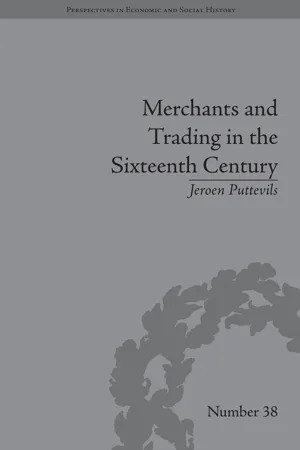
Merchants and Trading in the Sixteenth Century
The Golden Age of Antwerp
- 256 pages
- English
- ePUB (mobile friendly)
- Available on iOS & Android
eBook - ePub
About this book
Sixteenth-century Europe was powered by commerce. Whilst mercantile groups from many areas prospered, those from the Low Countries were particularly successful. This study, based on extensive archival research, charts the ascent of the merchants established around Antwerp.
1 Antwerp, Its Merchants and Their Trade
Introduction
The aim of this chapter and the next is quite straightforward: establish the key facts about the businesses of Low Countries merchants operating out of Antwerp.1 It endeavours to prove the ascent of Low Countries merchants on the Antwerp market and in various other European commercial cities. In this chapter the Antwerp market, its trade and merchants are dealt with. Using different sources, the growing number of native merchants active in Antwerp will be sketched. In the middle of the sixteenth century, the central government taxed imports to and exports from the Low Countries. The accounts of these taxes allow for a careful evaluation of the types and volumes of goods traded. The preferences of different groups of merchants for specific types of products and their destinations also become clear in this part of the analysis. Low Countries merchants were not more active in the marketing of home-grown products than were their foreign colleagues. This partially refutes the hypothesis by Herman Van der Wee that the Low Countries' industrial success propelled Low Countries merchants onto European markets.2 Moreover, this chapter proves the democratization of trade in sixteenth-century Antwerp: smaller traders were equally active on distant markets and traded similar goods to their bigger colleagues. Sixteenth-century Antwerp was one of the first cities to develop generalized or open-access institutions allowing all merchants to participate in commerce.3 The observed democratization indeed demonstrates that all merchants could participate.
Counting Antwerp’s Merchants
With the growth of the permanent market, the community of merchants grew. The inflow of new merchants in Antwerp is hard to quantify, as is the total number of merchants operating out of Antwerp, and especially the number of native, Low Countries merchants. Ludovico Guicciardini fawned over the wealth and the social and linguistic skills of Antwerp's native merchants but did not gauge their number.4 Unfortunately, no source is known which allows for the careful and direct reconstruction of this number and its growth throughout the sixteenth century. Hence, historians must rely on indirect sources and rough estimates.
None of these sources, because of their respective biases, informs us about the actual number of Low Countries merchants operating in sixteenth-century Antwerp, the evolution of that number or its relative magnitude as compared with that of the foreign merchant population. However, in putting these various numbers together, a picture emerges of the growth of the group of native merchants. By the end of Antwerp's Golden Age in 1585, when Antwerp fell back to the Spanish crown, the indigenous merchants had become a sizeable group and outnumbered their foreign colleagues.
The Antwerp magistracy produced certificates, written declarations on behalf of private persons, often local and foreign merchants, concerning various commercial and/or juridical issues. These so-called certificates consist of a declaration made under oath, sometimes in the presence of a witness, and provide the identity of the applicant, the nature of the issue, the types of goods, the time and place of the transaction, the means of transport and all persons involved in the transaction. Some of the certificates deal with seizure of goods, arrests, theft and loss of merchandise. The certificates did not adhere to a strict style, but they were considered legal evidence. People applied for certificates mostly to establish property rights and in cases of problems with transactions, as well as for many other reasons. This heterogeneity characterizes the certification books and, because of this broad scope and legal validity, certificates were often used by merchants.5 The applicant received an official version and the text was copied into the ledgers of the urban administration; these ledgers survived the fire of the city hall during the Spanish Fury in 1576. The (on average) 160 certificates per year were clearly insufficient to record all the daily transactions of the hundreds of merchants in the Scheldt town.6 As such, these certificates provide only an imperfect image of Antwerp's trade at the end of the fifteenth and early sixteenth centuries (1488–1513).7
To establish the presence of foreign and native merchants in the early trade of Antwerp, we have analysed the Antwerp certificates for two entire years: 1492 and 1512–13.8 In the 1492 and 1512 sample years respectively 259 and 499 certifications and aldermen's deeds were selected from the Doehaerd corpus.9 These supplied data on 124 merchants and commercial personnel operating in Antwerp10 for 1492 and 165 for 1512 for whom data of origin were available. In 1492 sixty-nine foreign merchants and fifty-five native merchants had certificates registered; in 1512 there were seventy-seven foreigners and eighty-eight natives.11
Although these certificates are unlikely to include all merchants in Antwerp at the time, they nonetheless provide an idea about the relative proportions of the groups of foreign and native merchants. These groups were about the same size in the late fifteenth and early sixteenth centuries. Yet, these numbers, around 150 merchants each, do not do justice to the entire merchant population which was surely far more numerous, especially during the fairs.
Roughly twenty years later, the Antwerp notarial records provide hundreds of deeds requested by local and foreign merchants. The records of Zeger Adriaan 's-Hertogen for 1540 were selected to count the number of foreign and local merchants using his services.12 His deeds show that the collective of foreign traders may have outnumbered native merchants, but native traders were the largest group among's-Hertoghen's clients.
In 1543 the central government imposed a one per cent export tax (Hundredth Penny) on the value of the goods. For export to France the tariff was set at six per cent. The proceeds of the tax were earmarked to finance the Habsburg war against France and its allies.13 This taxation took place in the second growth period of the Antwerp market which started at the end of the 1530s and lasted until 1566. This growth was mainly fuelled by trade with southern Europe.14 The accounts provide a highly detailed insight into the exports of the Low Countries in these years. However, because of the on-going war, these numbers should be considered as minima. The most complete data are those for exports to Italy. These registers contain the names of the exporters; their nationalities can be deduced from their names and the occasional geographic references.
In 1544–5, almost 4,000 merchants were engaged in Antwerp export: the largest groups were Low Countries and German traders (1,499 and 1,475 respectively). French, Iberian and Italian merchants were less numerous (453, 252 and 229; the English were exempt from the tax).15 A similar two per cent tax on imports from and exports to the Iberian Peninsula and its colonies was imposed form April 1552 through June 1553.16 These tax revenues were destined for the protection and arming of the merchant fleet in the Atlantic and North Sea.17 In the 1550s the merchants active in the trade with Spain and Portugal vastly outnumbered those in the trade with Italy ten years earlier. It is possible to count 875 exporters and 453 importers. Iberian merchants were the most numerous group, both in exports (432) and imports (221); however, the Low Countries merchants were a commercial force to be reckoned with (370 exporters and 184 importers).18 Historians of Antwerp have used these numbers and other bits and pieces of information to estimate the numbers of foreign and native merchants in Antwerp around the 1560s.
Table 1.1: Estimations of merchant group size in the middle of the sixteenth century
| Place of origin | Number (Brulez) | Number (Gelderblom) |
| Italy | 200 | 100 |
| Portugal | 150 | 100 |
| France | 100 | 150 |
| Spain | 300 | 150 |
| Germany | 300 | 300 |
| Hanseatic Germany | 150 | – |
| South Germany | 150 | – |
| England | 300–600 (during fairs) | 300 |
| Total foreign merchants | 1,350–1,650 | 1,100 |
| Low Countries | 400–500 | 400 |
| Source: Brulez, 'De Handel', pp. 128-31; Gelderblom, Cities of Commerce, p. 33. | ||
Brulez's and Gelderblom's estimates confirm the previous findings: Low Countries merchants were outnumbered by the foreign merchant community but were the largest merchant group active in Antwerp. In the second half of the sixteenth century a series of voluntary loans and taxes provides (partial) insights into the numbers of Antwerp merchants. In 1552 the Antwerp magistracy requested a voluntary loan from the city's inhabitants and merchants.19 Although the deposits of the lenders reflect individual generosity rather than personal wealth, the list itself provides an indication of the relative contribution of the native merchants: the sixty-eight Low Countries traders active in Antwerp accounted for 17.64 per cent of the total loan input.20 In comparison, the Italians and their nations raised 13.55 per cent of the loan. In 1574 Antwerp was forced to raise a compulsory 400,000 guilders loan in order to pay off mutinying Spanish soldiers. The 2,036 contributors, who accounted for between 12 and 15 per cent of the city's heads of household, lent between two thousand and eight thousand guilders.21 Three hundred and thirty native merchants contributed more than 240,000 guilders. However, this dominance of the native merchants as compared to their foreign colleagues is probably biased: the city government may have spared the foreign merchants in an effort to keep them in the city, and the Hanseats and English were exempt from the compulsory loan.22
In October 1579 new money was needed to pay for troops to fight Habsburg general Alessandro Farnese who had just conquered the town of Maastricht.23 Three hundred citizens each had to lend between 50 and 1,000 guilders on a monthly basis, secured on the revenues of several taxes.24 The loan was to be repaid within six months. A commission of current and former aldermen and members from the shippers', retailers' and cloth-workers' guilds were appointed to draw up a list of the three hundred lenders. At least fifty-seven of the three hundred assessed persons were well-known native merchants; collectively they paid 36.15 per cent of the 52,000 guilders monthly loan.
In 1584 and 1585 the beleaguered city of Antwerp organized a monthly tax on 4,687 heads of household with means (23.8 per cent of the total number of heads of household).25 Roughly 1,400 native merchants (not all of whom were assessed for the tax) can be...
Table of contents
- Cover
- Half Title
- Title
- Copyright
- Contents
- Dedication
- Acknowledgements
- List of Figures and Tables
- Introduction
- 1 Antwerp, its Merchants and their Trade
- 2 Antwerp Ties to the Low Countries Hinterland
- 3 Financing and Organizing Commerce: Partnerships
- 4 Debt Finance through Bills Obligatory
- 5 Institutions and the Political Economy of Sixteenth-Century Antwerp Commerce
- Conclusion
- Works Cited
- Notes
- Index
Trusted by 375,005 students
Access to over 1.5 million titles for a fair monthly price.
Study more efficiently using our study tools.
Frequently asked questions
Yes, you can cancel anytime from the Subscription tab in your account settings on the Perlego website. Your subscription will stay active until the end of your current billing period. Learn how to cancel your subscription
No, books cannot be downloaded as external files, such as PDFs, for use outside of Perlego. However, you can download books within the Perlego app for offline reading on mobile or tablet. Learn how to download books offline
Perlego offers two plans: Essential and Complete
- Essential is ideal for learners and professionals who enjoy exploring a wide range of subjects. Access the Essential Library with 800,000+ trusted titles and best-sellers across business, personal growth, and the humanities. Includes unlimited reading time and Standard Read Aloud voice.
- Complete: Perfect for advanced learners and researchers needing full, unrestricted access. Unlock 1.5M+ books across hundreds of subjects, including academic and specialized titles. The Complete Plan also includes advanced features like Premium Read Aloud and Research Assistant.
We are an online textbook subscription service, where you can get access to an entire online library for less than the price of a single book per month. With over 1.5 million books across 990+ topics, we’ve got you covered! Learn about our mission
Look out for the read-aloud symbol on your next book to see if you can listen to it. The read-aloud tool reads text aloud for you, highlighting the text as it is being read. You can pause it, speed it up and slow it down. Learn more about Read Aloud
Yes! You can use the Perlego app on both iOS and Android devices to read anytime, anywhere — even offline. Perfect for commutes or when you’re on the go.
Please note we cannot support devices running on iOS 13 and Android 7 or earlier. Learn more about using the app
Please note we cannot support devices running on iOS 13 and Android 7 or earlier. Learn more about using the app
Yes, you can access Merchants and Trading in the Sixteenth Century by Jeroen Puttevils in PDF and/or ePUB format, as well as other popular books in Economics & Economic Theory. We have over 1.5 million books available in our catalogue for you to explore.