The prevailing view of industrialization has focussed on technology, capital, entrepreneurship and the institutions that enabled them to be deployed. Labour was often equated with other factors of production, and assigned a relatively passive role. Yet it was labour absorption and the improvement of the quality of labour over the course of several centuries that underscored the timing, pace and quality of global industrialization. While science and technology developed in the West and whereas the use of fossil fuels, especially coal and oil, were vital to this process, the more recent history has been underpinned by the development of comparatively resource- and energy-saving technology, without which the diffusion of industrialization would not have been possible. The labour-intensive, resource-saving path, which emerged in East Asia under the influence of Western technology and institutions, and is diffusing across the world, suggests the most realistic route humans could take for a further diffusion of industrialization, which might respond to the rising expectations of living standards without catastrophic environmental degradation.
eBook - ePub
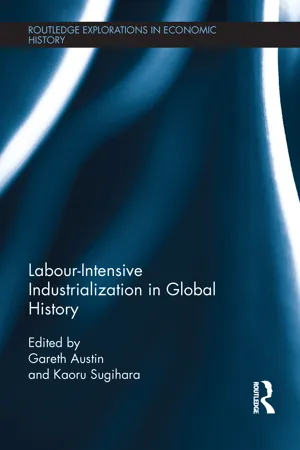
Labour-Intensive Industrialization in Global History
- 314 pages
- English
- ePUB (mobile friendly)
- Available on iOS & Android
eBook - ePub
Labour-Intensive Industrialization in Global History
1 Introduction
Over the last two centuries the uncompleted process of industrialization has been reshaping the world. Beginning in Britain, it diffused across Europe and North America and spread, often gradually but sometimes dramatically, to other parts of the globe, especially in Asia. Scholars and politicians around the world have traditionally been more impressed by the geographical limits of the process as they observed it at any one time than by its speed and increasing scale. The spatial unevenness of industrialization created huge gaps between rich and poor countries. But the spread of modern manufacturing has now continued to the point where it involves hundreds of millions of people belonging to societies previously considered as intractably resistant to rapid economic development. In order to understand the past trends and to consider the future, we now need to answer, not only the traditional question of why some parts of the world are poorer than others, but also the new question of how so much of the world has either achieved, or made striking progress towards, levels of manufacturing output that used to be the preserve of a small minority of countries. In short, it is time to explain what is now a global – albeit still far from universal - history of industrialization (Bénétrix et al. 2012).
The traditional perception of industrialization was founded on the nineteenth-century Industrial Revolution, which was driven by the introduction of machinery and steam power. In contrast, the experience of the global diffusion of industrialization suggests the significance of both the deployment of abundant resources of labour and the improvement of the quality of labour (human resource development) as major determinants of change. This history includes patterns and experiences that are far from being mere replications of Western precedents. This volume calls for a major rethinking of our understanding of industrialization for global history, by bringing the East Asian experience of ‘labour-intensive’ industrialization into focus and, thereby, reinterpreting both the Western experience of ‘capital-intensive’ industrialization and the equally distinctive experiences of countries in other regions of Asia and in Africa and Latin America. It is intended as a contribution to what will have to be a major scholarly effort to define and explain these variations, and to consider how they contributed to the global spread of industrialization.
Labour-intensive approach to economic development
The term ‘labour-intensive’ denotes the type of industrialization, seen typically in East Asia but partially present in many other parts of the world, which utilized labour, rather than capital or land (or other natural resources), as a major source of competitive advantage in relation to the world economy. Specifically, the labour-intensive approach to economic development, including industrialization, means a preference for maximizing the ratio of inputs of labour to inputs of cooperating factors. It is therefore manifest in choice of production technique and in the way in which other resources (land or capital) are handled. Theoretically, except in command economies, the default level for the making of such choices is the enterprise: whether a peasant farm or an industrial corporation. In modern history especially, governments have frequently affected the economic conditions influencing such choices, notably by policies that had the effect (whether intended or not) of altering the relative price of capital and labour. More rarely, certain governments have sought to promote capital intensity (as with mechanization in agriculture) or, on the contrary, to encourage labour intensity (whether as a strategy for maximizing productive efficiency or simply to absorb labour). For clarity, it is important to note that factor bias in choice of technique is not necessarily reflected in factor ratios. If labour is cheap in relation to capital, it may make sense to opt for the more labour-intensive of the techniques available. But, precisely because of the relative prices, total expenditure on hiring capital may exceed that of hiring labour, making the economy appear capital-intensive. For instance, an economy in which a lot of workers are hired at low wages to work a few very expensive machines may have a higher capital-labour ratio (in expenditure terms) than an economy in which a smaller number of highly-paid workers operate a relatively large number of machines. Hence, in examining the evidence for or against the adoption of a labourintensive approach to economic development in different historical contexts, the chapters that follow generally pay more attention to direct evidence on choice of technique, and to relative factor prices, than to factor ratios.
Where the same factor bias is continued in a series of choices of technique and/or institution, we may speak of a long-term ‘path’ of economic development, defined by its characteristic factor bias. The labour-intensive path is a complex set of technological and institutional tendencies, in which greater labour utilization and absorption has been attempted by entrepreneurs and policy makers without a corresponding improvement in the efficiency of capital accumulation. The result was a long-term path of economic development in which decisions were directed towards the efficient utilization of labour rather than capital. Various factors, including culture, ideology and consumption patterns, contributed to the persistence of such a tendency, but the single most important underlying determinant has been the difference in factor endowments, namely that labour was relatively more abundant and capital (or land and other natural resources) was more scarce in one region (notably the core regions of East Asia) than another (such as the core regions of Western Europe).
In an imagined world in which all factors of production were mobile, factor bias might not exist. But cultivable land, though its area may be expanded or reduced at the margin, is location-specific. The movement of capital is subject to institutional constraints and, in some cases, also to lack of opportunity for embodying capital in technologies that would be profitable in the context concerned (e.g. Austin 2008: 596–7). Institutional constraints have affected the feasibility and cost of movements. Even in the ages of ‘globalization’ in factor markets (in the pre-1914 golden age of free trade and in the post-war (to 1973) period of world economic growth, as well as in the most recent era of financial globalization), the majority of the world’s population were not free, in legal or practical terms, to move to where wages were highest. Had Japanese and Chinese labour been able to move to North America and Australasia on the same terms as European labour in the nineteenth and early twentieth centuries, the difference between the labour-intensive path in East Asia and the capital-intensive path in Europe and the ‘Neo-Europes’ would have been much attenuated.
In the trans-Atlantic economic historiography a classic debate concerned H. J. Habbakuk’s (1962) thesis that in the nineteenth century relative scarcity of labour, reflected in higher wages, encouraged earlier mechanization of agriculture in the United States than in the United Kingdom. This argument ran into the contention that in principle factor ratios cannot explain choice of technique, because whichever method happens to reduce unit costs will be preferred, irrespective of relative factor prices. In reality, while the logic governing the choice may be the same, the opportunities to minimize costs by choice of technique have been highly constrained by factor ratios (compare David 1975): and much follows from whether labour or capital (or, as argued in Chapter 9, land-extensiveness) is preferred. In retrospect, the Habbakuk thesis is the more remarkable because the divergence it addressed was relatively modest. The institutional, linguistic, cultural and technological barriers to labour mobility between the two countries concerned were small compared to those that divided the capital-intensifying West from the labour-intensifying East before, during and after the period which Habbakuk had in mind.
Recently, the importance of relative factor ratios in deciding the timing of industrialization has been highlighted by Robert Allen’s (2009b) demonstration that, on the eve of the Industrial Revolution, wages in Britain were considerably higher than those in neighbouring West European economies which had access to broadly the same pool of scientific and technical knowledge.1 He argues that it was precisely the problem of high wages that made it profitable for British entrepreneurs to introduce the labour-saving technologies of the Industrial Revolution. By experimenting, applying, and refining these technologies, the British firms made them cheaper, to the point at which it became profitable for firms on the European continent to mechanize too. As with the Habbakuk thesis, it is reasonable to suppose that the difference in factor endowments between Britain and its continental neighbours was dwarfed by the contrast with the resource ratios characteristic of East Asia and elsewhere. Another recent contribution which emphasizes the significance of differential factor prices in explaining British industrialization is that of Stephen Broadberry and Bishnupriya Gupta (2009). They argue that the development of the Lancashire cotton textile industry – a key part of the Industrial Revolution – was a case of import-substitution industrialization, in which British manufacturers were able to challenge the dominance of Indian cotton cloth, which (according to them) was produced with lower wages in a relatively labour-abundant economy, by implementing capitalintensive, labour-saving techniques in the comparatively high-wage economy of Britain.
The concept of the labour-intensive path needs to be situated in relation to other developments in the economic historiography of both Europe and Asia, especially for the early modern period. Interpretations of industrialization have traditionally focused on technology, capital and entrepreneurship, and the institutions that enabled them to be deployed. Labour was often equated to other factors of production, and was assigned a passive role, to be replaced progressively by machinery and capital. However, several streams in the more recent literature have already suggested qualifications to this position. The protoindustrialization thesis and the industrious revolution thesis both qualified the notion that the Industrial Revolution constituted a sharp break in European history. The former focused on rural industry and its relationship with population growth (Mendels 1972; Saito, Chapter 4 below); the latter on the greater deployment of the labour time of household members in production for sale during the early modern period (de Vries 1994, 2008, Chapter 3 this volume). Scholars of industrialization in turn confirmed the survival and partial growth of rural, un-mechanized or semi-mechanized small industries during the process of industrialization itself (Hudson 2004 for Britain; Hau and Stoskopf, Chapter 11 below in this volume for France; Nakamura 1983 for Japan). Meanwhile, revisionist scholars of Asian economic history suggested that the growth of the market economy and the standard of living in Japan and the more developed parts of China and India were roughly comparable to those in Western Europe on the eve of the Industrial Revolution in England (Pomeranz 2000; Parthasarathi 1998; for further research, see Broadberry and Gupta 2006; Pomeranz 2008a; Allen 2009a; Allen et al. 2011; for institutional issues important for the interpretation of the data, see Pomeranz 2008b: 136–7). Both protoindustrialization and the industrious revolution were present in Asia, though East Asian historiography captured the phenomena differently (Hayami 1977; Sugihara 2004a; de Vries and Saito Chapters 3 and 4 below). This volume as a whole builds on these revisions to explore how far the absorption of labour into ‘labourintensive’ industries and the improvement of the quality of labour formed a central mechanism of global diffusion of industrialization.
Factor endowments and multiple paths of economic development
In Chapter 2, which provides a framework and source of debate for the later essays, Kaoru Sugihara argues that East Asia, with its low land-labour ratio, followed a distinctively different path of economic development from the West, with a fuller use of labour before and during the process of mechanization. Industrial labour was often directly recruited from the peasant household, the members of which were used to working hard and were familiar with the gradual development of labour-intensive technology. While acknowledging the vital contribution of steam power, mechanization and accompanying institutional innovations of the West, the chapter maintains that the Western impact on East Asia, as well as on the rest of the world, fell short of eliminating factor endowment differences, especially in the land-labour ratio. Thus East Asia adapted Western technology and organizations to suit its factor endowment conditions and governments there developed a labour-intensive industrialization strategy.
Before 1945 only a few countries proceeded with this strategy. In those that did, serious efforts were made to minimize the input of capital and maximize the input of labour in achieving higher labour productivity. The replacement of labour with machinery was therefore accompanied by simultaneous efforts to replace capital with labour wherever technology was thought to be biased towards capital. In the cotton textile industry in Meiji Japan, for example, the iron frame for the power-loom was partially replaced by the less strong but cheaper wooden frame, while the night-shift system lowered the capital-labour ratio of spinning mills and created additional employment. To be sure, the power-loom technology rapidly improved, and looms came to be steel-framed and later ‘automatic’, and the night-shift system was eventually abandoned. But similar efforts to maximize the use of labour and minimize that of capital continued in rural weaving centres and small urban machine shops. This Japanese pattern was repeated less dramatically in China and Korea, and a number of relatively labour-intensive industries in East Asia became internationally competitive.
After 1945, the growth of international competitiveness of East Asia’s labour-intensive industries continued, as many countries there remained relatively labour-abundant and resource-scarce. By the early 1950s Japan regained the position of the world’s largest exporter of cotton textiles, and was replaced in this position by China in the early 1970s. The chain of development of labour-intensive industries across other Asian countries was impressive, starting from Hong Kong and spreading to Taiwan, South Korea, Thailand and Indonesia. By now it has reached many other Asian countries, including those with the lowest per capita incomes. Thus labour-intensive industrialization is transferable to labour-surplus economies through trade, investment and industrial and education policies. The most recent examples of such diffusion are post-1979 China and post-1991 India. In both countries exports of labour-intensive manufactures increased rapidly.
While this chain of diffusion cannot be seen as having made a global impact comparable to the Western path of economic development in terms of capital accumulation, development of high technology and – as yet – transformation of the international political and military order, it has been extremely important in three respects. First, in outcome: reducing the dramatic regional inequalities between West and East that were created by industrialization of the West. Second, in both process and outcome: through the creation of industrial employment on a global scale. Indeed, the majority of the world’s industrial population entered this employment because of the diffusion of industrialization beyond the West. And third, our contention is not just that the Western path of economic development has not been and is not the only route to industrialization, but that it is not an independent route either.
The pattern of the global division of labour since the second half of the nineteenth century suggests that capital-intensive and resource-intensive technology was developed by the use of a disproportionate amount of the resources available to humankind at each stage of development. There was no prospect of a major shift towards a global equalization of income through the direct diffusion of such a technology to the rest of the world. Rather, the global diffusion of i...
Table of contents
- Cover
- Half Title
- Title Page
- Copyright Page
- Table of Contents
- Notes on contributors
- Preface
- 1. Introduction
- 2. Labour-intensive industrialization in global history: an interpretation of East Asian experiences
- 3. The industrious revolutions in East and West
- 4. Proto-industrialization and labour-intensive industrialization: reflections on Smithian growth and the role of skill intensity
- 5. Labour-intensity and industrializaton in colonial India
- 6. Labour-intensive industrialization in the rural Yangzi Delta: late imperial patterns and their modern fates
- 7. From peasant economy to urban agglomeration: the transformation of ‘labour-intensive industrialization’ in modern Japan
- 8. Government promotion of labour-intensive industrialization in Indonesia, 1930–1975
- 9. Labour intensity and manufacturing in West Africa, c.1450–c.2000
- 10. ‘Colonial’ industry and ‘modern’ manufacturing: opportunities for labour-intensive growth in Latin America c.1800–1940s
- 11. Labour-intensive industrialization: the case of nineteenth-century Alsace
- 12. Labour-intensive industrialization and global economic development: reflections
- Index
Trusted by 375,005 students
Access to over 1.5 million titles for a fair monthly price.
Study more efficiently using our study tools.
Frequently asked questions
Yes, you can cancel anytime from the Subscription tab in your account settings on the Perlego website. Your subscription will stay active until the end of your current billing period. Learn how to cancel your subscription
No, books cannot be downloaded as external files, such as PDFs, for use outside of Perlego. However, you can download books within the Perlego app for offline reading on mobile or tablet. Learn how to download books offline
Perlego offers two plans: Essential and Complete
- Essential is ideal for learners and professionals who enjoy exploring a wide range of subjects. Access the Essential Library with 800,000+ trusted titles and best-sellers across business, personal growth, and the humanities. Includes unlimited reading time and Standard Read Aloud voice.
- Complete: Perfect for advanced learners and researchers needing full, unrestricted access. Unlock 1.5M+ books across hundreds of subjects, including academic and specialized titles. The Complete Plan also includes advanced features like Premium Read Aloud and Research Assistant.
We are an online textbook subscription service, where you can get access to an entire online library for less than the price of a single book per month. With over 1.5 million books across 990+ topics, we’ve got you covered! Learn about our mission
Look out for the read-aloud symbol on your next book to see if you can listen to it. The read-aloud tool reads text aloud for you, highlighting the text as it is being read. You can pause it, speed it up and slow it down. Learn more about Read Aloud
Yes! You can use the Perlego app on both iOS and Android devices to read anytime, anywhere — even offline. Perfect for commutes or when you’re on the go.
Please note we cannot support devices running on iOS 13 and Android 7 or earlier. Learn more about using the app
Please note we cannot support devices running on iOS 13 and Android 7 or earlier. Learn more about using the app
Yes, you can access Labour-Intensive Industrialization in Global History by Gareth Austin, Kaoru Sugihara, Gareth Austin,Kaoru Sugihara in PDF and/or ePUB format, as well as other popular books in Business & Business General. We have over 1.5 million books available in our catalogue for you to explore.