- 240 pages
- English
- ePUB (mobile friendly)
- Available on iOS & Android
eBook - ePub
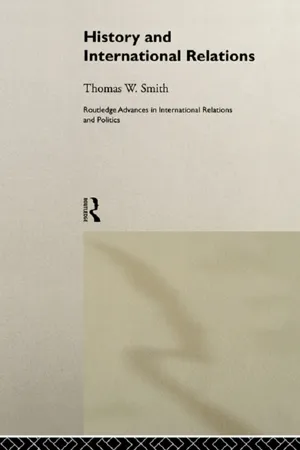
History and International Relations
About this book
This book is a major contribution to the debate about philosophy and method in history and international relations. The author analyses IR scholarship from classical realism to quantitative and postmodern work.
1
INTRODUCTION
Out of our conceptions of the past, we make a future.
Hobbes (1994: 32)
“The past,” the great skeptic of British philosophy Michael Oakeshott once noted, is “a field in which we exercise our moral and political opinions, like whippets in a meadow on a Sunday afternoon” (Oakeshott 1962: 166). Prompted by Oakeshott’s critique of history-as-ideology, this study scrutinizes international relations theory and research across the methodological spectrum from classical realism to quantitative and postmodernist work. Perhaps because it is a child of history, international relations, as it has developed, has tried to distance itself from historical discourse, through methodological and theoretical innovations seeking general knowledge about international and global politics. In this flight from the old ways of history, researchers have tended to downplay the historical content of their own work, and, at times, to embrace an easy historical empiricism. This uncritical view of the past has contributed to an often licentious historical method, with history serving less as an independent body of evidence than as a trove to be plundered, and which in the discipline’s most scientific work saddles history with more certainty than it can bear.
The historical problem is to some extent inherent in the material. As Hans Morgenthau noted in an opening passage of Politics Among Nations (1948),
The most formidable difficulty facing a scientific inquiry into the nature and ways of international politics is the ambiguity of the material with which the observer has to deal … The first lesson the student of international politics must learn and never forget is that the complexities of international affairs make simple solutions and trustworthy prophecies impossible. It is here that the scholar and the charlatan part company … In every political situation contradictory tendencies are at play … which tendency actually will prevail is anybody’s guess. The best the scholar can do, then, is to trace the different tendencies which, as potentialities, are inherent in a certain international situation.
(Morgenthau 1948: 4–6)
Quincy Wright, an early advocate of the quantitative study of international politics and one of the field’s greatest interdisciplinarians, had especially kind words for history. He noted that “in their emphasis on contingency [historians] provide a healthy antidote to the overenthusiastic social scientist,” and that an appreciation of history lent the student of war
a balanced sense of continuity and change, of uniqueness and repetition, of causation and contingency, and of choice and standards. He can better realize the complexity and uncertainty of human affairs, the many factors to be considered in making judgments, the dangers of abstraction, of dogmatism, of prediction, of action, and of inaction. He can better understand the abundance and variability of human values and the opportunities as well as the insecurities of any situation.
(Wright 1955: 87, 89)
Now more frequently cast in the mold of political science, students of international politics have largely abandoned these earlier ideas about the nature of history and the limits that history suggests for social science research. Today, “rigorous,” often grand, historical models are the norm, as is routine disregard for the problems of historical discourse.
The historical problem: an overview
In its most basic outline, the historical problem in the field of international relations comprises epistemology, ideology, and sociology. Epistemologically, history turns out to be an indispensable, but fickle, research partner. It is decidedly not the independent body of evidence touted by Leopold von Ranke (1874: vii) as history “as it really was” (wie es eigentlich gewesen ist). If getting history right is “like nailing jelly to the wall,” as Peter Novick suggests in his highly controversial, meticulously documented That Noble Dream: The “Objectivity Question” and the American Historical Profession (1988: 1), then the use of history in social science is no less challenging. Plunging into the historical literature, the researcher is quickly enmeshed in lively debate over description and explanation. History turns out to be not so much an archival puzzle, whose parts eventually fall neatly into place, than a patchwork of often incongruous facts and more or less plausible inferences, interpretations, and impressions. This is particularly the case as the historian moves into the realm of meaning and causality. As Stanley Hoffmann has argued (1987: 455), “many different readings of the same reality are possible. Even if all historians agreed on the facts, they would still disagree on the respective weight of those facts; in the act of ‘imaginative reconstruction’ that any causal analysis performs, assessments of motivation and causal efficiency vary considerably.”
Ideologically, history is ripe for partisan selection and interpretation. As the theorist constructs and reconstructs histories, allying inquiry with one interpretive school and carefully ignoring others, the findings risk being dictated or distorted by individual ideological or intellectual commitments. In place of searching historical inquiry, we get a lawyer’s brief that confuses evidence and advocacy. In terms of sociology, the customs and conventions of international relations have increasingly fostered a kind of heedlessness toward historical questions. It has become standard practice to brandish easy anecdotes and analogies, pursue ahistorical, stand-alone theory, or else to approach the “history” part of the enterprise as merely a formal testing stage on the road to theory. This is symptomatic of a broader affliction in the field. Yosef Lapid (1989: 249–50) suggests that, for many years, international relations has held “the dubious honor of being among the least self-reflexive of the Western social sciences.” Most debate in the discipline takes place within a “positivist” framework; it is assumed that rationally justified assertions about the “essential” nature of politics can be scientifically verified by observing its historical manifestations. Critics of theory and history generally respond with theory and history of their own, in what often becomes an all-or-nothing contest of evidence and ideas. Rarer are examinations of the field’s underlying assumptions and methods, particularly regarding the historical evidence itself, or the field’s roots in social science.
Most of the historical challenges described in this study fall within the following categories:
Selection bias: as the title of Barbara Geddes’s article (1990) states, “the cases you choose affect the answers you get.” This is the overarching problem in historical usage across the social sciences. Selection bias can be systematic, resulting from shoddy research; or it can be instrumental, aimed at promoting a particular theoretical position. Partisan selection bias is usually accompanied by the sin of omission of studiously avoiding unhelpful history. In all social science research, potential alternative explanations often reside in sources not enlisted or data not collected.
Anecdotalism generalizes from carefully chosen particulars. This is often more of a didactic tool than a research method, as the theorist airily presents hand-picked events and narratives in order to corroborate his/her ideas. Analogies may be anecdotal as well, as the scholar or policymaker sees current dilemmas closely mirrored in the past. Although it is a sub-set of selection bias, the anecdotal fallacy is so prevalent as to warrant special mention.
Ahistoricism promotes political theory emptied of content and context, often in an effort to sidestep the idiosyncrasies of political choice and the processes of change. Theorists may also be ahistorical in failing to recognize the impact of moment et milieu on their own research, thus presenting historically-contingent constructs as timeless laws of politics. The field is ahistorical as well in its focus on contemporary history and policy issues (Buzan and Little 1994: 233–4), and in its tendency to read the present back into the past.
Theoretical filtering interprets history through one’s theoretical lens. This practice is to some degree unavoidable: history needs theory to lend it coherence. At the extreme, theoretical filtering produces tautological research, undermining history’s role as an independent source of corroboration or falsification, as the case may be. Theoretical filtering is related to the quantitative fallacy as well, which arises when statistical methods propel research in a particular substantive direction. In postmodern work, a fixation on diversity and difference may prove so fine a filter that any similarities across historical periods or event are lost, thus walling off the past from the present.
Cathedrals of clay: here one constructs theories of painstaking precision as though the medium of research were Carrara marble rather than the softer stuff of history. This fallacy is common among quantitative researchers, who assume a tight affinity between historical data and history as it really was. Statistical methods allow for a great deal of sophistication and precision in research and theory, yet this precision may overstep the archival and historiographic evidence on which quantitative data are based.
Bridging history and international relations
Three preliminary comments may be made about work that attempts to bridge the disciplines of history and international relations. First, although some political scientists are loath to admit it, historians, at their best, are the furthest thing from antiquarians. Not only do historians interpret culture and politics with originality and flair, they also bear the daunting task of dismantling myths and preserving the past from ideology and oblivion. The adage goes that history can be written well only in a free country. By the same token, historians are in no small way guardians of the open society. “Why do ruling classes fear history?,” asks Harvey Kaye (1996). Anyone who has read Orwell, Kundera, or Koestler, or who knows the story of Picasso’s Guernica, understands that people in power invariably espouse a certain view of history. Some dictators have literally turned history into fiction, creating an “official story” out of whole cloth, or airbrushing politically inconvenient people from its pages. More subtly, states propagate heroic historical myths about themselves, viewing past wars, for example, as cleansing, redemptive struggles. Political leaders may cultivate what A. D. Smith (1995: 63) terms “ethno-history,” an amalgam of selective historical truth and idealization, in order to create and control political identity (see also Hobsbawm 1993). In one way or another, ideological history depicts the past merely as a sort of ante-room opening onto the political present. The free hand of the historian and the unencumbered hurly-burly of historical argument are the surest safeguards against these abuses. It was not for nothing that Khrushchev is reputed to have said, “Historians are dangerous, and capable of turning everything topsy-turvy. They have to be watched” (quoted in Owen 1995: 3). Warts and all, historical research and debate help to preserve integrity in politics.
Second, it should come as no surprise that history is a dynamic enterprise, constantly being rethought and rewritten. In the past few years alone, a flap erupted over how the Smithsonian Institution in Washington, DC should represent, fifty years on, the Enola Gay bombing of Hiroshima; Robert McNamara published an apologia for his lies that had spurred on the war in Vietnam; rather more ambiguous evidence has emerged concerning the Gulf War, undercutting what was at the time a tightly scripted portrayal of events; emerging from their forced hibernation, national historiographies are resurfacing in Eastern Europe and the former Soviet republics; in Moscow, the Soviet archives were ceremoniously opened at the end of the cold war, yet since that time access to the documents has been severely restricted; the stock of past presidents and prime ministers rises and falls on the tides of historical argument and evidence; under the pall of special prosecutors, state papers in some countries are probably more sanitized than ever; even the venerable American State Department series, Foreign Relations of the United States, has possibly become the source of disinformation, its editors declaring that their own government tampered with, and denied them, important evidence.
There is little reason to believe that the current state of historical evidence and judgment is definitive or final. This itself would signal the end of history. Lately, “historical revisionism” has become a pejorative term, used first in reaction to Marxist interpretations of the origins of the cold war, and, more recently, in the backlash against postmodern relativism in social and cultural studies (see Windschuttle 1997). At times, revisionist history is plainly pernicious. Issue after issue of the upright-sounding Journal of Historical Review, for example, carries “debate” about the “Holocaust myth.” Presumably, the publication’s high-minded banner (“bringing history into accord with the facts”) and its use of a sturdy, old-fashioned type for its masthead, are supposed to lend plausibility to its vile assertions. During the cold war, official Polish history had little to say about the massacre of Polish officers in the forest near Katyn by the Soviets in 1940 “until a joint Polish-Soviet commission charged with filling in historical ‘blank spots’ … declared it to be history” Blok 1992: 122). For reasons related to state security and national unity, many historians in Turkey have for decades denied that a separate or overlapping Kurdish identity may exist within the country’s borders. Until only very recently, Kurds were known euphemistically as “Mountain Turks.”
Historical revisionism is not always wrong, however. In many ways, revision is the lifeblood of the historian’s craft, as old verities are revisited, beliefs change, new documents and other artifacts are disclosed, and innovative interpretive models are employed (Gaddis 1997b: preface and Leffler 1995). This seems especially true when it comes to recent and contemporary political history. There is a certain timeliness and relevance attached to contemporary accounts, as historians attempt to bring coherence to the chaos of current events. Nevertheless, there are perils as well in passing historical judgment even as “the eggs are frying,” as Hemingway once noted in one of his front-line dispatches during the Spanish Civil War. Judgments will almost certainly change when viewed with the clarity and insight that often come with historical distance and detachment.
Finally, when working at the intersection of politics and history it is helpful to recall that the “disciplines” are contrived. Each represents a voice and method of discourse that provide a coherent framework for making intelligible one facet of experience. In their eagerness to erect academic walls, however, the disciplines risk isolating themselves, in effect shattering human experience. Fortunately, the social sciences resist this tendency. As the great social science historian Fernand Braudel notes (1980: 25–6), “the social sciences force themselves on each other, each trying to capture society as a whole, in its ‘totality.’ Each science encroaches on its neighbors, all the while believing it is staying in its own domain.” Events in one realm reverberate in others. Economics spills over into politics, and vice versa; anthropology, psychology, and linguistics borrow and trade ideas; history adopts insights and problems from its neighbors, and reflects them back again. This process is, of course, congenial to liberal learning. This book traces the combative intimacy of two disciplines having a great deal in common, yet struggling to maintain their separate identities. I hope it will be clear just how much students of international relations are indebted to historians, and vice versa, and how connected the two disciplines are in method, style, and content, and in terms of the paradigms guiding their ideas. In many ways, the similarities between the fields are more striking than the differences.
My hope in this study is to elucidate in a single argument a central problem of method and content across a very diverse discipline. The theories and research explored here represent a wide range of approaches to history in international politics, including philosophical, theological, inductive, policy-oriented, deductive, quantitative, and postmodernist work. The theorists and projects under review are also widely regarded as the finest exemplars of their respective method, thus providing the most rigorous “defense” of each against the author’s skepticism. The chapters flow chronologically. They also move, generally, from contingent views of history toward nomothetic political science analysis, before lapsing into the kaleidoscope histories of postmodernism. If any strand of international thought is not represented here (and many important ones are not), it is for reasons of space and because of the breadth of the field. Given the broad sweep of the study, some of the approaches that are treated will no doubt be given short shrift. I ask the reader’s indulgence for these shortcomings, as no slight is intended.
2
THE HISTORICAL PROBLEM IN INTERNATIONAL RELATIONS
Ian Lustick has encouraged students of politics to confront “the largely (now) uncontested claim that the work of historians is not understood by historians to be, and cannot legitimately be treated by others as, an unproblematic background narrative from which theoretically neutral data can be elicited for the framing of problems and testing of theories” (Lustick 1996: 605). The problem, as Benedetto Croce once noted, is that simple chronicle is but the “corpse of history,” il cadavere, for “history without interpretation is history without the historical problem” (quoted in Florovsky 1969: 353–4). Because it rests on inference of things past, historical thought is bound up in a web of prejudice and politics and honest disputes over ambiguous evidence. The effect, most fundamentally, is that there are histories, not history. While history is the only “empirical” evidence theorists of international politics can exploit, a diversity of interpretations would seem to support an array of theories, even contradictory ones.,1
This is a difficult notion for theorists and researchers in the discipline of international relations, who have long turned to historical writings as a source of insight and a field of evidence in which to test their ideas. James Bryce argued in International Relations (1922: vi–vii), “It is history which, recording the events and explaining the influences that have molded the minds of men, shows us how the world of international politics has come to be what it is. History is the best – in...
Table of contents
- Cover
- Title
- Copyright
- Contents
- Acknowledgments
- 1. Introduction
- 2. The Historical Problem in International Relations
- 3. History, Contingency, and the Roots of Realism: Reinhold Niebuhr and E. H. Carr
- 4. History, Analogy, and Policy Realism: Hans J. Morgenthau and George F. Kennan
- 5. The Poverty of Ahistoricism: Kenneth N. Waltz and neorealist theory
- 6. “The Importance of Being Scientific”: J.David Singer and the Correlates of War
- 7. Exit From History?: Postmodern international relations
- 8. Conclusion: History, skepticism, and the recovery of theory
- Notes
- Reference
- Index
Trusted by 375,005 students
Access to over 1.5 million titles for a fair monthly price.
Study more efficiently using our study tools.
Frequently asked questions
Yes, you can cancel anytime from the Subscription tab in your account settings on the Perlego website. Your subscription will stay active until the end of your current billing period. Learn how to cancel your subscription
No, books cannot be downloaded as external files, such as PDFs, for use outside of Perlego. However, you can download books within the Perlego app for offline reading on mobile or tablet. Learn how to download books offline
Perlego offers two plans: Essential and Complete
- Essential is ideal for learners and professionals who enjoy exploring a wide range of subjects. Access the Essential Library with 800,000+ trusted titles and best-sellers across business, personal growth, and the humanities. Includes unlimited reading time and Standard Read Aloud voice.
- Complete: Perfect for advanced learners and researchers needing full, unrestricted access. Unlock 1.5M+ books across hundreds of subjects, including academic and specialized titles. The Complete Plan also includes advanced features like Premium Read Aloud and Research Assistant.
We are an online textbook subscription service, where you can get access to an entire online library for less than the price of a single book per month. With over 1.5 million books across 990+ topics, we’ve got you covered! Learn about our mission
Look out for the read-aloud symbol on your next book to see if you can listen to it. The read-aloud tool reads text aloud for you, highlighting the text as it is being read. You can pause it, speed it up and slow it down. Learn more about Read Aloud
Yes! You can use the Perlego app on both iOS and Android devices to read anytime, anywhere — even offline. Perfect for commutes or when you’re on the go.
Please note we cannot support devices running on iOS 13 and Android 7 or earlier. Learn more about using the app
Please note we cannot support devices running on iOS 13 and Android 7 or earlier. Learn more about using the app
Yes, you can access History and International Relations by Thomas W. Smith in PDF and/or ePUB format, as well as other popular books in History & World History. We have over 1.5 million books available in our catalogue for you to explore.