eBook - ePub
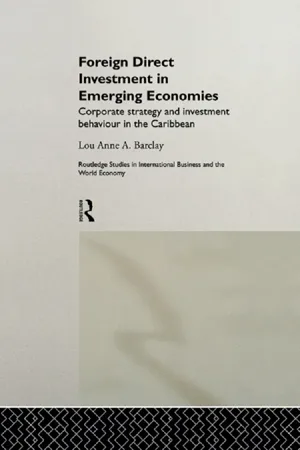
Foreign Direct Investment in Emerging Economies
Corporate Strategy and Investment Behaviour in the Caribbean
- 296 pages
- English
- ePUB (mobile friendly)
- Available on iOS & Android
eBook - ePub
Foreign Direct Investment in Emerging Economies
Corporate Strategy and Investment Behaviour in the Caribbean
About this book
The Caribbean countries of Jamaica, Barbados and Trinidad-Tobago represent excellent examples of the increasingly important role played by Foreign Direct Investment (FDI) in less developed, micro-economies. The increased dependence of these countries on FDI, however, calls into question the attractiveness of the business environment of the region to the foreign investor.
This volume examines both the investment behaviour and corporate strategies operating in these three countries, and assesses the factors which influence the motivations, location choices and market entry mode of multinationals making investments in the Caribbean.
1Introduction
The Attractiveness of Developing-Country Locales to Foreign Direct Investment
Since the mid-1980s, there has been a resurgence of foreign direct investment (FDI), directed by the multinational enterprise (MNE), into the economies of the developing world. Indeed, the annual growth rates of FDI inflows into these regions averaged 22 per cent during the 1985–89 period compared to a mere 3 per cent in the 1980–84 period and 13 per cent during the 1975–79 period (UNCTAD 1991). This growth in FDI inflows continued unabatedly into the 1990s with total FDI flows into the developing world soaring to a record level of US$149 billion in 1997 (UNCTAD 1998).
The majority of these flows has been concentrated in two regions: (1) South, East and South-East Asia, and (2) Latin America and the Caribbean. These regions are the largest developing-country recipients of FDI. During the years 1995–97, they accounted for approximately 86 per cent of the total developing-country FDI inflows (UNCTAD 1998: Annex Table B3). It is noteworthy that most of the FDI going into these regions is received by several core countries. China has been the principal driver in the foreign investment boom in the South, East and South-East Asia region, accounting for 55 per cent of the flows in 1997. Similarly, it is three countries – Argentina, Brazil and Mexico – which are members of the Associacion Latinomerican de Integracion (ALADI1) that receive the majority of FDI inflows in the Latin America and Caribbean region. These three countries accounted for 68 per cent and 62 per cent of the region’s FDI inflows during the years, 1990–91 and 1997, respectively (UNCTAD 1994b: Table VII; UNCTAD 1998: Annex Table Bl).
Interestingly enough, it appears that several of the smaller and less industrialised countries, which receive less flows of FDI, seem to be more dependent on these inflows. The Latin America and Caribbean region is an excellent example of this phenomenon. During the years 1990 to 1991, FDI inflows contributed to approximately 7 per cent of the gross domestic capital formation for the countries of the ALADI, 5 per cent for the Central American region and an astonishing 11 per cent for the Caribbean region2 (UNCTAD 1994a). Indeed, the Caribbean region has become increasingly dependent on FDI for the financing of its domestic investment. This dependence is clearly seen among several of the larger economies of the region. During the five-year period 1986 to 1991, FDI contributed a mere 3 per cent of Barbados’ gross fixed capital formation. However, by 1996, this figure rose to 6 per cent. In Jamaica, the figure was 7 per cent for the 1986 to 1991 period, but increased dramatically to 13 per cent by 1996. In Trinidad-Tobago, this increase was even more striking, with the ratio of FDI to gross fixed capital formation climbing from 11 per cent in the 1986 to 1991 period, to an astonishing 33 per cent by 1996. It is significant to note that the values recorded for these Caribbean countries exceed the aggregate value for developing countries. During the years 1986 to 1991, the ratio of FDI inflows to gross fixed capital formation for developing countries was an average of 3 per cent. The comparable figure for 1996 was 9 per cent (UNCTAD 1998: Annex Table B5).
Evidently, FDI, as directed by the Multinational Enterprise (MNE), is playing an increasingly important role in the economic development of the Caribbean region. This region is small. The entire English-speaking Caribbean comprises a mere 5.9 million people (United Nations 1997). Its economies are monocultural specialising in activities that are especially vulnerable to the vagaries of the international economy (tourism) or ones that have lost their growth dynamics (sugar, bauxite). The region is in economic crisis as evidenced by its disappointing economic performance over the last decade (Caribbean Commonwealth Secretariat 1988). Clearly, the renewed inflows of FDI are vitally needed in this region. With the recent implementation of the North American Free Trade Agreement (NAFTA), the issue of renewed FDI flows into these countries has become even more critical. It has been suggested that NAFTA will result in a diversion of foreign investment away from low-cost economies, notably the Caribbean, into Mexico (UNCTAD 1992: 28; Gill 1993).
These issues thus beg the question as to the attractiveness of the business environment of the Caribbean to the multinational enterprise. It is this research question that this book seeks to address. To this end, its objectives are fourfold, viz.:
- To examine the motivations for foreign direct investment undertaken in the region;
- To explore the factors that influence the locational choices of the MNE;
- To determine the modality of this investment; and
- To distil the policy implications that arise from this analysis to decision- makers in the Caribbean.
Foreign Direct Investment, Multinational Enterprises and Micro-Economies
For almost forty years, researchers have been grappling with issues surrounding the phenomenon of the MNE and the factors that influence itsbehaviour in different countries. The early studies conducted on FDI sought to explain the factors that influence the initial investment decision of the firm, which was engaged primarily in market-seeking FDI in industrialised countries (Hymer 1960, 1976; Vernon 1966; Kindleberger 1969; Caves 1971, 1974). Conversely, emphasis was placed on the factors that gave rise to the MNE, per se (Buckley and Casson 1976; Dunning 1979, 1980, 1981; Rugman 1980a, b, c, 1981). Studies also focused on what were the locational attractions of both developed and developing countries, which induced foreign direct investment (Reuber et al. 1973; Agodo 1978; Root and Ahmed 1979; Schneider and Frey 1985; Lecraw 1991). In addition, emphasis was placed on the efficacy of a single factor, for example, investment incentives, in attracting FDI (Guisinger et al. 1985; Lim 1983; Wheeler and Mody 1991). Alternatively, researchers focused on the factors influencing the MNE’s selection of a market entry mode (Johanson and Weidersheim-Paul 1975; Johanson and Vahlne 1977, 1990; Oman 1984; Beamish and Banks 1987; Kogut and Singh 1988; Gomes-Casseres 1990). Within the past decade, the rapid growth in export-seeking FDI has led to studies that have sought to determine the locational factors that influence this type of investment (Frobel et al. 1980; Rolfe and White 1992; Rolfe et al. 1993; Woodward and Rolfe 1993; Kumar 1994).
It is noteworthy that few of these studies examined the foreign direct investment undertaken in micro-economies, specifically the Caribbean. Indeed, most of the studies conducted on FDI in the Caribbean have emerged from the discipline of Development Economics. Thus, several inevitably focused on the inequitable relationship shared by the MNE and its host country (Me Intyre and Watson 1970; Girvan 1970, 1971, 1987; Farrell 1979). Alternatively, a few analysed the efficacy of the strategies implemented by these countries to attract FDI (Weiss 1989; Krammer 1991; Gore 1993).
The approach adopted in this book contrasts sharply to those undertaken on FDI in the Caribbean. This is a strategy-related study that draws heavily on international business theories. This monograph has broken new ground by integrating three main areas of concern in the foreign direct investment literature. To this end, it attempts to determine the factors that influence the motivations, locational choices and market entry mode of MNEs operating in the Caribbean. Moreover, this study seeks to ascertain the extent to which these factors are influenced by the timing of the investment decision, the type of FDI (resource-seeking, market-seeking and export-seeking), the quantum of initial investment and the country of origin of the investor. Further, this work does not only examine the factors that determine the initial investment decision (Coyne 1995), it also analyses the factors that affect the firm’s decision to continue operations in the Caribbean. Moreover, the “analysis is not only limited to one type of investment (Woodward and Rolfe 1993; Kumar 1994), it also examines all three types of FDI. Finally, the research did not merely seek to solicit responses from managers at the headquarters (Reuber 1973; Guisinger 1985; Coyne 1995), as responses from managers located at the subsidiary were also sought.
This study draws heavily on the FDI literature in its attempts at finding answers to the research question. Fourteen hypotheses were advanced from the literature. A triangulation method was employed in the testing of these hypotheses. The fourteen hypotheses were initially tested by means of a nine-page mailed questionnaire, which was administered to 299 executives of MNEs that operate in three Caribbean countries: Jamaica, Barbados and Trinidad-Tobago. The results of the mailed questionnaire were analysed using chi-square tests. The hypotheses were further tested using a qualitative method. The objectives of using a qualitative methodology were to capture the nuances of the MNE’s behaviour in the Caribbean and to gain a deeper understanding of the process of FDI as it is undertaken in the focus countries. The qualitative method used was that of the case study approach. Twelve core cases of MNEs operating in the export sectors of the three Caribbean countries were analysed.
The Organisation of the Book
Following this introduction, Chapter 2 introduces the three focus countries: Jamaica, Barbados and Trinidad-Tobago. It profiles the socio-economic and political conditions prevailing in these countries. This chapter also attempts to highlight the differences in the business environment of these three Caribbean countries to the foreign investor.
Chapters 3 to 5 review the literature that is relevant to the development of the fourteen hypotheses. Chapter 3 examines those theories, which seek to explain the factors motivating a firm to engage in production abroad. Chapter 4 analyses the strands of the FDI literature that attempt to elucidate where a firm is likely to locate its production and the factors that influence this decision. Chapter 5 is the last of the literature review chapters. In this chapter an analysis is undertaken of the theories that purport to explain the factors determining an MNE’s selection of a market entry mode. In all three chapters, special emphasis is placed on those theories that focus on the behaviour of the MNE operating in developing countries.
Chapter 6 discusses the hypotheses that were developed in Chapters 2 to 4. In addition, it provides the rationale for the use of a triangulation method in this study. This chapter also explains the process by which the MNEs and their respondents were selected for both the mailed questionnaire survey and the case studies.
Chapters 7 to 10 present the findings of the analysis of the research data. In Chapter 7 the research findings of the quantitative study are analysed and interpreted. In addition, it compares the findings of the quantitative study with those reported by other researchers. In Chapters 8 to 10, the hypotheses, which were analysed in Chapter 7, are further tested using the case study approach. To this end, case studies are conducted of a grouping of four firms that operate in the export sectors of the three Caribbean countries. Chapter 8 is a case study of four MNEs that have made investment in Jamaica’s apparel sector. In Chapter 9 a case study is made of four MNEs that operate in the information service industry of Barbados. Similarly, Chapter 10 conducts a case study of seven MNEs engaged in FDI in the natural gas sector of Trinidad-Tobago. In this case study, two of the firms examined are joint ventures: one involves three MNE partners; the other, two. In all three case studies, the industry selection is explained, case histories for the MNEs are presented and the foreign investment decision is analysed.
Chapter 11 cross-analyses the case study data. In this chapter, the foreign investment decisions made by the fifteen MNEs that operate in the focus countries are analysed with the aim of identifying patterns of similarities and differences. To this end, the factors that influence these firms’ motivations for FDI, choice of location and selection of market entry mode are analysed across industry and country.
Chapter 12 is the concluding chapter. In this chapter, a comparison is done of both the quantitative and qualitative studies. The objectives of this comparative analysis are to increase the generalisability, deepen the understanding and provide fuller explanations of the factors influencing the foreign investment decisions of the MNEs that operate in the three Caribbean countries. In addition, in this chapter public policy and strategic management issues arising from this study are articulated. Further, the chapter examines the limitations of the study and identifies areas for future research.
Foreign Direct Investment in Micro-Economies: Lessons Learnt
One insight gained from this study is the non-applicability of several of the FDI theories to the realities of small, less-developed economies. These economies will not only include those of the Caribbean, but also the smaller economies of the Pacific, of Africa and, possibly, some of the emerging economies of Eastern Europe.
The FDI theories have been developed largely to explain the behaviour of firms originating from advanced, industrialised countries which are making investments in these countries. Thus, not surprisingly, they do not seem to fully explain the FDI process conducted in small, less-developed countries. One notable example was the failure of the monopolistic advantage theory, initially postulated by Hymer (1960), to explain the motivations for the MNE investing in the three focus countries. Nonetheless, a few of these theories appeared to adequately explain the investment behaviour and corporate strategy of the MNE engaging in FDI in the Caribbean. The most noteworthy was the ‘Double Diamond’ hypothesis advanced by Rugman and D’Cruz (1993) and Rugman and Verbeke (1993). This study shows that the customised ‘Double Diamond’ model is a powerful framework for analysing the business environment of the three Caribbean countries studied. The customised ‘Double Diamond’ model demonstrated the extent to which the focus countries were integrated into the global corporate strategy of the MNEs studied. In so doing, it highlighted the deficiencies of the business environment of the three countries.
The study also highlighted several issues of public policy. It illustrated the importance of the governments of the focus countries aggressively pursuing strategies to ensure that their countries develop a business environment that is more supportive of the foreign investor. It seems that the focus countries still offer the MNE what has been termed ‘basic factors’ by Porter (1990). These are low-cost, semi-skilled labour and a strategic location. The work suggests that investments need to be made in human resource development, infrastructural improvements and the strengthening of the institutional framework for industrialisation. Also, it appears that a nexus needs to be created between the foreign investor and the government. Moreover, it seems that the investment incentive package needs to be revised. Finally, the study suggests that support should be given for the development of the local firm.
Strategic management issues were also revealed. The work demonstrates the criticality of human resource management to firms engaging in labour-intensive activities in micro-economies. It seems that managers of these firms need to offer both financial and psychic rewards to attract and maintain a productive workforce. In addition, this work suggests that managers need to intervene in the education system to ensure that it produces workers with the requisite skills. The study also shows that the local firm does not pose a competitor threat to the MNE. Interestingly, the MNE’s competitors are the other foreign firms operating in the host country. These firms may implement strategies that threaten the MNE’s access to those locational assets which lured its initial investment in the Caribbean. Managers of MNEs need to adopt collaborative strategies to counteract this threat.
This work also demonstrates the absence of well-developed clusters of firms and institutions in the three focus countries. Managers are thus obliged to access supplier and related goods and services from other locations. However, in Trinidad, a nascent cluster in the gas sector appears to be emerging. Managers operating in this country should develop relationships with the firms in this cluster. In so doing, they may gain potential first-mover advantages over competitors operating in this country. Finally, this study reveals tha...
Table of contents
- Cover
- Half Title
- Title Page
- Copyright
- Dedication
- Contents
- List of tables
- List of figures
- Acknowledgements
- Foreword
- 1. Introduction
- 2. The Caribbean host countries: an introduction
- 3. The motivations for foreign direct investment
- 4. The location of foreign direct investment
- 5. The modes of foreign direct investment
- 6. Hypotheses and methodology
- 7. Foreign direct investment in the Caribbean: a quantitative investigation
- 8. Foreign direct investment in Jamaica: a case study of the apparel industry
- 9. Foreign direct investment in Barbados: a case study of the information service industry
- 10. Foreign direct investment in Trinidad-Tobago: a case study of the natural gas sector
- 11. Foreign direct investment in the Caribbean: a cross-industry case study analysis
- 12. The future of foreign investment in the Commonwealth Caribbean: conclusions and recommendations
- Appendices
- Notes
- Bibliography
- Index
Trusted by 375,005 students
Access to over 1.5 million titles for a fair monthly price.
Study more efficiently using our study tools.
Frequently asked questions
Yes, you can cancel anytime from the Subscription tab in your account settings on the Perlego website. Your subscription will stay active until the end of your current billing period. Learn how to cancel your subscription
No, books cannot be downloaded as external files, such as PDFs, for use outside of Perlego. However, you can download books within the Perlego app for offline reading on mobile or tablet. Learn how to download books offline
Perlego offers two plans: Essential and Complete
- Essential is ideal for learners and professionals who enjoy exploring a wide range of subjects. Access the Essential Library with 800,000+ trusted titles and best-sellers across business, personal growth, and the humanities. Includes unlimited reading time and Standard Read Aloud voice.
- Complete: Perfect for advanced learners and researchers needing full, unrestricted access. Unlock 1.5M+ books across hundreds of subjects, including academic and specialized titles. The Complete Plan also includes advanced features like Premium Read Aloud and Research Assistant.
We are an online textbook subscription service, where you can get access to an entire online library for less than the price of a single book per month. With over 1.5 million books across 990+ topics, we’ve got you covered! Learn about our mission
Look out for the read-aloud symbol on your next book to see if you can listen to it. The read-aloud tool reads text aloud for you, highlighting the text as it is being read. You can pause it, speed it up and slow it down. Learn more about Read Aloud
Yes! You can use the Perlego app on both iOS and Android devices to read anytime, anywhere — even offline. Perfect for commutes or when you’re on the go.
Please note we cannot support devices running on iOS 13 and Android 7 or earlier. Learn more about using the app
Please note we cannot support devices running on iOS 13 and Android 7 or earlier. Learn more about using the app
Yes, you can access Foreign Direct Investment in Emerging Economies by Lou Anne A. Barclay in PDF and/or ePUB format, as well as other popular books in Business & Business General. We have over 1.5 million books available in our catalogue for you to explore.