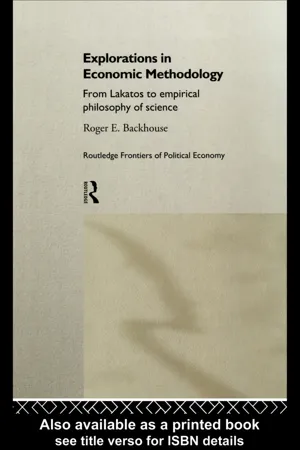
Roger Backhouse is a key figure in the field of economic methodology. Explorations in Economic Methodology both clarifies and responds to the issues raised by the literature and argues that methodology is an essential activity. Offering a constructive, but critical, response to the recent literature, this collection provides important new insights for students and researchers in economic methodology and the philosophy of science.
eBook - ePub
Explorations in Economic Methodology
From Lakatos to Empirical Philosophy of Science
- 256 pages
- English
- ePUB (mobile friendly)
- Available on iOS & Android
eBook - ePub
Explorations in Economic Methodology
From Lakatos to Empirical Philosophy of Science
Chapter 1
Introduction
1 ECONOMIC METHODOLOGY1
Dating the emergence of new disciplines and sub-disciplines is often problematic. In the case of economic methodology, however, it is relatively easy. The volume Method and Appraisal in Economics, edited by Spiro Latsis (1976), marked a break with most earlier methodological discussions, and played a role second only to Mark Blaug’s The Methodology of Economics (1980/92) in establishing economic methodology as an identifiable discipline involving economics, philosophy, and the history and sociology of science.
Method and Appraisal in Economics boasted a distinguished list of contributors, each of whom explored the relevance of Lakatosian ideas to economics. What marked such work off from previous methodological literature was that it focused on the dynamics of the subject – opening up new ways of thinking about how economics had developed over time. In doing this, it opened up the possibility of resolving long-standing puzzles about how the discipline worked. Because it comprised a series of case studies, it was possible for an economist to get interested in the book without any prior concern with abstract methodological ideas. In contrast, the earlier literature on economic methodology, outstanding as some of it was, seemed ahistorical and to be missing something vital. Robbins (1932/35), Hutchison (1938), Friedman (1953) and others seemed, in comparison with the contributions to the Latsis volume, to be offering over-simplified pictures of the subject.
It was, though, Blaug’s book that played the major role, defining economic methodology as a sub-discipline of economics. It was, however, more than simply a textbook: it placed philosophy of science up front, and established an agenda and a challenge. Economists, Blaug argued, generally practised what he termed ‘innocuous falsificationism’, but they should stop doing so. Economics would progress much more quickly if they would take falsificationism seriously. Whenever serious attempts had been made to test economic theories, Blaug contended, the result had been progress. The result was that economic methodology came to be centred on Popperian and Lakatosian ideas. Though Caldwell (1982) argued for a different conclusion (methodological pluralism), he and Blaug were addressing the same issues. The two books reinforced each other in establishing the issues to be addressed.
During the subsequent decade, however, interest in Lakatos waned for a number of reasons. The first was that, as people sought to investigate the Popperian and Lakatosian methodologies and to apply them to economics, they encountered problems. It became clear that they did not provide any magic formula for revealing what was going on in economics. The second reason was the increasing popularity of rhetorical, literary, sociological and other ‘postmodern’ analyses of economics. The key work here was Deirdre (formerly Donald) McCloskey’s ‘The rhetoric of economics’ (1983) and her subsequent book of the same title (McCloskey, 1986), in which she argued that the idea of ‘Methodology’ was misconceived, and premised on an out-moded and philosophically indefensible ‘modernist’ view of the world. Finally, but perhaps more important in the long term, was the increasing awareness amongst specialists on economic methodology of issues in the philosophy of science that extended beyond those raised by Popper, Kuhn and Lakatos. This came about for two reasons. One was that economic methodologists, typically self-taught in philosophy, became aware of wider issues. The other was that a number of philosophers took a serious interest in economics, and showed that much could be learned by approaching the subject from perspectives other than falsificationism.
The result was that, by the end of the decade, Popperian and Lakatosian methodologies had fallen out of fashion. Weintraub abandoned the Lakatosian perspective of General Equilibrium Analysis: Studies in Appraisal (1985) in favour of writing ‘thick’ history, inspired by ideas from literary criticism and the sociology of scientific knowledge (Weintraub 1991). Though he continued to see some merit in the Popperian tradition, Hands moved progressively further from falsificationism (see Hands, 1993). De Marchi increasingly played down Popper and Lakatos, in favour of what he termed ‘recovering practice’ (de Marchi, 1992). Rosenberg (1992) and Hausman (1992) produced major studies of economics that took owed nothing to Popper or Lakatos. At the Capri conference on research programmes in economics in 1989 (see de Marchi and Blaug, 1991), supporters of Lakatosian methodology were a beleaguered minority.
2 EXPLORATIONS IN ECONOMIC METHODOLOGY
This is the background against which the essays contained in this volume were written. Like other economists who came to economic methodology at this time, my entry was via Latsis (1976) and Blaug (1980), both, I recall, found accidentally whilst browsing through new acquisitions at a local bookstore soon after their publication. The possibility that it might be worth undertaking more serious study of methodology, however, did not occur to me. Instead, I concentrated on research in macroeconomics and, later, the history of economic thought. Though I could not resist bringing Popper, Kuhn and Lakatos (along with three all-too-brief paragraphs on sociology of science) into A History of Modern Economic Analysis (1985), I played this down, the result being a book which, apart from a few sections, rests on no explicit philosophical position. In retrospect, I am surprised at the sceptical attitude towards Kuhn and Lakatos adopted in that chapter.
One approach to the history of economic analysis would be to appraise economic ideas in terms of a particular methodology, taken from the philosophy of science. Kuhnian paradigms, or Lakatosian research programmes could be identified and the story told in these terms. Such an approach is not without value, but it begs the question of how far the methodology chosen is appropriate for economics. Suppose, for example, that it turned out that little of the history of economic analysis could be fitted into Lakatos’s methodology of scientific research programmes. One possible conclusion would be that the history of economics should be judged adversely. Alternatively, it would be possible to draw the conclusion that the methodology was simply inappropriate for economics.
There would be problems, too, should the methodology explain everything. Would some other methodology, such as Kuhn’s paradigms, have performed equally well? Were the criteria for testing the applicability of the methodology sufficiently stringent for the results to mean anything? For example, if economics is divided up into chunks, each of which is to be tried out as a Kuhnian paradigm, or as a Lakatosian research programme, there are many ways in which we might divide it up. We might take the whole of economic inquiry since Adam Smith as one unit. We might separate classical economics, marginalist economics and Keynesian economics. Dividing still further we might consider episodes such as the post-Marshallian theory of the firm, or neo-classical growth theory. ‘Verification’ of a methodology ought to be easy, as there are so many possible ways of applying it.
Why not, then, abandon the philosophy of science altogether? Firstly, the philosophy of science does provide useful concepts and ideas, and it suggests questions which are worth asking. Even though we may conclude that, for example, the marginal revolution does was not a scientific revolution in Kuhn’s sense, we may learn something in the process of coming to this conclusion. Secondly, though extreme caution must be applied in doing this, the history of economic analysis is useful for evaluating alternative methodologies. If economists have not followed what appear to be sound methodological principles, there may be a good reason why not (there may, of course, be less respectable reasons too).
(Backhouse, 1985, pp. 9–10)
It was in the late 1980s that I turned more seriously to methodology. I started with the attempt to apply Lakatos’s methodology of scientific research programmes to the development of macroeconomics since Keynes (reproduced as Chapter 2), finding that it fitted surprisingly well. By this time, however, Lakatos’s methodology of scientific research programmes had become unfashionable. At the Capri conference, Mark Blaug and I sometimes seemed the only people still prepared to take the Lakatosian project further. My response to this was to think much more carefully about Lakatos, the result being the other essays contained in Part I.
The perspective from which all the papers in Part I were written is that though there are problems with applying Lakatos’s methodology of scientific research programmes to economics, it none the less provides a useful framework for thinking about certain methodological issues. Rejection of Lakatos has often been associated with rejecting some important issues that are addressed in his methodology: empiricism (loosely defined), the importance of the growth of knowledge’ and the tension between appraising economic ideas and at the same time learning from what economists actually do. Even if Lakatos’s methodology of scientific research programmes has to be left behind, these should not be thrown out with it.
This conviction that the Popperian–Lakatosian methodology was right in certain key respects, combined with considerable scepticism about the details, explains the way I responded to ‘anti-positivism’ or postmodernism when it entered the debate over economic methodology. The stimulus was when Roy Weintraub came to Bristol to present an early version of ‘Methodology doesn’t matter, but the history of thought might’ (Weintraub, 1989). It immediately struck me that if one started from a Popperian position, his arguments were of no consequence, for Popperian methodology was based on the premiss that nothing was known with certainty. It was in responding to this paper that I started to analyse McCloskey’s critique of methodology, which overlapped to a considerable extent with Weintraub’s. However, whilst I was convinced that McCloskey’s and Weintraub’s anti-methodological positions were misconceived, and even inconsistent, I became convinced that rhetorical and other related perspectives could shed new light on what was going on within economics. The four essays in Part II make the case that hermeneutic, rhetorical and postmodern analysis have important points to make, but that they need to be treated with the same level of criticism as that to which traditional methodological approaches have been subjected. It is possible to learn from, say, rhetorical analysis, without abandoning the view that the methodological basis for economics needs to be analysed and criticized.
Part III contains responses to a variety of ‘economists’ writing on economic methodology. The word ‘economist’ in this context means someone whose main concern remains to contribute to economics, not to reflect on economics. Thus where McCloskey and Weintraub have chosen to specialize in reflecting on economics, Harcourt, Hahn, Krugman, and Kindleberger, though they have engaged in much methodological reflection, have been concerned primarily with doing economics. Their writings, however, all raise important methodological issues. Two themes predominate in these chapters: the merits of a pluralist, eclectic approach to economic theorizing, and the conditions most likely to produce progress in economics. These are related, in that the advocates of an eclectic approach argue that it results in insights that would otherwise be lost. Harcourt and Hamouda, in the survey of post-Keynesian economics discussed in , argue for a ‘horses for courses’ approach, whilst Kindleberger, the subject of Chapter 12, claims that economists should use a variety of tools, no single one being suitable for all problems. These chapters point out that, although the existence of a variety of perspectives and approaches to economics can stimulate fruitful enquiries that would otherwise not have taken place, there is another side to the coin: if ideas are to be tested and developed, a framework is needed. Neoclassical economics, though it has great problems, does provide such a framework.
Of the remaining chapters in Part III, Chapter 11 addresses Hahn’s claim, which would be echoed by many economists, that methodological discussions should be avoided as they distract attention from more serious work, and can be harmful. The argument used to counter this claim is that economists make methodological choices all the time, many of them remaining implicit. It is important that they are made explicit and subjected to critical analysis. Chapter 14 views the methodology of Schumpeter’s History of Economic Analysis (1954) in the light of Kuhn’s Structure of Scientific Revolutions (1962/70). The two have much in common, but differ in key respects. It is argued that a possible explanation of these differences is that Schumpeter reached different conclusions from Kuhn because, as an economist, his methodology was tailored to fit economics as he saw it. It can, to this extent, be seen as an example of empirical philosophy of science.
This leads into Part IV, ‘Pragmatism and empirical philosophy of science’. Chapter 15 uses Peirce’s terminology to investigate why economists disagree by turning the question round: how do economists manage to resolve disagreements amongst themselves? It focuses on the question of how econometric or other empirical evidence can be used to resolve disputes, and why it is not more effective in doing so. Several reasons specific to economics are suggested. After this, there follow three chapters on philosophical studies in which methodological conclusions are drawn from a close examination of what practising economists actually d...
Table of contents
- Cover
- Halftitle
- Title
- Copyright
- Contents
- 1. Introduction
- PART I. Rethinking Lakatos
- PART II. Rhetoric and postmodernism in economics
- PART III. Economists on methodology
- PART IV. Pragmatism and empirical philosophy of science
- Index
Trusted by 375,005 students
Access to over 1.5 million titles for a fair monthly price.
Study more efficiently using our study tools.
Frequently asked questions
Yes, you can cancel anytime from the Subscription tab in your account settings on the Perlego website. Your subscription will stay active until the end of your current billing period. Learn how to cancel your subscription
No, books cannot be downloaded as external files, such as PDFs, for use outside of Perlego. However, you can download books within the Perlego app for offline reading on mobile or tablet. Learn how to download books offline
Perlego offers two plans: Essential and Complete
- Essential is ideal for learners and professionals who enjoy exploring a wide range of subjects. Access the Essential Library with 800,000+ trusted titles and best-sellers across business, personal growth, and the humanities. Includes unlimited reading time and Standard Read Aloud voice.
- Complete: Perfect for advanced learners and researchers needing full, unrestricted access. Unlock 1.5M+ books across hundreds of subjects, including academic and specialized titles. The Complete Plan also includes advanced features like Premium Read Aloud and Research Assistant.
We are an online textbook subscription service, where you can get access to an entire online library for less than the price of a single book per month. With over 1.5 million books across 990+ topics, we’ve got you covered! Learn about our mission
Look out for the read-aloud symbol on your next book to see if you can listen to it. The read-aloud tool reads text aloud for you, highlighting the text as it is being read. You can pause it, speed it up and slow it down. Learn more about Read Aloud
Yes! You can use the Perlego app on both iOS and Android devices to read anytime, anywhere — even offline. Perfect for commutes or when you’re on the go.
Please note we cannot support devices running on iOS 13 and Android 7 or earlier. Learn more about using the app
Please note we cannot support devices running on iOS 13 and Android 7 or earlier. Learn more about using the app
Yes, you can access Explorations in Economic Methodology by Roger E. Backhouse in PDF and/or ePUB format, as well as other popular books in Business & Business General. We have over 1.5 million books available in our catalogue for you to explore.