- English
- ePUB (mobile friendly)
- Available on iOS & Android
eBook - ePub
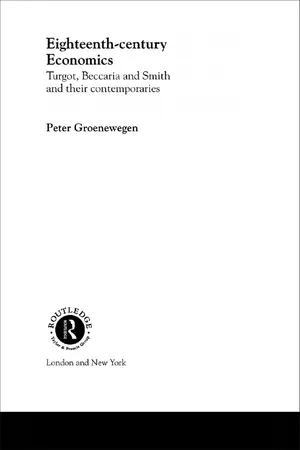
Eighteenth Century Economics
About this book
Peter Groenewegen is one of the world's foremost scholars of eighteenth century economics - the era that saw the effective 'mainstreaming' of the discipline in the work of Smith, Turgot and Quesnay. This collection of essays amounts to the definitive guide to eighteenth century economics and is a must for any economist's bookshelves.Eighteenth Cent
Part I
1 Turgot, Beccaria and Smith1
Introduction
It is well known and documented (Winch, 1970; Schumpeter, 1959) that the third quarter of the eighteenth century marks perhaps the most important period in the history of economic thought, since it is at the end of this period that economics emerged as a separate and new science (cf. Shackle, 1967, p. 2). During the 1760s and 1770s political economy gradually distinguished and emancipated itself from its roots in moral and political philosophy, and from the fragmented economic literature produced in the previous two centuries by merchants and administrators, which constituted its foundations (Schumpeter, 1954, esp. ch. 1). This period, with one major exception (Cantillon, 1959) saw the publication of the first general treatises on the subject, and the construction of systems of classical political economy which emphasised the reproduction of annual wealth, capital accumulation, value, distribution and growth. Such systems concentrated considerably less on the earlier preoccupations of economic writers, that is, matters of trade, money, credit and public finance, the practical issues which had inspired the earlier pamphleteers. In addition, this period saw the publication of the first economic journals, the establishment of the first chairs in political economy at European universities,2 and the gradual beginning of what can be described as an economics profession.
The reasons for the timing of this phenomenon in the history of political economy are substantially found in the developments in general intellectual thought which took place in the eighteenth century. As Leslie Stephen (1902) has convincingly demonstrated, the mid-eighteenth century marks the beginning of secular social science freed from the theological encumbrances which had hampered its development in earlier centuries. The great landmark of this liberation is Montesquieu’s l’Esprit des Lois published in 1748. This birth of a secular social science is confirmed in the blossoming of intellectual inquiry in fields such as history, sociology, politics, jurisprudence and political economy which flourished particularly in France and Scotland (the Enlightenment), but whose influence was spread over the whole civilised (European) world. The quality of this inquiry was enhanced by the growing acceptance of scientific method in the social sciences, pioneered at the end of the seventeenth century by the scientific and philosophic endeavours of Newton and Locke, whose influence was spread over the whole of Europe during the eighteenth century (for its influence on economics, see Letwin, 1963). As Pope put it so effectively in the eighteenth century:
Nature and Nature’s laws lay hid in night.
God said: ‘Let Newton be’, and all was light.3
The fruits of the new physical theory of knowledge which owed its existence to Newton and Locke were reaped as far as the social sciences were concerned in the rich harvest produced by the Enlightenment in this area during the second half of the eighteenth century (see Cassirer, 1951, esp. ch. 2).
In the history of political economy, three figures of the Enlightenment stand out at the end of the third quarter of the century: Turgot, Beccaria and Smith.4 Turgot, the philosopher, administrator and economist, at this time reached the greatest heights of his illustrious career in his position as Finance Minister (Contrôleur-général) of France from 1774 to 1776. Beccaria, philosopher, academic and administrator, was by then prominent as a social reformer and administrator following his period as professor of economics from 1768 to 1771 at the Palatine school in Milan. Adam Smith, the philosopher and academic, was putting the finishing touches to his magnum opus in political economy, which was published in 1776 as An Inquiry into the Nature and Causes of the Wealth of Nations. Of these three figures from the Enlightenment who all wrote extensively on political economy, only one, Adam Smith, has been given a prominent place in the history of economic thought. Turgot has generally been given a more minor, but nevertheless relatively important place, while Beccaria has been almost totally ignored in the histories of economics.
One major exception5 to this last proposition is the work of Schumpeter (1959) who spoke of the great ‘triumvirate’ of Turgot, Beccaria and Smith (p. 245) and who provides interesting comparisons of these three economists on a number of occasions (pp. 179–80, 245, 248–9). The following quotations illustrate the basis on which these comparisons were made:
For the moment, we concentrate upon Beccaria, the Italian, and A. Smith. The similarity between the two men and their performances is indeed striking. There is even some similarity in their social backgrounds and locations. There is similarity in their lives – and in those attitudes that are conditioned by one’s pursuits – though Beccaria was much more a public servant than A. Smith. … Both were sovereign lords of a vast intellectual realm that extended far beyond what, even then, was possible for ordinary mortals to embrace. Beccaria presumably knew more mathematics than A. Smith, but A. Smith seems to have known more astronomy and physics. Neither was merely an economist … Turgot’s brilliant achievements, his unchallenged place in the history of our science, and his evident title to membership in the triumvirate in which Beccaria and A. Smith are his colleagues are sufficient reasons why it is desirable to look for a moment at the man and his career … If we now try to compare Turgot’s scientific personality with those of Beccaria and A. Smith, significant similarities strike us first: all three were polyhistoric in learning and range of vision: all three stood outside the arena of business and political pursuits: all three displayed single-minded devotion to the duty in hand. Turgot was undoubtedly the most brilliant of the three, though his brilliance was somewhat tinged with superficiality, not in economics, but in his outlying intellectual domains. The main difference, from the standpoint of their scientific achievement, is that A. Smith expended very little of his energies on non-scientific work, Beccaria very much, and Turgot, from 1761 on, almost all he had. During the thirteen years at Limoges, Turgot can have had but scanty leisure; during his (nearly) two years of ministerial office, practically none: his creative work must have been done between the ages of 18 and 24. And this explains all there is to explain, not indeed about the comparative merits of the three works in question, but about the different degrees to which they were finished works at all.
(Schumpeter, 1959, pp. 179–80, 245, 248)
The broad comparison of the work, life and personalities of these three major economists from Italy, France and Scotland at the end of that quarter century during which economics emerged as a science, which Schumpeter draws only in bold outlines in his remarks quoted above, provides a major part of the purpose for this paper. The main emphasis, not surprisingly, will be on their economics (and in particular the sources of that economics) and thereby this paper will improve the understanding of this crucial period in the development of the science. This task is achieved as follows. The second section of the paper provides a biographical sketch of the three economists, giving details of their respective careers with considerable concentration on their intellectual pursuits. The third provides a comparative outline of the economic systems they constructed in their major treatises on the subject.6 The fourth section looks at the basic sources of this economics, particularly the common sources, and the final section elicits some of the conclusions which can be derived from this comparative study in the history of economic thought.
The purpose of this paper is, however, wider than a mere comparison of these three authors. Its more substantial aim is by such a comparison to illuminate the origins of classical political economy and to delineate its major characteristics, as contained in these three formulations of the classical system of political economy in the eighteenth century. By demonstrating first the unity of ideas in the economic systems of Turgot, Beccaria and Smith, the distinction between pre-Adamite (Blaug, 1962, ch. 1) and classical political economy starting with Smith, becomes less meaningful, and support is given to Marx’s more perceptive contention (Marx, 1859, pp. 52–3) that classical political economy developed from the works of Petty and Boisguilbert in the mid-to-late seventeenth century and more or less concluded with the works of Ricardo and Sismondi in the 1820s. Although this paper does not demonstrate agreement with all of Marx’s contentions in this context, it does support the broad thrust of his argument as far as the eighteenth century is concerned, as the final section of the paper makes clear.
Three philosophers of the eighteenth century
In order to provide a simple overview of the lives of Smith, Turgot and Beccaria which facilitates comparison, Table 1.1 gives a chronology of their lives which emphasises the dates of publication of their major works, the details of their education and appointments, and additional chronological information which places them in context. This table is not intended to be comprehensive, since its purpose is to provide reference material used in the discussion of this and the fourth section of the paper.
The first point to be noted is that Turgot, Beccaria and Smith were all complete products of the eighteenth century. All three were born and died within that century. Of the three, Smith had by far the longest life (sixty-seven years) and was also first born (1723). Beccaria, who survived Smith by nearly four years, lived for fifty-six years, while of the three Turgot had the shortest life: he died in 1781 at the age of fifty-three. As Schumpeter indicated in the passage quoted, these data are not unimportant. It may also be noted that despite their different birth years they nevertheless produced the work for which they became famous during their lifetime in the late 1750s and early 1760s. At the age of thirty-six, Smith made his name with the publication of the Theory of Moral Sentiments, the first edition of which was published in 1759; Beccaria, at only twenty-six, published his Dei Delitti e delle Pene in 1764; while Turgot at age twenty-nine had clearly established his substantial intellectual reputation with his Encyclopédie articles published in 1756 and 1757. From the chart, it can also be deduced that Turgot was the most precocious of the three: his first piece on economics which has been preserved7 was written at the age of twenty-one (the letter to l’Abbé de Cicé on paper money); Beccaria’s first work on economics appeared when he was twenty-four, while Smith’s first published work, the review of Samuel Johnson’s Dictionary, did not appear until 1755 when he was thirty-one.
Interesting comparisons can also be made on their educational experience. All three enjoyed extensive formal education at schools and at universities, but some differences may be noted. There are variations in the length of their formal education, and the same can be said about the extent to which they enjoyed the educational experience of foreign travel.
What details there are on Smith’s education have been chronicled by Rae (1895) as supplemented by Scott (1937). These can be briefly summarised. Smith attended the Burgh school of Kirkcaldy for approximately seven years (1730–7), a school described by Rae (p. 5) as ‘one of the best secondary schools of Scotland at that period’.8 He commenced Latin probably in 1733, and was ‘marked’ during this period of his schooling, as Rae (p. 8) put it, for ‘his studious disposition, his love of reading, and his power of memory’. At the age of fifteen he matriculated and entered the University of Glasgow, where he took his M.A. with distinction in 1740, having studied mathematics and natural philosophy,9 as well as the classics, logic and moral philosophy. Here he was influenced by Dunlop in Latin and Greek, Simpson in mathematics, and especially by the ‘never-to-be forgotten Hutcheson’ in philosophy, an influence which must have been of considerable importance in developing his interest in economic questions (see Taylor, 1965). In 1740 he was awarded a Snell exhibition to Balliol College, Oxford for over six years, a period which according to Rae he never regretted. Rae adds that his sojourn in Oxford allowed him the leisure for private reading of the classics as well as of modern literature: these included the Italian poets whom he could ‘quote easily’ and the French classics ‘on account of their style’ (Rae, 1895, pp. 22–3); Scott, 1937, p. 40). In 1746, he gave up the Snell exhibition because he could not accept its condition of taking holy orders in the Anglican church, and with that decision his formal education of sixteen years concluded.
Table 1.1 Biographical chronology of Adam Smith, Turgot and Beccaria
Details of Turgot’s schooling are as follows. His early schooling was at the Colleges of Duplessis and Bourgogne, and at the latter he was introduced to the work of Newton and Locke, the fathers of experimental science. In 1743 he entered the Séminaire de Saint-Sulpice, from which he obtained the Bachelor of Theology in 1748 with distinction. His thesis was regarded as brilliant. This allowed him to enter the Sorbonne in June 1749, where he was elected Prior for 1750. During this period (1749–50) he composed the two orations10 on the Benefits of Christianity and on the Successive Advances of the Human Mind, as well as a number of other philosophical works which have been preserved and which demonstrate his familiarity with Lockean philosophy and Newtonian physics.11 As in the case of Smith, his contemporaries recollected his prodigious memory, his love of reading and his studious disposition. He was versed in seven foreign languages (Greek, Latin, Hebrew, Spanish, German, Italian and English, the last three of which he spoke fluently) as well as his native French. Early in 1751, he left the Sorbonne because he did not want the ecclesiastical career which as a third son was the choice made for him. The length of Turgot’s formal education is difficult to assess, since no dates are available for his early schooling. As in the case of Smith, this may be estimated to have lasted for six to eight years, which together with his higher education at Saint-Sulpice (five years) and the Sorbonne (two years) gives a total of thirteen to fifteen years (see Dakin, 1965, pp. 7–13).
The details of Beccaria’s education are even more fragmentary but they appear to have followed a similar pattern. His early schooling took place at the Farensiano Jesuit College in Parma, where he specialised in mathematics, Newtonian physics and languages, particularly French. This period, as Venturi (1965, pp. 458–9) put it, demonstrated his lucidity and his precocious intelligence. His preliminary schooling lasted from 1746 till 1754. He then entered the University of Pavia, where he graduated in law on 13 September 1758.12 Although his preliminary education was therefore of similar duration to that of Turgot and Smith, his university education lasted for only four years as compared with seven for Turgot and nine for Smith (Romagnoli, 1958, I, p. XCIV; Venturi, 1965, pp. 458–9).
In the context of education it is also of interest to mention the travel experiences of the three authors, where, rather surprisingly it turns out that Smith was the more experienced traveller. As is well known, the greater part of Smith’s life was spent in Scotland (Kirkcaldy, Glasgow and Edinburgh). In addition he lived for some time in Oxford and in London. His famous travels to France as tutor to the Duke of Buccleugh took place in the three years 1764–6, but were largely spent in Paris (February 1764 and December 1765 to October 1766) and Toulouse (February 1764 to September-October 1765), apart from a short visit to Geneva largely for the purpose of visiting Voltaire (October–December 1765). Turgot travelled widely within France, particularly in the years 1753 to 1756, when he accompanied Gournay on a tour of inspection of French industry which covered Bourgogne, Lyonnais, Dauphiné, Provence, Languedoc, le Maine, Anjou and Bretagne (see Say, 1887, p. 59) and also within the intendancy of Limoges on official duties from 1761 to 1774. The major part of his life was spent in Paris. He apparently experienced only one short trip abroad in 1760, when he visited the Swiss Alps and Geneva, the latter largely for a visit to Voltaire. Beccaria’s travels were extensive if his tours in Italy and Vienna on official duties are included. His foreign travel otherwise was confined to a three-month visit to France (October–December 1766) which included time spent in Paris where he was feted by D’Alembert, Diderot, d’Holbach and Helvétius.13
The details of their respective subsequent careers can be more quickly provided. Certain important differences can be noted here which, as Schumpeter has pointed out, influenced the quality of their performance in economics.
Adam Smith followed his departure from Oxford in 1746 with two years in Kirkcaldy with his mother, a period about which virtually nothing is known. In 1748 he moved to Edinburgh to earn his living as a freelance lecturer. In the winter of 1748–9, and the two subsequent winters, he lectured on rhetoric and belles-lettres, but these lectures were supplemented, at least during 1750–1, with lectures on more philosophical topics. These have been variously described as dealing with jurisprudence, or the ‘history of civil society’ or the history of philosophy, and appear to have included economic material. In 1751 he was appointed Professor of Logic at the University of Glasgow, a chair he exchanged for that of Moral Philosophy in April 1752. In the later years of his academic career he busied himself with university administration (as Quaestor of the Library from 1758 to 1760, Dean of Arts from 1760 to 1763 and Vice Rector from 1761 to 1763). He resigned his chair early in 1764 on becoming tutor to the Duke of Buccleugh during the latter’s...
Table of contents
- Cover Page
- Routledge Studies in the History of Economics
- Title Page
- Copyright Page
- Illustrations
- Preface
- Acknowledgements
- Prelude
- Chronological table of contents
- Part I
- Part II
- Part III
Trusted by 375,005 students
Access to over 1.5 million titles for a fair monthly price.
Study more efficiently using our study tools.
Frequently asked questions
Yes, you can cancel anytime from the Subscription tab in your account settings on the Perlego website. Your subscription will stay active until the end of your current billing period. Learn how to cancel your subscription
No, books cannot be downloaded as external files, such as PDFs, for use outside of Perlego. However, you can download books within the Perlego app for offline reading on mobile or tablet. Learn how to download books offline
Perlego offers two plans: Essential and Complete
- Essential is ideal for learners and professionals who enjoy exploring a wide range of subjects. Access the Essential Library with 800,000+ trusted titles and best-sellers across business, personal growth, and the humanities. Includes unlimited reading time and Standard Read Aloud voice.
- Complete: Perfect for advanced learners and researchers needing full, unrestricted access. Unlock 1.5M+ books across hundreds of subjects, including academic and specialized titles. The Complete Plan also includes advanced features like Premium Read Aloud and Research Assistant.
We are an online textbook subscription service, where you can get access to an entire online library for less than the price of a single book per month. With over 1.5 million books across 990+ topics, we’ve got you covered! Learn about our mission
Look out for the read-aloud symbol on your next book to see if you can listen to it. The read-aloud tool reads text aloud for you, highlighting the text as it is being read. You can pause it, speed it up and slow it down. Learn more about Read Aloud
Yes! You can use the Perlego app on both iOS and Android devices to read anytime, anywhere — even offline. Perfect for commutes or when you’re on the go.
Please note we cannot support devices running on iOS 13 and Android 7 or earlier. Learn more about using the app
Please note we cannot support devices running on iOS 13 and Android 7 or earlier. Learn more about using the app
Yes, you can access Eighteenth Century Economics by Peter Groenewegen in PDF and/or ePUB format, as well as other popular books in Business & Business General. We have over 1.5 million books available in our catalogue for you to explore.