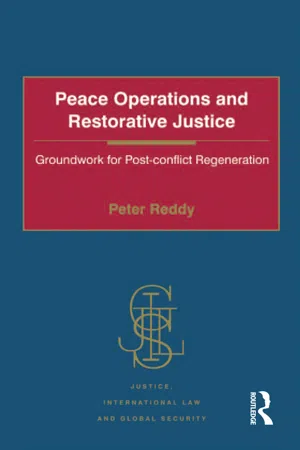
eBook - ePub
Peace Operations and Restorative Justice
Groundwork for Post-conflict Regeneration
- 264 pages
- English
- ePUB (mobile friendly)
- Available on iOS & Android
eBook - ePub
About this book
With a bold vision and a distinctive message, Reddy stipulates that international peacekeeping can be designed and implemented using the principles of restorative justice. To prove this, Reddy discusses the congruence of crime, armed conflict and violent disorder, critiquing restorative justice and its nuanced character as a suitable application to complex civil wars. This book provides a comprehensive survey of peace operations and then focuses on the cases of Somalia and Bougainville. The comparison between their societal contexts, their conflicts, peace operations and final outcomes are crucial to this argument. Furthermore, this shows how the constraining, maximising and emergent values of restorative justice can be applied in a peacekeeping setting, from the overall command level through to the behaviours of deployed peacekeepers - with direct contemporary application. This sharp study makes for evocative reading as it introduces the new concept of regeneration as key to any restoratively arranged peace operation. Military, police, NGO and civilian peacekeeper practitioners, as well as academic theorists, can use this unique work to produce better and more lasting results for conflict ridden communities.
Information
Chapter 1 Introduction
DOI: 10.4324/9781315599830-1
The Setting
Most armed conflicts today are civil wars. It has become the norm that these violent contests are unconventional and asymmetric (Manwaring 2001 and 2004). Many have significant effects on the international community and there is a substantial body of scholarly opinion that asserts that success with civil war peace agreements is underpinned by third party supervision (Hartzell 1999:16). Despite this, third party involvement, generally in the form of peacekeeping, is arguably often too limited in its goals and too narrow in its operational focus (Doyle and Sambanis 2000).
This book is a contribution to the discussion about the way peace operations can be carried out. A great deal of the data comes via eye witness accounts from peacekeepers, militia fighters and elite and ordinary people embroiled in the conflicts in Somalia and Bougainville.1 Many of these are quoted. The primary aim is to outline a conceptual framework that problematizes force of arms as the archetype for peacekeeping, and marries that perspective with an alternative informed by: greater recognition of the importance of diverse stakeholders, increased consideration of the plural causation – and plural kinds of damage – caused by civil war, and a longer term perspective on what peace operations are attempting to achieve. That alternative draws on a particular approach to conflict known as restorative justice.
To do this, the question posed throughout the book is: Can a restorative justice paradigm be applied successfully to the design and implementation of peace operations? Two case studies – Somalia and Bougainville – provide the prism through which this question is examined.
In the 1990s the ratio of civil to international wars was 5 to 1 (Long and Brecke 2003:5). The contemporary context of civil violence and international peacekeeping is that while the number of armed conflicts has declined by more than 40 percent since the early 1990s, there are about 18 major conflicts2 underway, and 24 smaller conflicts in progress (Mack 2005). At the close of 2011 around 16 United Nations peacekeeping operations and 7 regional coalition military intervention missions are deployed around the world. The UN has often been second only to the USA in terms of the international deployment of troop numbers, and currently peacekeepers total about 121,780 from over 100 countires. With a peacekeeping budget of some $7 billion this is a significant investment in attempting to bring a serious measure of peace and stability to warring populations and the international community (UN 2011).
For a variety of reasons many peace operations have failed. Herbst (1996:39) has remarked that ‘the how of intervention is often ignored in the search for grand rules about when to intervene’. Sometimes fatalism paralyses the will to act and thereby stifles possible creative approaches to conflict (Ury 1999:xvii). While there is general international agreement about the right, and often on the necessity, of the international community to intervene on behalf of vulnerable populations (Wills 2004:388), there has been little systematic attention applied ‘to what the intervening armed forces are actually supposed to do, and also what the eventual results of such interventions are supposed to be’ (A. Roberts in Wills 2004:388).
There have been some genuine attempts at improving the efficacy of UN peace operations since the early 1990s. Of the 38 proposals (Warner 1995:200–204) for improving the UN response to peace and security threats suggested by international bureaucrats, experienced peacekeepers and academics at the 1994 colloquium on ‘New Dimensions of Peacekeeping’ held in Geneva, only nine could be said to be concerned with solving or ameliorating the causes of, and harms caused by, any given conflict. Six of these suggestions were concerned with legal considerations, nine had a solely military focus and the remaining 14, nearly half the recommendations, focussed on the structure and organic processes of the UN itself. Nederveen Pieterse (1997:89) reckons that policy makers and military leaders lump their criticisms and needs together under the headings of lack of resources and inadequate control capacity, compelled by a mismatch between mandates and the resources required to carry them out.
New conflicts emerge often enough. In this context, experienced peacekeeping contributors and novices grapple with changing technologies and geo-political developments, and adjust as best they can. As does the UN. Yet these changes in the evolution of peace operations have not been matched by different and evolving scholarly analysis (Diehl, Druckman and Wall 1998:34). Pearson (2001:282) takes this further saying that the lacuna in theoretical development has resulted in a failure to compare outcomes of pre-dispute and crisis management approaches, and that policymakers therefore know little about ‘what works’ in specific types of circumstances.3
Conceptualizing peacekeeping and its variations is not a dominant theme of the available literature. In fact it can be said that there is a distinct paucity of theoretical frameworks available for description and analysis (Diehl, Druckman and Wall 1998:34).4 In the analyses that have been carried out, Fetherston (1995:3) writes, there is a prominent absence of ‘issues of transformation which go far beyond short-sighted arrangements for re-establishing political authority and [then] look to base activity in war zones on the needs of the people who live there’.
She argues further that despite peacekeeping’s ‘accidental provenance’, now that it is a valid and accepted part of the way humanity and the international community respond to the crisis of civil war, we should work purposively to strengthen it, and not allow it to develop by chance (Fetherston 1994:14). Such a conspicuous need exists because, for all the uncertainty of war, we know more about what constitutes ‘good practice’ in waging war than about what makes for ‘good practice’ in peacekeeping (Burk 2000:467). This book is an acknowledgement of the importance of peace operations and is based on systematic analysis, a critique of textual and interview data, and a willingness to consider more innovative arguments.
It has become a somewhat hackneyed assertion that ‘Peacekeeping is not a job for soldiers, but only a soldier can do it’ (Hammarskjöld quoted in Homza 2004:91, and in Pope 1994). This assumption and other common sense axioms about peacekeeping are questioned throughout this work. The structure is a comparative approach to both the Somalia and Bougainville operations. The uniqueness of the two individual cases means that there will be dynamics and attributes unique to each but importantly the commonalities are also drawn on to illustrate why they are useful examples.
Synopsis
No simple formula can take care of the origin of, and solution to, all wars. In any case, ‘it is impossible to judge every war in terms of criminal aggression and legitimate self-defense’ (Shklar 1964:178). Chapter 2 offers a description and analysis of a range of processes that have been developed to address human conflict, including violent armed contests. The relevance of petty and major criminal activities to contemporary civil wars is illustrated and responses such as negotiation, mediation and the practice of community justice are scrutinized. Restorative justice, the paradigm that this book explores as an alternative, and some criticisms of it, are also presented. From this perspective, it will be seen, the stakeholders to conflict, and this includes their communities, are given primacy. The concluding observation is that, as restorative justice has subsumed a variety of practices in responding to conflict, then, what precludes its application to peace operations and the violence that has spurred those interventions?
The restorative justice approach is very much a ‘grass-roots’ oriented one. There is a common tendency on the part of powerful interests to dismiss the potential of community based, ‘bottom up’ conflict resolution. Kaldor (1999:122) quotes David Owen, a negotiator in the former Yugoslavia as saying ‘citizens can’t make peace’. This is a narrowly conceived, yet recurrent, theme that courses through most conventional methods of dealing with civil war.
Military dominated interventions are the most common form of peacekeeping – Hammarskjöld’s statement above having become axiomatic. Because of this it is necessary, before debating the case studies and eliciting other possibilities, to examine how militaries design and go about their work. Chapter 3 deals with definitions of peace, as the condition aimed at, and military doctrines and operational strategies, as one way of going about that quest, and how the international community and its delegates – that is, the peace forces deployed – view the aims of peace operations. Definitional issues and the major reviews of peacekeeping, with specific discussion on rules of engagement (i.e. the regulation of the use of force), are analysed. Importantly, the issue of remoteness of purely military skills as opposed to more people-oriented relational or contact skills – much needed in these operations – is introduced.
There is a growing recognition of how crucial the skills of peacekeepers are. The values frameworks and practical skills employed by most peacekeepers in Somalia fit clearly within the perspective adhered to by one former Australian peacekeeper:
Infantry soldiers can only be deployed to establish the start point for restorative processes. They’re not trained for anything else. (Fieldwork notes, Sydney, August 2004)
The civil war in Somalia, a humanitarian crisis of enormous scale, and the international attempts to render effective succour are analysed in chapter 4. The background to the civil war and its multifarious causes are highlighted. The erosion of social control mechanisms, the local efforts to re-establish peace, and the wider Somali culture, it is argued, were seriously misunderstood, and this had manifold negative consequences for the chances of successful peacekeeping and peacebuilding. Among others, Hassan (1994:69) was urging during the intervention that Somali peacemaking must come from local people with benevolent intent and that it was ‘up to the world community to nurture signs of goodwill with encouragement and guidance’. This course was in effect largely omitted from consideration. The specific operations, UNOSOM I, UNITAF and UNOSOM II are analysed in detail and this is followed by an alternative critique, where the possibility of a different – a more restorative – option is applied.
Although the Somalia case is a clear example of what can happen when a predominantly military ‘use of force’ mind set is employed, not all peace operations are conducted with such a focus on coercion. According to Elliott and Cheeseman (2002:50), it is arguable that there are beginning to emerge substantial changes and adaptations by armies engaged more and more in peace operations, so that we have begun to see, in some real sense, the development of ‘cosmopolitan-minded militaries’. This positive re-orientation was demonstrated clearly in the way the peace force went about its work in Bougainville.
The causes of the civil war in Bougainville begin the analysis that is chapter 5. This precedes a description of how the multinational, regional peace force was formed and deployed, with a unique combination of women and men, soldiers and civilians, and different nationalities making up the patrol groups of this positively regarded peace force. It will be shown that pre-deployment cultural and linguistic training, combined with a long-term commitment tailored to supporting the local peace vectors of religion, women and elders (Navoko Lui 2001:133), proved to be one of the keys to Bougainville finding what appears to be lasting peace.
Drawing on these characteristics and then applying restorative justice theory will establish that this was a conflict, and a peace operation, that was more than amenable to the restorative construct. It emphasizes that, not only can the peacemaker come from anywhere, even from within the combatants, but that this needs to be anticipated, and then engaged with, by the peace force. Such opportunities were presented in Somalia, but were only occasionally exploited.
The two case studies expose vastly divergent bearings and responses. Chapter 6 illustrates that the origins of conflict were poorly understood in Somalia but comprehensively studied and engaged with for Bougainville. This is significant, and Genest (1996:2) writes that ‘the specific details of a crisis lose their meaning if we do not know what led up to the event and what happened’. The specific events within any conflict, if unresolved, are often the cause of lingering disputation and violence. Like both Somalia and Bougainville, all contemporary civil wars are complex and therefore require not simple, but complex, responses.
The variations between international perspectives on both conflicts are discussed, as are the preceding negotiations, the UN positions on each conflict and the need for intervention. The character of the conduct of both operations is contrasted, and finally, the outcomes of each and the current societal and national situation in both countries are explored. These outcomes, it is contended, are a direct result of the ways the peace operations, and specifically their capacity to directly affect reconciliation and societal regeneration, have played out. A more restoratively based design and implementation, it is concluded, could have led to a more solidly founded peace process in Somalia, as occurred in Bougainville.
A framework for resto...
Table of contents
- Cover Page
- Half Title Page
- Series Page
- Title Page
- Copyright Page
- Table of Contents
- List of Tables and Figure
- Abbreviations
- Preface
- 1 Introduction
- 2 Responding to Conflict
- 3 Peace, Military Doctrine and Peace Operations
- 4 Somalia: Collapsed State, Complexity and Muddled Rescue
- 5 Bougainville: From Crisis to Concord
- 6 A Comparative Analysis
- 7 A Restorative Architecture for Peace Operations
- 8 Conclusion
- References
- Index
Trusted by 375,005 students
Access to over 1.5 million titles for a fair monthly price.
Study more efficiently using our study tools.
Frequently asked questions
Yes, you can cancel anytime from the Subscription tab in your account settings on the Perlego website. Your subscription will stay active until the end of your current billing period. Learn how to cancel your subscription
No, books cannot be downloaded as external files, such as PDFs, for use outside of Perlego. However, you can download books within the Perlego app for offline reading on mobile or tablet. Learn how to download books offline
Perlego offers two plans: Essential and Complete
- Essential is ideal for learners and professionals who enjoy exploring a wide range of subjects. Access the Essential Library with 800,000+ trusted titles and best-sellers across business, personal growth, and the humanities. Includes unlimited reading time and Standard Read Aloud voice.
- Complete: Perfect for advanced learners and researchers needing full, unrestricted access. Unlock 1.5M+ books across hundreds of subjects, including academic and specialized titles. The Complete Plan also includes advanced features like Premium Read Aloud and Research Assistant.
We are an online textbook subscription service, where you can get access to an entire online library for less than the price of a single book per month. With over 1.5 million books across 990+ topics, we’ve got you covered! Learn about our mission
Look out for the read-aloud symbol on your next book to see if you can listen to it. The read-aloud tool reads text aloud for you, highlighting the text as it is being read. You can pause it, speed it up and slow it down. Learn more about Read Aloud
Yes! You can use the Perlego app on both iOS and Android devices to read anytime, anywhere — even offline. Perfect for commutes or when you’re on the go.
Please note we cannot support devices running on iOS 13 and Android 7 or earlier. Learn more about using the app
Please note we cannot support devices running on iOS 13 and Android 7 or earlier. Learn more about using the app
Yes, you can access Peace Operations and Restorative Justice by Peter Reddy in PDF and/or ePUB format, as well as other popular books in Politica e relazioni internazionali & Pace e sviluppo globale. We have over 1.5 million books available in our catalogue for you to explore.