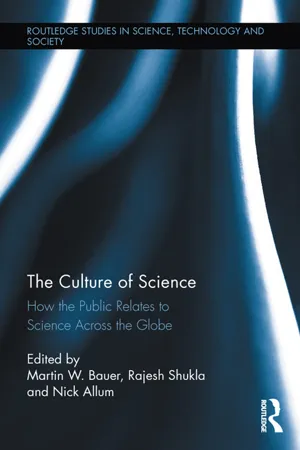
This book offers the first comparative account of the changes and stabilities of public perceptions of science within the US, France, China, Japan, and across Europe over the past few decades. The contributors address the influence of cultural factors; the question of science and religion and its influence on particular developments (e.g. stem cell research); and the demarcation of science from non-science as well as issues including the 'incommensurability' versus 'cognitive polyphasia' and the cognitive (in)tolerance of different systems of knowledge.
eBook - ePub
The Culture of Science
How the Public Relates to Science Across the Globe
- 472 pages
- English
- ePUB (mobile friendly)
- Available on iOS & Android
eBook - ePub
The Culture of Science
How the Public Relates to Science Across the Globe
1 Towards Cultural Indicators of Science with Global Validity
On November 5–6, 2007, a group of researchers met in the august halls of London’s Royal Society to discuss recent developments on ‘International Indicators of Science and the Public’. Participants arrived from twenty-one countries covering all five continents, a fact that our sponsors at the Royal Society noted with satisfaction.1 Ian Pearson, then Minister for Science & Innovation, presented his new and short-lived vision for ‘Science in Society’. Proceedings were interrupted when Queen Elizabeth II passed in full estate en route to opening the Houses of Parliament, providing fitting symbolism for the academic deliberations of which we here present the outcome.
The purpose of the meeting was to take stock of survey research on public understanding of science (PUS), i.e. measures of science literacy, interest, attitudes, and public engagement with science, and to initiate step-changes for future research.
In research on public understanding of science, large-scale national surveys have built a global momentum since the 1970s. The time has come to take a fresh look at this material and its conceptualisation to invigorate the research effort. In hindsight, the motto of the workshop might well have been ‘Working better with what has been achieved and developing it further’.2 Some of us have been involved for some time in calling for activities such as reassessing survey-based PUS research in handbook and review papers, not least with a view to opening the agenda to cultural indicators of science (Bauer, Allum & Miller, 2007; Bauer, 2008; Allum, 2010).
We question the phenomenon under study, most generally considered the ‘great societal conversation about science’. From a comparative perspective, this societal conversation fluctuates in intensity, topics covered, engagement of the population, and focus on controversies. It is influenced by the cultural context of language, political culture, local history of science, and current levels of technological development. Societal conversation implies more than opinions expressed in survey interviews. It encompasses writings in print and news media, exhibitions, stakeholder consultations, science policy documents, informal and formal learning by young and old, to name but some. The workshop explored how to compare this societal conversation across context and time. Ultimately, what is at stake is a dynamic process.
Nationally representative surveys are highly developed techniques of societal self-observation, but insufficient to map societal conversations. Complementary data streams are needed to understand the symbolic environment of a typical survey respondent and surrounding scientific culture. After all, a respondent will answer questions on the basis of his or her internal (cognitive and emotional) and external resources (the semiotic environment). Questionnaires return standard answers, but do not tell us how to interpret these in different contexts. The need to contextualise survey research raised the double agenda of this meeting:
• How to improve survey research, the perception indicators of science;
• How to mobilise complementary data streams: indicators of performance and societal communication of science.
Jointly, the subjective indicators of perceptions and objective indicators of activities can map the societal conversation, ultimately bringing forth the scientific culture of a nation. The present book is the outcome of these proceedings of 2007 at the Royal Society, revised and elaborated in the light of discussions. It comprises twenty-six chapters grouped into five parts.
Introducing the problem, Benoît Godin (Montreal) offers a glance at the history of ideas of cultural indicators of science. We are encouraged by the fact that this idea harks back to earlier UNESCO initiatives of the 1950s, which were displaced by the quest for economic indicators of science and technology. The time is ripe to return to cultural indicators in a globalising world distancing itself from a ‘one best way’ of doing things. The idea of cultural indicators starts from the intuition that there is no strong correlation between cultural richness and economic prowess, and that one might be a lever of the other. The remainder of the book is divided into five parts, four presenting step-changes in survey-based indicator research. The fifth demonstrates the deployment of complementary data streams and argues for new conceptual developments.
PART I: LONGITUDINAL ANALYSIS
In many world regions, surveys of PUS have been conducted for some time. It is now time to consolidate existing data and assess changes and stabilities over time. Because it is the primary data of many researchers in PUS, some considering it the ‘gold standard’ of social research, we dedicate much space to survey data streams. The research infrastructure has made considerable progress in recent years, and data consolidation has been achieved by teams in several regions. Here is a list of databases comprising micro-integrated data for longitudinal and comparative research:
• France (1972, 1982, 1989, 1992, 2001, 2007; see Boy);
• US (1979–2006, biannually; N ∼20000; see Losh);
• EU12 (1989, 1992, 2001, 2005, N ∼ 50,000; see Bauer & Shukla);
• India (2001, 2004, 2007, N ∼ 50,000; see Shukla & Raza);
• India-EU (integrated India04 and EU05; N∼60,000, see Shukla & Bauer);
• China-EU (integrated China-Hefei 2007 and EU05; see Liu & Bauer);
• Bulgaria-UK (1992, 1996, 2005), N ∼ 4000; see Petkova & Todorov);
• US-EU (The literacy database, see J Miller);
• ROSE (database of 15-year-olds in 40 countries, see Sjøeberg & Schreiner).
This progress means that in at least eighteen countries we are now in a position to conduct systematic longitudinal and comparative research, analysing trends in adult science literacy and public attitudes to science over two decades. The workshop further documented, shown in Table 1.1 (see Appendix 1), similar nationally representative surveys in many other contexts that have comparable elements and where micro-integration of data will bring a step-change in the analysis of material on a global scale. In all of these global contexts, it will require effort and political-academic enthusiasm to recover data files, document the data, and systematically integrate files for analysis. However, the benefits of such an undertaking are considerable: teams can move from reporting headline figures for news making to quasi-cohort and trend analysis, and to explore in their respective contexts how these indicators are useful and how they are moving.
The first part of this book documents in six chapters the progress in longitudinal analysis with data from France, US, Bulgaria, the UK, Japan, China, and across the old Europe of EU12. A common feature of these chapters is the focus on generational analysis using age cohorts rather than the age variable. This allows us to compare trends in public understanding of science along two lines: across time period and across generation. We expect that different generations move differently through time because their experiential formation is different.
Daniel Boy (Paris) presents an analysis of France from 1972 to 2007 and maps increasing ambivalence of the French public towards science and technology, showing the complex interaction between period and generational groups. Susan Losh (Florida) presents her work on the integrated NSF science indicators database, and traces changes in literacy and para-scientific beliefs through time and across generational groups. Christina Petkova and Valery Todorov (Sofia) compare Bulgarian and UK cohorts over the years 1992 and 2005, providing evidence for surprising similarities and differences between contexts that are historically so very different. In that period, Bulgaria was awakening from Stalinist hibernation. It demonstrates how such comparisons constitute explananda that call for cultural-historical insights to come to terms with them. A similar exercise is presented by Martin Bauer’s (London) first analysis of the EU12 database, which spans the years 1989 to 2005 and four waves of multinational surveys. Patterns of change and stability of indicators over time and across cohorts provide evidence for the post-industrial model: the polemical deficit model according to which knowledge drives positive attitudes to science is at best a special case, to be historically defined. Kinya Shimizu and Takuya Matsuura (Hiroshima) offer a trend analysis of Japanese adult literacy from 1991 to 2001. Their detailed analysis assesses the extent to which each question item is suitable for this comparison, present an overall score based on items response theory (IRT), and examine this score in relation to various predictor variables including generational groups. The last chapter in this part is the contribution by Ke Wang and colleagues (Beijing), who describe efforts to survey the science literacy of China since the early 1990s. They compare two versions of a literacy index and its diagnostic powers for purposes of conducting comparisons within China.
PART II: CROSS-NATIONAL COMPARISONS
Examples of horizontal data integration and analysis are presented in the second part. Four chapters offer cross-national comparisons on a number of indices. Xuan Liu and colleagues (Hefei and London) analyse a newly integrated database of a large-scale regional Chinese survey of 2007 and the 2005 Eurobarometer survey. They document difficulties of micro-integration of data with items that are semantically equivalent but do not have the exact-same format, and arising informative comparisons. The analysis suggests a typology of public understandings of science profiled on literacy, interests, engagement and attitudes to science, cognitive tolerance for para-science, age, sex, education, and urban and rural life. Distributions of these types of PUS are very different across populations of China and EU27. Carmelo Polino and Yurij Castelfranchi (Buenos Aires and Belo Horizonte) report on recent efforts to coordinate PUS surveys across Latin America and offer comparisons of seven urban environments. The core is a ‘science & technology information index’ modelled for the different contexts. Another example of index construction is offered by Rajesh Shukla (Delhi) and Martin Bauer (London) who have integrated data for India 2004 and EU 2005. They construct and validate a composite science culture index comprising state-level STS data (GDP per capita, R&D, etc.) and individual-level PUS measures (knowledge, interest, attitudes, engagement) for twenty-three Indian states and thirty-two European national units. On this index all units can be ordered and profiled in terms of objective and subjective science culture, creating a score that can offer politically useful information comparable to the UN’s Human Development Index (HDI). Finally, Svein Sjøeberg and Camilla Schreiner (Oslo) present an analysis of the forty country ROSE database, which collects data on attitudes to science among adolescents aged 15. Comparing these countries and in particular looking at the persistent gap between girls and boys on several indicators, they find strong correlations between PUS indicators and the human development index (HDI). The ROSE effort contrasts with the OECD’s PISA measures of educational achievement, which in 2006 focused on science literacy. PISA does not consider youth’s attitudes to science as part of its remit.
PART III: MEASUREMENT ISSUES AND THE SOPHISTICATION OF INDEX CONSTRUCTIONS
Workshop discussion also focused on measurement issues and how PUS survey data might grow in sophistication. Existing questionnaire items on literacy, interest, attitudes, and engagement with science afford further examination to determine their value for the construction of indicators for global comparison. Are items diagnostic of differences between populations? Much of this part focuses on standard literacy or knowledge items, sometimes erroneously called the ‘OXFORD scale’ because a team of Oxford researchers used them, but most of these items are older than the 1988 UK study. The literacy items are textbook type items; in most cases a correct or incorrect answer can be determined on good authority, but this authority is not uncontroversial.
The question was raised whether these literacy or knowledge items are useful for assessing people’s understanding of science at all. For example recent Latin American efforts do not include literacy items because they are considered culturally biased and unable to pick up locally relevant practical knowledge (see Polino & Castelfranchi). Many items taken out of context have led to strange usage in public discourse on a country’s ‘deficient public’, which most researchers who do not want to be held hostage to fortune will want to avoid. An older argument stipulates that literacy items measure little other than level of formal education and are therefore redundant (Boy in France). By contrast most efforts in Far Eastern countries, such as Japan and China, focus on literacy, and the issue of public attitudes to science is approached wi...
Table of contents
- Cover
- Halftitle
- Title
- Copyright
- Contents
- List of Figures
- List of Tables
- Acknowledgments
- 1. Towards Cultural Indicators of Science with Global Validity
- 2. The Culture of Science and the Politics of Numbers
- PART I. Longitudinal Analysis
- PART II. Cross-National Comparisons
- PART III. Measurement Issues
- PART IV. Cultural Aspects of Sensitive Topics
- PART V. Complementary Data Streams
- Contributors
- Index
Trusted by 375,005 students
Access to over 1.5 million titles for a fair monthly price.
Study more efficiently using our study tools.
Frequently asked questions
Yes, you can cancel anytime from the Subscription tab in your account settings on the Perlego website. Your subscription will stay active until the end of your current billing period. Learn how to cancel your subscription
No, books cannot be downloaded as external files, such as PDFs, for use outside of Perlego. However, you can download books within the Perlego app for offline reading on mobile or tablet. Learn how to download books offline
Perlego offers two plans: Essential and Complete
- Essential is ideal for learners and professionals who enjoy exploring a wide range of subjects. Access the Essential Library with 800,000+ trusted titles and best-sellers across business, personal growth, and the humanities. Includes unlimited reading time and Standard Read Aloud voice.
- Complete: Perfect for advanced learners and researchers needing full, unrestricted access. Unlock 1.5M+ books across hundreds of subjects, including academic and specialized titles. The Complete Plan also includes advanced features like Premium Read Aloud and Research Assistant.
We are an online textbook subscription service, where you can get access to an entire online library for less than the price of a single book per month. With over 1.5 million books across 990+ topics, we’ve got you covered! Learn about our mission
Look out for the read-aloud symbol on your next book to see if you can listen to it. The read-aloud tool reads text aloud for you, highlighting the text as it is being read. You can pause it, speed it up and slow it down. Learn more about Read Aloud
Yes! You can use the Perlego app on both iOS and Android devices to read anytime, anywhere — even offline. Perfect for commutes or when you’re on the go.
Please note we cannot support devices running on iOS 13 and Android 7 or earlier. Learn more about using the app
Please note we cannot support devices running on iOS 13 and Android 7 or earlier. Learn more about using the app
Yes, you can access The Culture of Science by Martin W. Bauer,Rajesh Shukla,Nick Allum in PDF and/or ePUB format, as well as other popular books in History & Science History. We have over 1.5 million books available in our catalogue for you to explore.