
- 216 pages
- English
- ePUB (mobile friendly)
- Available on iOS & Android
eBook - ePub
Rosa Luxemburg and the Critique of Political Economy
About this book
This book analyzes the important contributions of Rosa Luxemburg to economic theory as well as devoting some space to her background as a left social-democratic politician and her personality.
The book's main focus of attention is the theory of capitalist development and the theory of the crash, but its connection with the theory of value, the theory of the monetary circuit, the theory of distribution and the theory of international finance are also explored.
The contributors to the volume come from different theoretical perspectives, both from within and outside the Marxian tradition - Post-Keynesians, Kaleckians and Circuitists are all included.
Frequently asked questions
Yes, you can cancel anytime from the Subscription tab in your account settings on the Perlego website. Your subscription will stay active until the end of your current billing period. Learn how to cancel your subscription.
No, books cannot be downloaded as external files, such as PDFs, for use outside of Perlego. However, you can download books within the Perlego app for offline reading on mobile or tablet. Learn more here.
Perlego offers two plans: Essential and Complete
- Essential is ideal for learners and professionals who enjoy exploring a wide range of subjects. Access the Essential Library with 800,000+ trusted titles and best-sellers across business, personal growth, and the humanities. Includes unlimited reading time and Standard Read Aloud voice.
- Complete: Perfect for advanced learners and researchers needing full, unrestricted access. Unlock 1.4M+ books across hundreds of subjects, including academic and specialized titles. The Complete Plan also includes advanced features like Premium Read Aloud and Research Assistant.
We are an online textbook subscription service, where you can get access to an entire online library for less than the price of a single book per month. With over 1 million books across 1000+ topics, weâve got you covered! Learn more here.
Look out for the read-aloud symbol on your next book to see if you can listen to it. The read-aloud tool reads text aloud for you, highlighting the text as it is being read. You can pause it, speed it up and slow it down. Learn more here.
Yes! You can use the Perlego app on both iOS or Android devices to read anytime, anywhere â even offline. Perfect for commutes or when youâre on the go.
Please note we cannot support devices running on iOS 13 and Android 7 or earlier. Learn more about using the app.
Yes, you can access Rosa Luxemburg and the Critique of Political Economy by Riccardo Bellofiore in PDF and/or ePUB format, as well as other popular books in Business & Business General. We have over one million books available in our catalogue for you to explore.
Information
1
Rosa Luxemburgâs critique of Marxâs schemes of reproduction
A re-evaluation and a possible generalization
Meghnad Desai and Roberto Veneziani
Introduction
Rosa Luxemburgâs immanent critique of Karl Marxâs accumulation schemes is well known. In her book The Accumulation of Capital (1913), she not only gave an account of the rather spirited, but confused, debate that broke out among the European Marxists on the publication of Volume 2 of Capitalâespecially the last chapter on the scheme of expanded reproductionâbut she offered her own cogent critique and proposed a solution (Luxemburg, 1913; see also Desai, 1979: Chapter 15). Marxâs scheme appeared to offer a model of capitalist accumulation that guaranteed perpetual growth at a steady rate for both sectors (departments) and, indeed, has been characterized as the fastest converging two-sector balanced growth model by Morishima (Morishima, 1973: Chapter 10; see also Morishima, 1958). Marxâs model seemed to go against the vision of a permanently cyclical course for capitalist accumulation outlined in Part VII, Volume 1, of Capital. There were other inconsistencies between the two volumesâ portrayal of capitalist accumulation. In the scheme for expanded reproduction (SER) (i) there is no technical progress and hence the value per unit of physical output in both departments and the organic composition of capital are constants; (ii) the profit rate is computed in value terms rather than in money terms and differs between the two sectors; and (iii) the profit rate in each sector is constant and does not decline. Also. in terms of Volume 2 itself, while Part I laid out the three circuits of capital in terms of value, money and physical quantities, the SER is only in value terms. Prices and money play no role in the SER.
The SER generated a long debate. Was it a scheme for abstract study of how gross and net output are reconciled at the aggregate level, hence a pioneering exercise in national income accounting, or was it a realistic picture of how it was possible for a capitalist economy to grow? Was it a scheme for planning, as later proved useful in Felâdmanâs model for the Soviet Economyâs First Five Year Plan, or did it lay down conditions that made it impossible for a capitalist economy ever to achieve balanced growth if it relied on uncoordinated accumulation plans, as opposed to the accommodative behaviour postulated in the SER?1
Rosa Luxemburg criticized Marxâs model as inconsistent within its own logic, since the realization problem is not squarely faced but solved, as it were, by a sleight of hand. The limits to the supply of labour power are assumed away. Since each department does not have ready demand for its output before it can plan accumulation, where, she cogently asked, does each department get the money to place the order for the extra machines that dissolve the problem?
Where does the money come from? This question is loaded with dynamite. Marx had not tackled the circuit of money capital in the SER. Thus, the exchange of goods between the two departments seemed to occur outside the exchange nexus, in a gigantic book-keeping exercise for all capital...
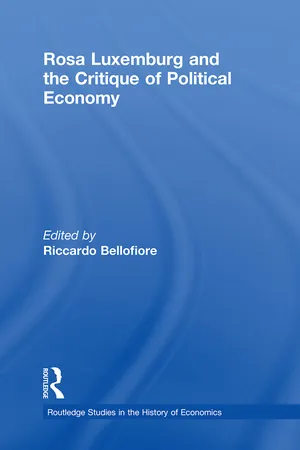
Table of contents
- Routledge Studies in the History of Economics
- Contents
- Contributors
- Acknowledgements
- General introduction
- 1 Rosa Luxemburgâs critique of Marxâs schemes of reproduction
- 2 Where does the money and demand come from?
- 3 The monetary circuit of capital in the Anti-Critique
- 4 Late Marx and Luxemburg
- 5 Rosa Luxemburg and finance
- 6 Economics, politics and crisis theory
- 7 Luxemburgâs and Kaleckiâs theories and visions of capitalist dynamics
- 8 Imperialism today
- 9 Rosa Luxemburg on imperialism
- 10 Rosa Luxemburgâs The Accumulation of Capital
- 11 A very political political economist
- 12 Rosa Luxemburg on trade unions and the party*
- 13 Rosa Luxemburg
- Index