US Democracy Promotion in the Middle East
eBook - ePub

US Democracy Promotion in the Middle East

The Pursuit of Hegemony

  1. 192 pages
  2. English
  3. ePUB (mobile friendly)
  4. Available on iOS & Android
eBook - ePub

US Democracy Promotion in the Middle East

The Pursuit of Hegemony

About this book

US Democracy Promotion in the Middle East seeks to explore the changes in US strategy towards democracy promotion in the Middle East during the Clinton and Bush administrations, with a particular focus on Egypt, Iraq and Kuwait.

At a time of regional turmoil and political reform, the topic of democracy promotion has never been more pertinent. We are witnessing the emergence of popular movements that are challenging authoritarian governments long supported by the US. Tracing the contours of the ongoing transition in US policy in the Middle East, this book critically deconstructs the strategy of democracy promotion on both a theoretical and empirical level. By formulating and applying an analytical framework derived from a Gramscian approach, Markakis seeks to propose a re-evaluation of what US foreign policy in the Middle East truly constitutes, critiquing both the ideological foundations of the strategy as well as the implementation.

This book will provide a solid foundation for the analysis of US policy and in particular the strategy of democracy promotion at this time of momentous transition across the region.

Trusted by 375,005 students

Access to over 1.5 million titles for a fair monthly price.

Study more efficiently using our study tools.

Information

1 The analytical framework A neo-Gramscian approach

DOI: 10.4324/9781315852546-2
In all societies … two classes of people appear – a class that rules and a class that is ruled … The first class, always the less numerous, performs all political functions, monopolizes power and enjoys the advantages that power brings, whereas the second, the more numerous class, is directed and controlled by the first, in a manner that is more or less legal, now more or less arbitrary and violent.1
Theories of social morality are always the product of a dominant group which identifies itself with the community as a whole, and which possesses facilities denied to subordinate groups or individuals for imposing its view of life on the community. Theories of international morality are, for the same reason and in virtue of the same process, the product of dominant nations or groups of nations.2

Introduction

The Gramscian approach to international relations provides a valuable critical perspective with which to analyse US democracy promotion in the Middle East. Its origins lie in the scholarship of Robert Cox, who innovatively applied Antonio Gramsci's theoretical insights, which primarily addressed the domestic sphere, to the field of international relations in the early 1980s.3 A number of scholars have since contributed to this approach, a loose collective termed the ‘neo-Gramscian’ school; they include Stephen Gill, Kees Van Der Pijl and William Robinson amongst others.4 The value of the neo-Gramscian approach lies in the fact that it transcends many of the traditional assumptions and debates within international relations (IR) theory. While acknowledging the state as a valid unit of analysis, neo-Gramscian scholars do not position it as exclusive, thus counteracting the reification of the state prevalent in much of the literature, especially that of a realist persuasion. Likewise they reject reductionist, structuralist explanations of the international system. Utilising a historicist perspective, the neo-Gramscian approach analyses international relations by examining both the domestic and international levels, and accounting for political, economic, ethical and ideological variables and their mutual interactions.5 This allows for a depth and richness of analysis that the traditional theoretical approaches, such as realism or liberalism, simply do not provide. As Gill observes: ‘in international studies the Gramscian approach is an epistemological and ontological critique of the empiricism and positivism which underpin the prevailing theorisations’.6 This holistic approach has also allowed neo-Gramscian theory to largely avoid criticisms of economic determinism, so often levelled at Marxist-derived perspectives.
This chapter outlines an analytical framework, adapted from Gramscian theory, which will be used to examine US democracy promotion in the Middle East, and the case studies of Egypt, Iraq and Kuwait. First the chapter analyses the concept of hegemony, which is central to this study. It then examines the role assumed by ideology in the hegemonic process, and what the term ‘democracy’ actually means in the context of US foreign policy. The chapter then discusses how the achievement of hegemony is rooted in civil society and its institutions. Finally it explores the process of hegemony in terms of the Middle East, highlighting the challenges faced by the strategy of democracy promotion from counter-hegemonic forces under the banner of political Islam.

The analytical framework: a neo-Gramscian Approach

The concept of hegemony

Integral to any Gramscian analysis of US foreign policy, the concept of hegemony underpins this study. Gramsci himself provided a broad definition of hegemony, describing it as ‘the “spontaneous” consent given by the great masses of the population to the general direction imposed on social life by the dominant fundamental group’.7 He attributed this consent to the ‘prestige (and consequent confidence) which the dominant group enjoys because of its position and function in the world of production’.8 The concept of hegemony rests on the assumption that:
within a stable social order, there must be a substratum of agreement so powerful that it can counteract the division and disruptive forces arising from conflicting interests … that is, on the values, norms, perceptions and beliefs that support and define the structures of central authority.9
In contrast to realist theory, which broadly views hegemony as the leadership or dominance of one state over others, Gramscian theory offers a more complex, nuanced interpretation.10 This is achieved by distinguishing between coercive and consensual mechanisms of social control. In the context of the Middle East, it is possible to differentiate between contemporary authoritarian Arab states, which are heavily reliant on coercion, and the elite-based democracies the US seeks to eventually encourage in the region, which are based on more consensual forms of governance. The latter is a feature of the institutionalisation which characterises contemporary liberal democratic systems, which provides the means, in the context of forums, practices and procedures, for managing or resolving conflicts, as for example through periodic elections. It is important to note that democracies do utilise coercive force, but as a secondary measure, deployed in the absence of successful hegemonic practices. Gramsci referred to this as ‘hegemony protected by the armour of coercion’.11
The attainment of hegemony is dependent on the active consent of the governed, and their internalisation of the promoted ideology as logical or natural. As Robinson argues:
A Gramscian hegemony involves the internalization on the part of subordinate classes of the moral and cultural values, the codes of practical conduct, and the worldview of the dominant classes or groups – in sum, the internalization of the social logic of the system of domination itself.12
This occurs when elite groups ‘articulate a social vision which claims to serve the interests of all’, using incentives to mobilise support from subordinate groups, as well as preclude any opposition.13 It is achieved ultimately when the promoted ideology is voluntarily assimilated by society itself. It is worth noting that Gramsci perceived hegemony as fluctuating: from strong hegemony, which incorporates a high level of social integration and direct consensus between elites and masses, as for example in the US or the United Kingdom (UK), through to weak hegemony, which is characterised by a high level of elite integration, but with little incorporation of the masses, as for example in Greece or Pakistan.14 This is particularly relevant to the Middle East, given the nascent state of democratisation there.

The ideology of liberal democracy

The essence of hegemony lies in the ideology promoted. As part of the hegemonic process, Gramsci stated:
Previously germinated ideologies … come into confrontation and conflict, until only one of them, or at least a single combination of them, tends to prevail, to gain the upper hand, to propagate itself throughout society – bringing about not only a unison of economic and political aims, but also intellectual and moral unity, posing all the questions around which the struggle rages not on a corporate but on a ‘universal’ plane, and thus creating the hegemony of a fundamental social group over a series of subordinate groups.15
Gramsci saw ideology as a ‘spontaneous philosophy’.16 He argued that it is found first in ‘language itself, which is a totality of determined notions and concepts and not just of words grammatically devoid of content’.17 Second, it is found in ‘ “common sense” [conventional wisdom] and “good sense” [empirical knowledge]’.18 Finally, in ‘popular religion and, therefore, also in the entire system of beliefs, superstitions, opinions, ways of seeing things and of acting, which are collectively bundled together under the name of “folklore”’.19 Rather than simply a ‘system of ideas and ideals’, as it is commonly defined, ideology is more appropriately described by Anthony Giddens as the ‘shared ideas or beliefs which serve to justify the interests of dominant groups’.20 This is supported by Joseph Femia, who argues that ‘the reigning ideology moulds desires, values and expectations in a way that stabilizes an inegalitarian system’.21 An ideology ultimately provides the moral foundations for a system of government. Over the course of the twentieth century, imperialist, fascist and communist governments sought legitimation, domestically and internationally, based on their respective ideologies. For America, liberal democratic political values and free market economic principles, deriving from a broader Western legacy, constitute the primary elements of its ideology, and the basis of its efforts to promote it across the world.
This has involved a fundamental re-interpretation of the prevalent understanding of the term ‘democracy’ in the West. Christopher Hobson notes:
The original connotations of the term demokratia [democracy] … have been obscured by the tendency to translate it simply as the people (demos) exercising power (kratos). While demos can be read as being the whole political community, it was generally understood in a more narrow sense as one class of people: the poor multitude. This interpretation was found notably in authors such as Plato and Aristotle, and would structure the concept of democracy well into the 19th century. Kratos, meanwhile, has a forceful and almost violent dimension to its meaning that has been wholly lost. The term kratos ‘refers to might, strength, imperial majesty, toughness, triumphant power, and victory over others, especially through the application of force’.22
Hobson concludes that:
What were thus taken as the defining elements of the Athenian experience – the direct and forceful exercise of power in a small polity by the poor many – formed the backbone of complaints and concerns which condemned democracy to disuse and irrelevance for centuries.23 This fear of a ‘tyranny of the majority’ led America's founders to reject the notion of democracy at independence in 1776. Reflecting the predominant views of the time, none other than James Madison claimed that ‘democracies have ever been spectacles of turbulence and contention; have ever been found incompatible with personal security, or the rights of property; and have, in general, been as short in their lives, as they have been violent in their deaths’.24 It was only after President Wilson's unprecedented call for the world to be ‘made safe for democracy’ in 1917, that the concept truly began to be rehabilitated in the West. And despite the fact that this rationale was not initially welcomed by the other Allied powers, it served to frame and justify the Allied war effort, and their subsequent vic...
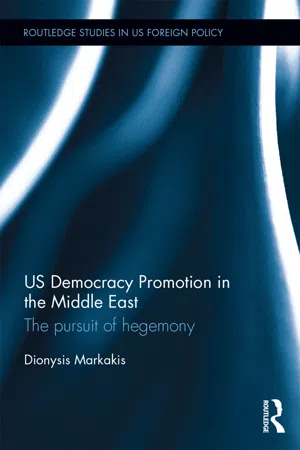
Table of contents

  1. Cover Page
  2. Half Title Page
  3. Series Page
  4. Title Page
  5. Copyright Page
  6. Dedication
  7. Contents
  8. Acknowledgements
  9. Introduction
  10. 1 The analytical framework A neo-Gramscian approach
  11. 2 US democracy promotion The pursuit of hegemony in the aftermath of the Second World War
  12. 3 US democracy promotion in the Middle East The regional approach
  13. 4 US democracy promotion in Egypt
  14. 5 US democracy promotion in Iraq
  15. 6 US democracy promotion in Kuwait
  16. Conclusion
  17. Index

Frequently asked questions

Yes, you can cancel anytime from the Subscription tab in your account settings on the Perlego website. Your subscription will stay active until the end of your current billing period. Learn how to cancel your subscription
No, books cannot be downloaded as external files, such as PDFs, for use outside of Perlego. However, you can download books within the Perlego app for offline reading on mobile or tablet. Learn how to download books offline
Perlego offers two plans: Essential and Complete
  • Essential is ideal for learners and professionals who enjoy exploring a wide range of subjects. Access the Essential Library with 800,000+ trusted titles and best-sellers across business, personal growth, and the humanities. Includes unlimited reading time and Standard Read Aloud voice.
  • Complete: Perfect for advanced learners and researchers needing full, unrestricted access. Unlock 1.5M+ books across hundreds of subjects, including academic and specialized titles. The Complete Plan also includes advanced features like Premium Read Aloud and Research Assistant.
Both plans are available with monthly, semester, or annual billing cycles.
We are an online textbook subscription service, where you can get access to an entire online library for less than the price of a single book per month. With over 1.5 million books across 990+ topics, we’ve got you covered! Learn about our mission
Look out for the read-aloud symbol on your next book to see if you can listen to it. The read-aloud tool reads text aloud for you, highlighting the text as it is being read. You can pause it, speed it up and slow it down. Learn more about Read Aloud
Yes! You can use the Perlego app on both iOS and Android devices to read anytime, anywhere — even offline. Perfect for commutes or when you’re on the go.
Please note we cannot support devices running on iOS 13 and Android 7 or earlier. Learn more about using the app
Yes, you can access US Democracy Promotion in the Middle East by Dionysis Markakis in PDF and/or ePUB format, as well as other popular books in Politics & International Relations & Politics. We have over 1.5 million books available in our catalogue for you to explore.