eBook - ePub
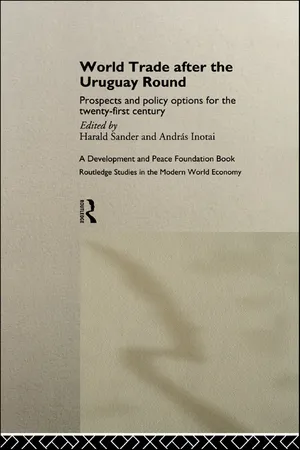
World Trade after the Uruguay Round
Prospects and Policy Options for the Twenty-First Century
- 212 pages
- English
- ePUB (mobile friendly)
- Available on iOS & Android
eBook - ePub
World Trade after the Uruguay Round
Prospects and Policy Options for the Twenty-First Century
About this book
The completion of the Uruguay round promised a new era in international trading relations. However, there remains a wide range of issues which could threaten international trading stability, including regionalisation and regionalism, increased non-tariff forms of protection and the proliferation of unilateral and bilateral trade deals. This work assesses both the immediate impact of the GATT deal and the future of the world trading system. It concludes with an assessment of the long-term possibilities for creating a mutually beneficial world economic system.
Part I
THE WORLD TRADING SYSTEM AND THE URUGUAY ROUND:
ISSUES, RESULTS AND CONSEQUENCES
1
MULTILATERALISM, REGIONALISM AND GLOBALISATION
The challenges to the world trading system1
Harald Sander
INTRODUCTION
The Uruguay Round of the General Agreement on Tariffs and Trade (GATT) was the most comprehensive round in the succession of multilateral trade talks, both in scope and duration. Ironically, its ambitious agenda was set up and had to be negotiated during a time when the GATT system of multilateral and non-discriminatory trade policy was facing two serious challenges: an increasing non-tariff protectionism by industrial countries and a new wave of regionalism, visible in the proliferation of new trading blocs around the globe as well as in the extension and deepening of existing ones.
The rise in protectionist practices was more than just a backlash against multilateral tariff reductions negotiated in earlier GATT rounds. As those measures predominantly surfaced as non-tariff barriers to trade, directed against particular trading partners, they violated the spirit of the GATT which stands for a ‘fix-rule’ trading regime, with these rules applying to all GATT members without discrimination (except under specific, multilaterally agreed criteria). Likewise, regionalism almost by definition discriminates against non-members of a trading bloc as the latter receive less favourable treatment than club members.
These threats to the multilateral trading system must be seen against the background of a changing economic geography, both in terms of an uneven relative growth performance by individual countries and regions in the world economy and, of special interest here, in terms of changing patterns of trade, investment and production, a process commonly referred to as globalisation. Globalisation is visible in the financial sphere, in trade, and in cross-border investments. It is predominantly driven by microeconomic forces, like new technologies and globally oriented corporate strategies, but at the same time it has been propelled and reinforced by the market-oriented policy framework prevailing since the early 1980s. The subsequently increased intensity of international competition resulted more often than not in shifting comparative advantages.
Since productivity growth slowed down in the major industrial countries when the so-called ‘Golden Age’—the post-World-War-II era of increasing global prosperity—came to an end approximately around 1973, a tremendous catching-up process of developing countries has also become visible. However, this was concentrated on some newly industrialising economies (NIEs), mainly in the Far East. Many NIEs are now ‘first-rank fighters’ for trade liberalisation—often after having gone through long periods of nurturing and protecting their domestic industries.
As globalisation is coinciding with a relatively weakened position of industrial countries, signalled by high unemployment rates, it has contributed to a higher sensibility of those countries towards foreign competition which is increasingly being perceived as unfair and threatening the standard of living in the rich part of the world. The problem is aggravated further by bilateral trade imbalances (such as the US trade deficit with Japan), which is partly a result of (earlier) exchange rate misalignments. Globalisation may thus have conditioned the build-up of protectionist pressures—including calls for competitive devaluation—as well as the proliferation of those regional initiatives directed towards isolating the respective region from the perceived threats of globalisation. At the same time, the internationalisation of production has made domestic and regional ‘beyond-the-border’ policies more powerful in competing for production locations and thus jobs.
These developments have been casting doubts on the appropriateness of the GATT system to govern the world trading system in the future. Although the successful conclusion of the Uruguay Round is commonly viewed as a victory for multilateralism, neither the protectionist nor the regionalist challenges to the world trading system have been eradicated. The words of the Uruguay Round agreements point in the right direction. The success of multilateralism, however, will depend on to what extent the major players in the world economy will act in the spirit of the agreement and develop the multilateral system further in a direction capable of coping with the challenges emanating from globalisation in a mutually beneficial way.
The objects of this chapter are the threats to the multilateral trading system, in particular in relation to the challenges of globalisation. The second section, pages 19–26, discusses the major threats to multilateralism: the new protectionism and the new regionalism. The third section, pages 26–33, reviews the structural changes in the international division of labour and the challenges of globalisation for the multilateral system thereof. The fourth section, pages 33–4, concludes by calling for a combination of a national/regional policy response with an institutional response at the multilateral level, the latter both within the sphere of multilateral trade negotiations and beyond the ‘frontiers’ of the international trading system.
MULTILATERALISM, PROTECTIONISM AND REGIONALISM
The multilateral approach of the GATT
The General Agreement on Tariffs and Trade was signed in 1947 by twenty-three countries in order to restore an open international trade environment and to rebuild international economic integration. While the initial efforts to create an international trade organisation as the third pillar of the post-war international economic order (next to the Bretton Woods institutions) did not succeed, the GATT system—which is essentially a contract between signatory states—established the instrument of periodic multilateral trade negotiations, the so-called GATT rounds, directed at reducing tariff and non-tariff barriers to trade.
The approach adopted in the GATT rounds is based on the principle of multilateralism with the major elements of non-discrimination and reciprocity. Reductions in import impediments are offered in return for reciprocal market access concessions by the other trading partners. Non-discriminatory treatment2 is ensured by the most favoured nation principle (MFN) which demands that concessions granted to individual trading partners are extended to all signatories of the GATT. To avoid a free-rider problem and thus to ensure reciprocity, multilateral trade negotiations are required.
While multilateralism is the backbone of the GATT system, it is neither a necessary nor a sufficient condition for establishing a liberal world trading order. In theory, even unilateral trade liberalisation can enhance national welfare because it would result in lower import prices and thereby free resources for a higher demand of those domestic products where the home economy is more efficient. This would constitute an incentive for individual countries to liberalise unilaterally. If all countries would follow this textbook advice, a liberal world trading system would evolve even without any multilateral mechanism. There are, however, a number of (valid as well as non-valid) arguments against the textbook case, and these arguments more often than not govern the more reluctant approach of policy-makers towards free trade. This is why the GATT is important and necessary for reducing trade barriers in practice. But the same arguments simultaneously expose the GATT to the threat that important signatory states may attempt to circumvent its very principle of non-discrimination.
It would be a mistake, however, to view the GATT as well as its successor, the World Trade Organization (WTO), as a free trade organisation per se. From the point of view of individual countries, GATT is often primarily perceived as instrumental to gaining access to foreign markets rather than as an unconditioned commitment for opening up the home market. The GATT system can be understood as the outcome of a compromise between neo-mercantilist sentiments and free trade arguments. As Paul Krugman (1992:429) noted, the ‘theoretical’ underpinnings of GATT negotiations can be related to what he calls ‘GATT-think’: ‘a simple set of principles that is entirely consistent, explains most of what goes on in the negotiations, but makes no sense in economies’. According to Krugman, it is based on three ‘rules’ about the objectives of the negotiating countries: (1) exports are good, (2) imports are bad, and (3) an equal increase in exports and imports is good. The principles (1) and (2) are—strictly speaking—economic nonsense. The implied trade surpluses are impossible to achieve by all trading partners simultaneously as the surplus of one group necessarily requires a combined deficit of all remaining countries, and trade surpluses would ultimately invoke upward adjustments in wages, prices or the exchange rate, resulting in a correction of the trade imbalance. But the rules are in line with the political economy of protectionism (if one adds ‘for the exporting industry’ and ‘for the import competing domestic industry’ to rules (1) and (2), respectively). Rule (3), however, is compatible with the economists’ belief in mutual beneficial trade expansions.
Consequently, GATT members speak of concessions when ‘granting’ market access to foreign exporters and demand ‘reciprocity’—a ‘compensatory’ access to the foreign country’s market.3 Armed with and assisted by the MFN principle, the success of the GATT in reducing MFN tariffs is easy to understand. Countries interested in market access in a foreign country would approach it and offer concessions in return. By means of the MFN principle, the concessions made are extended to all GATT members. Reciprocity then calls for compensating concessions from all ‘benefiting’ countries. The free-rider problem potentially involved in such a process, however, can only be overcome by multilateral trade talks that force all members to the negotiation table. MFN and reciprocity thus work as accelerators of multilateral trade liberalisation, while backsliding is prevented by binding the lowered (average) MFN tariffs.
The item-by-item negotiations in the first GATT rounds, however, proved to be too time-consuming, and balancing concessions for thousands of goods and with many countries simultaneously became a formidable task that slowed down the progress considerably. Therefore, a formula approach was implemented in the Kennedy Round (1963–7) and thereafter. The formula requires a certain average tariff cut for all but some excluded products. This tariff cut applies to all industries unless certain industries can convince their governments that they need more protection. The formula approach brought considerable tariff reductions (see also Baldwin 1987:42–3) of about 35 per cent in the Kennedy Round, some 30 per cent in the Tokyo Round (1974–9), and 38 per cent in the Uruguay Round. Post-Uruguay Round MFN tariffs on manufactured goods in developed countries will come down to below 4 per cent.
The political economy of trade policy therefore makes the multilateral approach of the GATT a more promising and necessary way towards an open world trading system. But at the same time, it is this particular political economy that tends to undermine the GATT’s very principle of non-discrimination in practice.
Protectionist motives
While free trade is mutually beneficial in theory and in principle (but not in general), policy-makers and their electorates rarely share the economists’ beliefs. The reasons given for resistance against multilateral liberalisation are manifold. Some of them are simply economic nonsense, partly because they are the outgrowth of successful lobbying efforts by vested interest groups, partly because they are being based on purely nationalist arguments or ‘feelings’. Others refer to concerns over adjustment costs caused by rapid structural changes that may follow an external liberalisation. And a final group of arguments draws on the insights of the ‘new trade theory’ (which partly incorporates elements of the infant industry protection argument advanced by Friedrich List in the first half of the nineteenth century) as a rationale for a strategic trade policy.
Adjustment cost can become important if declining industries are not replaced at the same speed by new industries and/or if resources are specialised in a way that they will not or cannot be used by the new industries. Structural unemployment can surface and lead to a period of output losses. However, the root of the problem is the structural adjustment capacity of the resources rather than the actual structural change. Several policy responses are possible. First, attempts can be made to slow down the speed of the structural change by means of protecti...
Table of contents
- COVER PAGE
- ROUTLEDGE STUDIES IN THE MODERN WORLD ECONOMY
- TITLE PAGE
- COPYRIGHT PAGE
- TABLES
- CONTRIBUTORS
- ACKNOWLEDGEMENTS
- INTRODUCTION
- PART I: THE WORLD TRADING SYSTEM AND THE URUGUAY ROUND: ISSUES, RESULTS AND CONSEQUENCES
- PART II: PERSPECTIVES AND POLICY OPTIONS FOR THE WORLD TRADING SYSTEM
Trusted by 375,005 students
Access to over 1.5 million titles for a fair monthly price.
Study more efficiently using our study tools.
Frequently asked questions
Yes, you can cancel anytime from the Subscription tab in your account settings on the Perlego website. Your subscription will stay active until the end of your current billing period. Learn how to cancel your subscription
No, books cannot be downloaded as external files, such as PDFs, for use outside of Perlego. However, you can download books within the Perlego app for offline reading on mobile or tablet. Learn how to download books offline
Perlego offers two plans: Essential and Complete
- Essential is ideal for learners and professionals who enjoy exploring a wide range of subjects. Access the Essential Library with 800,000+ trusted titles and best-sellers across business, personal growth, and the humanities. Includes unlimited reading time and Standard Read Aloud voice.
- Complete: Perfect for advanced learners and researchers needing full, unrestricted access. Unlock 1.5M+ books across hundreds of subjects, including academic and specialized titles. The Complete Plan also includes advanced features like Premium Read Aloud and Research Assistant.
We are an online textbook subscription service, where you can get access to an entire online library for less than the price of a single book per month. With over 1.5 million books across 990+ topics, we’ve got you covered! Learn about our mission
Look out for the read-aloud symbol on your next book to see if you can listen to it. The read-aloud tool reads text aloud for you, highlighting the text as it is being read. You can pause it, speed it up and slow it down. Learn more about Read Aloud
Yes! You can use the Perlego app on both iOS and Android devices to read anytime, anywhere — even offline. Perfect for commutes or when you’re on the go.
Please note we cannot support devices running on iOS 13 and Android 7 or earlier. Learn more about using the app
Please note we cannot support devices running on iOS 13 and Android 7 or earlier. Learn more about using the app
Yes, you can access World Trade after the Uruguay Round by Andras Inotai,Harald Sander in PDF and/or ePUB format, as well as other popular books in Business & Business General. We have over 1.5 million books available in our catalogue for you to explore.