- 264 pages
- English
- ePUB (mobile friendly)
- Available on iOS & Android
eBook - ePub
About this book
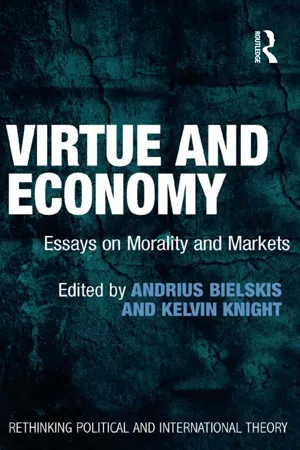
Interest in Aristotelianism and in virtue ethics has been growing for half a century but as yet the strengths of the study of Aristotelian ethics in politics have not been matched in economics. This ground-breaking text fills that gap. Challenging the premises of neoclassical economic theory, the contributors take issue with neoclassicism's foundational separation of values from facts, with its treatment of preferences as given, and with its consequent refusal to reason about final ends. The contrary presupposition of this collection is that ethical reasoning about human ends is essential for any sustainable economy, and that reasoning about economic goods should therefore be informed by reasoning about what is humanly and commonly good. Contributions critically engage with aspects of corporate capitalism, managerial power and neoliberal economic policy, and reflect on the recent financial crisis from the point of view of Aristotelian virtue ethics. Containing a new chapter by Alasdair MacIntyre, and deploying his arguments and conceptual scheme throughout, the book critically analyses the theoretical presuppositions and institutional reality of modern capitalism.
Information
The Virtue Critique of Capitalist Economy
Chapter 1
The Irrelevance of Ethics
At the end of Plato’s Phaedrus Socrates addresses a prayer to Pan and other local gods, a prayer that concludes: ‘May I think him rich who is wise; and of gold may I have only as much of it as a temperate man might bear and carry with him’. Plato’s thought is this: that we may measure ourselves and our activities either by the standards of wisdom and temperateness, the standards of the virtues, or by the standards of money, but that we cannot do both. We have to choose between them. Yet we here now inhabit a culture in which on the one hand the truth of Plato’s thought is recurrently confirmed, while on the other our dominant economic institutions and our business schools continue to present themselves rhetorically as fostering and often attaining excellence by both standards.
From time to time however it becomes impossible to avoid acknowledging that there is a problem. So it has been strikingly in the period following the large-scale economic disasters that the capitalism of advanced modernity recently brought on itself and on the peoples of the world. It matters a good deal how we formulate those questions, since, if they are badly posed, we will misdirect our enquiries. And misdirected enquiries will lead to conclusions that are not just false, but that may confirm us in some of the modes of thought and action that generated the disasters. So it has been, I shall suggest, with much recent discussion of ethics and business activity, especially discussion of the place of ethics in business education.
The presupposition of such discussion has been that individuals who went astray in their judgements and actions often did so only because they had failed to pay sufficient heed to what the standards of the virtues enjoin and so had been morally misguided as to what standards should have guided them in their money-making activities. On this view it is not that there is anything about the activity of money-making as such that it is difficult to reconcile with the injunctions of the virtues. It is just that too often morally inadequate or misguided individuals have not understood what was required of them, if they were both to make money successfully and to conform to what the virtues require. What is missing in such individuals, so it is claimed, is an ethical dimension. And, if we are to have fewer such individuals in future, we must, it is concluded, provide for more strenuous teaching of ethics as part of a business education, perhaps indeed of education in general.
Ethics has of course been in vogue for quite some time: medical ethics, legal ethics, journalistic ethics, the ethics of this and of that. Whenever there is serious malpractice, the cry goes up: Bring on the teachers of ethics! So courses, programmes, academic appointments, centres, have multiplied. There is now money to be made in ethics, even if not all that much. Here I shall speak only of the teaching of ethics designed to be relevant to business, arguing first that such teaching, like the academic teaching of ethics in general, has little or nothing to do with the formation of moral character and is ineffective as an instrument of moral transformation, and secondly that, in the case of business ethics, its teaching is a dangerous distraction from enquiry into the nature and causes of what is morally flawed in our economic institutions and activities.
Begin from some facts about the teaching of ethics. First, there is no hard evidence of any kind that the teaching of ethics in academic courses has any effect whatsoever on the subsequent conduct of students in such courses. Of course absence of evidence leaves open the possibility that such teaching is morally effective, although we do need to note that, even if it were the case that students who attended business schools in which the teaching of ethics was given special attention were found to behave better subsequently than the graduates of other business schools, this might be only because students of better moral character choose to attend business schools which attend to the teaching of ethics.
We should however note that we do possess one piece of indirect evidence about the effects of the academic teaching of ethics, albeit evidence about its teachers, not its students. Eric Schwitzgebel and Joshua Rust have recently canvassed and reported on the moral evaluations of teachers of ethics by their colleagues in university and college philosophy departments. Their finding is that those colleagues ‘do not tend to see ethicists, in general, as particularly well-behaved. Indeed a substantial minority of non-ethicists asserted that ethicists on average behave morally worse than non-ethicists’ (Schwitzgebel and Rust 2008: 1053). Given this, we should not be too surprised if the teaching of ethics turns out to fail as a remedy for bad behaviour. But we have a much better reason for not being surprised at this. Everything that we already know of moral character should have suggested that attendance at courses on ethics, no matter how good the teacher, is bound to be ineffective. Why?
Begin with the record of those notable, although not too numerous institutions that have had significant success in taking young people who have gone badly wrong and redirecting them into participation in constructive activities and worthwhile ways of life, some of them prisons for juvenile offenders or reform schools, some of them tough boarding schools, some of them providing the kind of basic training that the United States Marine Corps affords its recruits. Uniformly such institutions succeed by subjecting the young to rigorous discipline, introducing them to testing activities in which they have to depend on others and become such that others can depend on them, learning a mode of common life, learning some trade, and always incurring penalties, if they fail to learn, until they have learned at last that failing to learn is itself the worst penalty.
What such imposed discipline achieves, if successful, is a radical transformation of attitudes and habits, a transformation without which those who need it would be unable to hear, let alone to be persuaded by, arguments about how it is best for them to live. And we have only to say this to be reminded that it has already been said by Aristotle in Book X of the Nicomachean Ethics. In order to attend to and learn from arguments, we must first have certain predispositions of character, formed by right training and habituation (1179b2–31).This is why in the modern world of business ethics, although it is just those who lack the relevant character formation who most need a moral education, it is they who will be least able to benefit from academic courses in ethics. What then are the habits that we need to acquire, if we are to act as morally responsible agents?
Let me select just four. I begin not from Aristotle, but from D.W. Winnicott, whose psychoanalytic understanding of the influence of mothers on very young children has still not been surpassed (Winnicot 1964 and 1971). What Winnicott taught us is that mothers of such children have to find a mean between a too strict and a too indulgent regime. The outcome of an over strict regime is apt to be a child who is too compliant, too deferential to authorities and too yielding to circumstance, while the outcome of a too indulgent regime is apt to be a child insufficiently able to distinguish realities from the projections of her or his fantasies. And in our subsequent lives we need to strengthen those character traits that enable us to chart a way between, on the one hand, unrealistic confidence in ourselves and in our powers and, on the other, an overestimation of obstacles and difficulties. So a first mark of moral character is a tempered realism about oneself, one’s powers, one’s self-knowledge.
Those traits are closely related to dispositions that Aristotle identified in his discussion of the virtue of courage, dispositions that are a second mark of the morally responsible agent. The courageous human being, on Aristotle’s account, strikes a mean between rashness and cowardice. She or he is able to assess impending dangers accurately, to identify the resources available to confront those dangers, and to judge which risks it is reasonable to take and which are foolhardy, whether those risks are to her or himself or to others. But in any case the courageous agent puts her or himself on the line. If things go wrong, she or he will be among those who lose out. And this trait is in turn related to a third mark of morally responsible agents. Their care for and commitment to particular others is not at the expense of their care for and commitment to themselves. And their care for and commitment to themselves is not at the expense of their care for and commitment to particular others. They are neither self-sacrificing altruists nor self-indulging egoists. What they have understood is that the achievement of their own good is inseparable from their achievement of some set of common goods, common goods shared with those others whom they encounter or on whom their lives impact in their various activities.
A fourth characteristic of those with developed moral character is neither to focus on the present at the expense of the future nor on the future at the expense of the present. This involves understanding oneself as responsible not just for this or that set of actions, but for living out and for having lived out one’s life well or badly. It is to know which projects are to be persisted in, even when they are going badly, and which are to be set aside. It is to prefer honourable failure to dishonest success and to know what to do next when one fails. It is to understand the importance of contributing to projects that began before one was born and that will flourish long after one’s death. It is to know to what history one belongs.
There are of course other significant marks of moral character, but attention to these four is instructive when we consider what is demanded of those at work in the financial sector who trade in securities and currency, either on behalf of their firm’s clients or for their firm itself, that is, what personality traits seem indispensable for success as a trader. Begin with self-confidence. Adam Smith remarked that ‘The chance of gain is by every man more or less overvalued and the chance of loss by most men undervalued’ (Smith 2007: X, 70). Traders, in order to be successful, need to communicate to their clients, to their employers, and most of all to themselves that their abilities and resourcefulness are such that gain can be confidently expected from their activities. And reports of how traders behave both when engaged hour after hour in complex and testing transactions and afterwards when celebrating success suggest that self-questioning and self-doubt are states of mind that traders cannot afford to entertain. Studies by social psychologists provide persuasive evidence that it is those of us who have mildly depressive personalities who are most likely to see things as they are. It is difficult not to conclude that by contrast an ability to see things – including oneself – as more promising than they are is an essential ingredient in trading success. And here then is a first respect in which the possession of a trait that is the mark of an agent with well developed moral character is generally incompatible with success as a trader. Traders have to be too self-confident and therefore lacking in self-knowledge.
Turn now to risk-taking. Traders want to be able to calculate risk accurately and they want to distribute risk, so that as much of it as possible is borne by other people. Their wish to calculate risk accurately is in itself admirable. But it has very often misled overconfident traders into believing that they could get from a formula what can only be supplied by good judgement. And this belief has been powerful enough to allow them to rely on formulas provided by others, formulas too often understood only imperfectly. In such cases bad judgement or at least an incapacity for good judgement has worn the mask of mathematical sophistication. One result of this has been that a wish to transfer as much risk as possible to others has been accompanied by either an inability or an unwillingness to explain either to those others or to oneself the nature and extent of the risk that is being taken on. So traders are apt to fail as risk-takers, unable to distinguish adequately between rashness, cowardice and courage, and they fail not because they fall short of their own professional standards, but just because and insofar as they conform to those standards.
A third salient characteristic of traders is the line that they draw between those others whom they take into account when making professional decisions and those others whose fate they believe that they can safely ignore. On one side of that line are the traders themselves, the firm that employs them, most of their firm’s clients, and those on whose goodwill they may have to rely in future. On the other side lies everyone else, including those who are the victims of collateral damage resulting from transactions in the financial markets. Speaking of the effects of the market crises of the 1990s on those who were both socially and geographically remote from those markets, the Governor of the Bank of England, Mervyn King, noted that ‘In Korea unemployment tripled. In Indonesia several years of economic growth were wiped out leading to political instability and similar results have been visible in other parts of Asia as well as Latin America’ (speech at the Federal Reserve Bank, September 9, 1999).Yet, if such effects were remembered at all by analysts or traders during the next decade, it was only as contributions to the data that enabled them to assign probabilities to the various possible outcomes on which they were placing wagers. And it is clear that only by putting the larger human costs of transactions in the financial markets out of mind that traders are able to function as they do, with their own severely limited versions of cost-benefit analysis. So their understanding of the relationship of their professional actions to the common goods that they share with others is inevitably and radically defective.
Fourthly, the focus of traders has to be almost exclusively on the present and the near future. They are held strictly to account for short term successes and failures under conditions of extreme competitiveness in which immediate responsiveness to changing prices is required of them. Their effectiveness is always under scrutiny and their annual self-reviews and reviews by their managers, reviews that determine the size of their income, define their professional time horizons. Thought of and for the longer term is professionally precluded.
Compare then point by point what on the one hand is required for the formation of moral character in respect of self-confidence and self-knowledge, in respect of risk-taking, in respect of regard for the relationships of the self to multifarious others, and in respect of time horizons, and on the other how traders are shaped by their professional norms. It is at once obvious that the differences are such that, were we successfully to impose on someone the kind of discipline that issues in the formation of genuine moral character, we would have disqualified that someone from success as a trader and, most probably from employment as a trader. We have thus arrived at a second conclusion much stronger than our first. Our first conclusion was that we have no reason to believe that the teaching of courses in ethics effects any significant moral transformation in those subjected to them. Our second conclusion is that, just as the successful training of a boxer will destroy his prospects as a violinist, so the inculcation of qualities of moral character is no way to prepare someone for a rewarding career in the financial sector. Ethics is not just irrelevant. It is a probably insuperable disadvantage.
To understand this conclusion it is important to note what I am not saying. I am not saying that traders are or are apt to be ‘bad’ people by any conventional standards. My conclusion holds of traders who are meticulous in their performance of their duties to their clients and their firms, who abstain scrupulously from bad professional behaviour. It is indeed because of and not in spite of their being good in this way that they fail by the standards that I have identified as the standards of moral character. So it is easy to imagine as a vigorous rejoinder a complaint that I have simply not understood what ethics is or should be. And it would turn out if the quarrel resulting from this complaint were pursued that what divides me – and more importantly Aristotle and Aquinas – from the complainants is the view that each of us takes of human flourishing.
Note too that my thesis is not only about traders. It is true that trading is only one among several types of activity in the financial sector. Investors, analysts, quants, managers of different kinds, all are unlike traders in various ways. But all of them are able to function as they do only because and insofar as traders function as they do. So that it is the financial sector as a whole that is from the Thomistic Aristotelian point of view a school of bad character, while from the point of view of those at work in it, it is, if rightly conducted, a benevolent engine of growth, productive of goods conferred on very many people by a globalised and globalizing economy. How then did this conflict in points of view occur? The answer that I propose provides a third reason for regarding the standard teaching of ethics as irrelevant to the problems presented by the financial sector. It is that those concerned with ethics in the last two hundred years, from whatever standpoint, became insufficiently concerned with money and those engaging with money became insufficiently concerned with ethics. What ethics became as a result and what the management of money became as a result are such that we no longer know how to connect them. The most that we can hope to do is first, to understand the limitations of our present moral and intellectual condition, and then to ask how we can best live and act in that condition.
In the thinking of the Enlightenment it took a long time for the divorce between ethics and concerns with money to become as complete as it is today. Political economy was the offspring of moral philosophy and Adam Smith after all wrote both The Theory of the Moral Sentiments and The Wealth of Nations. But the former is now read in one set of courses by one set of students, while the latter is generally read only selectively – how seldom do we hear Smith (2007: X, 84) quoted as saying that ‘People of the same trade seldom meet together, even for merriment and diversion, but the conversation ends in a conspiracy against the public … ’ – and, when it is read, it is by a very different set of students in other courses. John Stuart Mill wrote both Utilitarianism and the Principles of Political Economy, but, while many students still read the former, very, very few now read the latter. My point is not just that postEnlightenment academic ethics has gone one way and academic economics another, but that this divide is one symptom of a condition such that no one knows how to educate our culture into thinking coherently about money. So what is the problem set by the way we think about money...
Table of contents
- Cover Page
- Title Page
- Copyright Page
- Dedication
- Contents
- List of Contributors
- Introduction
- PART I THE VIRTUE CRITIQUE OF CAPITALIST ECONOMY
- PART II POLEMICISING THE CRITIQUE
- PART III ALTERNATIVES TO CAPITALIST ECONOMY
- Index
Trusted by 375,005 students
Access to over 1.5 million titles for a fair monthly price.
Study more efficiently using our study tools.
Frequently asked questions
Yes, you can cancel anytime from the Subscription tab in your account settings on the Perlego website. Your subscription will stay active until the end of your current billing period. Learn how to cancel your subscription
No, books cannot be downloaded as external files, such as PDFs, for use outside of Perlego. However, you can download books within the Perlego app for offline reading on mobile or tablet. Learn how to download books offline
Perlego offers two plans: Essential and Complete
- Essential is ideal for learners and professionals who enjoy exploring a wide range of subjects. Access the Essential Library with 800,000+ trusted titles and best-sellers across business, personal growth, and the humanities. Includes unlimited reading time and Standard Read Aloud voice.
- Complete: Perfect for advanced learners and researchers needing full, unrestricted access. Unlock 1.5M+ books across hundreds of subjects, including academic and specialized titles. The Complete Plan also includes advanced features like Premium Read Aloud and Research Assistant.
We are an online textbook subscription service, where you can get access to an entire online library for less than the price of a single book per month. With over 1.5 million books across 990+ topics, we’ve got you covered! Learn about our mission
Look out for the read-aloud symbol on your next book to see if you can listen to it. The read-aloud tool reads text aloud for you, highlighting the text as it is being read. You can pause it, speed it up and slow it down. Learn more about Read Aloud
Yes! You can use the Perlego app on both iOS and Android devices to read anytime, anywhere — even offline. Perfect for commutes or when you’re on the go.
Please note we cannot support devices running on iOS 13 and Android 7 or earlier. Learn more about using the app
Please note we cannot support devices running on iOS 13 and Android 7 or earlier. Learn more about using the app
Yes, you can access Virtue and Economy by Andrius Bielskis,Kelvin Knight in PDF and/or ePUB format, as well as other popular books in Politics & International Relations & Political Economy. We have over 1.5 million books available in our catalogue for you to explore.