- 192 pages
- English
- ePUB (mobile friendly)
- Available on iOS & Android
eBook - ePub
About this book
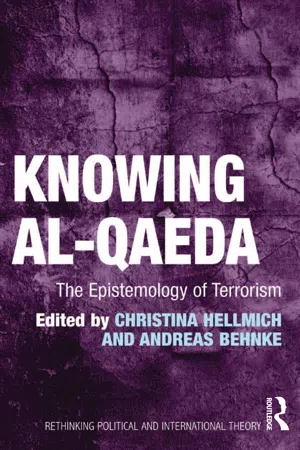
Despite a plethora of studies devoted to it, the current understanding of al-Qaeda and the threat it poses remains vague and ambiguous. Is al-Qaeda a rigidly structured organisation, a global network of semi-independent cells, a franchise, or simply an ideology? What role did Osama bin Laden play within the group and its terrorist campaign? What does it mean to talk about the "global Salafi-jihad" threat allegedly confronting the West? In addressing such questions many writers have sought to offer definitive answers, yet overall the truth about al-Qaeda remains elusive. This book moves beyond this traditional approach in order to investigate and critically assess how such answers reflect the particular epistemological frameworks within which they are produced. Its chapters explore the varied contexts within which the obscure entity labelled al-Qaeda is constituted as a comprehensible object of political, strategic, cultural, and scientific knowledge, and within which 'terrorism' is rendered an experience of quotidian life. This volume offers a much-needed critical reflection on Western ways of talking and of thinking about the frightening experience of global terrorism. In trying to know how we know al-Qaeda, it offers us an opportunity to try to know ourselves and our often hidden assumptions about legitimacy, violence, and political purpose.
Information
Chapter 1
Introduction: al-Qaeda and Terrorism as a Challenge to Knowledge
Ten years after 9/11, al-Qaeda continues to embody the enigmatic new reality of terrorism. Since perpetrating the most destructive act of terrorism to date on 11 September 2001, it has dominated discussion of national and international security in the media as well as in academic and policymaking circles. Who would do such a thing, and why? What sense does it make to fly planes into buildings? What possible political purpose can such an act achieve? Ten years into the global war against terrorism, one would expect to find clear answers to these basic, though critically important, questions. Yet despite the fact that few issues have generated more substantial debate than the task of explaining the rationale and appeal of spectacular mass murder in the name of Islam, speculations about the nature and extent of the group continue to run rife. Indeed, a closer look at the extant literature on the subject generates more questions than answers. Is al-Qaeda a rigidly structured organization, a global network of semi-independent cells, a franchise, or simply an ideology which has captured the imagination of Muslims in different parts of the world? Was Osama bin Laden an engineer, a business-school graduate, a playboy or a university dropout? What is meant by talk of the ‘global Salafi-jihad’ that is allegedly confronting the West? Ten years after 11 September 2001, al-Qaeda remains an enigma. Yet, the purpose of this book is not to solve this puzzle by means of adding yet another explanatory narrative to the many already in existence. Rather, it is interested in the variety of different explanations, the processes by which terrorism and the spectral entity of al-Qaeda are made objects of scientific, cultural, and political knowledge. Put simply, how is al-Qaeda known? What version of it emerges as a result of various discursive processes of trying to make sense out of what appeared to be a senseless act and out of the terrorist campaign that followed it, and what are the political consequences of these different interpretations of what al-Qaeda is?
The starting-point and underlying assumption of this inquiry is the view that the attacks of 9/11 was an act as terrifying as it appeared to be meaningless. The spectacular acts of destruction in New York and Washington DC literally came out of the blue and took the Western world by surprise,1 launching a rollercoaster of uncertainty, fear and speculation. Indeed, a striking feature of the early days following the attacks was the circulation, and recirculation, of pictures – close-up images of the collapsing Twin Towers and of people literally jumping to their death – which engrained the experience of the event into the consciousness of all those who watched in disbelief. At the same time, little room was allocated to text – meaningful analysis and explanations of what had happened. In many ways, the inescapable presence of those horrifying images in newspapers and on television screens was the visual evidence of a mounting confrontation of the bewildered Western world with questions to which there were no easy answers, upsetting Western assumptions about basic principles of the conduct of politics and the liberal political order. 11 September 2001 could be said to be the opening of a blank page on which the narrative about al-Qaeda had yet to be written.
In more theoretical terms, and in order to capture this particular ‘state of mind’, ‘9/11’ is referred to here as an ‘event’ in the sense that Jacques Derrida defines it, that is, as an act of historic proportions that resists immediate subsumption under a given structure of meaning, law, or truth, yet which due to its spectacular nature cries out for speedy analysis, definition and categorization. However, this ‘appropriation’ of the event falters in the absence of a given and self-evident horizon of anticipation and experience.2 Observers in the USA and in the West simply did not have cognitive or discursive frameworks readily available through which to make sense of 9/11. It is therefore the very ‘event’-character of this incident that induces the persistent, endlessly incomplete search for meaning with regard to 9/11 and al-Qaeda. This ‘meaninglessness’ of 9/11 does not stem from any metaphysical or transcendental quality of the act itself. Rather, it emanates from the difficulty, if not impossibility, of making sense of it by means of traditional Western concepts of politics and the Political. A number of peculiar features of the attack and its perpetrators come to mind here. The spectacular scope of the attack itself seemed to amount to more than the regular terrorist act in the traditional sense. Rather, it was more akin to an act of war, yet perpetrated by a non-state actor. What was previously the prerogative of the state – the waging of war – had now been spectacularly enacted by a radical religious group inspired by an ideology which refers back to the early Middle Ages (according to the Western timeframe), yet with means available only to the postmodern age. And whilst war in the Western imagination is a continuation of politics by other means, 9/11 confronted the US and the West with a strategy, purpose and goal that seemed to lie beyond the political realm. The radical religious rhetoric of al-Qaeda, the uncompromizing nature of its demands for a different global order, based on religious, transcendental truths, and the willingness of its fighters to die for their cause, exploded the conceptual framework of modern Western conceptions, which have always considered the realm of politics to be limited to this side of the Great Beyond. Yet if the threat of death can no longer serve as the ultimate sanction by which to maintain political order, Western notions of the Political are effectively exploded. As Michael Ignatieff’s initial response to 9/11 expresses it:
After the initial shock of September 11, it seemed reasonable to argue that terrorism must be understood, like war, as the rational pursuit of political objectives by other means. But September 11 was not politics by other means. (…) What we are up against is apocalyptic nihilism. The nihilism of their means – the indifference to human costs – takes their actions not only out of the realm of politics, but even out of the realm of war itself. The apocalyptic nature of their goals makes it absurd to believe they are making political demands at all. They are seeking the violent transformation of an irremediably sinful and unjust world. Terror does not express a politics, but a metaphysics, a desire to give ultimate meaning to time and history through ever-escalating acts of violence which culminate in a final battle between good and evil. People serving such exalted goals are not interested in mere politics.3
The idea of the ‘meaninglessness’ of 9/11 was further solidified by a peculiar disinterest on the part of Western societies with regard to al-Qaeda’s own narrative. Despite the organization’s, and in particular Osama bin Laden’s, continued effort to communicate his broader message – by means of open letters, propaganda videos, and statements released over the internet – his voice remained largely unheard. Until the publication of his central public speeches, letters and interviews in 2005, only fragments of his statements were available in English translation.4 Similar to the way that former First Lady Laura Bush urged parents to shield their children from the horrific images of 9/11,5 the adult Western audience has largely been shielded from the voice of bin Laden, almost as if hearing him unedited posed a threat to the national wellbeing. The selected parts of his statements that have been reproduced in the Western media tended to focus on controversial proclamations that call for the use of violence against Western targets and hence provided only a partial glimpse of the broader agenda rather than accurately representing it in its entirety. In the light of the nature and scope of al-Qaeda’s terror that upset and destabilized Western conceptions of the Political and of politics, it appears that the irrelevance of their narrative was a foregone conclusion. As Audrey Cronin, author of How Terrorism Ends, fittingly put it: ‘You cannot negotiate with a terrorist group who seeks nothing less than the complete destruction of everything we are.’6 Her statement encapsulates the widely held belief that with an enemy of such radical, fundamentalist orientation, no meaningful political or communicative action is possible. Western governments and international organizations such as NATO hastened to proclaim that they would never negotiate with terrorists, and that their demands and claims were therefore a priori invalid, to be silenced and ignored.
In the absence of any self-evident structure of meaning, and given the adamant unwillingness of Western institutions to heed the organization’s own narrative, al-Qaeda’s campaign of terrorism is thus a form of political violence that poses first and foremost an epistemological problem – a problem of political knowledge and interpretation – rather than one of gathering all relevant facts. Before anyone can even begin to contemplate how to fight this threat, before an effective strategy against this threat can be formulated, it needs to be understood and thereby made ‘meaningful’. Yet such a process can never be accomplished ex nihilo, or hope to produce perfect and objective knowledge. All knowledge is produced within particular frames of reference, and thus relies on underlying ontological assumptions and normative commitments. Thus, whilst for a Liberal like Ignatieff, 9/11 calls for a war against terror within which the West affirms its moral superiority against the forces of nihilism,7 for a Realist like Kenneth Waltz, the same event changes virtually nothing in the great scheme of power politics.8 How we (in the West) understand, and what we know about al-Qaeda in particular, and terrorism in general, is thus always a matter of such prior frames of reference. The initial shock to our epistemic systems thus seemed to produce responses that tell us more about the assumptions underlying these frames of reference than about al-Qaeda and its terrorism itself.
Ten years after 11 September, such an investigation into the framing of al-Qaeda is as relevant as ever. At the time of writing, the death of Osama bin Laden at the hand of US Special Forces led to yet another reassessment of al-Qaeda’s structure and his role within it. Had the organization’s terrorism campaign indeed disintegrated into what Marc Sageman refers to as a leaderless jihad, or do the documents allegedly found in the compound in Abbottabad ‘demonstrate’ that bin Laden was in fact an effective leader of a continuously hierarchical organization? Does the so-called ‘Arab Spring’, the popular uprising which began in early 2011 in many Arab countries of the Middle East, indicate the ultimate demise and irrelevance of al-Qaeda and its fundamentalist ideology, or will the destabilization of established regimes provide the organization with political opportunities? Again, what answers we will find for these questions will depend to a great extent upon our assumptions about the structure and political role of terrorism in the 21st century.
Whilst accepting the challenge that terrorism poses to our systems of knowledge, and to our structures of meaning and truths, this publication’s contributors do not seek to provide their own individual explanatory narratives of what al-Qaeda is and what its violence means. The common thread of the chapters in this book is an interest in the various political and politicized frameworks of reference that are deployed in order to make sense out of an opaque organization and its incomprehensible violent acts. Judgment as to al-Qaeda’s nature is expressly suspended; instead, the chapters here investigate different political, cultural, and scientific fields in order to understand the conceptual and epistemic frameworks that are invoked in the process of others scholars attempting to reach such conclusions. We thus take the notion of ‘making sense’ literally: sense, or meaning, is always a product that involves and draws on particular methodological resources which, if they do not determine, then at least significantly influence, renderings of al-Qaeda and its violence.
Christina Hellmich’s chapter, Here Come the Salafis: The Framing of al-Qaeda’s Ideology Within Terrorism Research, begins this inquiry into how al-Qaeda is understood with a critical assessment of various attempts to explain al-Qaeda’s raison d’être. Whilst commentators variously attempted to portray al-Qaeda adherents as madmen, religious hypocrites, Wahhabis of the twenty-first century or Salafi-Jihadists, what these approaches have in common is what might be described as an ‘outside-in’ perspective that assumes a concept of the underlying logic of al-Qaeda without sufficient reference to primary sources of evidence and excludes alternative approaches that would have offered a different reality. The chapter argues that particularly those explanations that seem to have become the official wisdom regarding the fundamental logic of al-Qaeda, Wahhabism and the Salafi-Jihadist discourse, are concepts that are distinguished schools of thought only within the realm of terrorism studies and are in fact subject to much controversy in the broader fields of Middle East and Islamic studies. Knowing al-Qaeda in this case is about referring to particular stereotypes, categories, that are, upon critical inspection, quite unhelpful. In the anxious quest to explain al-Qaeda, the terrorism studies community deviated from the guidelines of academic conduct and instead contented itself with recycling old oversimplifications of the complexity of Islamic thought and positing new ones, thereby granting those oversimplifications a lease of life. But whilst the ‘Salafi-jihadi’ theory label continues to stick, it offers no explanation of the lingering appeal of bin Laden’s messages amongst a wide tranche of the Islamic faithful or of the fact that many ordinary Muslims across the world have declared him a Muslim hero.
Moving on from the ideological manifestations of al-Qaeda, Anna M. Agathangelou’s chapter, Anxieties of Global Empire: Politics of Visibility Epistemologies and ‘Terror’, embeds an analysis of the epistemology of visuality of terror and terrorists within a radical postcolonial critique of existing power structures that are reflected and shaped in images and icons. Herein, images of al-Qaeda and of bin Laden become sites of a struggle over global power relations; they are made and read in order to sustain and legitimize political and economic structures of domination. Based on Fanon, Mbembe and other postcolonial writers,9 Agathangelou articulates, what she calls an ‘onto-slave-cratic visuality’ that structures species (i.e. flesh), subjectivities, experiences, and positionalities. Within this framework, the images she reads point to the ways dominant leaders and agents of power constitute a white supremacy complicit in reinforcing racial and gender objects of desire for gratuitous violence that underpin an existential practice and everyday life called the world with Europe as its leader. This project extracts people from their communities and kills them. Drawing on Fanon, she argues that the relationship of visuality is onto-politico affectively-structural; it makes possible some realities at the expense of others with dire effects on some and the accrual of power to others. Hence, by giving terrorism a face, terrorism becomes re-coded within an anthropocentric register: as a problem to be tackled by finding ‘the evildoers’ and ‘smoking them out’. Not only is the ‘shadowy network’ of al-Qaeda and its leader thereby located into the realm of the visible and thus ‘actionable’, the visualization of bin Laden also establishes him as the racially and sexually charged deviant and coherent other. It is within this visual(ized) register that the US can generate and implement its War on Terror – a campaign, Agathangelou argues, that is itself made possible by relentless and gratuitous terror.
Continuing the discussion over the framing of the enemy in the War on Terror, Lars Berger’s chapter, Conceptualizing al-Qaeda and US Grand Strategy, examines the political determinants and implications of how al-Qaeda has been portrayed and framed within different traditional US foreign policy discourses ‘post-9/11’. By comparing the respective renderings of al-Qaeda within the isolationist, the defensive and the offensive realist, and finally the liberal discourse, Berger is able to demonstrate the extent to which the US debate on al-Qaeda, and how (or whether) to fight it, is inextricably embedded within specific ontologies of international politics and long-held convictions about the global role which the United States can and should play. Thus, for Isolationists, the war against terror is at best futile, and at worst serves only to further stoke the flames of fundamentalist violence against the US. Within this discourse, al-Qaeda is constructed predominantly in terms of an orientalized, irrational other, unable to understand the inherent benevolence of American foreign policy, and thus not an appropriate interlocutor for the US administration. Realist responses emphasize the need to respond militarily to the terrorist threat, thus casting al-Qaeda as a predominantly military agent. As Berger demonstrates, they do differ, however, as to the scale of the military action necessary to fight the organization, with defensive realists arguing the case for a more disaggregated and selective engagement than offensive realists. Finally, it is within the liberal discourse that terrorism is read as a threat to an increasingly interconnected and interdependent world, in which soft power plays an increasi...
Table of contents
- Cover Page
- Title Page
- Copyright Page
- Contents
- List of Figures
- Notes on Contributors
- Acknowledgements
- 1 Introduction: al-Qaeda and Terrorism as a Challenge to Knowledge
- 2 ‘Here Come the Salafis’: The Framing of al-Qaeda’s Ideology within Terrorism Research
- 3 Anxieties of Global Empire: Politics of Visibility Epistemologies and ‘Terror’
- 4 Conceptualizing al-Qaeda and US Grand Strategy
- 5 Measuring al-Qaeda: The Metrics of Terror
- 6 Fear as Sovereign Strategy and the Popular Tactics of Laughter
- 7 The Friend of My Enemy: al-Qaeda, Iran and the US
- 8 Terrorizing Women: Re-thinking the Female Jihad
- 9 Afterword: Knowing Knowing al-Qaeda
- Index
Trusted by 375,005 students
Access to over 1.5 million titles for a fair monthly price.
Study more efficiently using our study tools.
Frequently asked questions
Yes, you can cancel anytime from the Subscription tab in your account settings on the Perlego website. Your subscription will stay active until the end of your current billing period. Learn how to cancel your subscription
No, books cannot be downloaded as external files, such as PDFs, for use outside of Perlego. However, you can download books within the Perlego app for offline reading on mobile or tablet. Learn how to download books offline
Perlego offers two plans: Essential and Complete
- Essential is ideal for learners and professionals who enjoy exploring a wide range of subjects. Access the Essential Library with 800,000+ trusted titles and best-sellers across business, personal growth, and the humanities. Includes unlimited reading time and Standard Read Aloud voice.
- Complete: Perfect for advanced learners and researchers needing full, unrestricted access. Unlock 1.5M+ books across hundreds of subjects, including academic and specialized titles. The Complete Plan also includes advanced features like Premium Read Aloud and Research Assistant.
We are an online textbook subscription service, where you can get access to an entire online library for less than the price of a single book per month. With over 1.5 million books across 990+ topics, we’ve got you covered! Learn about our mission
Look out for the read-aloud symbol on your next book to see if you can listen to it. The read-aloud tool reads text aloud for you, highlighting the text as it is being read. You can pause it, speed it up and slow it down. Learn more about Read Aloud
Yes! You can use the Perlego app on both iOS and Android devices to read anytime, anywhere — even offline. Perfect for commutes or when you’re on the go.
Please note we cannot support devices running on iOS 13 and Android 7 or earlier. Learn more about using the app
Please note we cannot support devices running on iOS 13 and Android 7 or earlier. Learn more about using the app
Yes, you can access Knowing al-Qaeda by Christina Hellmich, Andreas Behnke in PDF and/or ePUB format, as well as other popular books in Politics & International Relations & Politics. We have over 1.5 million books available in our catalogue for you to explore.