The economic success of Singapore has established the country as a model for other nations. Yet until now the ideas behind this accomplishment have not been critically examined.
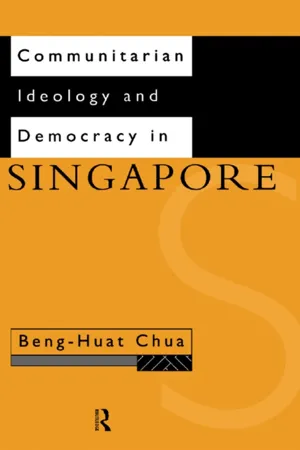
Communitarian Ideology and Democracy in Singapore fills this gap. The book outlines the policies the ruling party has adopted over the past three decades. It charts the government's move away from Western concepts towards the evolution of 'Asian democracy'. The author analyses this anti-liberal democracy and the government's motives for repackaging cultural heritage into a national ideology of Asian communitarianism.
This book avoids the polarization that has tended to characterise texts on Asian governments. It neither concentrates on a history of authoritarian repression nor unequivocally praises the regime but critically examines its political success. As such it provides a new and balanced account to the student of Singapore politics.
- 256 pages
- English
- ePUB (mobile friendly)
- Available on iOS & Android
eBook - ePub
Communitarian Ideology and Democracy in Singapore
About this book
Information
Chapter 1
Ideological trajectory
From authoritarianism to communitarianism
Singapore as an independent polity was inconceivable before the event. Granted self-government in domestic affairs by the British colonial office in 1959, it was, however, difficult for its leaders to push on to the obvious next political step because an independent Singapore was thought to be ‘a foolish and absurd proposition’ (Lee Kuan Yew quoted in Drysdale, 1984:249) for largely economic reasons. Then, when import substitution was the development strategy favoured by decolonised states, island Singapore needed for its new industrialisation programme the larger market of peninsular Malaya.
The political leadership in Malaya was, however, not warm to the prospect of a merger. In the words of the then Prime Minister of Malaya, Tunku Abdul Rahman, ‘Naturally we didn’t want Singapore’ (Drysdale, 1984:258). Nevertheless, in May 1961 he announced, in Singapore, that ‘the possibility of a merger with the Federation of the Borneo territories and Singapore could not be excluded’ (Drysdale, 1984:260). This was because, according to Tunku, the British, fearing that an independent Singapore would fall into communist hands, had made the inclusion of Singapore as a condition for the merging of peninsular Malaya and the three British territories in Borneo (Drysdale, 1984:259). Lee Kuan Yew moved quickly to seize this opening and, in 1963, the Malaysia Federation was constituted, with North Borneo renamed Sabah. Membership proved politically difficult for Singapore, leading to its separation from Malaysia after two brief years. In August 1965 political independence was thrust upon its population (Yong, 1992:32–35). The unimaginable had become reality.
Throughout Singapore’s journey to a reluctant independence, the PAP kept gaining political strength. Founded in 1954, it captured state power in 1959. It then moved immediately to consolidate its power by suppressing opposition forces through repressive legislation. However, as the development strategies began to succeed and the material life of the population improved incrementally, an economic instrumental rationality, encapsulated ideologically in the PAP’s concept of ‘pragmatism’, became increasingly accepted by the electorate. The latter, by and large, voluntarily lent its support to the PAP and the need for overt repression subsided. The PAP has since governed without a break for more than three decades, establishing a strong ideological hegemony throughout the 1960s and 1970s. It is likely to govern for a considerable period yet in the future.
It is easy empirically to stress the continuities of the longestablished PAP regime. Both its early politically repressive strategies and the longevity of its first generation leadership have been read often as an ‘unchanging’ authoritarianism. It is then but a short step to attribute Singapore’s economic success to this authoritarianism; contributing to the problematic general theoretical proposition that authoritarianism is a necessary pre-condition to economic development for Third World nations (Wong, 1991). As the majority of post-colonial authoritarian governments have failed to achieve rapid economic growth, it is obvious that the authoritarianism of the PAP leadership and its allied governmental strategies cannot singularly account for Singapore’s economic success, even less the PAP’s political popularity and its apparently invincible hold on power.
On the contrary, PAP’s popularity lies significantly in its ability to develop an ideological system which was able to crystallise and reflect, relatively accurately, the underdeveloped material condition of the island population at the time of independence. This enabled it to provide the leadership which united the population behind its developmental policies, which in turn delivered material returns to the governed. The success of PAP’s authoritarianism is thus itself to be explained by its acceptability to or at least toleration by the population through the presence of an ideological hegemony or consensus.
As the realities of underdevelopment were replaced by those of economic growth, the initial ideological frame began to lose its hold on the population. With hindsight, the ideological currency of economic instrumentalism may be said to have been waning since the beginning of the 1980s, when one of its constituent values, individualism, became a target of PAP’s ideological concerns. Nevertheless, this development became apparent by the unexpected sharp decline of electoral support in the 1984 election. After that the need to establish a new ideological consensus with the electorate became an explicit item on the political agenda.
Changes in the ideological sphere in Singapore may be characterised thus: a long period of continuity, ruptured by discontinuity at a certain juncture, and followed subsequently by evolutionary changes once the discontinuity is absorbed and political adjustment made by the regime itself. So conceived, the critical break may be located at the beginning of the 1980s, a period in which individualism was inverted from being a much promoted value to one that had to be surgically removed from the body politic. The surgery was to be performed with the enthronement of new ideological concepts to replace individualism as a motivating force among the population. The search for appropriate and efficacious concepts began with moral education through religious knowledge and Confucianism, in the early 1980s, which subsequently evolved into the currently exhorted Shared Values and communitarianism.
This ideological trajectory, from the rise of the PAP to its hegemonic position to the current state of ideological uncertainty is tied to the specific concepts that were developed as responses to various historical turning-points. Therefore, an understanding of the internal logic and evolution of this trajectory is central to the understanding of the continuity of the single party dominance of the PAP in the Singapore polity.
ASCENDANCY OF THE PAP: IDEOLOGICAL LEADERSHIP IN DECOLONISATION
At its founding in 1954, the PAP was constituted by a coalition of left-wing unionists and a group of British-educated professionals under the common banner of anti-colonialism. If the unionists’ anticolonialist motivation was transparent, that of the professionals was analytically enigmatic.
In classic Gramscian fashion, like all groups that successfully transformed their respective polities, this professional group was a breakaway fragment from its own class and corporate interests. Instead of continuing to enjoy the advantages granted to them by the colonial regime, the fragment saw its long-term interest in identification with other subaltern classes. It was able to articulate and represent the anti-colonial sentiments of all the subaltern classes as the general or universal interest of the society and in so doing set itself up to lead the decolonisation process. This Englishspeaking class-fragment was already in a position of ideological leadership even before it captured state power.1
However, without access to popular support, the fragment had to form a coalition with unionists and other left-wing organisations, whose constituencies were the disenfranchised and discriminatedagainst mass of workers and Chinese-educated youth. On the other hand, faced with the colonial regime’s readiness to outlaw procommunist activities, the left welcomed the veneer of ‘respectability’ that the English-speaking class-fragment provided. The result was a political party with two distinct factions, each with its own agenda but united by a sense of mutual need and anti-colonialism.
Realising that it would be difficult to govern through a partially elected Parliament in which power remained in the hands of exofficio colonial administrators, the PAP nominally contested the first general election six months after its founding just ‘to secure a forum in the Legislative Assembly to propagate the Party’s objectives’ (Fong, 1979:26). The Labour Front, a pro-labour socialist party, which had failed to forge a coalition with the PAP (Chan, 1984:75), won the most seats and formed the first elected government. The PAP won three out of four constituencies contested. The Progressive Party, a bastion of English-educated, Straits-born Chinese, was decimated. The results showed that anti-colonial parties with social democratic tendencies were in the ideological ascendancy.
After the Labour Front government assumed state power in 1955, Chinese-educated students who had been mobilised politically by their resistance to the colonial regime’s intention to impose military conscription on them joined cause with the workers. Picket lines of striking workers, unionised under the leadership and legal counsel of prominent PAP leaders, were supported by well-organised student contingents. Events came to a head when skirmishes between workers/students and police turned violent during strikes at a private bus company on May 12, leaving four people dead. The strike was settled two days later in favour of the workers.
Then, the first Chief Minister, David Marshall resigned after a brief fourteen months in office. This was in keeping with his promise that he would do so if he failed to obtain independence for Singapore. He was replaced by Lim Yew Hock who moved to crush the popular mobilisation by deregistering radical student associations and unions and detaining their leaders. Riots broke out in late October 1956 but subsided within a week because the police were well prepared (Clutterbuck, 1984:121–133). With their repression went any credibility on the part of the Labour Front as an anti-colonial socialist party and Lim was himself reduced, in popular parlance, to representation as a ‘running dog’ of colonialism, leaving the PAP as the sole leader of the anti-colonial movement. Nevertheless, crushing the popular mobilisation did induce the British to soften their stand on ‘independence’ for Singapore. Full self-government except for defence and foreign policies was agreed to in 1957, to be granted after general elections in 1959. Buoyant because of its obvious political popularity, the PAP vigorously contested these elections and won forty-three out of the fifty-one seats. Lee Kuan Yew accepted the office of Prime Minister, after securing the release of PAP left-wing unionists from political detention. All right-wing political parties were reduced to insignificance.
The election victory moved the PAP from the periphery to the centre of power. To its ideological leadership was thus added the monopoly of state power. The PAP was in possession of ‘the means to push forward [its] hegemony to the fullest possible extension’ (Sassoon, 1980:129). But first, the internal division in the Party had to be reckoned with.
The first instance of overt intra-party struggle came with a byelection in Anson constituency, in 1961, for the seat vacated by the untimely death of the PAP incumbent (Drysdale, 1984:242 and 264). The left threatened to switch electoral support to ex-Chief Minister Marshall, if the Lee faction refused to redress its grievances against a whole battery of repressive measures. These included absence of civil liberties and the continuing detention of political detainees under the Preservation of Public Security Ordinance and the Internal Security Council; deprivation of citizenship to left-wing individuals; attempts to control the radical trade union movement instead of helping it to consolidate its political base; and finally, absence of intra-party democracy within the PAP (Rodan, 1989:67) because the cadre system of electing executives, introduced during the detention of the left-wing leaders, had deprived the latter access to power in the Party (Bloodworth, 1986:185).
When the Lee faction stood firm, the left delivered its threat and caused the PAP to lose the seat. This gave Lee the chance to force the intra-party division into the open by calling a confidence vote on his own government. In the ensuing vote, eight of the left-wing faction crossed the floor and five abstained; the government survived with the majority of one. The thirteen members of the PAP were immediately expelled and they, along with the left unionists, formed the Barisan Sosialis. Massive ground defection from the PAP followed (Bloodworth, 1986:243), leaving the Lee faction with little organised support base but in control of the state.
HEGEMONY BEGINS: ELABORATION OF A ‘NATIONAL INTEREST’
Against the left, the Cabinet ‘reconstituted’ itself as the ‘moderate’ faction and moved to regain its political leadership by appealing directly to the electorate. Devoid of a party base but with constitutional power in hand, the Cabinet identified itself as the ‘government’ which must define and act in terms of the ‘national’ interests, instead of the ‘sectarian’ interests of the left. At that time, Singapore as a ‘nation’ was yet unformed. The construction of this ‘nation’, as a necessary ‘myth’ for the population (Yong, 1992), was addressed ideologically in a series of one-sided radio broadcasts, which Lee called the ‘battle for merger’, delivered during the long run-up to the referendum on merger, that is, Malaysia, on September 1, 1962.
In these broadcasts, he began by characterising/exposing the communists as, ironically, pro-colonialism. He argued that they would rather Singapore remained a colony so that their struggles could be seen as anti-colonial and thus occupy the political moral high ground; whereas struggles against a popularly elected government and popular nationalist leaders would expose their antinationalist sentiments (Lee, 1962:45). The distinction between the ‘popularly elected PAP government’ and the ‘communists’ enabled Lee to claim political legitimacy for himself and the PAP government, in spite of the fact that both had come to power through the massive electoral mobilisation by the left faction, which he was now casting as an anti-nationalist fringe. It was as nationalists that the PAP spoke to the ‘nation’ and the ‘people’.
This ‘nation’ and ‘people’ needed to be textually constructed in the broadcast too.2 However, constitutive components were at hand: ‘The Malay-speaking, Tamil-speaking and the English-speaking groups are quite certain that Lim Chin Siong and his Communist friends are up to no good, and consider that they should be put away and not allowed to do mischief’ (Lee, 1962:56). The obstacle to such construction was the care needed to shape a crucial Chinese component to fill out the abstract ideological concept of ‘nation’: distinctions had to be made between the alleged communists and those who were not, otherwise the government would fall ‘into the Communist trap of allowing themselves to be presented as anti-Chinese culture and Chinese education’ (Lee, 1962:58). The sense of a ‘national constituency’ that emerged was therefore defined by its supposedly essentially multiracial, non-communist and/or anticommunist orientation.
The ‘nation’ of racially diverse ‘non-communist’ population had concrete material interests which again could be aggregated in the same textual strategy into the ‘national’ interests:
The English-educated want to be assured that merger does not mean that four to one ratio between Malays and non-Malays will apply in the Singapore section of the civil service.
Businessmen, contractors and bus companies want to be assured that priority of tenders and licences will be as before, with no priorities or special rights for anybody.
Chinese parents who want their children to go to Chinese schools want to be assured that the present policy of equal treatment of all streams of education will go on.
Workers want to be assured that our pro-labour policy will continue.
Merchants want to be assured that our free port status and our free trade with all countries will continue, and that our trading links with the whole world will remain as they have been, free and easy. Every legitimate interest will be protected.
(Lee, 1962:78–79)
The aggregate effect of this particular juxtaposition of the selfevident anti-communist multiracial constituent groups, and their equally self-evident economic interests in their daily life was to produce an authoritative image of the ‘nation’ and ‘national interests’, respectively, and in turn of Singapore as a political entity. The presence of these groups and interests was never actually substantiated. It is in this precise sense of being authoritative without factual evidence that the political consequences achieved by such textual strategies may be said to be unavoidably ideological.
Two ideological/political effects were achieved. First, the conceptually/ideologically reconstituted ‘non-communist’ national constituency provided a focus for a large segment of population who were carried along by the anti-colonial mobilisation but were not necessarily communist-inclined. It enabled this constituency to get a sense of cohesiveness and act accordingly as an ‘imagined community’.3 Second, it redirected the attention of this mobilised constituency from political struggles to economic development. In this redirection, Lee sought to conflate politics and economics: ‘Political problems ultimately mean the problem of how we make our living, how we can give everyone a fair and equal chance to study and work and have a full life’ (Lee, 1962:83); this ideological reduction is still central to the PAP government today.
Alongside the ideological construction of a ‘non-communist nation’, the PAP government began to speed up its industrialisation programme and increase its social expenditure, especially in housing and education. By the time of the referendum on merger in September 1962, these programmes had begun to show impressive results. These improvements were ‘real reforms of benefit to the working class’ which, as such, were essential to the direct appeal and political penetration of the PAP into the social base, in spite of an absence of political organisation (Rodan, 1989:66). These improvements lent evidence to the PAP’s ideological construction of a nation with common material interests.4 The result was that 71 per cent of enfranchised individuals voted for the PAP proposal in the referendum. It should be noted that all the three alternative proposals presented to the electorate in the referendum assumed merger to be a given. They differed only in details regarding the relationship between Singapore and the federal government of Malaysia (Drysdale, 1984:304).
ELIMINATING THE OTHER
After the referendum, the PAP government intensified its use of monopoly state power to repress oppositional forces. In February 1963, a raid codenamed Operation Cold Store detained more than a 100 radicals (Clutterbuck, 1984:158). This raid was authorised by the Internal Security Council in which Malaya held the determining vote in a council of seven members, three from the elected Singapore government and three British officials (Clutterbuck, 1984:144–145). Thus, althought present at the meeting in which the detention decision was taken, Lee Kuan Yew was able to minimise his role in it (Clutterbuck, 1984:159). Having so deprived the Barisan Socialis of its leaders, the PAP announced a snap general election. As a testimony of its strength, Barisan captured 33.3 per cent of the popular votes, winning thirteen seats, relative to the PAP’s 46.9 per cent and thirtyseven seats. Unfortunately, it failed to consolidate its base as the only viable opposition party to the PAP. When the new legislative assembly was sworn in, three of the thirteen had been arrested and two had fled the country (Bloodworth, 1986:287). Barisan Socialist secretarygeneral imposed a boycott on its MPs sitting in Parliament. Subsequent resignations in 1965 of the remaining eight MPs gave the PAP the opportunity to pick up more seats through by-elections. The gross tactical mistake of boycotting Parliament spelt the end of a viable opposition voice in Singapore for decades to come.5
On the other hand, the PAP’s victory was also impressive. Its direct appeal to the electorate, including almost a year of arduous personal campaigning by Lee Kuan Yew himself in all the constituencies, particularly those which had voted against the PAP during the referendum on merger (Bloodworth 1986:279–280), had obviously paid off and in the process galvanised the population into a sense of ‘nation’ and ‘a people’.
As Singapore was obliged to leave Malaysia in 1965, the victory for merger was short-lived. The resulting ideological gains of having configured the ‘nation’ and its ‘people’ were, however, far more lasting to both the PAP government and to newly independent Singapore. The political process had enabled the government to articulate a new vision for Singapore and Singaporeans which emphasised economic developm...
Table of contents
- Cover Page
- Title Page
- Copyright Page
- Preface
- Acknowledgements
- Introduction
- Chapter 1
- Chapter 2
- Chapter 3
- Chapter 4
- Chapter 5
- Chapter 6
- Chapter 7
- Chapter 8
- Chapter 9
- Conclusion
- References
Trusted by 375,005 students
Access to over 1.5 million titles for a fair monthly price.
Study more efficiently using our study tools.
Frequently asked questions
Yes, you can cancel anytime from the Subscription tab in your account settings on the Perlego website. Your subscription will stay active until the end of your current billing period. Learn how to cancel your subscription
No, books cannot be downloaded as external files, such as PDFs, for use outside of Perlego. However, you can download books within the Perlego app for offline reading on mobile or tablet. Learn how to download books offline
Perlego offers two plans: Essential and Complete
- Essential is ideal for learners and professionals who enjoy exploring a wide range of subjects. Access the Essential Library with 800,000+ trusted titles and best-sellers across business, personal growth, and the humanities. Includes unlimited reading time and Standard Read Aloud voice.
- Complete: Perfect for advanced learners and researchers needing full, unrestricted access. Unlock 1.5M+ books across hundreds of subjects, including academic and specialized titles. The Complete Plan also includes advanced features like Premium Read Aloud and Research Assistant.
We are an online textbook subscription service, where you can get access to an entire online library for less than the price of a single book per month. With over 1.5 million books across 990+ topics, we’ve got you covered! Learn about our mission
Look out for the read-aloud symbol on your next book to see if you can listen to it. The read-aloud tool reads text aloud for you, highlighting the text as it is being read. You can pause it, speed it up and slow it down. Learn more about Read Aloud
Yes! You can use the Perlego app on both iOS and Android devices to read anytime, anywhere — even offline. Perfect for commutes or when you’re on the go.
Please note we cannot support devices running on iOS 13 and Android 7 or earlier. Learn more about using the app
Please note we cannot support devices running on iOS 13 and Android 7 or earlier. Learn more about using the app
Yes, you can access Communitarian Ideology and Democracy in Singapore by Beng-Huat Chua in PDF and/or ePUB format, as well as other popular books in Social Sciences & Ethnic Studies. We have over 1.5 million books available in our catalogue for you to explore.