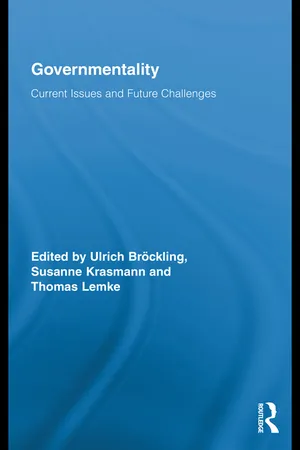
Examining questions of statehood, biopolitics, sovereignty, neoliberal reason and the economy, Governmentality explores the advantages and limitations of adopting Michel Foucault's concept of governmentality as an analytical framework. Contributors highlight the differences as well as possible convergences with alternative theoretical frameworks. By assembling authors with a wide range of different disciplinary backgrounds, from philosophy, literature, political science, sociology to medical anthropology, the book offers a fresh perspective on studies of governmentality.
eBook - ePub
Governmentality
Current Issues and Future Challenges
- 332 pages
- English
- ePUB (mobile friendly)
- Available on iOS & Android
eBook - ePub
About this book
Information
1
From Foucault’s Lectures at the Collège de France to Studies of Governmentality An Introduction
Ulrich Bröckling, Susanne Krasmann and Thomas Lemke
1. FOUCAULT AND GOVERNMENTALITY
In Foucault’s writings, the term “governmentality” (gouvernementalité) first surfaces in the Collège de France lectures of 1978 and 1979. The term is derived from the French adjective gouvernemental, and already had some currency before Foucault made it into a central concept in his work. In the 1950s, Roland Barthes used what he referred to as this “barbarous but unavoidable neologism” (1989: 130) to denote a mechanism inverting cause and effect and presenting the government as the author of social relations: as “the Government presented by the national press as the Essence of efficacy” (ibid.: 130). Foucault took up this “ugly word” (2007: 115), freeing it from its semiological context. For Foucault, governmentality thus does not stand for a mythic practice of signs depoliticizing and masking those relations, but rather for a range of forms of action and fields of practice aimed in a complex way at steering individuals and collectives (2007: 122; 2000c: 295).
Foucault’s interest in studying government signals a far-reaching correction and refinement of his analysis of power. Up through the publication of Discipline and Punish (1978), in order to investigate social relationships he had used “Nietzsche’s hypothesis” (2003: 14–19) against the juridical concept of power, approaching power above all in terms of struggle, war, and confrontation (see for example 1978: 26). But in the mid-1970s, it became clear that in its initially conceived form the “micro-physics of power” (ibid.: 26) had two serious problems. On the one hand, the analytic accent lay mainly on the individual body and its disciplinary formation, and there was no consideration of more comprehensive processes of subjectification. As a result, the analysis of power could not do justice to the double character of this process as a practice of subjugation and a form of self-constitution. On the other hand, in the critique of state-centered approaches, focusing only on local practices and specific institutions like the hospital and prison turned out to be insufficient. It was, it seemed, necessary to analyze the state’s strategic role in the historical organization of power relationships and the establishment of global structures of domination. What was needed, then, was a double expansion of the analytic apparatus, in order to appropriately account for both processes of subjectification and state formation (see Foucault 2008: 358).
As a “guideline” (2007: 363) for Foucault’s work over the coming years, the concept of government stood at the center of his new theoretical orientation. With this concept, he introduced a new dimension into his power analysis, allowing him to examine power relations from the angle of the “conduct of conduct” (2000b: 341) in order to distance himself simultaneously from the paradigms of law and war. In this manner, the governmentality concept was introduced for the sake of a “necessary critique of the common conceptions of ‘power’” (1997a: 88). Its significance in Foucault’s work lies in the mediating function he ascribes to it: in the first place, it mediates between power and subjectivity, making it possible to study how techniques of rule are tied to “technologies of the self” (Foucault 1988) and how forms of political government have recourse to “processes by which the individual acts upon himself” (1993: 203); in the second place, the problem of government allows systematic scrutiny of the close relationship—repeatedly underscored by Foucault—between techniques of power and forms of knowledge, since governmental practices make use of specific types of rationality, regimes of representation, and interpretive models.
Foucault first presented his new “direction for research” (2000a: 323) in the framework of the above-mentioned lectures. Their subject was the “genealogy of the modern state” (2007: 354)—Foucault being less interested theoretically in a historical reconstruction of the emergence and transformation of political structures than in the long-term processes of co-evolution of modern statehood and modern subjectivity. For that reason, in the Collège de France lectures he uses the concept of governmentality with a “very broad meaning” (2000b: 341), taking up a range of meanings it had into the eighteenth century (Sellin 1984; Senellart 1995). Foucault now distinguishes “the political form of government” from the “problematic of government in general” (2007: 89). The latter is concerned with leadership in a comprehensive sense: self-government, heading a family, raising children, guiding the soul, but also leadership of a community or business (see 2000b: 341). Within this framework, Foucault examines processes of state formation in close connection with the development and changing forms of subjectification. For this reason, the “governmentalization of the state” (2007: 109) investigated in the lectures is simultaneously a “history of the subject” (ibid.: 184). Foucault does not understand the modern state first of all as a centralized structure, but rather as a “tricky combination in the same political structures of individualization techniques and of totalization procedures” (2000b: 332).
In his lecture series, Foucault considers the “genesis of a political knowledge” (2007: 363) of governing humans from ancient Greek and Roman ideas on the subject to early modern reason of state and “police science,” and onward to relevant liberal and neoliberal theories. In the process, he opens up the following historical argument for discussion. The modern (Western) state is the result of a complex linkage between “political” and “pastoral” power. Where the former is derived from the ancient polis and is organized around law, universality, the public, and so forth, the latter represents a Christian religious conception centered upon the comprehensive guidance of the individual. Pastoral power conceives the relationship between the shepherd and his flock and between leaders and those they lead along the lines of a government of souls: their individual instruction and guidance takes place in view of otherworldly salvation, pastoral authority thus complementing the authority of moral and religious law (2007: 115– 190; 2000a: 300–311). Unlike the ancient Greek and Roman approach to government, that of the Christian pastorate is characterized by the development of analytic methods, techniques of reflection and supervision intended to secure the knowledge of the “inner truth” of the individuals. Alongside obedience to moral and legal norms appears the authority of a pastor, who permanently controls and cares for individuals in order to set them on the road to salvation (Foucault 2000b: 333; see Foucault 2007).
Foucault observes that such pastoral guidance techniques experienced an expansion and secularization in the sixteenth and seventeenth centuries. The gradual dissolution of feudal structures and the development of large territories and colonial empires, together with the reformist and counter-reformist movements, led to a broadening of pastoral power beyond its original ecclesiastical context. Foucault’s analysis of government is thus based on the assumption that the pastoral techniques eventually produced forms of subjectification from which the modern state and capitalist society could in turn develop. The particular quality of this specifically modern form of government—of human beings rather than “souls”—lies, to begin with, in the need for reflection on its premises, object, and goals. “Political reason” represents an autonomous rationality derived neither from theological-cosmological principles nor from the person of the prince. At the same time, the earlier goals of happiness, salvation, and well-being are now secularized and re-articulated in the framework of the “political” problematic of the state. Foucault speaks here of the modern state’s simultaneous tendency towards totalization and individualization, this itself constituting both a legal-political structure and “a new distribution, a new organization of this kind of individualizing power,” “a modern matrix of individualization, or a new form of pastoral power” (2000b: 334).
If we follow Foucault’s interpretation, the innumerable treatises about the arts of government emerging at the start of the Early Modern period indicate that political reflection was separating itself from the problem of sovereignty and extending to all conceivable activities and fields of action. Standing at the center of the art of government is
“a sort of complex of men and things. The things government must be concerned about [ … ] are men in their relationships, bonds, and complex involvements with things like wealth, resources, means of subsistence, and, of course, the territory with its borders, qualities, climate, dryness, fertility, and so on. ‘Things’ are men in their relationships with things like customs, habits, ways of acting and thinking. Finally, they are men in their relationships with things like accidents, misfortunes, famine, epidemics, and death.” (Foucault 2007: 96)
Potentially, every human realm and activity, from spiritual conflicts to military maneuvers, from guidance of the family to questions of wealth, now falls within the purview of government.
Foucault is, however, less interested in diagnosing an extension of the realm of government as such than in identifying the specific rationalities allowing an ordering of the various areas covered by governing and orienting them towards its different goals. In the framework of this “history of ‘governmentality’” (2007: 108), Foucault examines three forms of government in particular: reason of state, police, and liberalism. But these governmental rationalities do not, for the most part, mark historical stages on the way to a continuous “modernization” of the state; rather, the difference and discontinuity between a range of technologies of power—law, discipline, security techniques—stand at the center of Foucault’s analysis. Interestingly, departing from the position he took in his previous work, Foucault here no longer juxtaposes sovereign right with the mechanisms of discipline but demarcates both from “apparatuses of security” (2007: 108). In his earlier work on discipline and the juridical model of power, he described a process through which disciplinary techniques have accrued validity and “colonized” law both within the interstices and against the mechanisms of legal norm-setting (2003: 38–39). These techniques, he argued, install hierarchizing separations between the useful and useless, normal and abnormal, functioning by way of a set value and its operationalization; in other words, procedures are established orienting and aligning individuals to such predetermined standards (2007: 44–47; 56–57).
The technology of security represents the exact opposite of the disciplinary system: where that system presumes a prescriptive norm, the starting point of security technology is the empirically normal, serving as a second-order norm and allowing further differentiations. Instead of orienting reality toward a previously defined should-be value, it takes that empirical reality—as defined by the statistical distribution of frequency, rates of disease, birth, and death, and so forth—as a benchmark. The “mechanisms of security” (2007: 7) draw no absolute line between the permitted and the forbidden, but rather specify an optimal medium within the range of variations. For his further work, Foucault thus distinguishes analytically between the legal norm, disciplinary normation, and the normalization of security technology (2007: 56–79).
As Foucault sees it, the development of security mechanisms is closely tied to the emergence of liberal governmentality in the eighteenth century. He understands liberalism not as an economic theory or political ideology, but as a specific art of government oriented toward the population as a new political figure and disposing over the political economy as a technique of intervention. Liberalism, he indicates, introduced a rationality of government unknown to either medieval notions of rule or Early Modern raison d’état: the idea of a nature of society forming both the basis and limits of governmental action. For Foucault this idea was no remainder of tradition (or premodern relic), but rather marked an important break in the history of political thought. In the Middle Ages, a good government was part of the God-willed natural order: an idea that integrated and limited political action within a cosmological continuum. Reason of state broke with the idea, replacing it with the artificiality of the “Leviathan,” which earned it the reproach of atheism. With the physiocrats and political economy, nature resurfaced as an orientation point for political action—but another, previously unknown nature, having nothing to do with a divine plan of creation or cosmological principles. This nature was the outcome of altered relations of production and conditions of living: the “second” nature of developing bourgeois society (2007: 87–110; Meuret 1988).
Foucault sees the distinctive feature of liberal forms of government as their replacement of external regulation by inner production. Liberalism does not limit itself to a simple guarantee of freedoms (...
Table of contents
- Routledge Studies in Social and Political Thought
- Contents
- 1 From Foucault’s Lectures at the Collège de France to Studies of Governmentality An Introduction
- 2 Relocating the Modern State
- 3 Constituting Another Foucault Effect
- 4 Governmentalization of the State
- 5 Government Unlimited
- 6 The Right of Government
- 7 Foucault and Frontiers
- 8 Beyond Foucault
- 9 Coming Back to Life
- 10 The Birth of Lifestyle Politics
- 11 Biology, Citizenship and the Government of Biomedicine
- 12 Human Economy,Human Capital
- 13 Decentering the Economy
- 14 The Economic Beyond Governmentality
- 15 Constructing the Socialized Self
- Contributors
- Persons Index
- Subject Index
Trusted by 375,005 students
Access to over 1.5 million titles for a fair monthly price.
Study more efficiently using our study tools.
Frequently asked questions
Yes, you can cancel anytime from the Subscription tab in your account settings on the Perlego website. Your subscription will stay active until the end of your current billing period. Learn how to cancel your subscription
No, books cannot be downloaded as external files, such as PDFs, for use outside of Perlego. However, you can download books within the Perlego app for offline reading on mobile or tablet. Learn how to download books offline
Perlego offers two plans: Essential and Complete
- Essential is ideal for learners and professionals who enjoy exploring a wide range of subjects. Access the Essential Library with 800,000+ trusted titles and best-sellers across business, personal growth, and the humanities. Includes unlimited reading time and Standard Read Aloud voice.
- Complete: Perfect for advanced learners and researchers needing full, unrestricted access. Unlock 1.5M+ books across hundreds of subjects, including academic and specialized titles. The Complete Plan also includes advanced features like Premium Read Aloud and Research Assistant.
We are an online textbook subscription service, where you can get access to an entire online library for less than the price of a single book per month. With over 1.5 million books across 990+ topics, we’ve got you covered! Learn about our mission
Look out for the read-aloud symbol on your next book to see if you can listen to it. The read-aloud tool reads text aloud for you, highlighting the text as it is being read. You can pause it, speed it up and slow it down. Learn more about Read Aloud
Yes! You can use the Perlego app on both iOS and Android devices to read anytime, anywhere — even offline. Perfect for commutes or when you’re on the go.
Please note we cannot support devices running on iOS 13 and Android 7 or earlier. Learn more about using the app
Please note we cannot support devices running on iOS 13 and Android 7 or earlier. Learn more about using the app
Yes, you can access Governmentality by Ulrich Bröckling,Susanne Krasmann,Thomas Lemke in PDF and/or ePUB format, as well as other popular books in Politics & International Relations & Political History & Theory. We have over 1.5 million books available in our catalogue for you to explore.