eBook - ePub
Technology, Trade and Growth in OECD Countries
Does Specialisation Matter?
- 208 pages
- English
- ePUB (mobile friendly)
- Available on iOS & Android
eBook - ePub
About this book
Presenting new material and a fresh perspective, Technology, Trade and Growth in OECD Countries, provides a unifying framework for the exploration of the role played by specialisation in economic growth and international competitiveness.
1 Introduction
The theoretical framework
This book focuses on the role played by the composition of technological activities on countries’ international competitiveness and economic growth. In particular it argues that in a process of growth sustained by innovation, the dynamics of specialisation assume an important role in affecting the performance of different countries because of differences in technological opportunities and in income elasticities of demand across different activities.
At a theoretical level, the areas of research relevant to this study can be identified within the theories of economic growth and international trade. These are two broad areas of investigation that have become increasingly interdependent in the mainstream economic analysis since the development of the new growth theory and the new trade theory. In particular it has now been recognised that the opening-up of trade can have permanent effects on country performance by affecting not only the level of macroeconomic activity but also the rate of growth. The main channels for this to happen are scale effects matched with endogenous technical change and resource allocation effects.
An interesting feature of the work undertaken in the old neoclassical tradition, both in the domain of economic growth and of international trade, has been the long-lasting neglect of the process of technical change. The assumptions of an equal rate of exogenous technical change across countries within the traditional neoclassical growth theory, and of given technologies within the traditional neoclassical trade theory, have been crucial for the predictions of convergence in growth rates. Another aspect that has characterised the neoclassical approach to economic growth (and that is still present in the new growth theory) is the lack of any role played by demand in affecting the rate of growth. With exogenous and even technical change and no demand constraints, the neoclassical growth theory does not leave any role for the composition of national activities and the process of structural change to affect country performance.
It has been observed that the neoclassical work on economic growth has been affected by the need to maintain logical consistency with a pre-conceived pure-exchange theoretical scheme deriving from the marginalist revolution of the end of the nineteenth century (Pasinetti, 1981). The advent of the marginalist revolution, with the attention coming to be focused on the optimal allocation of scarce goods, led to a decrease in the attention devoted to the process of production and accumulation that was central in the work of Classical political economy. In this period the work of Schumpeter represented the only major exception. The central role attributed to innovation in his work was exceptional and modified the focus of the economic analysis to the extent that he had to look for a name to give to his area of investigation (he defined it as dynamics in contrast to the static analysis undertaken by the marginalists, or development in contrast to their study of the circular flow: Schumpeter, 1934; 1982). Another aspect of the marginalist revolution (though originally debated within classical political economy) was the adoption of Say's Law, i.e. the thesis that supply creates its own demand. In the context of the general-equilibrium static model, this meant that demand could not be a constraint on full employment, and in the context of dynamic analysis that economic growth had to be independent from demand. The critique of this view in the context of a stationary economy was the focus of Keynes’ General Theory (1936) which stressed the role played by effective demand in affecting the rate of macroeconomic activity.
The new growth and trade models recognise the crucial role played by technical change and its endogeneity, however this stream of literature still understates the strong uncertainty that surrounds the innovation process, the discontinuities that arise from technical change, and the role played by demand. The conviction that the uneven and disequilibrating nature of technical change on one hand, and the role of demand on the other, are essential for understanding the long-run processes of international competitiveness and economic growth led us to develop this book using a richer framework. In particular, on the supply side the main source of inspiration is the Schumpeterian idea that technical change is the driving force of economic growth and that it is not evenly distributed through time or across countries and sectors, but appears discontinuously in swarms. Moreover we adopt the view that in the course of different waves of development different sectors or technologies play a major role in the process of growth, affecting the whole economic system through the existence of intersectoral links. Technological opportunity is not equally distributed across different technological classes; rather, over time, various activities offer different opportunities for innovation. Moreover, not all innovations have the same degree of pervasiveness; i.e. they do not have the same ability to affect different branches of the economy. If this is the case, countries that have a high share of activities in fields of high technological opportunity and a high degree of pervasiveness might experience faster rates of technical change and of economic growth. In the last wave of development, information and communication technologies (ICTs) appear to be areas of high technological opportunity and a high degree of pervasiveness.
This approach is concentrated on the supply side of the economy and downplays the role played by demand in affecting countries’ long-run rates of growth. On the demand side, this study draws on the idea that different products have different income elasticities of demand and that as income grows the composition of goods consumed changes (Engel's law). As a consequence, which goods countries produce turns out to be important in affecting their capability of benefiting from an increase in international demand.
The simultaneous account of the concepts of technological opportunity and pervasiveness on the supply side, and income elasticities of demand on the demand side, is the framework used in this book for analysing the impact of technological specialisation on international competitiveness and economic growth. Other studies have linked together the role played by technological competition (as stressed by the Schumpeterian-evolutionary approach) with post-keynesian accounts of growth based on the balance-of-payments constraint (e.g. Fagerberg; 1988a). The contribution of this book consists in introducing the role played by the composition of national technological activities within this framework. In particular we consider both the direct effects of specialisation on growth and the indirect effects of specialisation on growth through its impact on the income elasticities of export and import. A summary of these linkages in represented in Figure 1.1.
Following the Schumpeterian-evolutionary approach general technological competitiveness and investment activity directly impact on economic growth through product and process innovation and diffusion. Specialisation in fields of high technological opportunity also directly impacts on growth because new technologies have a pervasive effect in the different sectors of the economy. Moreover general technological competitiveness and favourable specialisation interact as higher R&D expenditures allow entry into the fields of high technological opportunity, and favourable specialisation induces a higher rate of technical change. Technological competitiveness and favourable specialisation patterns also impact on international competitiveness by creating favourable income elasticities of demand. Finally, international competitiveness impacts on growth through the balance-of-payments constraint. The feedback mechanism works as follows: economic growth feeds back directly on investment activity and technological competitiveness through the accelerator mechanism and demand-induced innovations, thus creating the possibility of virtuous and vicious circles of growth.
In this framework technological innovation and diffusion are the driving forces of economic growth and international competitiveness. Moreover patterns of specialisation affect economic growth since different technologies have different degrees of pervasiveness and different products have different income elasticities. We also expect favourable income elasticities of demand and specialisation in fast-growing technologies to be related due to the larger share of income spent on high quality or ‘newer’ goods. The emphasis on technological competitiveness as affecting international competitiveness stresses the role played by absolute advantages: in a system where there are idle resources the main effect of an increase in international demand is an increase in resource utilisation. Since most countries cannot sustain, in the long run, permanent surpluses or deficits in the current account of the balance-of-payments, technological competitiveness and patterns of specialisation become important in affecting the income elasticities of export and import. Countries with favourable elasticities can appropriate a larger share of the increases in world demand and, at the same time, can face larger increases in domestic income without running into balance-of-payments problems. In this book we will investigate what determines differences across countries in income elasticities of demand. Finally, in our view, innovation and a large share of activities in fields of high technological opportunity contribute to an overall increase in world income.
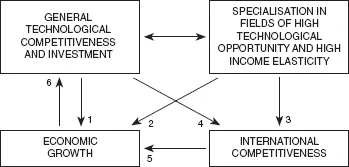
Figure 1.1 The framework of the book
The methodology
The contribution of this book is mainly empirical. As with any other empirical analysis, this research is inspired by the objective of trying to answer some theoretical and empirical issues. In particular, it tries to interpret some stylised facts on technical change, international competitiveness and economic growth, in the light of an eclectic theoretical approach.
The theoretical approach adopted in the book has already been presented in the previous section; here we want to clarify some methodological issues that arise from it. In the first place we want to emphasise that this work does not aim at discriminating between alternative theories of international competitiveness and economic growth. It rather aims at shedding some light on the factors lying behind uneven development and international competitiveness across countries. In doing so, we decided to work on some building blocks borrowed from various theoretical frameworks. This choice presents some drawbacks on the side of the theoretical rigour of the analysis but also has some advantages in the set of keys that it offers for interpreting a complex set of relationships.
We believe that the central theme of this book, the impact of technological specialisation on countries’ performance, can be analysed in depth only by taking into account, at the same time, technology and demand. Moreover we find that the Schumpeterian-evolutionary approach and the post-keynesian approach can be used together in order to enrich the theoretical framework without creating problems of conceptual inconsistency. The strong uncertainties that characterise the environment in which economic agents operate and their consequent suboptimal behaviour depicted by the Schumpeterian-evolutionary approach appear to us perfectly consistent with the macroeconomic problems of ex-ante disequilibrium between demand and supply depicted in the Keynesian tradition. The empirical character of our research, however, did not allow us to explore further the possible linkages in the areas of international competitiveness and economic growth between the Schumpeterian-evolutionary approach on one side and the post-keynesian approach on the other. This appears to us an interesting and promising area of research that is left for further investigation.
In the empirical analyses carried out in the different chapters of the book we take as the main unit of observation the nation state. The choice is dictated by the belief that nations are still relevant units of analysis for studying the processes of economic growth and innovation. This view is becoming controversial in the light of at least two recent trends: i) increasing internationalisation and globalisation of production and technology; ii) the process of European integration. Increasing internationalisation and globalisation leads to increasing interdependence among countries’ economic and technological performance and affects the role of government as an agent of national economic policy (Dunning, 1997). European integration calls for a harmonisation of European policies and infrastructures. Nevertheless we share the view that typically national features such as the education system, the system of university research and public laboratories, the laws, financial institutions and other public infrastructure are still largely national and affect countries’ technological and economic performance (Nelson, 1992). Moreover the type of activity that a country attracts, in the international division of labour, depends upon its specific local capabilities and institutions, and national differences may be reinforced by the locational decisions of multinational corporations (Cantwell, 1992). For these reasons we have chosen to study the processes of innovation, international competitiveness and economic growth at the level of the country. Finally, as we think that countries’ overall performance is not independent from the composition of their technological and trade activities, we have also used more disaggregated data in order to measure the distribution of national activities across technologies and sectors within each country.
In the various chapters of the book we have used different quantitative tools with the aim of collecting a large body of empirical evidence and testing the robustness of our results to various specifications. In Chapter 4 we have started to investigate the role played by specialisation on performance using the analyses of constant market share, correlation and regression on dummy variables. These quantitative tools offer some instruments for examining the behaviour of single variables (in the case of constant market share analysis), the relationship between two variables (in the case of correlation analysis) and the relationship between multiple but relatively uninformative variables (in the case of regression on dummy variables). In Chapters 5 and 6 these tools have been complemented by the use of multivariate regression analyses that allow taking into account the simultaneous interaction of various independent factors on the dependent variable. This is particularly important as we are convinced that the effect of specialisation on growth and international competitiveness cannot be understood without incorporating the simultaneous processes of catching-up, investment and general innovative efforts. Moreover the refinement of the econometric methodologies used for dealing with panel data have allowed us also to take into account national specificity that cannot be directly measured (such as organisational features). In Chapters 6 and 8, in the context of panel data estimation, we have used a stochastic parameter estimation that is suited to dealing with the empirical specifications where the estimated coefficients are functions of some exogenous variables. This methodology has been used both for allowing the income elasticities of export to depend on specialisation across countries (Chapter 6) and for capturing the effects of the degree of openness on the elasticity of exports to price and non-price factors over time (Chapter 8). Finally, in the analysis carried out in Chapter 7, we have made use of econometric techniques used for dealing with the estimation of simultaneous equations (in particular linear and non-linear two-stage least squares). These tools have allowed us to investigate the role of specialisation and of price and non-price variables on economic growth in the framework of the balance-of-payments growth model, while taking into account some feedback mechanisms. A more detailed description of the methodologies used is reported in the respective chapters.
A major problem in most empirical analyses is the definition of the endogenous and exogenous variables. This is particularly so when examining a process of change that is driven from inside the system. In this respect we agree with the proposition that ‘The only truly exogenous factor is whatever exists at a given moment of time, as a heritage of the past’ (Kaldor, 1985, p. 61). However, when estimating a set of relationships it is necessary to specify some independent variables. In particular, in some chapters of the book when investigating some of the direct relationships highlighted in the figure presented in the previous section, we will often ignore feedback mechanisms. This does not mean that we are not aware of these mechanisms or that we underscore their importance, but that the focus of the analysis is not on them at that stage. Keeping in mind that econometric exercises are only a tool for investigating economic relationships, we have tried to complement them throughout the analysis with the discussion of the results found by other qualitative and quantitative studies. Finally, we have aimed at keeping the empirical work as close as possible to the theoretical discussion.
The measurement of specialisation
Since the main aim of this book is to assess whether countries’ perfor...
Table of contents
- Front Cover
- Half Title
- Series
- Title Page
- Copyright
- Contents
- List of tables
- List of figures
- Foreword
- Acknowledgements
- 1 Introduction
- 2 The role of specialisation within different theoretical approaches to trade and growth
- 3 Stylised facts emerging from the empirical literature on technology, trade and growth
- 4 The relationship between the composition of national activities and country performance: a preliminary analysis
- 5 The impact of specialisation in areas of strong technological opportunity for economic growth
- 6 The impact of technology and income elasticities of demand on international competitiveness
- 7 Technological specialisation and national performance in a balance-of-payments constrained growth model
- 8 The impact of increasing openness on the sensitivity of export shares to price and non-price competitiveness
- 9 Conclusions
- Bibliography
- Index of names
- Subject index
Trusted by 375,005 students
Access to over 1.5 million titles for a fair monthly price.
Study more efficiently using our study tools.
Frequently asked questions
Yes, you can cancel anytime from the Subscription tab in your account settings on the Perlego website. Your subscription will stay active until the end of your current billing period. Learn how to cancel your subscription
No, books cannot be downloaded as external files, such as PDFs, for use outside of Perlego. However, you can download books within the Perlego app for offline reading on mobile or tablet. Learn how to download books offline
Perlego offers two plans: Essential and Complete
- Essential is ideal for learners and professionals who enjoy exploring a wide range of subjects. Access the Essential Library with 800,000+ trusted titles and best-sellers across business, personal growth, and the humanities. Includes unlimited reading time and Standard Read Aloud voice.
- Complete: Perfect for advanced learners and researchers needing full, unrestricted access. Unlock 1.5M+ books across hundreds of subjects, including academic and specialized titles. The Complete Plan also includes advanced features like Premium Read Aloud and Research Assistant.
We are an online textbook subscription service, where you can get access to an entire online library for less than the price of a single book per month. With over 1.5 million books across 990+ topics, we’ve got you covered! Learn about our mission
Look out for the read-aloud symbol on your next book to see if you can listen to it. The read-aloud tool reads text aloud for you, highlighting the text as it is being read. You can pause it, speed it up and slow it down. Learn more about Read Aloud
Yes! You can use the Perlego app on both iOS and Android devices to read anytime, anywhere — even offline. Perfect for commutes or when you’re on the go.
Please note we cannot support devices running on iOS 13 and Android 7 or earlier. Learn more about using the app
Please note we cannot support devices running on iOS 13 and Android 7 or earlier. Learn more about using the app
Yes, you can access Technology, Trade and Growth in OECD Countries by Valentina Meliciani in PDF and/or ePUB format, as well as other popular books in Business & Business General. We have over 1.5 million books available in our catalogue for you to explore.