eBook - ePub
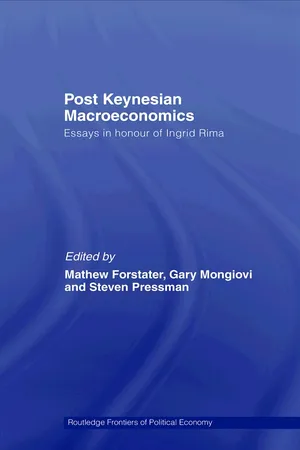
Post-Keynesian Macroeconomics
Essays in Honour of Ingrid Rima
- 240 pages
- English
- ePUB (mobile friendly)
- Available on iOS & Android
eBook - ePub
Post-Keynesian Macroeconomics
Essays in Honour of Ingrid Rima
About this book
Edited by three very well known academics in the field and contributed to by John Smithin, Laurence Moss and G. C. Harcourt, this volume reflects the breath of the honouree's interests and as such it covers a wide range of topics including political economy, labour economics, history of economic thought and macroeconomics.Ingrid Rima, one of the fi
1 Ingrid Rima and Post Keynesian macroeconomics
Steven Pressman
Post Keynesian economics developed in the latter half of the twentieth century, following publication of the General Theory (Keynes, 1964 [1936]). Some of the main figures in this endeavor were Paul Davidson, John Kenneth Galbraith, Nicholas Kaldor, Michal Kalecki, Joan Robinson, and Sidney Weintraub (see King, 2002). Their key insight was the theory of effective demand and its consequences – it is spending that drives macroeconomic performance, a monetary production economy can experience prolonged bouts of high unemployment, and economic policies are needed to assure full employment, low inflation, and stable financial markets.
For Post Keynesians, the key macroeconomic problem has always been unemployment. While the mainstream views unemployment as a temporary problem that will go away in the long run if wages, prices, and interest rates were sufficiently flexible, Post Keynesians see unemployment as a problem that will not go away unless macroeconomic policies are used to create jobs. Most of the figures instrumental in developing Post Keynesian economics made this point about unemployment by focusing on aggregate macroeconomic models. These models explained how the level of output for the whole economy depended on effective demand, and how unemployment could exist, and why it would persist, whenever demand and output were insufficient.
One drawback to this approach is that ignores real world labor markets. It is, of course, in the labor market that employment decisions get made and that unemployment arises when there are insufficient jobs to meet the needs of a nation’s citizens. Neoclassical economics has pointed out that sufficiently flexible markets will clear. Thus, the unemployment problem would tend to get resolved by itself if wages fell and approached the marginal productivity of workers whenever there was high unemployment. This leads to the main policy conclusion of neoclassical economics – that macroeconomic policies were irrelevant and might do more harm (generating inflation) than good. Instead, we need to make labor markets more flexible and more like the perfectly competitive markets that exist in neoclassical models.
It is within this context that Ingrid Rima has made her main contribution to Post Keynesian Economics. She has examined involuntary unemployment as a result of what happens in real world labor markets. She has argued continuously against the neoclassical view that employment in labor markets is determined mainly by the demand for labor, which, in turn, depends on the marginal productivity of workers. And she has moved Post Keynesian economics forward by arguing that employment outcomes in labor markets are not just due to inadequate demand; they are also due to labor market institutions, history, power, and technological, sectoral, structural, and global changes. Unemployment is the result of how these myriad factors impact on labor supply and demand.
Taking on the neoclassical position, Rima (1984a, 1984b, 1986b) has attempted to explicate Keynes’s notion of involuntary unemployment, and has argued that viewing unemployment as involuntary makes more sense than the job search models that have fascinated labor economists over the past three to four decades. In addition, she has attempted to bring out the neglected second strand of the economics of Keynes. Seeking to understand how labor markets actually function, and how they are related to the macroeconomy, has led logically to a concern with wages, with income distribution, and with poverty. This set of problems is what Robinson (1972) called, in her Presidential Address to the American Economic Association, “the second crisis of economic theory.”
In attempting to understand and explain both unemployment and the maldistribution of income, Ingrid has brought to labor economics many of the key insights from Post Keynesian economics – the importance of history (rather than equilibrium), the use by firms of markup or cost-plus pricing over (mainly labor) costs, and the importance of wage-setting institutions (rather than marginal productivity theory) to explain wages. More importantly, following the lead of Robinson, she (Rima, 2003) has argued that the level of money wages is an historical accident that depends on the ability of workers to maintain relative wage rates. It depends on things like history, institutions, and the bargaining power of workers. This is one of the key factors that keep wages from adjusting when unemployment rates are high. But Ingrid has also brought to the analysis of unemployment and inequality her own unique perspective, one that has been neglected by both the mainstream and Post Keynesians. This analysis has focused on sectoral changes in employment, and the existence of dual labor and product markets, especially in a global economy, as main causes of unemployment and income inequality; and it has led Ingrid to call for worker training, public sector employment, and wage subsidies for the working poor (Rima, 1996, 2000b, 2003).
Ingrid was born in Barmen, Germany, not far from Cologne. Around a year after her birth, her parents arrived in the United States. She grew up in Brooklyn, New York, where her father worked as a textile engineer. Both her parents stressed the importance of education, and Ingrid listened to their advice – taking the college preparatory track rather than the commercial track in high school.
After high school, Ingrid did her undergraduate work at Hunter College in New York City. Besides studying dance, Ingrid took a course in price theory. As she has told Olson and Emami (2002, p. 19), she “loved all those graphs that looked so beautiful and orderly, and thought market equilibrium was quite an extraordinary phenomenon. . . . I thought that the most beautiful concepts in the world were marginal cost and marginal revenue.”
Fortunately, her mentors at Hunter were Dorothy Lampen, author of Adam Smith’s Daughters, and Hazel Roberts, a leading scholar on the economics of Physiocrat Marshall Vauban (Olson and Emami, 2002, pp. 19–20). Lampen and Roberts introduced Ingrid to the history of economic thought. Two early figures intrigued her most – William Petty and François Quesnay (Rima, 2005). Both were physicians before they began to study economics; as such, when approaching economic questions, their instincts were to come up with solutions to the problems faced by individuals. This became the hallmark of Ingrid’s approach to economics – the economy can develop illnesses, and it is the job of the economist to understand the causes of the disease and also figure out what can be done to heal the ailing patient. Besides Petty and Quesnay, Ingrid also studied Marshall, Robinson’s (1933) Economics of Imperfect Competition, and Keynes. A careful reading of the General Theory led logically to an interest in the problem of unemployment.
After graduating from Hunter in 1945, Ingrid applied to several graduate programs in economics. She chose to attend the University of Pennsylvania because it was not in New York and also not far from New York. At Penn she specialized in monetary and international theory, as well as industrial relations, the closest thing to the field of labor economics at the time. Sidney Weintraub arrived at Penn shortly after Ingrid began studying there and soon became her mentor. Weintraub sparked her interests in macroeconomics and introduced her to Post Keynesian thinking (Olson and Emami, 2002, p. 27). Her M.A. thesis was on equilibrium exchange rates. After receiving her M.A. in 1946, she was offered a research position at the Federal Reserve Bank of Philadelphia. One of her professors at Penn told her that Temple University was expanding. Ingrid applied for a job, received an offer, and accepted a teaching position there. Since 1947 she has taught at Temple University. She became an assistant professor after receiving her Ph.D. (in 1951) following the successful defense of her dissertation on public utility rate making. In 1967 she became a full professor. As Ingrid has remarked: “In a sense, 1967 is when my life as an economist began. The only date that really counts is 1967. . . . Until then nobody took me seriously (Olson and Emami, 2002, p. 24).
Ingrid has certainly been taken seriously as an economist, and has also been remarkably productive as a scholar. She has served (in 1993–94) as President of the History of Economics Society. Perhaps more important, Ingrid was one of the founders of the Eastern Economic Association in 1974, and served as editor of the Eastern Economic Journal from 1979 to 1991. Besides establishing the principle that the journal would be an open forum for all perspectives in economics and all areas of specialization, she also established the practice of double-blind refereeing, something that is now common in economics but was not common when Ingrid introduced it. Several contributors to this volume (Bober, Moss, Pressman, and Smithin) were appointed to the Editorial Board of the Eastern Economic Journal and mentored by Ingrid. Two (Moss and Pressman) followed in Ingrid’s footsteps, becoming journal editors themselves.
Ingrid’s scholarly output includes numerous books and journal articles covering a wide range of topics in labor economics, the history of economic thought, international economics, and macroeconomics. Taken as a whole, what is perhaps most remarkable about Ingrid’s scholarly work is its great range. Besides her main fields, the history of economic thought and labor economics from a global and macroeconomic perspective, she has written on poverty (Rima, 1986b, 1990), on technical change and innovation (Rima, 1989), and on the history of econometrics (Rima, 1988, 1995). Such breadth has been one of Ingrid’s greatest strengths as an economist and a scholar.
Continuing her early interests in the history of economic thought, Ingrid has written extensively on Alfred Marshall, John Maynard Keynes, and Joan Robinson (Rima, 1986b, 1988, 1990, 1991, 2003). Her Development of Economic Analysis (Rima, 2000a) is one of the best-selling history of economic thought textbooks, and will soon be in its seventh edition. It has introduced tens of thousands of students to the history of economic thought. An edited volume honoring Joan Robinson (Rima, 1991) explores the important contributions of this important Post Keynesian economist. Ingrid’s essay in the Robinson volume draws attention to Robinson’s contribution to the Keynesian Revolution. She notes that “It was Robinson who pushed Keynes to recognize the revolution he precipitated stemmed from his abandoning the concept of equilibrium to move toward that of history” (Rima, 1991, p. 196).
A concern with getting history right is evident in Ingrid’s work on Alfred Marshall and labor markets. Rima (1986a) makes clear that Marshall was not responsible for the conventional wisdom that remuneration to factors of production is governed by the same principles that determine commodity prices. Labor markets are thus different from other types of markets for Marshall, a position that is similar to Keynes in the General Theory and to the view that Rima has stressed throughout her career.
Ingrid’s interests in the history of thought, labor economics from a macroeconomic perspective, and the real world consequences of unemployment all converge in a paper on Marshall’s view of poverty (Rima, 1990). In the second edition of the Principles, Marshall identified a growing residuum of individuals who were incapable of doing a good day’s work or earning a decent wage. Rima argues that Marshall was concerned with this residuum on humanistic as well as moral grounds, and that he was interested in developing policies to assist the poor. At an analytic level, Marshall was concerned with explaining the existence of this residuum. Rima then shows that Marshall’s inquiry into labor market peculiarities bridges the gap between his analytic and humanistic concerns. Chapters 4 through 6 (Book VI) of the Principles trace the problem of the residuum to the disadvantages of labor in wage bargaining. Poverty persists from generation to generation, according to Marshall, because nothing is done to break the cycle of poverty or improve the bargaining position of labor.
This analysis has numerous linkages with Post Keynesian thought. It emphasizes history and cumulative causation rather than equilibrium, it sees wages as determined by some bargaining process rather than by worker productivity, and it focuses on the real world problems of poverty and income distribution. It also dovetails with the analysis of Galbraith (1958, 1964, 1979) concerning the causes of poverty in both the United States and the developing world.
More recently, as globalization has become increasingly important, Ingrid has turned her attention to the global economy. The global economy is important because it changes the dynamics of the labor market (Rima, 1996, 2000b). For example, US workers in a global economy have to compete not only against other US workers with similar characteristics, expectations, and living standards, but they also must compete with workers in less developed countries. In many of these places, workers receive a good education and acquire the skills necessary to compete with US workers. They also live in places where the average living standard is one-fifth or less of US living standards, and where US laws that seek to prop up wages and demand (e.g., minimum wage laws) and establish a certain level of working conditions do not apply. For all these reasons, this leads to an exodus of jobs from the US to these less developed nations. But this movement also leaves many problems in its wake; these are all problems related to the labor market – unemployment and greater income inequality.
In the spring of 1991, Ingrid organized a conference in Rome on economic restructuring that examined the causes and the consequences of globalization, and set forth policies to deal with the challenges of globalization. The two conference volumes (Rima, 1993) demonstrate both Ingrid’s breadth and her Post Keynesian orientation. The papers in these volumes address the stability in the world economy as globalization proceeds, and many papers discuss trying to how we might achieve stability and full employment in a global economy.
The essays that comprise the rest of this volume all touch, and expand, on some of the main ideas and contributions of Ingrid Rima. The first four chapters, comprising Part I of this volume, make connections between Post Keynesian economics and earlier economic thinkers.
Ingrid’s early interest in the work of Quesnay was noted previously. Chapter 2 traces some of the main ideas of Keynes and the Post Keynesians back to the work of François Quesnay in the eighteenth century. According to Pressman, there are several things that Quesnay and Post Keynesian economics have in common. Both developed macroeconomic models that could explain economic fluctuations and that did not result in highly desirable outcomes. Quesnay showed how it was possible that economies could continue to decline year after year, and how after years of decline there was no guarantee of greater economic growth; similarly, Keynes and the Post Keynesian showed how unemployment equilibria could persist without appropriate economic policies. In addition, both Quesnay and the Post Keynesians hold that money is not neutral in the economy, but has real economic effects. Next, both believe that investment determines savings, rather than vice versa. In addition, both Quesnay and the Post Keynesians have developed economic models which explain how demand for the goods of different economic sectors can lead to either growth or economic decline. Finally, both employ sequential models, where history is important, rather than general equilibrium models, where everything happens all at once.
In Chapter 3, Stanley Bober discusses the importance of Marx and the relationships between Marx and Post Keynesian economics. He first considers the philosophical basis of Marx’s work and his essential message. Then he talks about the relevance of Marx in today’s global economy. Current interest in Marx, according to Bober, stems from several factors. Especially important are weaknesses in the foundation of orthodox economics, the reemergence of labor exploitation, and the continuous assault on worker rights in a global economy. Bober argues that if this revival of Marx is to be successful, it must resonate with the current political and social context. This means that Marxists need to be in the forefront of putting worker rights on the same plane with human rights, and to insist that worker rights be part of the democratic institutional arrangements that exist in every country. By focusing on the impact of free markets on labor, and the importance of political power in guaranteeing worker rights and higher labor incomes, a great deal of common ground can be found between Marxists and Post Keynesians.
In Chapter 4, Geoff Harcourt expands upon this theme, and notes a number of other connections between Marx and Keynes. Both figures shared similar views of how capitalist economies work, views that differ greatly from most contemporary attempts to understand capitalism. The main difference between Marx and Keynes concerns how they viewed the economic problems that spring forth under capitalism. Keynes saw these problems as a challenge, and he sought to devise economic policies that would save capitalism and let us reap the benefits of its efficiencies without suffering from its dark side. In contrast, Marx saw these problems as signs of the inherent instability of capitalism and evidence of its ultimate demise.
In Chapter 5, Maria Cristina Marcuzzo and Eleonora Sanfilippo look at the history of the notion that profit maximization guides the behavior of entrepreneurs. Marshall (1920) developed the MC = MR profit-maximizing rule for firms. Keynes (1964 [1936]) accepted this as a good short-run decision rule, as did Robinson and many others at Cambridge in the 1930s and 1940s; but Keynes stressed that investment in new plants and equipment involves a great deal of uncertainty and is not subject to this sort of calculation. As a result, the profit-maximization rule of Marshall could not hold for these long-run investment decisions. But Keynes and most Post Keynesian held that Marshall’s maximization rule operated in the short run. It is only with the work of Kalecki that short-run entrepreneurial behavior becomes dependent on customs, habits, and the opinions of other entrepreneurs. At this point in time we move from the Marshallian MC = MR approach to the Post Keynesian approach of markup or costplus pricing (see Lavoie, 2001). However, as Marcuzzo and Sanfilippo show, Robinson and Richard Kahn remained skeptical of both Kalecki’s work on pricing and the markup approach. So this did not become part of the early Post Keynesian approach to pricing. One important implication of this chapter is that Post Keynesian pricing theory may not have really begun until the mid-1970s. Only with the notion that the markup is determined by the funds needed for investment and firm growth (Harcourt and Kenyon, 1976), did the markup approach become generally accepted by Post Keynesians. With this doctrine Post Keynesians eschew that macroeconomics have microeconomic foundations, argue that they have given microeconomics good macrofoundations, and begin to link up what happens in macroeconomic models to what happens in labor and product markets.
The second part of this book contains a set of chapters that focus on Post Keynesian macroeconomics and Post Keynesian models.
In Chapter 6, Richard P.F. Holt presents the f...
Table of contents
- Cover Page
- Title Page
- Copyright Page
- Contributors
- 1 Ingrid Rima and Post Keynesian macroeconomics
- Part I: Historical antecedents
- Part II: Post Keynesian macroeconomics
- Part III: Post Keynesian macroeconomics in a changing world
Trusted by 375,005 students
Access to over 1.5 million titles for a fair monthly price.
Study more efficiently using our study tools.
Frequently asked questions
Yes, you can cancel anytime from the Subscription tab in your account settings on the Perlego website. Your subscription will stay active until the end of your current billing period. Learn how to cancel your subscription
No, books cannot be downloaded as external files, such as PDFs, for use outside of Perlego. However, you can download books within the Perlego app for offline reading on mobile or tablet. Learn how to download books offline
Perlego offers two plans: Essential and Complete
- Essential is ideal for learners and professionals who enjoy exploring a wide range of subjects. Access the Essential Library with 800,000+ trusted titles and best-sellers across business, personal growth, and the humanities. Includes unlimited reading time and Standard Read Aloud voice.
- Complete: Perfect for advanced learners and researchers needing full, unrestricted access. Unlock 1.5M+ books across hundreds of subjects, including academic and specialized titles. The Complete Plan also includes advanced features like Premium Read Aloud and Research Assistant.
We are an online textbook subscription service, where you can get access to an entire online library for less than the price of a single book per month. With over 1.5 million books across 990+ topics, we’ve got you covered! Learn about our mission
Look out for the read-aloud symbol on your next book to see if you can listen to it. The read-aloud tool reads text aloud for you, highlighting the text as it is being read. You can pause it, speed it up and slow it down. Learn more about Read Aloud
Yes! You can use the Perlego app on both iOS and Android devices to read anytime, anywhere — even offline. Perfect for commutes or when you’re on the go.
Please note we cannot support devices running on iOS 13 and Android 7 or earlier. Learn more about using the app
Please note we cannot support devices running on iOS 13 and Android 7 or earlier. Learn more about using the app
Yes, you can access Post-Keynesian Macroeconomics by Mathew Forstater,Gary Mongiovi,Steven Pressman in PDF and/or ePUB format, as well as other popular books in Business & Business General. We have over 1.5 million books available in our catalogue for you to explore.