- 404 pages
- English
- ePUB (mobile friendly)
- Available on iOS & Android
eBook - ePub
About this book
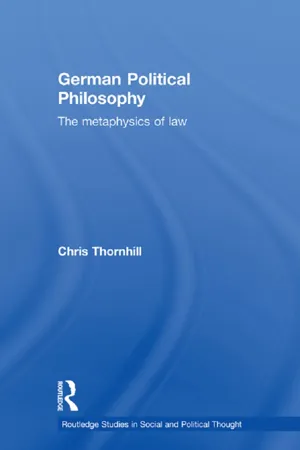
This book combines philosophical, intellectual-historical and political-theoretical methodologies to provide a new synoptic reading of the history of German political philosophy. Incorporating chapters on the political ideas of Luther and Zwingli, on the politics of the early Enlightenment, on Idealism, on Historicism and Lukács, on early Twentieth-Century political theology, on the Frankfurt School, and on Habermas and Luhmann, the book sets out both a broad and a detailed discussion of German political reflection from the Reformation to the present. In doing so, it explains how the development of German political philosophy is marked by a continual concern with certain unresolved and recurrent problems. It claims that all the major positions address questions relating to the origin of law, that all seek to account for the relation between legal validity and metaphysical and theological superstructures, and that all are centred on the attempt to conceptualise and reconstruct the character of the legal subject.
Information
1 The Reformation and the Loss of Law
Against Natural Law
The philosophical background of Luther’s theology was shaped by a series of debates about the law, so that his religious ideas necessarily evolved, in part, within a set of legal references and discussions. The prevailing philosophical controversy in German universities in the latter part of the fifteenth century was the debate between the realists and the nominalists, in which realists, or the Thomists, represented the so-called via antiqua, and the nominalists, or Ockhamists, represented the via moderna. The increasingly influential nominalist view in these controversies was founded in the belief that God is essentially will, and that God’s redeeming freedom in human history is an act of divine will, and is not tied to rational normative preconditions. The nominalists opposed the intellectualist claims of Thomism, they negated the Thomist presupposition that there exists an eternal metaphysical law in nature, or that the universe is an ‘organic whole’ in which all things are connected ultimately to the divine mind,1 and they rejected the central Thomist assumption that the church and the state form an insoluble legal unity.2 The via moderna, therefore, contained an attack on the ideas of divinity as an intellectual essence promoted by medieval scholasticism and an attack on the legal and institutional doctrines rising from medieval ius-naturalism, which presupposed that the laws of the world exist in continuity with God’s will and God’s reason, and that human action and human politics can be evaluated by their proximity to this will and this reason. Underlying the philosophical environment from which Luther emerged there was thus an increasing willingness to construe God’s freedom in volitional terms, and to question whether God might be construed as a juridical presence in the world, accessible to human reason and manifest in clear prescriptions for individual moral and collective political order.
The influence of Ockhamist nominalism on Luther was perhaps rather vague and indirect.3 However, in certain respects Luther’s early writings contain an intensification of ideas associated with late medieval nominalism and the via moderna. Fundamental to Luther’s first writings is the claim that there exists an opposition between faith and law, and that conformity with law cannot bring salvation. Indeed, at the heart of these works is a rejection of the defining view of medieval Thomism: namely, that God’s will is evident in the positive legal order of the world, and that human beings can use their rational powers to understand the foundations of this originary metaphysical order and shape their own wills in accordance with it. Instead, Luther saw God as removed and remote, as absolutely free, and so as evident only in faith, not demonstrable or manifest in any metaphysical scheme or any stable system of law. In this, he extended the voluntaristic conceptions of the via moderna, and he argued that God exercises his will with absolute freedom in the world, and inhabitants of the world, where they do not have faith, can only despair over their inability to appreciate and obey God’s will and God’s law. No element of worldly ordinance can, in consequence, be placed on a continuum with God’s will, and there is no necessary or intellectual unity either between God’s will and human reason, or between God’s will and the laws used to govern human societies. No law, Luther indicated simply, can begin to form an adequate reflection of God; no action or works in conformity with law can lead to justification before God; and human reason cannot obtain laws that unite it, in metaphysical knowledge, with God’s will.
Luther initially elaborated this opposition between faith and law in his very early interpretation of what was ultimately to become the one of the central texts of Reformation theology: St Paul’s Epistle to the Romans.4 Commenting on this Epistle, he explained that obedience to the law cannot lead to human salvation. In fact, obedience to the law leads to pride and ‘self-glorification’, and it obstructs true faith by promising salvation as the entitled reward for outward human activity.5 Justification can only occur as a passive experience of grace, which God ‘enacts by acting upon us’, without any concern for our ‘works and deserts’.6 The path to salvation is through faith alone, not through works demonstrating compliance with law.
In this argument, Luther addressed one of the fundamental problems in the history of Christian doctrine: that is, the problematic relation between the Old Testament and the New Testament, and the relation of Mosaic law to faith in Jesus Christ. In his treatment of this, he followed Augustine’s anti-Pelagian approach, and he insisted on the primacy of the New Testament and faith over the Old Testament and law, and he stated that only a direct reading of the New Testament, and the faith that this might inspire, can make salvation possible. This argument referred primarily to the salvation of souls: it claimed that no external displays of devotion or righteousness can lead to justification before God, and that the religious orders that confuse law and faith or place law before faith threaten the souls of their adherents. In addition, however, this argument also contained implications for wider legal and political concerns: it implied that true law is not expressed as natural or material ordinance, but that the true law is the new law, the invisible law of a community united in Christian faith alone, and only this law can bring salvation. Unlike purely antinomian or Gnostic theologians, Luther did not entirely reject the Old Testament, or the elements of Christian natural law founded in the Decalogue. He claimed that the moral codes in the Old Testament might be accepted as long as they serve interests of public order and help to protect Christians from the evil deeds of the ungodly. Indeed, his teaching also intermittently expressed a minimal conception of natural law, and he was prepared to accept as natural those laws preserving outer conditions of stability and reflecting a general human interest in peace and security. He, therefore, saw the Old Testament as expressing a natural law of practical utility, which is ‘written in the hearts of all men’, and contains certain universally acceptable precepts.7 Nonetheless, he viewed ‘natural law’ as, by definition, a limited law, and he saw the validity of such law as restricted to the human person in its natural condition, without relevance to the person as a bearer of faith. Moreover, he argued that natural law is the law of the Jews: he described the Decalogue as ‘the common law [Sachsenspiegel] of the Jews’.8 Such law is contaminated by worldly pride and false piety, and it is the law of those who ‘boast about the law which they have received and brag that they are its adherents and followers.’9 Above all, natural law is the law of those who cannot ascend to the new law of faith and whose legal compliance is limited to outward things, and obedience to this law does not elevate the person to the level of a true Christian.10 Natural law, in short, cannot express an embracing continuity between divine and human law. It is essential to natural law that it applies to all people, Christians, Jews and heathens, and it cannot be viewed as a medium of grace, which is offered only to Christians.11 Natural law applies to that realm of natural life where there is no faith.
Luther’s early attack on natural law was specifically designed as an attack on Roman Catholicism and on the scholastic orthodoxy of Aquinas, and it immediately touched at the nervous centre of Roman Catholic orthodoxy.12 Aquinas also argued that compliance with the law of the Old Testament cannot confer grace without faith. However, Thomism assumed a partial continuity between the law of the Old Testament and the faith of the New Testament; it argued that the natural law of the Old Testament anticipates and foreshadows the salvation eventually to be brought by Christ, and that even ceremonial laws bring humanity close to God. Moreover, Aquinas also saw the pope as a privileged interpreter of the eternal law, and he viewed the church as the primary custodian of the law.13 For Aquinas, in short, God’s grace possesses a juridical nature; he saw obedience to laws, sanctioned by the church, as a primary means of obtaining grace, and he saw the church as responsible for guiding people towards legal obedience and towards salvation. Luther, in contrast, argued that faith is corrupted by the law, that belief in natural law exaggerates the extent of human knowledge and allows people to assume salvation without true faith. The belief in natural law, therefore, persuades people that they can be saved without faith, and it dilutes the urgency with which each person seeks salvation through faith. A ‘Christian person’, Luther explained, ‘has enough in faith, so that he does not need works to be pious’, and whoever has faith is ‘delivered from all commandments and laws.’14 The institutions of the Roman Catholic Church, he concluded, are founded on the false precondition that the administration of law facilitates salvation, and that God’s will can be made legally apparent as a certain path to salvation, and, in offering indulgences and dispensations for sins, they assert their own legal order to the detriment of Christian souls. In his polemics on this matter, he demanded a complete segregation of faith and law, arguing that the church should have power only in the resolution of spiritual questions,15 and that matters of secular law should be left to ‘worldly judges’.16 ‘There is’, he concluded, ‘no power in the church’, except the power of spiritual improvement,17 and the claim that representatives of the church might possess any legal authority is a Pelagian heresy, which endangers the souls of the members of the church.18
The Gemeinde and the Two Kingdoms
Central to the practical implications of Luther’s theology is the belief that the church only exists as a pneumatic community, or as a pure community of believers, not as a hierarchical, legally ordered or metaphysically representative institution. He saw the church as an invisible community, whose offices are restricted to teaching and biblical interpretation, whose members are united by faith alone, not by law, as a universal priesthood. All Christians, he explained, are ‘the brothers of Christ’ and all are ‘consecrated as priests’.19 In this respect, Luther took the charismatic communes of the early church as the model for a reorganization of ecclesiastical life, and he argued that the principle of universal priesthood meant that the parish or commune (Gemeinde) should be seen as the centre of all religious life and should replace the hierarchical order of the Roman Catholic Church. The episcopate and the ordained priests of the Roman church do not truly constitute a Gemeinde, he argued.20 The bishops and the priests of the papacy, he explained, have corrupted the New Testament through the representative legal order that they have imposed upon the church. It is only where it divests itself of law that a church becomes a true Gemeinde, founded in faith and truth. In an authentic church, Luther concluded, members of the Gemeinde give laws in accordance with the scriptures alone, without reliance on natural laws or any laws external to the common unitary experiences of faith.21
In its original articulation, the concept of the Gemeinde was not focused solely on the church, and it envisaged an ideal of the self-organizing community, which implicitly expanded beyond religious life and administration. In fact, Luther’s early anti-legal strictures reflected a wider attitude, which attacked the concentration of power in both ecclesiastical and secular jurisdiction. The conflation of law and faith in the church, he claimed, had created a realm of ‘priestly tyrants’, who distortedly interpreted Christianity as a doctrine of ‘worldly authority’.22 In secular life, then, the law served to bolster the standing of the outwardly ‘powerful and the wise’, whose claims to social dignity were based on illusions of virtue, obtained through law.23 In his earliest works, Luther questioned the right of ‘worldly princes and rulers’ to take common goods from their subjects; he opposed the emerging hierarchical government under Roman law; and he suggested that ‘the law and morals of the land’, not the newly received Roman law, should act as the basis for legal ruling. God had ordained, he concluded, that ‘every land has its own manner and talents, and should be governed by its own simple laws’.24 The early doctrine of the Gemeinde integrated in faith alone was thus first conceived as a radically egalitarian doctrine, which condemned the authority of law in both religious and worldly contexts, which denounced false piety and socially instituted displays of esteem and worth, and which sought to bind all people under shared laws. In this respect, therefore, Luther used his broad anti-legalism as a vehicle for criticizing secular law, and for demanding that all law should draw from a common source. In the Gemeinde, he stated, people are bound by internally held laws: ‘each is the judge of the other, and in turn also subject to the other’, and faith places all people on equal legal footing.25 Moreover, the members of the Gemeinde are, in so far as they are guided by the scriptures, entitled to assume authority for themselves and to organize their communities as they see fit.26
Despite this, however, Luther’s account of the Gemeinde remained highly equivocating in the political role that it imputed to the community united in faith. His idea of the Gemeinde was primarily concentrated on questions of religious organization, teaching and appointment, not on the formation of secular or worldly power. Indeed, despite the critical aspects of his earliest reflections on worldly law, in his later theoretical career he was unwilling to accept that the religious community could produce laws for worldly organization. The Gemeinde, he argued, has power and freedom only in religious matters, and it only obtains this power and freedom because of its objective inspiration by the New Testament. In all other matters, the Gemeinde is obedient to worldly laws. ‘Christ speaks’ in the Gemeinde, Luther stated. But in the world ‘the authorities command what they want, and the subjects accept it.’27 At the heart of his mature idea of the Gemeinde is the claim that the realm of the inspirited community, integrated under new laws, cannot determine the realm of natural or objective authority: indeed, it is constitutive of new law that it does not have objective or material force.
In this light, the conception of the law in the early Reformation appears as a complex and dialectical form. At one level, Luther identified the religiously inspired community, divested of the legal, hierarchical and metaphysically representative order of the Roman Catholic Church, as the locus of human freedom and integrity – as the congregation of the universal priesthood. He saw this as a community of equals, bound only by very rudimentary forms of external law and internally united by the invisibly experienced regime of faith. At the same time, however, he saw this community, to a large extent, as the community of faith alone, largely defined by the fact that it is not political. Central to the idea of the Gemeinde, therefore, is the belief that worldly power and spiritual power form two quite distinct areas of human existence, or two separate kingdoms, that each of these kingdoms should acknowledge that it is limited by ...
Table of contents
- Cover
- Half Title
- Title Page
- Copyright
- Dedication
- Contents
- Acknowledgements
- A note on texts and translations
- Introduction
- 1. The Reformation
- 2. The early Enlightenment
- 3. German idealism
- 4. Historicism and romanticism
- 5. The Young Hegelians and Karl Marx
- 6. Positivism and organic theory
- 7. The vitalist interlude
- 8. Neo-Kantianism
- 9. The Weimar Republic
- 10. Critical theory and the law
- 11. The dialectics of refoundation
- 12. Habermas and Luhmann
- Conclusion
- Notes
- Index
Trusted by 375,005 students
Access to over 1.5 million titles for a fair monthly price.
Study more efficiently using our study tools.
Frequently asked questions
Yes, you can cancel anytime from the Subscription tab in your account settings on the Perlego website. Your subscription will stay active until the end of your current billing period. Learn how to cancel your subscription
No, books cannot be downloaded as external files, such as PDFs, for use outside of Perlego. However, you can download books within the Perlego app for offline reading on mobile or tablet. Learn how to download books offline
Perlego offers two plans: Essential and Complete
- Essential is ideal for learners and professionals who enjoy exploring a wide range of subjects. Access the Essential Library with 800,000+ trusted titles and best-sellers across business, personal growth, and the humanities. Includes unlimited reading time and Standard Read Aloud voice.
- Complete: Perfect for advanced learners and researchers needing full, unrestricted access. Unlock 1.5M+ books across hundreds of subjects, including academic and specialized titles. The Complete Plan also includes advanced features like Premium Read Aloud and Research Assistant.
We are an online textbook subscription service, where you can get access to an entire online library for less than the price of a single book per month. With over 1.5 million books across 990+ topics, we’ve got you covered! Learn about our mission
Look out for the read-aloud symbol on your next book to see if you can listen to it. The read-aloud tool reads text aloud for you, highlighting the text as it is being read. You can pause it, speed it up and slow it down. Learn more about Read Aloud
Yes! You can use the Perlego app on both iOS and Android devices to read anytime, anywhere — even offline. Perfect for commutes or when you’re on the go.
Please note we cannot support devices running on iOS 13 and Android 7 or earlier. Learn more about using the app
Please note we cannot support devices running on iOS 13 and Android 7 or earlier. Learn more about using the app
Yes, you can access German Political Philosophy by Chris Thornhill in PDF and/or ePUB format, as well as other popular books in Philosophy & Philosophical Metaphysics. We have over 1.5 million books available in our catalogue for you to explore.