- 216 pages
- English
- ePUB (mobile friendly)
- Available on iOS & Android
eBook - ePub
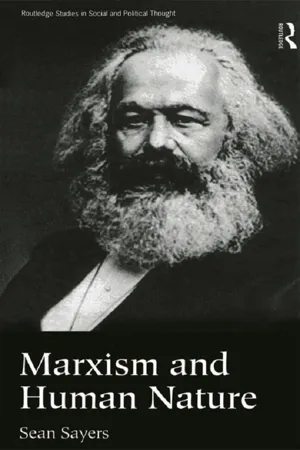
Marxism and Human Nature
About this book
Is there such a thing as human nature? Here Sean Sayers defends the controversial theory that human nature is in fact an historical phenomenon. He gives an ambitious and wide ranging defence of the Marxist and Hegelian historical approach and engages with a wide range of work at the heart of the contemporary debate in social and moral philosophy.
Information
Part I
WORK AND HUMAN NATURE
1
INTRODUCTION: HUMAN NATURE AS A HISTORICAL PHENOMENON
In this book I develop and defend a historical account of human nature and explore its moral and social implications. The main source for this account is the work of Marx and Hegel, and I present it as an interpretation of Marx’s philosophy. However, my primary concern throughout is with the ideas I am discussing rather than with questions of Marxist or Hegelian scholarship.
The concept of human nature is controversial these days, and the view that Marxism involves it is doubly so. On the one hand, it is sometimes said that we should reject the notion altogether and adopt an ‘anti-humanist’ or ‘anti-essentialist’ stance. Others argue that this leads inevitably to a disastrous sort of relativism. We must hang on to traditional enlightenment humanism, they insist, for social theory and critical values can be defended only on the foundation of universal and timeless features of human nature. Often these are presented as the only alternatives, and the attempt is made to force Marxism into one or other of these pigeonholes.
However, neither is satisfactory, either as an interpretation of Marxism or as an account of human nature. Marxism involves a Hegelian historicist account of human nature. This abandons the enlightenment project of looking for foundations in universal human nature; but it is not simply a sceptical, negative ‘anti-humanism’ which rejects the concept of human nature. Rather, Marxism involves a historical and social account of human needs and powers, and this leads to a historical form of humanism. My main purpose in this book is to develop and explore these ideas.
According to them, human beings are not the mere passive, individual consumers of so much liberal social thought: they are active, social and productive beings. Through their productive activity they not only bring about changes in the natural world, they also transform their social relations and their own natures. Human beings are both the subjects and objects of their own social productive activity (Lichtman 1990: 14); and human history is the story of this process of human self-creation. ‘The whole of what is called world history is nothing more than the creation of man through human labour’ (Marx 1844a: 357).
It is often thought that an account of this sort necessarily leads to scepticism and relativism. For by seeing human nature in a purely historical fashion, it is said, it abandons any hope of finding universal and fixed standards of what is human in terms of which we can assess present social conditions or advocate alternatives. This fear of relativism is perhaps the greatest barrier standing in the way of a proper appreciation of the historical approach. Throughout this book, and particularly in Part II, I argue that this fear is unwarranted. Far from undermining the possibility of a critical perspective, the historical approach gives moral values a determinateness and specificity lacking in traditional, ‘essentialist’ moral and social thought. It provides a concrete and realistic basis for an ideal of human fulfilment and self-realization which is fundamental to the moral vision of Marxism.
As a way into these issues, I begin with a discussion of Mill’s dictum that it is ‘better to be Socrates dissatisfied than a fool satisfied (Mill 1863: 9). This embodies the idea that we have ‘higher’ needs, and that human fulfilment is a matter of what Mill calls ‘self-development’. These notions cannot be reconciled with the simple hedonist assumptions of utilitarianism, which Mill also professes. Nevertheless, Mill gives one of the best accounts of a certain non-utilitarian strand of thought about human nature and human fulfilment, which also underlies Marxism.
However, there are also other and less satisfactory aspects to Mill’s philosophy which Marx’s approach usefully illuminates. As is often noted, Mill’s dictum involves an elitist opposition of mental to manual activities. Mill puts a one-sided value on the mental and cultured activities of the likes of Socrates, and he denigrates the physical and sensual life of the ‘fool’. Marxism, by contrast, involves an ideal of all-round human development involving both of these kinds of activities. It puts forward a notion of human fulfilment which includes the full development and exercise of all our powers and capacities.
The cultivation of all the qualities of the social human being, production of the same in a form as rich as possible in needs, because rich in qualities and relations — production of this being as the most total and universal social product for, in order to take gratification in a many-sided way, he must be capable of many pleasures, hence cultured to a high degree.(Marx 1858: 409)
Moreover, in Marx’s hands this notion of human development is not a merely theoretical ideal. For according to Marx’s theory of history, the conditions for its realization are being created by actual historical developments, by the growth of capitalism and modern industry. In this way, Marxism involves a social and historical approach to moral issues which provides a concrete account of their real content, and which, I argue throughout, is the great innovation and distinctive strength of the Marxist approach to moral issues.
Mill attempts to develop his moral philosophy within a utilitarian and hedonist framework. According to this, human beings are primarily consumers, mere creatures of need. Marx, by contrast, portrays human beings as essentially active, social and productive creatures. This has profound implications for ideas about the role of productive activity in human life. These are the topic of the next two chapters.
Starting with a discussion of the empirical evidence about attitudes to work in Chapter 3, I explore and defend the idea that we are essentially social, productive beings. Again the stress is on the historical and changing character of these attitudes. In modern society the need to work has become integral to our nature, not just in the sense that we are creatures of need who must work to live (which has always been so), but in the sense that it is now increasingly the case that people need work as an element of fulfilment and as an end-in-itself. For in the modern world, I argue, self-realization has increasingly become a need, which is satisfied mainly in and through work. These ideas are extended in Chapter 4 through a discussion of the role of leisure. Leisure in its modern form (as distinct from mere idleness and rest) exists and has value only as a complement to work. The human need for it is also a historically developed phenomenon.
In the discussion of work and leisure I am arguing on two fronts. In the first place, I am taking issue with the utilitarian and hedonist view that we are mere consumers, mere creatures of need, for whom work is a painful necessity, a mere means to an end which we would avoid if we could. To many people this still seems common sense, but it is hard to square with the empirical evidence about attitudes to work. By contrast, I argue that work is a basic human need.
By work in this context I mean a job, employment. I thus also take issue with a growing body of Utopian and romantic — ‘post-industrial’ — social thought which claims that jobs can never be fulfilling. My main protagonist here is André Gorz. I concentrate on him because he gives such a lively and thought-provoking presentation of this philosophy.
Gorz is not a hedonist, he recognizes that productive and creative activity is a necessary part of human fulfilment. He maintains, however, that work which takes the form of a job is a mere means to the end of earning a living, and it is inevitably alienating. What people want is ‘liberation from work’ (in the sense of employment), an expansion of free time for ‘autonomous creative activity’ (Gorz 1982, 1985) or ‘work for oneself’ (Gorz 1989).
The papers upon which the chapters in this volume are based were originally written in the 1980s. I considered revising them to take account of the discussion they have provoked as well as other more recent literature on this topic. However, it would have been impossible to do so without completely rewriting them. Instead, I will briefly respond here to some of these criticisms.1
A number of writers have criticized me for misrepresenting Gorz by attributing to him the view that employment is inevitably alienating (Bowring 1996: 112–22; Little 1996: 115–16; Lodziak and Tatman 1997: 102–3). Gorz writes in a flamboyant and polemical style which often sacrifices precision for effect, and it is not always easy to know exactly what he intends. But it is difficult to avoid this interpretation when one reads his works of the early 1980s, with their call for a ‘liberation from work’ (Gorz 1982, 1985). At the time, moreover, I was by no means alone in this reading of Gorz (Frankel 1987: 91; cf. Bowring 1996: 112–13). Indeed, such views had widespread support from many other writers during this period (Pahl 1980, 1984; Robertson 1985, etc.; see Frankel 1987 for a contemporary survey). Since then Gorz’s views on this topic have evolved. I chart some of these changes in ‘Gorz on Work and Liberation’ (Appendix; cf. comments on this by Bowring (1996: 102–3); Little (1996: 133–6); Lodziak and Tatman (1997: 105–8)). In short, it is not my account of Gorz’s views which is at fault, but his views that have changed.
However, my main concern is not to give an account of what Gorz may or may not have really meant, but is with the moral and social issues about work and human nature that he raises. Bowring correctly identifies the fundamental point at issue when he writes
Sayers is fundamentally committed to the Marxist project of reconciling the productive with the lived meaning and intentions of creative workers whereas, according to Gorz, socialism cannot hope to eliminate the inertia and rigidities of the system and its apparatuses. … The separation of the fruits of human labour from the … personal intentions of workers could only be reversed by a return to the kind of pre-modern, self-sufficient communities that both Gorz and Sayers regard as regressive. This is why Gorz believes that genuinely autonomous activity requires freedom from work.(Bowring 1996: 114)
In Gorz’s view, in short, social relations just as such are necessarily hostile to individual liberty. For liberty is pure individual autonomy, which can be achieved only in the absence of any social constraint.
I do indeed question these views. They involve an extreme form of individualism, reminiscent of Sartrean existentialism.2 It is quite wrong to conceive of society as a purely hostile and alien imposition, always and necessarily limiting and restricting what would otherwise be our spontaneous and free individual development. On the contrary, we are inherently and essentially social beings. We develop our natures — our individuality and freedom — only by participating in society, only in and through social relations. For liberty does not exist merely in the absence of social constraint; it is not a purely negative phenomenon. It requires also the presence — the positive existence — of the social conditions in which we can actually develop and use our powers and capacities.
In other words, and paradoxical as it may at first appear, freedom and individuality are social products. They do not exist despite social ‘constraint’ but only because of it. Social constraint — or better, social influence — is the necessary precondition for all genuine freedom and human development. Most basically, the individual not ‘constrained’ by others would simply perish; for at birth the human infant is entirely dependent on others for its survival. Sociality is inscribed in our very biology. As Geertz puts it, at birth we are ‘incomplete or unfinished animals who complete or finish ourselves through culture’ (Geertz 1993: 49). And if an infant somehow did manage to survive and grow up without any social contact, it would become a mere member of the human species without the distinctively human characteristics of freedom and individuality. In short, ‘there is no such thing as a human nature independent of culture’ (ibid.: 49). Freedom and individuality are social phenomena. We acquire them only by entering into social relations, by participating in social life.3
Of course, to insist that we are social beings is not to deny that social relations (and particularly those involved in work) are often also hostile to the development of individuality and liberty. However, it is to deny that social relations are ever simply and solely negative or that the negative features of work can be attributed to its social character simply as such. For social relations provide the necessary framework within which alone human nature can develop and be realized. Social relations thus both make possible the development of human nature, and at the same time limit it. And in so far as they limit it, they have become fetters and constraints on capacities that they themselves have helped to create.
It is these ideas which underlie the argument of Chapter 5, which deals with the human effects of economic and social development. Writers in the individualist philosophical tradition, like Gorz, portray the development of the market and modern industry as inherently oppressive and inhuman. It is true, of course, that capitalist development is often destructive; and no one describes this aspect of it more powerfully than Marx. For all that, however, Marx does not regard the human impact of capitalism as purely negative; he sees that there is a more positive aspect to it as well. As a result of the growth of industry and commerce under capitalism, working people are brought into new activities and relationships, their consciousness is extended and their natures transformed. Involuntarily and unconsciously, Marx believes, capitalism is ultimately creating not only the objective economic conditions for its own supersession but also the subjective conditions — the subjects, the agents — who will bring this about, its own ‘grave-diggers’ (Marx and Engels 1848: 45). This is what he calls the ‘civilizing mission’ of capitalism (Marx 1894: 819). In this way, the forms of human nature which Marx believed to be the necessary precondition for socialism are being produced by the actual processes of present history. ‘Universally developed individuals … are no product of nature, but of history’ (Marx 1858: 162).
In the second part of this book, I explore some of the metaphysical foundations of these ideas. These lie in Hegel’s philosophy. According to Hegel’s historicism, values are not timeless theoretical ideals, they have their foundation in historical reality. Hegel sums up his approach in the notorious saying, ‘what is rational is actual and what is actual is rational’ (Hegel 1821: 10). How Marx appropriates this approach — what he accepts and what he discards of it — is the topic of Chapter 6.
A very different account of Marx’s method is contained in the work of ‘analytical’ Marxism, which has dominated recent philosophical discussion of Marxism in the English-speaking world. Running through the writings of this school is a hostility to the Hegelian aspects of Marx’s thought, and the attempt to interpret Marxism within the non-dialectical (and often positively anti-dialectical) framework of analytical philosophy. Much of the second part of the book is taken up with a critical engagement with the work of this school.
I focus particularly on the role of moral values in Marxism. Marxism is often said to have contradictory views on this topic. On the one hand, Marxism claims to be founded on a theory of history, the primary aim of which is to understand social development rather than to judge it morally; but equally, as I have been arguing, Marxism involves a humanist critique of capitalism based on a moral ideal of self-realization.
Analytical Marxism has tended to interpret these claims through the prism of a rigid and exclusive fact—value dichotomy which renders them incoherent. For the result is that Marxism is dissected into separate and incompatible aspects: a value-free social theory on the one side and, on the other, an ethical outlook which, whatever Marx may have said to the contrary, is supposed to appeal to a set of trans-historical moral values based on universal characteristics of human nature or timeless principles of reason.
Marxism cannot be understood in these terms. It claims to be both a social theory and an evaluative perspective, and to contain both of these within the unity of a single whole. It involves an immanent critical method which holds that existing conditions themselves contain the basis for a critical perspective. The existing social order is not simple and static it contains tensions and conflicts. It includes negative as well as positive aspects; tendencies which oppose and negate it, as well as forces supporting and sustaining it. That is to say, negative and ‘critical’ tendencies are in the world. They do not have to be brought from outside...
Table of contents
- Cover
- Half Title
- Routledge Studies in Social and Political Thought
- Full Title
- Copyright
- Dedication
- Contents
- Preface
- Acknowledgements
- PART I Work and human nature
- PART II Values and progress
- Appendix: Gorz on work and liberation
- Notes
- Bibliography
- Index
Trusted by 375,005 students
Access to over 1.5 million titles for a fair monthly price.
Study more efficiently using our study tools.
Frequently asked questions
Yes, you can cancel anytime from the Subscription tab in your account settings on the Perlego website. Your subscription will stay active until the end of your current billing period. Learn how to cancel your subscription
No, books cannot be downloaded as external files, such as PDFs, for use outside of Perlego. However, you can download books within the Perlego app for offline reading on mobile or tablet. Learn how to download books offline
Perlego offers two plans: Essential and Complete
- Essential is ideal for learners and professionals who enjoy exploring a wide range of subjects. Access the Essential Library with 800,000+ trusted titles and best-sellers across business, personal growth, and the humanities. Includes unlimited reading time and Standard Read Aloud voice.
- Complete: Perfect for advanced learners and researchers needing full, unrestricted access. Unlock 1.5M+ books across hundreds of subjects, including academic and specialized titles. The Complete Plan also includes advanced features like Premium Read Aloud and Research Assistant.
We are an online textbook subscription service, where you can get access to an entire online library for less than the price of a single book per month. With over 1.5 million books across 990+ topics, we’ve got you covered! Learn about our mission
Look out for the read-aloud symbol on your next book to see if you can listen to it. The read-aloud tool reads text aloud for you, highlighting the text as it is being read. You can pause it, speed it up and slow it down. Learn more about Read Aloud
Yes! You can use the Perlego app on both iOS and Android devices to read anytime, anywhere — even offline. Perfect for commutes or when you’re on the go.
Please note we cannot support devices running on iOS 13 and Android 7 or earlier. Learn more about using the app
Please note we cannot support devices running on iOS 13 and Android 7 or earlier. Learn more about using the app
Yes, you can access Marxism and Human Nature by Sean Sayers in PDF and/or ePUB format, as well as other popular books in Social Sciences & Sociology. We have over 1.5 million books available in our catalogue for you to explore.