eBook - ePub
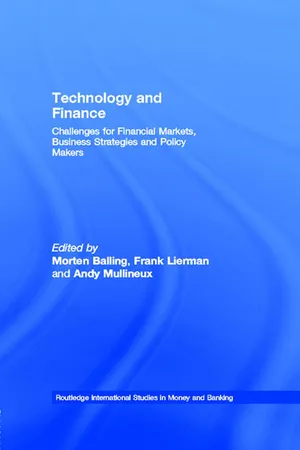
Technology and Finance
Challenges for Financial Markets, Business Strategies and Policy Makers
- 400 pages
- English
- ePUB (mobile friendly)
- Available on iOS & Android
eBook - ePub
Technology and Finance
Challenges for Financial Markets, Business Strategies and Policy Makers
About this book
Technology and Finance analyses the dramatic implications of technology for today's financial sector, for productivity growth and for monetary policy. A wide range of financial market activities are now technology driven; technology is also crucial in retail, private and corporate banking, and it has lowered entry barriers to the sector. New partic
Part I
Survey lectures from plenary
sessions
1 Central banking in an evolving environment*
Guy Quaden
Ladies and gentlemen,
I am particularly pleased to speak before this eminent forum and to have the opportunity of addressing the topic ‘Technology and Finance’ from a central banker’s point of view.
Technology and the challenges it raises for financial markets is a most appropriate theme for this colloquium. On the one hand, technology is closely intertwined with the evolution of many other factors affecting financial markets and so allows coverage of a wide range of issues. On the other hand, it has far-reaching consequences for all market participants, and this certainly includes central banks. In the first part I propose to briefly recall how technology has impacted on our macroeconomic and regulatory environment. In the next two parts I would like to sketch the main consequences of these developments on what my colleagues at the Bank of England have described as the two wings of central banking, i.e. monetary and financial stability.
Technology is a powerful factor of change in our macroeconomic environment. So, a few years ago, our colleagues of the Federal Reserve had to recognize that something new was happening in the US economy: a persistent higher growth and lower unemployment without the emergence of inflationary strains. This was related, at least partly, to the revolution in the information and communication technologies, which increased productivity growth and fostered efficiency in the labour market too. A third feature of the so-called new economy, the reduction in the variability of output growth, obviously proved to be short-lived! But a wave of over-pessimism should not submerge the previous wave of over-optimism. The question whether the American economy is still on a higher trend productivity growth path remains open, as well as what the prospects for the European economy are in this respect. Europe will benefit from a specific driving force, the completion of the single market with the new single currency, which should trigger further structural reforms and hence foster innovative energies.
Technology also radically transformed the financial sector, which by the way greatly contributed to the new technological wave by financing it. New techniques in the treatment, the storage and the transfer of information exerted profound effects on a sector which is largely an information-based industry.
In a first stage, information technologies made it possible to develop more sophisticated products, to build up a better market infrastructure, to implement more accurate and reliable techniques for the control of risks, to reach more distant and diversified markets, and to multiply the value and the volume of operations. In short, new technology has radically transformed all three major functions performed by banks, i.e. access to liquidity, transformation of assets and monitoring of risks.
A new phase is presently at work with the emergence of e-money, e-banking and e-finance. It is clearly this new development which will represent the great challenge of the coming years. The speed of adoption of these new products remains difficult to forecast. Contrary to the preceding phase, this new wave is not limited to professional operators but involves all customers, including the retail market. Many of the scenarios suggested by IT firms or consulting groups have proved to be overly optimistic. At the same time, it would be wrong to become complacent. Most new technology is spreading following an S-shaped curve. The base section of the S can be quite long and practically horizontal; however, it will sooner or later be succeeded by a steep section. The example of Nordic countries, and more specifically Finland, shows how quickly e-finance can develop, once circumstances are ripe.
It is important to emphasize that the integration of new technology into the financial sector did not take place in isolation. Rather, it is the interaction of technology with another major development, deregulation, that contributed to reshaping the financial landscape. True, the pressure of the market to fully exploit the new technologies was strong, probably even irresistible. However a receptive environment had also been created by a lifting of the rather strict financial and banking regulations which were still prevalent at the end of the 1970s.
The increased awareness of the wide-ranging possibilities offered by new technologies illustrated that a lot could be gained through the removal of distortions in competition, directly linked to excessive regulation or intrusion from the government.
In combination, these two evolutions contributed to the emergence of a more open, competitive and globalized financial market, which obviously improves efficiency in the world economy. The transition, however, has not been a smooth one. It was not easy for the authorities who had to cope with the more frequent arbitrages operated by market participants between the various currencies and financial instruments or even between different legal, regulatory or tax regimes. Neither was it easy for financial intermediaries that had to work in a much more competitive environment where traditional protection and barriers to entry were progressively lifted. In short, the shift toward a more liberalized system together with the quick expansion of new products and markets has greatly increased uncertainties and risks for financial sectors.
This was not immediately recognized by many market participants who had previously been sheltered by the existing regulation. As a result, individual bank failures and banking crises, quasi non-existent between the end of the 1940s and the early 1970s, became all too frequent during the past two decades. In this context, the absence of significant problems within the Belgian banking sector during the recent period must be considered more an exception than a rule.
Despite deregulation there is still a major role to be played by public authorities, among others in the field of competition rules, consumer protection, fight against money laundering – and, of course, central banking. Central banks indeed have to provide stability, which certainly does not mean ‘no change’ but, on the contrary, building the best foundations for a sustainable dynamism. In doing so, central banks will cope with the evolving environment shaped by technical progress, by deregulation and globalization and, last but not least in Europe, by the single currency.
As regards the first wing of central banking, monetary stability, central banks have to provide a durable anchor in order for the price system to appropriately guide economic decisions. A stable value of money is all the more necessary for preserving the information value of relative prices in a changing world, where decisions have to be taken rapidly. Maintaining price stability is the primary objective of monetary policy, not only for the Eurosystem – according to the Treaty of Maastricht – but also for every central bank.
Nowadays the only regulations central banks rely on in designing the operational framework of monetary policy are the monopoly of banknote issuance and reserve requirements. The Eurosystem fully respects the principle of an open market economy with free competition, as enshrined in the Treaty. Its main instrument is the weekly allotment of credit by euro area-wide tenders. Minimum reserves, which are remunerated, have a stabilization function, thanks to an averaging provision, and are enlarging the structural liquidity shortage of the money market.
As the development of e-money is liable to weaken the leverage of the Eurosystem and in order to provide for a level playing field, e-money issuers should not escape reserve requirements. A European directive of last year rightly broadens the definition of credit institutions in order to include e-money institutions.
Technological change and financial market developments do not only affect monetary policy instruments but also the whole transmission process and consequently the strategy of monetary policy. In this complex and changing world the Eurosystem was right in rejecting any simple rule and adopting an all-encompassing two-pillar strategy. Central bankers have to continuously reassess the information content of many economic indicators. Let me pick out some of them – output, money, stock prices and bond market indicators – not because other variables, like wage developments and the fiscal policy stance, are less important, but because the former are most affected by technological and financial market changes.
Central bankers, even in the Governing Council of the ECB, are not insensitive to growth and employment prospects, as some critics argue. But they are well aware of two limitations: first, growth should not be stimulated to the detriment of price stability, because such a stimulus would be short-lived and would imply longer-term costs; second, as ‘à la plus belle fille du monde on ne peut demander que ce qu’elle a’, monetary policy may exert some influence on the demand side of the economy but cannot solve structural problems, like persistent unemployment. Central banks may nevertheless contribute to output stabilization, as far as the risks to price stability are linked to the business cycle.
A central concept in this respect is the output gap, but its measurement, especially in real time, is surrounded with a large degree of uncertainty. Potential output growth, which is an ingredient of both pillars of the Eurosystem’s strategy, is not known with precision. Should the new economy materialize, higher rates of growth could become sustainable. In the absence of any firm evidence of a new economy in the euro area – although some driving forces are to some extent in place – and since the emergence of a new economy is not driven by monetary policy, the Eurosystem did not take the risk of pre-emptively accommodating it. Nevertheless it monitors a wide range of indicators in order to periodically reassess the ‘speed limit’ of the euro area economy.
Needless to say, in the present circumstances growth is unfortunately even below the old economy speed limit, and the associated decrease in inflationary pressures has already prompted a 100 basis points interest rate cut in three steps since the spring.
The first pillar of the strategy of the ECB gives a prominent role to money. It is based on the conviction that inflation is a monetary phenomenon in the long run and underlines the medium-term orientation of monetary policy and the inheritance in this respect from the Deutsche Bundesbank. Recognizing that the demand for money can be subject to short-term fluctuations which are harmless for price stability, the ECB has not announced an ‘intermediate objective’ but rather a ‘reference value’ for the growth of a broad monetary aggregate. The recent rise in M3 growth is up to now interpreted as being such a short-term fluctuation, caused by the relatively flat yield curve and the weakness in stock markets.
Technology and financial market changes obviously affect the first pillar. They might increase the volatility of the income velocity of monetary aggregates and, as they are blurring the frontiers of ‘moneyness’, they complicate the definition of key aggregates. To paraphrase a former Governor of the Bank of Canada speaking about M1 twenty years ago, I would say that while the ECB is not planning to abandon M3, I cannot rule out that, some day, M3 could abandon us, but you already noticed that the first pillar is much more than the reference value. It encompasses a broad monetary analysis which will duly take into account such developments.
The first pillar also rests on the fact that credit institutions remain major players in the transmission process of monetary policy. The development of euro area capital markets could however increase the weight of financial market indicators in the second pillar.
The stock market is still a much less important channel of transmission in the euro area than in the USA, but the holding of shares is spreading, for example through mutual funds. I would not attempt to summarize the vast debate about the appropriate monetary policy reaction to asset price movements. I am inclined to say that central banks have not to put on these variables more emphasis than warranted by their effects on demand and should avoid asymmetric reactions – benign neglect in the case of irrational exuberance, intervention in the case of sharp downwa...
Table of contents
- Cover
- Half Title
- Routledge International Studies in Money and Banking
- Full Title
- Copyright
- Contents
- List of figures
- List of tables
- List of contributors
- Acknowledgements
- Introduction
- PART I Survey lectures from plenary sessions
- PART II Contributions on technology and financial institutions
- PART III Contributions on technology and financial markets
- PART IV Contributions on technology and payments
- PART V Contributions on technology and productivity
- Index
Trusted by 375,005 students
Access to over 1.5 million titles for a fair monthly price.
Study more efficiently using our study tools.
Frequently asked questions
Yes, you can cancel anytime from the Subscription tab in your account settings on the Perlego website. Your subscription will stay active until the end of your current billing period. Learn how to cancel your subscription
No, books cannot be downloaded as external files, such as PDFs, for use outside of Perlego. However, you can download books within the Perlego app for offline reading on mobile or tablet. Learn how to download books offline
Perlego offers two plans: Essential and Complete
- Essential is ideal for learners and professionals who enjoy exploring a wide range of subjects. Access the Essential Library with 800,000+ trusted titles and best-sellers across business, personal growth, and the humanities. Includes unlimited reading time and Standard Read Aloud voice.
- Complete: Perfect for advanced learners and researchers needing full, unrestricted access. Unlock 1.5M+ books across hundreds of subjects, including academic and specialized titles. The Complete Plan also includes advanced features like Premium Read Aloud and Research Assistant.
We are an online textbook subscription service, where you can get access to an entire online library for less than the price of a single book per month. With over 1.5 million books across 990+ topics, we’ve got you covered! Learn about our mission
Look out for the read-aloud symbol on your next book to see if you can listen to it. The read-aloud tool reads text aloud for you, highlighting the text as it is being read. You can pause it, speed it up and slow it down. Learn more about Read Aloud
Yes! You can use the Perlego app on both iOS and Android devices to read anytime, anywhere — even offline. Perfect for commutes or when you’re on the go.
Please note we cannot support devices running on iOS 13 and Android 7 or earlier. Learn more about using the app
Please note we cannot support devices running on iOS 13 and Android 7 or earlier. Learn more about using the app
Yes, you can access Technology and Finance by Morten Balling,Frank Lierman,Andy Mullineux in PDF and/or ePUB format, as well as other popular books in Business & Business General. We have over 1.5 million books available in our catalogue for you to explore.