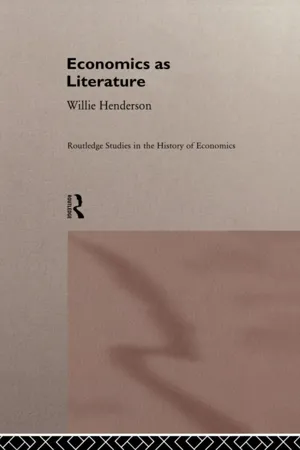
A rich vein of economics writings which runs through the nineteenth century and beyond is now largely ignored because its authors were women or because they favoured literary over scientific forms. Economics as Literature re-examines some of the most interesting texts from within this tradition.
The works considered include:
*stories (eg by Maria Edgeworth and Harriet Martineau)
*dialogues (eg by Jane Marcet and Thomas de Quincey)
*'imaginative' writing (eg from Ruskin and Francis Edgeworth)
*Keynes' General Theory which is locked within a nineteenth century 'tradition' of uniting science and art.
- 200 pages
- English
- ePUB (mobile friendly)
- Available on iOS & Android
eBook - ePub
Economics as Literature
About this book
1
Economics as literature
An introduction to ‘literary economics’
The contemplation of the nineteenth century in the history of economic thought is primarily focused upon the canons of political economy, i.e. for the period under examination here, works by Adam Smith, Thomas Malthus, David Ricardo and John Stuart Mill. Whilst there may be debate about the precise nature and significance of the canons, writing on the canons dominates the field and efforts to re-work the major writers in terms of later economic and mathematical insight abound. The method of analysis used has been described as ‘canonization’ (Brown, 1993: 67). When a canonical interpretation is made of what are seen as key texts, the tendency is to frame the texts in terms of the origins of modern-day economic ideas. Past texts are read in terms of current developments and an intellectual parentage established for recent trends. Such a framework, according to Brown, tends to restrict, over time, the meanings found in the text as the discipline, through academic discussion and negotiation, reduces the range of acceptable interpretations. Many possible voices in the text are, by the process, reduced to one voice. This process is the very opposite of that taken by scholars of literature to the fictive writing of the same era. Literary analysis accepts the ‘many voiced’ nature of a text, the possibility of ambiguity and the changes of meaning consequent upon the changing point of view of the reader and of protagonists in the narrative (Brown, 1994b: 4). The aim is to open-up rather than to restrict meanings.
A literary approach is potentially available for the study of political economy texts, and such an approach, backed by scholars such as McCloskey and Brown, challenges the ‘single voice’ results of canonical investigation. A concrete example will serve as a means of illustrating the problem. De Quincey is usually interpreted as a follower of Ricardo, and there is much in his writing that suggests pure hero-worship. In objecting to the social dangers of rent consuming all the available surplus De Quincey points out Ricardo’s omission of technical change, and refers to
that great antagonist force for ever at work in Great Britain – through skill, capital, and the energy of freemen; only by an antagonist law for ever operative in throwing back the descents – in raising the soil in case E, in the year 1700, to the level B as it was in 1500 – the soil of O, in the year 1800, to the level of E as it stood in 1600: thus and only thus, do we escape, have escaped, and shall escape, the action of rent; which action, by the just exposures of Ricardo, tends always to engulf us; which action, by the unjust concealments of Ricardo, ought long ago to have frozen us into dead lock – anything to the contrary notwithstanding which has ever been insisted on by that great master of economy.(De Quincey, 1897e: 248–249)
This could be seen as simply a matter of exploring the consequences of technical change, De Quincey merely adding to the scientific model by shifting the production possibility curve, thus demonstrating his technical ability in political economy. Look again at the language, see how the economic agents are depicted in terms suggestive of free agents and conservative and sustained social values, rather than as mechanistic and value-free. Economic agents work consistently over-time, secure within the timelessness of English society, to counter the effects of mechanistic law. Such an understanding makes De Quincey’s text critical, value-laden in senses different from those of Ricardo, ironic and potentially antagonistic towards some Ricardian ideas (McDonagh, 1994: 49). The passage illustrates a more general ambiguity towards Ricardo in Logic.
In canonical terms, the essays as written here are ‘outside the field’ both with respect to subject matter and with respect to style of analysis. Whilst there is inevitably summarisation and translation, the method of analysis attempts to integrate the economics and the linguistic expression, i.e. the concern is both with economic argument and the ways in which the argument is presented in literary form. The focus is sometimes upon the economics or on the economics education and sometimes on the ways in which ideas are expressed and developed. If framed by the literary approach to economics writing promoted by McCloskey’s work The Rhetoric of Economics,1 and pursued in the cross-over between literature and economics in Marc Shell’s The Economy of Literature (1978) and Kurt Heinzelman’s excellent The Economics of the Imagination, then these essays are attempting to bring to economists and economics educators some of the benefits of that alternative tradition. They are part of results of the process of paying more attention to the encoding and decoding of economics meanings. A careful consideration not only of what is written but how it is written changes the meaning and implications of text. In this context, the relationship between, say, Ricardo and De Quincey becomes problematic.
Canonical approaches have deepened knowledge of the origins and development of sets of economic ideas and forms a legitimate basis for making judgements on past and present economic argument. This knowledge has been purchased at a price. Economic texts have been cut off from their contemporary audiences; the impact of economics writing, for most of the century accessible to educated people in general, on contemporary values and ideas and the interaction between economics and education, economics and literature and literature and economics has not tended to be seen as part of the official histories. The canonical approach reconfirms the professionalisation of the discipline and justifies the compartmentalisation of knowledge. The works of Adam Smith, Thomas Malthus, David Ricardo and John Stuart Mill (for the period that the essays in this collection concentrate upon) are, and remain, key works – but they were not alone in the field. They, and the economic circumstances that they were engaged in analysing, gave rise to further works, including novels with socio-economic themes, which have their origins in the writings of Maria Edgeworth and Harriet Martineau, and to the imaginatively rather than scientifically constructed economic ideas of the Romantic poets. The earliest writings took the form of educational works in political economy. Later works, by the Romantic poets, inaugurated a criticism of economic ideas, culminating in the economic writings of John Ruskin. Francis Ysidro Edgeworth, nephew of Maria Edgeworth, blended the literary tradition with the scientific tradition and passed on to his contemporaries, including John Maynard Keynes, some of the cultural traditions of literary economics. The meaning to be attached to literary economics is explored below. What is emphasised here, for the time being, is the self-conscious ‘literariness’ of the texts (the term ‘literariness’ is borrowed from Brown, 1994: 368). The set of essays published here represent an attempt, using the original sense of the word essay, to apply insights that flow from a heightened awareness of literary criticism, rhetoric and language-use in economics to economics texts that have rarely been recognised as part of the literature of economics. These are not ‘authorised readings’ of authorised texts, but individual readings of writings which incorporate different discursive practices, which promote economics understanding within different, but related, genres and for different kinds of audiences.2 The writings come from a period when intellectual culture was not yet split by academic specialisation, when literary figures could challenge or support economic ideas considered as part of the joint stock of knowledge of writers and thinkers. It would not have been possible to write this work without having the benefit of working within, and of reading works within, the growing literature on undertaking a literary analysis of economics. Although an individual reading, that reading has taken place within the growing discursive practices promoted by the ‘rhetorical’ turn in economics.
The essays do not constitute, however, an integrated study of nineteenth- century literary economics. That is a vast undertaking, demanding wide reading in a variety of subjects and genres. Currently such works are being pursued by the academics interested in the critical appraisal of English literature, McDonagh’s work being a prime example. A close reading of individual texts remains a literary method even when it illuminates problems in the history of economic thought. There may be a need to integrate the study of major and minor economics texts as history with the insights achieved by literary analysis. The studies presented here are concerned primarily with individual texts, with re-establishing such texts as interesting and significant in terms of the contemporary audiences for them and only then, and retrospectively at that, for their interconnections.
The subject matter is different kinds of economic texts: economic stories for children written by Maria Edgeworth; Jane Marcet’s economics textbook based upon dialogue; economic stories, by Harriet Martineau, written for adults; dialogues and an introductory text written by Thomas De Quincey; John Ruskin’s emotive essays challenging popular economic values; and a blend of science and literature in the case of F. Y. Edgeworth. Keynes is included because he represents a late flowering of the tradition which the other writers represent. The General Theory (1936) was available to an educated audience (an audience whom he intended to re-educate) and not simply to economists. The level of reader awareness, the literary quality of the more rhetorical passages and the subtle references to a wider literary culture in Keynes’s work suggests a link with Edgeworth and through him to the other authors examined here. Even although united by common interests in economics and in education, the implication of the variety of styles and purposes is that the type of literary analysis undertaken and personal responses to the readings vary from chapter to chapter. The question as to how these and other texts can be read is reflected upon in the section headed ‘A Literary Reading of Literary Economics’.
The works examined, though from different time periods and written with differing problems and audiences in mind, are strongly linked through the loosely defined notion of literary economics. All authors had literary interests and all of the works display a talent for narrative writing involving the development or application of economic ideas. Most of the works examined here have been given scant attention by historians of economic thought.3 It must not be forgotten, however, that canonical writing was also literary in a sense however. Adam Smith’s texts were produced under the influence of notions of rhetoric and belles-lettres, while culture (in its modern and ideological sense) had a great significance in the work of John Stuart Mill. Both Smith and Mill are acknowledged as fine writers and so, in this sense, style is a concern of nineteenth-century economics. Ricardo is an exception, for his work is regarded by his contemporaries and others, for stylistic and structural reasons, as ‘difficult’. The origins of the ‘difficulty’ of Ricardo needs textual exploration in a way which integrates the economics and its literary expression, though De Quincey puts forward in his Logic of Political Economy (1897) a convincing set of justifications for such a view. The examination of literary economics as both economics and literature, could equally be applied to Smith and to Mill as it is to the writers and texts examined here. Though the canonical works are rarely touched upon in this volume, in the section headed ‘Smith, Ricardo, Malthus and Mill as Literary Economists’, some thoughts on such key texts are set out.
Another strong link between the texts, which weakens only with the essay on the early work of F. Y. Edgeworth, is the concern for education with which the economics writing is infused. If the nineteenth century is a century of social and intellectual innovation, one of its key shifts was with respect to education. A prime shift in emphasis came with the concern, exhibited throughout the movement towards socio-political reforms, with the notion of appropriate education. Whilst the issues are complex, refined classical knowledge came to be increasingly contrasted with the notion of useful knowledge. The notion of useful knowledge was worked out by the middle classes for the working classes, the intelligentsia being taken-up with establishing cultural standards for Coleridge’s ‘cleresy’, an intellectual class dedicated to the maintenance of classical culture in the context of aristocratic decline and the rise of the commercial middle classes. What constituted useful knowledge was the subject of considerable debate, particularly in the years leading to the Reform Act of 1832. Political economy, provided a method of communicating it to the ‘lower orders’ could be established, was, with its notion of social truths, one of the most significant subjects (though not, of course, the only subject). The primary examples of how an economics curriculum for the wider society could and should be developed are the works of three women, usually dismissed as popularisers and propagandists, but treated here as serious minded educators, operating with either explicit or implicit educational theories. Maria Edgeworth, working within the context of the reform of manners as well as ‘practical education’, led the field with works for children based as much upon Priestley’s and Bentham’s notions of utilitarianism as on the works of Adam Smith. Jane Marcet followed with Conversations on Political Economy, aimed at adolescents, particularly young women. She was in turn followed by Harriet Martineau, who wrote economic tales for adults. That Martineau was able to write for a living, for a period of more than two years, on economics education, is truly remarkable. Marcet also made money out of her writing, though her educational writing spread well beyond economics. Marshall, the leading figure in the professionalisation of neoclassical economics by the end of the century, had one eye on the economics profession and the other on the general public and disliked the contributions made by Marcet and Martineau. He argued that they peddled economics as truths without the framework of cautions and assumptions necessary for economic ideas to have such a status. Even Marshall admitted, however, that the belief in the truth of economics was widespread at the time and shared by some of the writers in the classical tradition. The view from the end of the nineteenth century ought not to be the final judgement on their texts. Re-reading in order to recapture the richness of the texts requires a focus that is not simply that of Marshall. The narrative element is strong in such examples of literary economics.
All of the essayists (save F. Y. Edgeworth) were also professional writers, engaged to some extent in deliberate educational activity. Keynes was a pamphleteer and the opening flourishes of The General Theory owe something to that genre. Most made a distinctive contribution to ideas concerning the nature of economics education as well as to the development of literary economics. Thomas De Quincey’s Dialogues owe something to Marcet and share, as does his Logic, with Martineau a willingness to reflect upon the nature of audience (both explicitly and implicitly). Like Martineau, he wrote to earn a living. Extensive exemplifications in De Quincey’s Logic are essentially vivid short stories uniting the art of description and narrative with analytical intention and share something of Martineau’s purposes. De Quincey, unlike Marcet and Martineau is also explicitly concerned with furthering, and hence critically assessing, economic argument. However, it is important not to push the point too far: Marcet, through the character of the young student Caroline, puts forward numerous points, often of a moral nature, against conventional economics which the political economist, Mrs B. goes to great lengths to refute. Dialogue allows at least two points of view to be stated, although carefully constructed monologue (but not a catechism) can achieve similar results. An independent reader has the opportunity of agreeing with Caroline. If a comparison must be made, Marcet’s two-way dialogue is simpler, clearer and more direct that De Quincey’s three. Martineau also demonstrates an understanding, though not in the stories so much as in her morals, of the important role of government in the context of laissez-faire.
John Ruskin is misunderstood if his educational motives are not appreciated as being a significant part of his aims as an economics commentator. Ruskin wrote many things, but his lecturing and writing were primarily inspired by a desire to educate. Some, particularly those biased towards the genius of John Stuart Mill, will balk at the idea of Martineau and Ruskin being treated seriously as writers of economics. Ruskin’s reputation as a socio-economic critic and reformer, in particular, is subject to bouts of attention and neglect, elaborate praise and acid criticism. The emotional basis of his writing (dismissed as ‘hysterical’ and ‘feminine’ in the view of many of his masculine contemporaries) makes many responses possible. Martineau was also regarded as having been ‘un-sexed’ by her writing and hence said to display ‘masculine’ characteristics. In writing as they did, each challenged accepted notions of the proper, i.e. gendered, division of labour. The switching of roles and of genres disturbs accepted notions of the textual division of labour, and hence of categories of appropriate knowledge. Ruskin’s works, as products of emotion, were not deemed capable of carrying any scientific meaning.
It is, of course, a mistake to read Ruskin only for his prose style to the detriment of intended or possible meanings. It is as well to remember that the nineteenth century gave rise to a whole set of new words and concepts, identified by Raymond Williams (1960) as part of the set ‘industry, democracy, class, art and culture’, many of which had their origins in the need to describe and construct a society based not upon agrarianism but on manufacturing and the social inequalities and change that it gave rise to (Williams, 1960: xv, xvii). Many of these terms and their changing significance have their origins in the need to understand the socio-economic problems of the early nineteenth century and are directly or indirectly related to the subject matter of literary economics. A concern for the meaning of words, something that Ruskin learned from Carlyle, that other great literary critic of economic modernism and laissez-faire, is, given the changes of meaning that were essential to further discussion of changing society, not out of place or trivial. Smith, Ricardo, De Quincey, Mill and Ruskin worked hard on the notions of ‘wealth’ and of ‘value’, providing elements of a discourse which helped shape their changing world. Ruskin was in the thick of such words, his socio-economic criticisms have their origins in the contemplation of the relationship between art and society and between art and the industrial arts, between ‘labour’ and ‘work’, between ‘wealth’ and ‘value’. Exploring his images and his use of words reveals a poetically constructed discourse which is capable of yielding up critical and potentially scientific ideas.
Ruskin’s paternalism shares, in its desire to see an ethical and responsible governing class worthy of the respect of working people, much with Martineau, though she was essentially a democrat. Where they differ is in the relationship between responsibility and political economy. For Martineau, political economy suggested a pattern for social reform. For Ruskin, political economy was itself the object of reform. By reforming ideas about the proper nature of a ‘true’ economy, the economic world itself would be reconstructed. Ruskin deliberately uses the powers of the imagination as an antidote to what he sees as a mistaken science.
F. Y. Edgeworth shared many of the literary interests of De Quincey and Ruskin and shows in his early economics writing an appreciation of the cultural and literary traditions, of literary economics, liberally larding his texts with subtle references to literary culture, in much the same way as De Quincey and Ruskin. There is textual (and other) evidence, in his early work that he had read both of these writers. F. Y. Edgeworth’s writing, which seems in the history of economic thought, out of step with the general development of scientific economic writing is, in the context of De Quincey and Ruskin at least, part of the wider cultural and literary tradition of the nineteenth century. Edgeworth’s text looks backwards towards that tradition; and forwards, in its mathematical reasoning, towards the economics argumentation of the middle decades of the twentieth century. As with Ruskin, a modern reader will typically struggle with Edgeworth. Keynes’s major work illustrates, in its literary qualities, hi...
Table of contents
- Cover Page
- Title Page
- Copyright Page
- Acknowledgements
- 1: Economics as literature: An introduction to ‘literary economics’
- 2: Child’s play: Maria Edgeworth and economics education
- 3: Jane Marcet’s Conversations on Political Economy: A new interpretation
- 4: Harriet Martineau or ‘when political economy was popular’
- 5: Thomas De Quincey reads David Ricardo
- 6: John Ruskin or the political economy of ‘soul’
- 7: The problem of Edgeworth’s style
- 8: Style, persuasion and The General Theory
Trusted by 375,005 students
Access to over 1.5 million titles for a fair monthly price.
Study more efficiently using our study tools.
Frequently asked questions
Yes, you can cancel anytime from the Subscription tab in your account settings on the Perlego website. Your subscription will stay active until the end of your current billing period. Learn how to cancel your subscription
No, books cannot be downloaded as external files, such as PDFs, for use outside of Perlego. However, you can download books within the Perlego app for offline reading on mobile or tablet. Learn how to download books offline
Perlego offers two plans: Essential and Complete
- Essential is ideal for learners and professionals who enjoy exploring a wide range of subjects. Access the Essential Library with 800,000+ trusted titles and best-sellers across business, personal growth, and the humanities. Includes unlimited reading time and Standard Read Aloud voice.
- Complete: Perfect for advanced learners and researchers needing full, unrestricted access. Unlock 1.5M+ books across hundreds of subjects, including academic and specialized titles. The Complete Plan also includes advanced features like Premium Read Aloud and Research Assistant.
We are an online textbook subscription service, where you can get access to an entire online library for less than the price of a single book per month. With over 1.5 million books across 990+ topics, we’ve got you covered! Learn about our mission
Look out for the read-aloud symbol on your next book to see if you can listen to it. The read-aloud tool reads text aloud for you, highlighting the text as it is being read. You can pause it, speed it up and slow it down. Learn more about Read Aloud
Yes! You can use the Perlego app on both iOS and Android devices to read anytime, anywhere — even offline. Perfect for commutes or when you’re on the go.
Please note we cannot support devices running on iOS 13 and Android 7 or earlier. Learn more about using the app
Please note we cannot support devices running on iOS 13 and Android 7 or earlier. Learn more about using the app
Yes, you can access Economics as Literature by William Henderson in PDF and/or ePUB format, as well as other popular books in Economics & Economic Theory. We have over 1.5 million books available in our catalogue for you to explore.