- 248 pages
- English
- PDF
- Available on iOS & Android
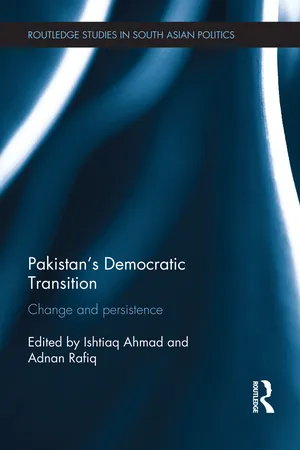
Pakistan's Democratic Transition
About this book
Politics in Pakistan has traditionally been understood in the context of civil-military relationship. In May 2013, for the first time in history, Pakistan saw an elected government complete a full term in office and transfer power through the ballot box to another civilian government.
In view of such an important development, this book offers critical perspectives on Pakistan's current democratic transition and its implications for national politics, security and foreign policy. It critically analyses the emerging political trends in the country, including their underlying sources, attributes, constraints, and prospects of sustainability. Drawing on history, diverse theoretical perspectives, and empirical evidence, it explains the dynamics of the democratic process, contested borders and spaces, and regionalism. Contributions are from 13 prominent scholars in the field, who provide a wide-ranging analysis of Pakistan's contemporary national and regional challenges, as well as the opportunities they entail for its viability as a democratic state.
Taking the debate on Pakistan beyond the outmoded notions of praetorian politics and security, the book explores the future prospects of civilian supremacy in the country. It will be of interest to students and scholars of South Asian Politics, Political Sociology and Security Studies, as well as policy-makers, diplomats, security experts and military professionals.
Frequently asked questions
- Essential is ideal for learners and professionals who enjoy exploring a wide range of subjects. Access the Essential Library with 800,000+ trusted titles and best-sellers across business, personal growth, and the humanities. Includes unlimited reading time and Standard Read Aloud voice.
- Complete: Perfect for advanced learners and researchers needing full, unrestricted access. Unlock 1.4M+ books across hundreds of subjects, including academic and specialized titles. The Complete Plan also includes advanced features like Premium Read Aloud and Research Assistant.
Please note we cannot support devices running on iOS 13 and Android 7 or earlier. Learn more about using the app.
Information
Table of contents
- Cover
- Half Title
- Title Page
- Copyright Page
- Table of Contents
- List of figures
- List of tables
- Notes on contributors
- Acknowledgements
- Introduction
- 1 Pakistanâs third democratic transition
- 2 Enduring challenges to democracy
- 3 Mapping the âEstablishmentâ
- 4 New politics of the middle class
- 5 Social drivers of democratic change
- 6 Military, militancy, and the crisis of governance
- 7 Pluralist society vs. monist state
- 8 Judicial activism, and the rule of law
- 9 Demographic dividend, and democracy
- 10 The Baloch question after the Eighteenth Amendment
- 11 The challenges of a resilient economy
- 12 Civilâmilitary convergence for stability
- 13 Great powers, military supremacy, and persistent contestation
- Index