![]()
1 On the unpredictability of history
Václav Havel
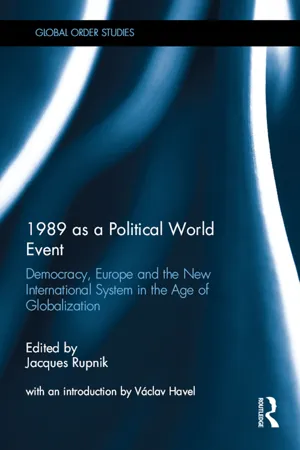
The following speech was given by Václav Havel on the acceptance of his honoris causa doctorate at Sciences Po in Paris, in 2009, at a conference that led to the chapters in this book.
Allow me to take this opportunity to reflect briefly on the events that I have witnessed or participated in over these past decades, and on one aspect of that experience in particular.
In the days when I was considered one of the “dissidents”, I was occasionally visited by Western journalists, and I often sensed from their questions enormous amazement at the fact that we dissidents – as a tiny percentage of the population – were openly striving for a fundamental change of the status quo, even though it was patently obvious that we could not achieve any fundamental change. On the contrary, it seemed a way of provoking only more persecution. Our efforts seemed in vain because they lacked the support of any levers of power or even the visible backing of some valid section of society. What do you want to achieve when you don’t have the backing of the working class, the intelligentsia, an insurgent movement, a legal political party or other major social force? Those were the sort of questions journalists asked us and we had our standard responses ready.
The origin of their amazement was a feeling that they had understood all the basic historical mechanisms and therefore knew what was going to happen or could happen, what had a chance of success and what had none, what was sensible and realistic and what was sheer madness. I would often emphasise in the course of those interviews that under totalitarian conditions it was very hard to see into the inner workings of a society that appeared on the surface to be a monolith, but that monolith – seemingly loyal to the regime but welded together chiefly by fear – could in reality be much less stable than it appeared at first glance, and no one could tell when some chance snowball would unleash an entire avalanche. Admittedly that awareness was not the main or sole driving force of our actions at that time, but that is how we perceived things.
The lesson to be learnt from that is obvious: one should not be certain of having understood all the laws of history and therefore capable of predicting infallibly what will happen.
Twenty years ago the Czechoslovak snowball in the form of the brutal suppression of a student demonstration turned into an avalanche. And the entire totalitarian system started to collapse like a house of cards. Many factors played a role in this, however, including the regime’s profound internal crisis, the events in neighbouring countries, and the favourable international situation. And yet we were surprised how quickly and relatively easily it happened. On that occasion it was not only the Western journalists who were surprised: we were equally amazed. We did not expect it to happen so soon or that it would be so simple. The dissidents turned out to be no better off than the Western journalists or political analysts. We also had misjudged things and proved incapable of seeing and understanding the processes occurring unseen not only within the power structures but also within society, and therefore unable to predict their possible outcomes. We endeavoured to act freely, speak the truth, and bear witness to the situation in our country, but we did not strive for power. It did not occur to us in the least that we who considered ourselves at most public mouthpieces would suddenly be handed the power of government lock, stock and barrel.
We accepted it with discomfiture, because there were no alternatives. And at that moment an interesting thing happened: many of those who had mutely toed the line for years as well as many of those who regarded our former endeavours to be a waste of time started to reproach us for being ill prepared for history. They wanted to know how it was that we didn’t have a new democratic constitution written long ago? Why didn’t we have an agreement on a new electoral law? How come we hadn’t drafted ages ago all sorts of legislation – including one creating the legal framework for the entire gigantic privatization process that our country had to undergo? How come we had not prepared the programmes of the various political parties that must be established in order for a pluralist political system to operate? And we continue to be pounced on for all the things we should have done, but failed to do, or that we shouldn’t have done and did.
All of a sudden there were many new “generals after the battle”, who blamed us for the same thing, over which we used to criticise sceptical outside observers, i.e. that we had failed to see latent possibilities, failed to foresee history’s hidden fluctuations, failed to think ahead sufficiently, and failed to admit that something could happen that we had previously considered most improbable.
That fact is that the dissidents were professors, painters, writers and boiler men, anything but politicians. Where were we to find an alternative political leadership out of the blue? And so we were simply flabbergasted by everything we were required to do.
And yet I think it was good that we were caught unawares by history, or rather the acceleration of the pace of history. Generally speaking I am a bit wary of those who are over-prepared.
There were further surprises waiting in store for us. Although we had no ready-made laws drafted during the dissident years, in that atmosphere of universal enthusiasm created by the painless revolution, when all and sundry were offering their disinterested help, it seemed to us that the renewal of a democratic political system and the denationalization of the economy could proceed rapidly and in an uncomplicated fashion.
That was not the case, however. It proved impossible to consider, formulate and implement all the necessary reforms in the space of hours or days. Each of them inevitably offered scope for unending debates, and it was necessary to plough one’s way through mountains of contradictory arguments, seek out with difficulty the requisite assistance, overcome innumerable obstacles, including the greatest obstacle of all: the lingering social demoralization, which was given fresh scope in thousands of ways with the return of freedom and the unprecedented redistribution of property. I recall how I became almost pathologically impatient during the first months and years of my presidency, and how I would be continually annoyed by the fact that nothing happened straight away and everything took so maddeningly long. That was perhaps the greatest surprise for me – and not only for me: that history can be influenced to a certain extent, but there is no hurrying it.
It is irksome, but it must be taken into account. Incurable haste could have far worse consequences than those resulting from that exasperating sluggishness. And back it came once more. Yet again I had to accustom myself to the fact that history is not fully predictable and so one can never be entirely prepared for it.
For various good reasons, our country, in company with other countries of the former Soviet bloc, made intensive efforts from the very outset to gain entry to Western institutions, particularly NATO and the European Union. Eventually it happened. It took a long time and their many obstacles had to be overcome. We are now, I believe, firmly anchored in an environment to which we belong and from which we were torn by force. Nevertheless, I am not sure whether the “old”, democracies of the West don’t occasionally regret this enlargement. And I am not sure, if the decision were being taken today, whether they would accept us among their number.
If that were the case, I wouldn’t be particularly surprised. But at the same time I am sure of what I have been talking about all this time: that patience pays off. It paid off in our case as dissidents; it paid off in the laborious building of a democratic state. The fact is that you won’t make a lawn grow by tugging at the grass. It can be irritating sometimes, but nonetheless it would seem that there is a time for everything. A Europe permanently divided is an awful thought. In our part of Europe it could lead to a risky upsurge in nationalism and its cohorts, which is happening almost everywhere when the terrain is unstable. This would definitely be an even greater headache for the West and the world in general, than the one it has with us already. And the infection would spread further. So patience obviously makes sense.
Impatience could lead to pride and pride to impatience. By impatience I mean the proud conviction that I alone know everything and I alone have understood history, and hence I am capable of predicting what will happen. And when the course of events or world affairs no longer fit my concept, then I have to intervene. By force, if necessary. That is the case of Communism, after all. The self-assurance of its theorists and of those who implemented it eventually led to the Gulags. After all it all started with the conviction that at last everything was clear and so it was obvious how to build a just world. Why delay matters with explanations? In the interest of humankind the better world must be created straight away by those who know how, irrespective of what human-kind thinks. Dialogue is a waste of time and you can’t make an omelette without breaking eggs.
When the Iron Curtain collapsed and the bipolar division of the world – which formerly seemed to be one of the main causes of all ills – came to an end, it was undoubtedly an event of historical importance. It ended the violation of the world and the danger of a third world war evaporated. It might have occurred to many in those first moments that history had truly been brought to an end and that some kind of splendid era out of time had been ushered in.
That too reflected an inadequate sense of the mysteriousness of history, or quite simply a lack of imagination. Time didn’t come to a halt. Granted a number of major dangers ceased to exist, but countless seemingly lesser dangers emerged from beneath the cracked bipolar shell. But in an era of globalization what is a “small danger”? In the past world wars arose in Europe, which was for so long a sort of centre of world civilization. Can we be sure that this will always be the case? Isn’t it possible, for instance, at a time when any tin-pot dictator can lay his hands on an atom bomb, that some more serious regional conflict will escalate into a global conflict? Don’t today’s terrorists have disproportionately greater scope than they ever had in the past? In this first ever atheistic civilization, which has no regard for eternity, isn’t there an alarming growth in dangers resulting simply from short-sightedness? Are we not seeing the emergence of new generations of crazed fanatics or hatred-ridden people who are given infinitely greater opportunities in our days than ever in the past? Are we not, every day, interfering in the life of our planet by hundreds of different actions that have pernicious and irreversible consequences?
It strikes me that the most important thing today – and my observations and experience of recent decades confirm me in this opinion – is to maintain a humble attitude to the world, to have reverence for what transcends us, to take into account that there are mysteries that we will never understand, and to realise that although we must assume our responsibility for the world, we cannot base this on the conviction that we know everything and therefore know how everything will turn out. We know nothing. But no one can deprive us of our hope.
Besides, a life in which there were no surprises would be extremely boring.
![]()
Part I
The meanings and legacies of 1989
![]()
2 The world after 1989 and the exhaustion of three cycles
Jacques Rupnik
The year 1989 was dubbed annus mirabilis because of the suddenness and the surprising ease of the collapse of dictatorships and the international order inherited from the Cold War. Václav Havel, who started the year in prison and ended it in the Prague Castle as president, symbolized the moment. The unpredictability of history provides the theme of his beautiful opening essay in this volume, which hints ironically at journalists and political scientists who thought they understood the “system” and the “laws of history”. This indeed remains one of the important lessons for students of international affairs: experts and social scientists failed to anticipate the possibility of a “1989” although they had no shortage of knowing arguments after to demonstrate why collapse had been inevitable …
This is not a book about the events of 1989, but about 1989 as a “world event”. The fall of the Berlin Wall symbolically marked the end of the Cold War, heralding the transformation of the international system that had prevailed since the end of World War II. It clearly represents a caesura, the closure of the “short twentieth century” (1914–1989) marked by two world wars and two totalitarianisms that originated in Europe. As a peaceful transition to democracy and the “return to Europe”, 1989 had a global resonance, but the dispersion of its echoes also revealed a plurality of meanings. Though originating in Europe – the initial core of the cold-war system – it may have been the last time Europe constituted the center-stage of a world event. The center of gravity has since been shifting eastward, from the Atlantic to the Pacific. Two decades after the “return to Europe”, some are heralding its eclipse.
1989 had a global impact, but meant different things to a variety of actors in different parts of the world. A Western or “Eurocentric” narrative of 1989 thus needs to be confronted with contrasting perceptions from Asia or Africa. In Asia, it marked the advent of global capitalism, but not quite the end of the Cold War, as Communist China, Vietnam and a divided Korea remind us. 1989 was democracy’s founding moment in the heart of Europe, but, while on June 4 Poland held its first free elections, on the very same day the pro-democracy movement was crushed in Tien an Men square in Beijing. What was seen at the time as setting China at odds with the democratic tide of 1989, is in retrospect perceived in Asia as the opening of China’s spectacular rise on the international scene as an economic and strategic superpower.
The collapse of the Soviet Union might have weakened the Arab regimes associated with it, but it had little impact on the Arab–Israeli conflict. Moreover, the rise of political Islam at the expense of “progressive nationalism” in the region pre-dates the end of the Cold War. 1989 was the year when freedom of expression was recovered in Eastern Europe and glasnost became the motto of the day in Moscow. It was also the year the Ayatollah Khomeini launched a fatwa against Salman Rushdie, the author of The Satanic Verses. The real echo of the revolutions in Eastern Europe, it has been argued, came 20 years later with the Arab Spring. Writing in the midst of the events, the Lebanese writer Amin Maalouf argued that “2011 will not just go down in history as the Arab equivalent of 1989 in Central and Eastern Europe…. It is an exceptional, unprecedented phenomenon, and perhaps a harbinger of a democratic renewal worldwide”.1
It seems as if every revolution has to measure itself against its predecessors in the quest for recognition and universal significance. The shockwaves of 1989 and the end of the Cold War also helped to bring about more silent revolutions in South Africa, with the end of apartheid, and, in very different contexts, the end of the political stalemates that had prevailed for decades in countries such as Japan and Italy. The end of the Christian Democratic Party’s monopoly on government in Italy, along with the implosion of the Communist Party and the Italian party system more generally, were direct consequences of the end of the Cold War. These developments were seen at the time as advancing democratic pluralism, but they also opened the way for new political entrepreneurs like Berlusconi …
The interpretations of 1989 and the world it brought about have also changed over time. The aim of this volume is not to provide another account of the events of 1989, their underlying causes and main protagonists. Rather, beyond the heroic narratives associated with the revolutionary wave that swept through communist dictatorships and the Soviet empire, it examines the main ideas and political trends associated with 1989 that have shaped the globalized world we live in. After briefly examining the legacies of the “velvet revolutions”, this book explores both the significance of the Great Transformation they brought about, but also the crisis of expectations that followed and the exhaustion of the paradigms and models it projected on the world two decades ago.
The post-1989 world can be examined through a triple transformation: the transition to democracy as the only source of legitimate government; the globalization of market economies as the path to prosperity and modernity; and the triumph of the West in the Cold War as the prelude to the reunification of Europe and the quest for a “new international order”. Now may indeed be the appropriate moment to examine the legacies of 1989 as, more than 20 years on, we can see the limits or the exhaustion of the three interrelated post-1989 cycles that have shaped the post-1989 world: (1) from the democratic élan of 1989 to democratic fatigue or crisis of democracy and the rise of authoritarian regimes; (2) from the unrestrained triumph of a globalized market economy promoted by the West to the international financial and economic crisis that since 2008 has shaken the very foundations of Western economic preeminence; and (3) from the hopes in the 1990s of a “Europe whole and free” an...