In the 1990s, the Chinese government launched an unprecedented reform of state enterprises, putting tens of millions of people out of work. This empirically rich study calls on comprehensive surveys and interviews, combining quantitative data with qualitative in its examination of the variation in workers' collective action. Cai investigates the difference in interests of and options available to workers that reduce their solidarity, as well as the obstacles that prevent their coordination. In addition, and perhaps more importantly, this book explores the Chinese Government's policies and how their feedback shaped workers' incentives and capacity of action.
eBook - ePub
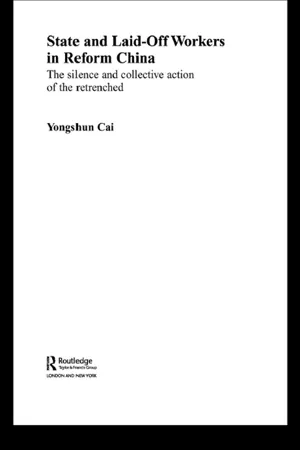
State and Laid-Off Workers in Reform China
The Silence and Collective Action of the Retrenched
- 208 pages
- English
- ePUB (mobile friendly)
- Available on iOS & Android
eBook - ePub
State and Laid-Off Workers in Reform China
The Silence and Collective Action of the Retrenched
About this book
Information
1 Introduction
Communism produced a class of workers with strong emotional ties to and material interest in maintaining that system,1 so economic restructuring in the industrial sectors in communist states is very likely to invite labor resistance. The government would need to employ cautious measures to avoid strong resistance and possible social unrest. While there seems to be a “surprise of labor weakness” in post-communist societies, the reasons for labor quiescence are complex, including weak trade unions, limited worker solidarity, and prolonged economic downturns that produce discouragement and a kind of “learned powerlessness” among workers and their leaders.2 But labor quiescence in some former socialist countries was also related to the modes of retrenchment. During the “shock therapy” of post-communist Poland, for example, the Polish government offered workers early retirement with generous compensation, which helped reduce laid-off workers’ resistance. In 1990, the number of employees in Polish state-owned enterprises (SOEs) fell by 31 percent, with early voluntary retirement accounting for at least 70 percent of the net drop in employment. Voluntary retirement blunted the resistance to reform: “If the initial wave of job losses had been predominantly involuntary, a backlash might well have ensued; but the pattern that was actually observed in 1990 and 1991 posed far fewer risks, allowing much-needed reforms to take root.”3 In Russia, economic restructuring primarily involved privatization and did not lead to immediate large-scale layoffs. An overwhelming number of firms adopted the option of allowing workers and managers to hold a part or the majority of the firm’s shares.4 Privatization might not work to the advantage of Russian workers, but neither had it driven them to resist. Kramer writes: “Although in some cases privatization has indeed been a stimulus to worker mobilization, it has not in general proved to be such as workers have shown themselves to be too demoralized, divided and fatalistic to believe that they have the power to influence such major decisions.”5
Unlike Poland and Russia, China initiated reform of SOEs in the 1990s by dismantling the lifetime employment system through massive layoffs. The number of employees in the state and collective sectors plummeted by more than 48 million from 1995 to 2000, a number equal to the population of South Korea.6 Compounding the plight of laid-off workers is the absence of an inadequate welfare system, coupled with a difficult reemployment environment.7 Facing the loss of jobs, decrease in income, and uncertainties about the future, some laid-off workers have acted collectively in defense of their interests.8 Since the 1990s, numerous incidents of workers’ collective action, with participants ranging from dozens to tens of thousands, have posed a serious concern for the Chinese government.9 It has been claimed that “a more restive Chinese working class is in the making, as shown by the massive eruption of collective actions over the past two decades.”10 Hence, unlike in most other transitional economies, the issue of worker layoffs in China has been a serious challenge to the Chinese government.
Nevertheless, although worker resistance in China has stumbled the pace of economic restructuring,11 it has failed to stop the government from carrying out reform measures. In 1995, the Chinese government began privatizing, closing, and declaring bankrupt small SOEs and collective enterprises. In 1997, the government officially promoted the privatization of small SOEs across the country. After 1999, the government applied these same policies to medium-sized SOEs and some large ones.12 The continuation of the reform indicates that the retrenchment has not become an insurmountable challenge for the government. An important reason is that a majority of laid-off workers have remained silent.13 This is puzzling given the fact that those who acquiesced may not fare better than those who resisted. The case of Chinese workers raises several questions: facing threat against their interests, why do some workers resist while many others do not? Why and when is collective resistance possible in China? What are the implications of worker resistance for reform and political stability in China? These are the questions that this book seeks to answer in order to understand collective action under an authoritarian regime and the relations between political institutions and economic transition.
Dismantling of moral arrangements and motivations for resistance
In communist states like the former Soviet Union and China, labor relations are claimed to be based on a “tacit agreement” or moral arrangement between the state and labor that protects workers’ interests.14 Where such contracts are fulfilled, labor movements are rare.15 Cook describes state–labor relations in the former Soviet Union in this manner:
[T]he regime provided broad guarantees of full and secure employment, state-controlled and heavily subsidized prices for essential goods, fully socialized human service, and egalitarian wage policies. In exchange for such comprehensive state provision of economic and social security, Soviet workers consented to the party’s extensive and monopolistic power, accepted state domination of the economy, and complied with authoritarian political norms. Maintenance of labor peace in this political system thus required relatively little use of overt coercion.16
Similarly, prior to the reform era, labor relations in SOEs in China were characterized as “organized dependence” of workers on firms. In this arrangement, workers depended on their work units or employers for highly secure jobs as well as cradle-to-grave welfare coverage, although provisions of welfare varied across firms. As Walder suggests, “the extraordinary job security and benefits, the goods and services distributed directly by the state enterprise in a situation of scarcity that affects other sectors of the workforce more severely, is an important source of the acceptance of the system.”17
The implicit moral agreement functions on the assumption that workers are willing to sacrifice their rights to effective and meaningful political participation in exchange for economic and other welfare benefits.18 The corollary, moral economists would suggest, is that ending the moral arrangement will make workers angry and drive them to take action.19 It is thus maintained that workers become intolerant when their sense of justice—composed of both illusion and truth with regard to ethos, dignity, well-being, and freedom—is violated.20 For example, Posusney suggests that Egyptian workers protested out of anger when the status quo was disrupted, namely, that they lost their salary and other benefits.21
Loss and anger have also been suggested as the motivation for worker resistance in China. For example, Chen writes: “Labor protests by laid-off Chinese workers are largely motivated by a crisis in which workers find their subsistence ethic violated. Managerial corruption in factories that workers perceive as exacerbating their economic plight intensifies their sense of injustice and further inflames their militancy.”22 Indeed, the situation of laid-off workers in China also fits what Ted Gurr calls “decremental deprivation,” whereby people are angered over the loss of what they once had or thought they could have. They experience relative deprivation by reference to past circumstances. One implication is that discontent “arising from the perception of relative deprivation is the basic, instigating condition for participants in collective violence.”23 This has also been claimed to hold true for China: “Most protest actions taken by workers have been driven by economic grievances, mostly over the cracking of their ‘rice bowl’.”24 Lee suggests that Chinese workers’ resistance amounts to a “revenge of history”; that is, the collective memories of Maoist socialism, under which workers’ interests were protected, motivate action.25
It may be true, as prospect theory also suggests, that when facing loss, as opposed to gains, individuals tend to be less averse to taking risks and are thus more likely to take action.26 Yet, motivation may not be a sufficient explanation. Studies also find that Chinese laid-off workers take action because the structural barriers (i.e., workers’ dependence on their firms) against labor movements are lowered, and thus the risk of retaliation is diluted.27 In the pre-reform period, dependence on SOEs for almost all their basic needs and a lack of alternatives gave management powerful leverage over workers. Walder writes: “This complex web of personal loyalty, mutual support, and material interest creates a stable pattern of tacit acceptance and active co-operation for the regime that no amount of political terror, coercion, or indoctrination can even begin to provide.”28 Crowley points to the same reason for labor silence in the former Soviet Union: “While workers everywhere face the problem of collective action, workers in Soviet enterprises have run the risk that an unsuccessful strike would likely deprive the initiators not only of wages, but of housing, day care, summer vacations, and the rest.”29
Reform of SOEs in China implies a possible end to traditional labor relations and welfare provisions. Workers who will be laid off no longer depend on their firms as before, and their collective action is thus less risky. Chen points out that laid-off workers were only nominally affiliated with SOEs and were entitled to minimal living allowances. Many actually received no assistance whatsoever from their enterprises and were left to fend for themselves. “But this also means that they now have less to fear by engaging in collective action—for they have already lost everything from benefits to jobs . . . . In short, the constraints on collective action largely evaporated once the dependence of laid-off workers on enterprises was ruptured.”30 If this were true, one would expect collective resistance to be widespread in China.
Nevertheless, other studies argue that it is not common for laid-off workers to take action, because they lack the motivation for resistance. Blecher’s research suggests that workers fail to take action because “many—probably most—of China’s workers have come to accept the core values of the market and of the state as legitimate.”31 This may be the case for some workers but not others. For example, Hung and Chiu find that many laid-off workers belong to the “lost generation” whose “life histories bear witness to a series of state policy changes, each of which had disadvantaged them in some way.”32 These workers believe that the state is responsible for their problems, especially when they failed to receive the minimum allowance after being laid off.33 Therefore, they fail to resist perhaps because of causes other than their acceptance of the core values of the market and of the state as legitimate. In fact, there is evidence that other factors, such as a lack of confidence in taking action, are responsible for workers’ silence. In Blecher’s own research, some workers he interviewed reported that they did not take action because “there’s no use in doing so.”34 In other words, the possible costs involved in resistance and the slim odds of success may dampen workers’ incentive to resist, although they may not accept the core values of the market or are resentful of the state.
The aforementioned explanations of workers’ reaction have no doubt promoted our understanding of workers’ reaction to reform measures in China. Yet they have not adequately addressed the variation in workers’ reaction. Explanations of worker resistance tend to focus on those who act but fail to explain those who do not. Hence, while “accelerated reforms have triggered both a proliferation and a deepening of labor activism,” it is unclear who has taken action.35 On the other hand, the explanation of worker silence based on market hegemony focuses only on those who remain silent. This approach thus needs to show that the numerous incidents of collective action have been taken by those who refused to accept the hegemony of the market. But it is also possible that workers may take action because they lack alternatives, regardless of whether or not they blame the state.36
Reform and resistance: a dual interaction
In examining collective resistance to reform, it is imperative to analyze the solidarity and coordination among those seeking redress as well as the target at which their action is directed. People negatively affected by reform should not be seen as a group with much solidarity. Specifically, in China, while tens of millions of workers have been laid off, they should not be regarded as a group ready for collective action. How do the different degrees of suffering affect workers’ attitudes toward and thus participation in collective action? Equally important, when workers intend to take action, what mechanisms are needed to translate their intention into action? As individuals are interdependent in collective action in the sense that “one’s participation tends to encourage others’ participation by making collective action more likely to succeed,”37 how can individuals know one another’s interest in taking action?
Reform is a dynamic process in which reformers interact with affected individuals. Hence, reform policies shape individuals’ incentives or perceptions of costs as well as their ability to resist. The interactive nature of reform requires any explanation of reactions to reform to take into account the power and policies of the reformers. The targets of Chinese laid-off workers’ action include the management of their firms and the government, especially local governments,38 so it is imperative to analyze their policies toward workers.
Given the need for sufficient participants and mobilization in collective action as well as the interactive nature of reform, this study shows that Chinese workers’ resistance is better understood as a result of a dual interaction: one among workers and the other between workers and the targets of action. It argues that workers’ collective resistance is possible because the political space in the Chinese political system creates opportunity for action a...
Table of contents
- Cover Page
- Title Page
- Copyright Page
- Tables
- Acknowledgments
- Abbreviations
- 1. Introduction
- 2. The Ending of a Socialist Contract and Retrenchment
- 3. Retrenchment and Laid-Off Workers’ Responses
- 4. Fragmentation and Collective Action
- 5. Management and Worker Silence
- 6. The Government and the Prevention of Worker Resistance
- 7. The Collective Action of Chinese Laid-Off Workers
- 8. Conclusion
- Appendix: Data Collection
- Notes
- Bibliography
Trusted by 375,005 students
Access to over 1.5 million titles for a fair monthly price.
Study more efficiently using our study tools.
Frequently asked questions
Yes, you can cancel anytime from the Subscription tab in your account settings on the Perlego website. Your subscription will stay active until the end of your current billing period. Learn how to cancel your subscription
No, books cannot be downloaded as external files, such as PDFs, for use outside of Perlego. However, you can download books within the Perlego app for offline reading on mobile or tablet. Learn how to download books offline
Perlego offers two plans: Essential and Complete
- Essential is ideal for learners and professionals who enjoy exploring a wide range of subjects. Access the Essential Library with 800,000+ trusted titles and best-sellers across business, personal growth, and the humanities. Includes unlimited reading time and Standard Read Aloud voice.
- Complete: Perfect for advanced learners and researchers needing full, unrestricted access. Unlock 1.5M+ books across hundreds of subjects, including academic and specialized titles. The Complete Plan also includes advanced features like Premium Read Aloud and Research Assistant.
We are an online textbook subscription service, where you can get access to an entire online library for less than the price of a single book per month. With over 1.5 million books across 990+ topics, we’ve got you covered! Learn about our mission
Look out for the read-aloud symbol on your next book to see if you can listen to it. The read-aloud tool reads text aloud for you, highlighting the text as it is being read. You can pause it, speed it up and slow it down. Learn more about Read Aloud
Yes! You can use the Perlego app on both iOS and Android devices to read anytime, anywhere — even offline. Perfect for commutes or when you’re on the go.
Please note we cannot support devices running on iOS 13 and Android 7 or earlier. Learn more about using the app
Please note we cannot support devices running on iOS 13 and Android 7 or earlier. Learn more about using the app
Yes, you can access State and Laid-Off Workers in Reform China by Yongshun Cai in PDF and/or ePUB format, as well as other popular books in Politics & International Relations & Politics. We have over 1.5 million books available in our catalogue for you to explore.