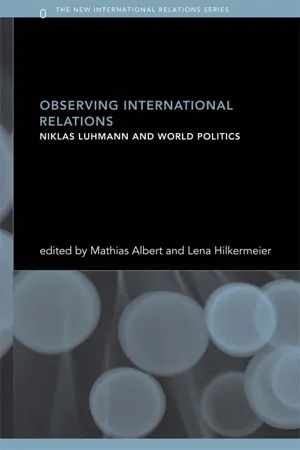
Observing International Relations draws upon the modern systems theory of society, developed by Niklas Luhmann, to provide new perspectives on central aspects of contemporary world society and to generate theoretically informed insights on the possibilities and limits of regulation in global governance.
The authors develop a Luhmannian theory of world society by contrasting it with competing notions of international society, critically discussing the use of modern systems theory in international relations theory and assessing its treatment of central concepts within international relations, such as power, sovereignty, governance and war.
eBook - ePub
Observing International Relations
Niklas Luhmann and World Politics
- 272 pages
- English
- ePUB (mobile friendly)
- Available on iOS & Android
eBook - ePub
About this book
Information
1 Introduction
Why Modern Systems Theory and International Relations?
The field of International Relations already seems to be characterized by a bewildering variety of theories, both in terms of specific disciplinary approaches as well as in terms of theoretical imports from neighboring disciplines. So why, with the sociological body of theory conceived by and following Niklas Luhmann, bring another theory to the purview of IR? The chapters in this volume are an attempt to provide possible answers to this question, particularly also giving room to answers which in the end conclude that Modern Systems Theory (MST) and International Relations make uneasy bedfellows. The preliminary answer given in these introductory remarks is of a more superficial kind and pertains to the legitimacy of starting with the entire exercise in the first place. Arguably, the study of international relations has always benefited from taking insights from theories of society into account: be it in the more direct connections between realist understandings of international relations on the one and sociological thought on the other hand as in the work of Raymond Aron, for example; be it in the impact which Parsonian theory had on the work of Karl Deutsch and others; or be it, of more recent origin, in the form in which Anthony Giddens’ theory of structuration has been put to use by Alexander Wendt in order to conceptualize the international system, or in the way in which Jürgen Habermas’ theory of communicative action has been employed to understand the generation and impact of norms by Thomas Risse and others. Given that notions of an “international society” or indeed a “world society” feature increasingly prominently in attempts to provide comprehensive conceptual frameworks to understand the contours and the dynamics of what can no longer satisfactorily be described as a (“Westphalian”) “international system,” IR thus seems well prepared to thoroughly think through these notions of a society beyond the state, utilizing its well-established links to sociological theory. Against this background, it comes all the more as a surprise that up to now Luhmann's work has received scant attention by IR scholars only. Although probably one of the most fervently supported and most polemically opposed contemporary theories of society, not even its most enthusiastic opponents deny that it is one of the (if not the) most fully developed and sophisticated macro-theories of society around. And, at least at first glance, for IR scholars struggling with how to conceptualize a “post-Westphalian” world, this theory1 might seem to be particularly attractive since it does conceive itself as a theory of world society. World society is not seen as a contemporarily emerging phenomenon by Luhmann, but rather as something whose existence cannot plausibly be denied if society is seen as being constituted by communication and if today all communication can, at least in principle, connect to all communication (i.e. there is no undiscovered “blind spot” of communication left on the planet).
This is not the place to elaborate extensively on why it is that IR theory has not paid much attention to the work of Niklas Luhmann, but two reasons seem to stand out: first of all, and rather straightforward, the theory of Niklas Luhmann, which for more than thirty years has formed the counterpart to the work of Jürgen Habermas in German social theory and public intellectual discourse (see Habermas and Luhmann 1973), and which is read and discussed widely particularly in Scandinavian countries, Italy, Spain, and Japan, has not been received widely in Anglophone – nor, for that matter, Francophone – countries. Relatively few of Luhmann's books have been translated into English, and those translated have been discussed more in cultural studies than in the social sciences.2 While this only sparse reception of Luhmann's work in Anglo-American sociology arguably already impedes upon its further reception in the discipline of International Relations, the fact that this reception has also not taken place in IR debates in countries where Luhmann's work plays a prominent role in sociological discourse points to a second reason, which is of a more systematic kind in that it pertains to the contents of Luhmann's theory. This theory is, to put it bluntly, an extremely complex kind of theory; as a theory of society, it consists of three different sets of theories connected to each other: a theory of social systems, a theory of social differentiation, and a theory of social evolution.3 In all of these theories, it arguably presents a major deviation from the previously existing state of theorizing; and it comes along with the rather far-reaching claim to actually present a comprehensive theory of society (a claim which is however ironically counteracted by Luhmann's radical constructivism). To critics, this results in a body of literature plainly incomprehensible at best; to proponents, it opens up an extremely rich reservoir of ideas, concepts, and methods to think about society in a novel and stimulating way.
Against this background, the present volume sets itself a difficult task. It seeks to inspect the possible uses of Luhmannian theory for studies in the discipline of IR. It does so for what is deemed to be a deserving purpose, namely to partake in the search for conceptual vocabularies and tools which help to grasp and more aptly describe a global societal context which can no longer be reduced to an international system (and in which such an international system may possibly also not form a clearly delineated fabric of social reality either). Yet this task is complicated by the fact that Luhmann's theory is extremely complex in itself and little known in the IR community.
To measure up to such a task, an obvious strategy would be to first introduce Luhmann's theory and then “apply” it to IR. The present volume does, however, not adopt such a strategy, for basically one reason: it is clearly beyond its scope; the most we can hope to achieve is to introduce some ideas and concepts which are central to this complex body of theory and which are important for relating it to IR (and, of course, to instill some interest to read on beyond that). This is of course to clearly take sides in the ongoing dispute on whether or not it is possible to use Luhmann's rich body of theory as a “toolbox” or whether it forms somewhat of a self-enclosed system in itself which can and must only be treated as such. And it is to argue that just as there is no monolithic bloc of “IR theory” on the one side, so there is no static Luhmannian theory of society on the other. Against this background, it is the strategy of this volume not to introduce a theory and apply it to something, but to stage a number of encounters between elements of Luhmann's theory of society and parts of contemporary IR theorizing. These encounters can be summarized along three lines which also provide the ordering principle for the following chapters. Part I deals with the general issue of whether and how it actually makes sense to try and somehow conjoin Luhmannian and IR theorizing. Part II then leaves Luhmannian theorizing to a certain extent in that it takes a focus on different contemporary notions and concepts of “world society.” The purpose of this part is not only to further elucidate some aspects of Luhmann's notion of “world society” in contrast to other such notions, but also to identify points where these diverging notions of world society show points of overlap which could be developed further. Part III then seeks to demonstrate and assess the perspective which Modern Systems Theory offers on central concepts of IR, such as power, sovereignty, governance, and war.
Overview of the chapters
Part I sets the tone for the entire volume in that it comprises contributions which diverge in their assessment of the usefulness of bringing IR and MST closer to each other, yet also demonstrate the quite varied ways in which it is possible to read – and thereby introduce – Luhmann's theory.
As much as Mathias Albert argues for the fruitfulness of an encounter between Modern Systems Theory (MST) and IR, yet also points out some limits of such an encounter, Thomas Diez stresses the limits of MST for IR yet seeks to preserve some beneficial insights. Albert argues that the relation between MST and IR should be conceived of as a two-way street. For him, MST offers a conceptual framework which takes the “society” in “world society” seriously, i.e. as something which sees world society as a subject to be properly treated by a theory of society and its component parts. Such an orientation quite resolutely places thought about a global beyond any kind of “methodological nationalism” and it forces IR to rephrase its subject matter in that it can henceforth only be delineated in terms of internal differentiations of world society; yet it also requires one to critically inspect some notions central to IR – such as politics and power – in the light of an MST reading of these concepts. By so doing, argues Albert, some shortcomings of MST also come into sight for which contributions from IR might provide some correctives. Among other things, this first and foremost pertains to MST's notion that the political system of world society remains primarily differentiated into states; this premise ignores much of the work done in IR on emerging forms of institutionalization and governance beyond the state which could in fact point to a change in the primary form of differentiation of one of world society's function systems. While Thomas Diez also sees some potential benefits to be gained from MST, his main argument is that critical theorizing in IR, particularly if inspired by poststructuralist works, offers much the same yet does not shed the political and emancipatory impetus in the same way as does Luhmann. The similarities between poststructuralist and particularly Foucauldian thought on the one hand and Luhmann's work on the other are numerous: in both cases, for example, a radically constructivist stance is adopted; in both cases, the existence and in fact possibility of a universally shared normative ground is denied. Yet, in Diez's view Luhmannian thought throws out the baby with the bathwater: it not only “de-centers” the subject, but seeks to do away with it and any concept of agency based thereupon entirely. This makes MST potentially useful for producing some theoretical insights, but not for a critical discourse in IR ultimately oriented towards some form of political practice. While Stefan Rossbach also shares the skepticism regarding the usefulness of MST and particularly Luhmann's notion of “world society,” he offers a reading very different from the chapters by Albert and Diez. Although skeptical, Rossbach provides a reading much more deeply immersed in Luhmann's writings. Quite surprisingly, Rossbach seems to criticize what both Albert and Diez seem to agree on as forming a virtue in Luhmann's thought, namely his anti-ontological and radically constructivist stance. He argues that – traceable in Luhmann's writings – the notion of totality inherent in world society refers to a mysticism in Luhmann, bearing resemblance to Gnostic thought. Rossbach's chapter makes interesting reading in that he does not overtly reject Luhmann; but he points to a certain tradition in which his thought is situated which is not usually acknowledged, yet which “appeals to his readers today to the extent that they share this loss of orientation.”
Besides the arguments they provide as such, the three chapters of the first part of this volume are exemplary for the different ways in which it is possible to approach MST, ranging from some sort of largely sympathetic yet critical encounter (Albert), to a critical encounter retaining some sympathy (Diez), to an exegesis which seems as full of criticism as admiration (Rossbach); similar varying forms of engagement with MST can be found in all the chapters which follow.
The contributions in Part II are arguably most remote from staging direct encounters with MST. They seek to elucidate MST's notion of “world society” not through a development of MST vocabulary as such, but by contrasting it with other notions of world society. This part can thus also be read as an attempt to provide an overview over different concepts of “world society” within contemporary IR and sociological theory.
Chris Brown asks whether international society theory in the English School tradition, which has gained prominence again in recent debates, is compatible with competing notions of world society. While international society theory is seen to share more basic assumptions with classical realism than is often acknowledged, it is distinctly set apart from the latter by allowing for a flourishing of different conceptions of the Good. In that respect, Burton's notion of the state as a concentration of power within his account of world society also puts it closer to classical realism than to international society theory. In contrast, Brown finds many more shared aspects and points of contact between the English School and the sociological institutionalism of the Stanford School which, as he argues, both share a basic underlying “structurationist” tendency in their conceptualization of the relation between states on the one hand and international/world society on the other, and which both put a great deal of emphasis on international institutions. Against this array of possible commonalities between different accounts of world society (or the international system in the realist case) and the English School account of an international society, Brown observes a deep and fundamental, possibly unbridgeable, gap between this account and Luhmann's notion of world society. The basic rift is not only located in the very different notions of “system” employed, but also, and possibly more important, relates to the fact that while international society is something constituted by norms, world society is seen as not being integrated normatively at all by MST.
Working from within the tradition of the Stanford school-type sociological institutionalism, George Thomas finds more possible points of contact with a Modern Systems account of world society. Both approaches focus on change in world society as some form of endogenous change within society, yet differ in that they attribute this change to either differentiation (in the systems theoretical case) or to a rationalizing process (in the institutionalist case). This rationalizing process can be demonstrated by the way in which world cultural models shape organizational forms and have effects on both state and non-state actors alike. The rising number of International Non-Governmental Organizations is a case in point; the formal similarities between different religious movements all over the world (despite marked differences in the world views advocated) is another. After outlining the institutionalist research agenda, Thomas takes up its relation to MST. While in no way downplaying the rather fundamental difference which lies in the ascription of change to either differentiation or rationalization, he argues that both approaches are still in the same quadrant of viewing the world in that neither is actor-centered and both ground their analyses in processes rather than in (actors’) interests. Yet institutionalist analysis tends to at least include actors as being constituted out of the rationalization of activity, and thus reserves an important place for them where MST does not. However, and here echoing similar observations in the sociological debate, there is still a lot of room left to explore between MST and sociological institutionalism.
Lothar Brock provides a marked contrast to both MST and sociological institutionalism in that he argues for a view of world society to be understood as something constituted “from the bottom up.” Although the evolution of an international and a world society “from the bottom up” are also to be understood in a rather direct sense in that they are fed by an increase and a “thickening” of inter-and transnational relations, the point in Brock's argument is that international system, international society and world society designate three different standards of appropriateness of political behavior. Thus understood, all three have been around for quite a while and the most important question in order to trace change would then be the shifting importance between these standards of appropriateness of political behavior. With reference to long-term historical change Brock argues that world society formation “from the bottom up” manifests itself in that the logic of multiple representation (characteristic of world society) increasingly “is beginning to permeate those institutions which represent the logic of autonomy.” Such a view does not see world society as an entirely normatively integrated world-wide form of “classical” society, yet does acknowledge the necessity of at least some form of symbolic integration of such a world society which “involves the internalization of universal norms as identical points of reference in widely differing contexts.” In this sense, Brock brings an element of community formation to world society formation and is thus arguably rather distant from both Stanford School or MST notions of world society, and much closer to classical theories of society. The relation between these classical theories of society as far as embedded in classical theories of modernity and the notion of world society is inspected in Dietrich Jung's chapter. In Jung's reading, Luhmann's theory of society stands in the tradition of classical theories of modernization and society, yet replaces the central distinction between tradition and modernity by one between system and environment. Yet already in the classical texts by, among others, Weber, Simmel and Bloch, an emergent world society is seen to be diagnosed in which, however, patterns of modern and traditional society are arranged in a patchwork-like fashion and create the impression of heterogeneity; nonetheless, regarding society as a whole, unlike MST the classical texts do still entail a view of the world in moral and normative terms. In that it shifts its focus from social to functional integration, MST works without such a view. However, the construction of an at least rough line of discursive and theoretical continuity between classical theories of modernization and Luhmann's theory of society allows Jung to stay away from the diagnosis of significant, and sometimes even radical and unbridgeable disjunctures between MST's notion of world society and the other notions of international/world society inspected by the other chapters in this part. Quite to the contrary, Jung is able to relate the arguments of Brown, Brock, and Thomas to the identified continuum of theorizing about (world) society. Thus, for example, the view of world society in the world cultural approach represented by Thomas is seen as a continuation of Max Weber's conceptualization of modernity as a process of rationalization. Because of this, Jung is able to diagnose an exchange between IR theory and sociological theories of society (in the plural) as a potentially fruitful exercise.
In addition to providing valuable insights into different contemporary conceptualizations of world society/international society, the contributions of Part II also demonstrate the vastly different possibilities, ways, tones and styles to engage with Luhmann's theory. This vast array of different possibilities highlights both the richness of Luhmann's work as well as the difficulty of simply “employing” it. This double richness and difficulty is further highlighted in the third and most extensive part of this volume. Unlike in Part II, which somehow circled Luhmannian theory on the “margins” by relating to its notion of world society which in Luhmann's work is of great systematic importance yet barely developed explicitly itself, the authors of the chapters in Part III seek more direct recourse either ...
Table of contents
- Front Cover
- Observing International Relations
- Title Page
- Copyright
- Contents
- Notes on contributors
- Preface
- Series editor's preface
- Acknowledgements
- 1 Introduction
- PART I: Luhmann and IR: a worthwhile encounter?
- PART II: Competing notions of world society and world society as the “largest social system possible”
- PART III: Bringing Modern Systems Theory to the study of IR: concepts and questions
- Bibliography
- Index
Trusted by 375,005 students
Access to over 1.5 million titles for a fair monthly price.
Study more efficiently using our study tools.
Frequently asked questions
Yes, you can cancel anytime from the Subscription tab in your account settings on the Perlego website. Your subscription will stay active until the end of your current billing period. Learn how to cancel your subscription
No, books cannot be downloaded as external files, such as PDFs, for use outside of Perlego. However, you can download books within the Perlego app for offline reading on mobile or tablet. Learn how to download books offline
Perlego offers two plans: Essential and Complete
- Essential is ideal for learners and professionals who enjoy exploring a wide range of subjects. Access the Essential Library with 800,000+ trusted titles and best-sellers across business, personal growth, and the humanities. Includes unlimited reading time and Standard Read Aloud voice.
- Complete: Perfect for advanced learners and researchers needing full, unrestricted access. Unlock 1.5M+ books across hundreds of subjects, including academic and specialized titles. The Complete Plan also includes advanced features like Premium Read Aloud and Research Assistant.
We are an online textbook subscription service, where you can get access to an entire online library for less than the price of a single book per month. With over 1.5 million books across 990+ topics, we’ve got you covered! Learn about our mission
Look out for the read-aloud symbol on your next book to see if you can listen to it. The read-aloud tool reads text aloud for you, highlighting the text as it is being read. You can pause it, speed it up and slow it down. Learn more about Read Aloud
Yes! You can use the Perlego app on both iOS and Android devices to read anytime, anywhere — even offline. Perfect for commutes or when you’re on the go.
Please note we cannot support devices running on iOS 13 and Android 7 or earlier. Learn more about using the app
Please note we cannot support devices running on iOS 13 and Android 7 or earlier. Learn more about using the app
Yes, you can access Observing International Relations by Mathias Albert,Lena Hilkermeier in PDF and/or ePUB format, as well as other popular books in Politics & International Relations & International Relations. We have over 1.5 million books available in our catalogue for you to explore.