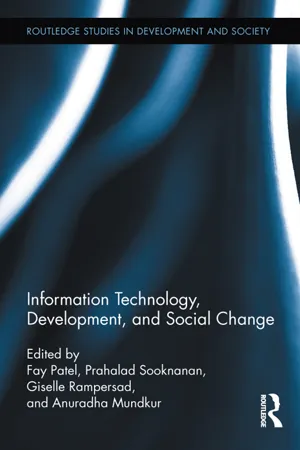
The speed and cost effectiveness of new information technology has prompted many to view these innovations as a panacea for social and economic development. However, such a view flies in the face of continuing inequities in education, health, food, and infrastructure. This volume explores these issues – along with questions of access, privilege, literacy, training, and the environmental and health effects of information technologies in the developing world – arguing that a higher level of development does not always result from a higher level of technologization.
eBook - ePub
Information Technology, Development, and Social Change
- 158 pages
- English
- ePUB (mobile friendly)
- Available on iOS & Android
eBook - ePub
Information Technology, Development, and Social Change
About this book
Information
Part I
Alternative Perspectives on the Diffusion of Innovations and International Development
Traditional paradigms of the diffusion of innovations and international development were designed and implemented to modernize and civilize the developing communities as a desired goal. Of course, another less articulated goal was to increase the economic prosperity of Western nations which was done under the guise of knowledge transfer initiatives–between the developed and the developing communities. These models were exported during the mid to end of the last century as industrialization and modernization packages from the Western nations. In the developing community context, recipients of the innovation and development initiatives spoke out about the incompatibility of these development initiatives with their indigenous knowledge, cultural values and beliefs, and various aspects of sustainable development. However, the voices of developing communities remained insignificant whispers in the wind because Western superpowers like the United States of America, Britain and some European countries had a remarkable hegemonic influence on the global political economy. Alternative paradigms advocating for a human-centred perspective in development that respect and value the cultural and indigenous knowledge of developing communities were ignored and dismissed.
The authors of the introductory chapters reiterate the call for human-centred alternative paradigms that respect and value cultural and indigenous knowledge and suggest that it is imperative that innovation diffusion and international development in the 21st century take cognizance of the need to design and implement innovative development that will consider human and sustainable development as the ultimate goal. In chapter one, Patel, Rampersad and Sooknanan retrace the history of innovation diffusion and international development and make a bold attempt to seek some form of justice for the wrongs that modernity has imposed on developing communities. They contend that many atrocities have been inflicted upon developing communities in the past in the name of modernization and industrialization and that the current trends in technologization and globalization have the same agendas. Next, Patel implores practitioners, sponsors, and agencies to re-establish socially responsible, just, and sustainable goals and agendas so that the human development component is fully supported and resourced in all future initiatives. Rampersad further develops the theme of empowerment and calls for a holistic approach to the diffusion of innovations. Particularly, the chapter provides a framework for sustainable innovation that will allow developing communities to drive the innovation in tandem with their goals for a sustained future.
1 Diffusing the Innovation Divide in International Development
Redressing the Injustices of Modernity
INTRODUCTION
In the early part of the 20th century, there was a notable trend in modernizing the world through industrial development. Both the superpowers and the developing communities were striving to win the race or to catch up with industrialization in an effort to be seen as industrialized nations that were committed to a modern, higher quality of life for their citizens. In the 21st century, that same fervor to modernize has emerged once more with a renewed vigor, but this time there is an urgency to technologize. In other words, the goals and dreams to keep the world chugging along on the old steam engine have suddenly moved forward at lightning speed to digitize an already modern and industrial economy bringing information and communication fast forward into the 21st century.
This chapter will critically assess if technologization and globalization have replaced the old paradigm of modernization and industrialization and, if so, in what ways. The authors identify the old socio-economic and political tensions and divisions in the current traditional paradigm and offer alternative perspectives which bring unique challenges. They subscribe to the view that the new century calls for a more candid statement on the elimination of the socio-economic and political divide within and across the developed and developing community contexts in an attempt to redress the injustices that were delivered in the name of modernity.
HISTORICAL OVERVIEW
Communication technologies have long been lauded for their potential as development tools (Lerner, 1958; Schramm, 1964). In the same vein, Rogers (1969) maintained that the mass media have the capacity to bridge the gap between tradition and modernity and are ‘magic multipliers’ in the process of social change. Indeed, these were the Western notions of development that constituted the dominant paradigm of development during the 1950s and 1960s. By the 1970s, however, the dominant paradigm of development had fallen short of expectations (Rogers, 1976). In other words, the Western theories that supported the direct and powerful effects of the mass media had failed to yield meaningful results in the developing countries context. In fact, instead of being a significant variable in the development process, the mass media were blamed for increasing the knowledge gap between the advantaged and disadvantaged communities in the developing nations (referred to as the ‘Third World’ in the literature in previous decades). Mody (1991) attributed this failure to the unwitting disregard for the Third World (developing community) context with regard to their social, psychological, political, and economic environment.
In the aftermath of the dominant paradigm, emerging technologies ushered in a new era in development and the role of information and communication technologies (ICTs) in particular. ICTs, otherwise known as ‘new media’, held promise for corresponding changes in the nature of human communication and social change. These assumptions were premised on the fact that new communication technologies are interactive (can ‘talk back’ to the user), de-massified (can individualize the exchange of information), asynchronous (can send and receive messages at convenient times to the user), and also synchronous as more people expect immediate and real-time response via the ICTs as they do over the telephone and in person. In other words, new media were perceived as having the unique ability to transcend temporal and spatial constraints as well as facilitate collaboration and participatory communication (Rogers, 1986). The advent of new communication technologies or ICTs, therefore, heralded a new wave of optimism in national development. In contrast with traditional mass media communication, Stover (1984) upheld that ICTs go further by offering possibilities for change and new perspectives for development. More specifically, ICTs were seen as having tremendous potential for improving development initiatives in areas such as health, science, agriculture, and education associating it with uplifting the economic wellbeing of people and leading to the eradication of poverty among developing communities.
Notwithstanding the touted benefits, tangible results from development potentials did not materialize for a variety of reasons. For one thing, the concept of development remained ambiguous in social and economic thought. Fagerlind and Saha (1989) claimed that development was used interchangeably with social change, growth, advancement, and modernization. More critically, they claimed that, with the exception of the term social change, the others imply change in a specific direction, which is regarded by users as positive or highly valued. In retrospect, this was consistent with the positive and uni-linear bias of development which strongly influenced the European or Western model of development that was deployed to restore war-torn Europe. Development later became known as Westernization or Europeanization (Mowlana & Wilson, 1988).
Given the success of the Western model of development during the 1950s and early 1960s, Western scholars were led to believe that this feat could be duplicated among the newly independent nations that emerged among the developing communities. Indeed, their optimism was misguided because this model of development was influenced by events such as the Industrial Revolution, the colonial experience of the Third World, dominant quantitative empiricism, and prevailing economic and political thinking (Rogers, 1976). Melkote (1991), concurs with this view outlining that this dominant paradigm of development advocated economic growth through industrialization, introduction of capital-intensive technology, capital formation by saving money and sacrifice of short-term goals for long-term ones, a top-down structure of authority, and a ‘modern’ mindset among individuals. By the late 1960s and 1970s, it was not surprising that the Western models of development had failed among Third World (developing community) countries (Mowlana & Wilson, 1988). Melkote (1991) criticized this alien model of development for its pro-economic bias and quantifiable variables, neglecting labor-intensive strategies, ignoring constraints imposed from outside, supporting a top-down approach to planning and development, overlooking the socio-cultural context showing lack of concern for self-reliance and participation in development activities. In retrospect, Eisenstadt (1976) lamented that the dominant paradigm of development succeeded more as a description of social change in Western Europe and North America than as a predictor of change in developing countries.
Evidently, the failure of Western models of development can be attributed to their inappropriateness and false assumptions. To this end, Fagerlind and Saha (1989) argue that difficulties arise when one attempts to extrapolate alien economic growth models to countries with different socio-cultural values and structures and whose resources preclude normal strategies for industrialization. They further contend that these models assume that a number of key variables will remain constant, when in fact they can be unpredictable. In contrast, the success of an economic growth model is dependent upon growth, capital accumulation, motives to maximize profits, and the improvement in general conditions of life. In other words, the ideal economic model turns out to be partly sociological as well as psychological.
Nearly over half a century after the rush to modernize and industrialize the world and, particularly, to export diffusion of innovations to the developing communities around the world, we are standing once more on the edge of another phenomenal revolution: technologization. New sophisticated information and communication technologies are emerging at greater speed than before. The range of technology and growing network access capabilities include
a) Laptops, Notebooks, Netbooks, and Tablets now available for mobile use
b) Internet and email access through Wifi and Fibre Optic networks
c) Smartphones that provide multiple communication services such as email, text messaging, banking and document exchange
d) HDTV with its revolutionary picture clarity and 3DTV with Wi-Fi and Internet capabilities
e) Social media options such as Facebook and Twitter and their integration and constant presence in all aspects of life.
The rapid increase in the variety of digital media options and rate of diffusion is having an overwhelming effect on ordinary people. At the same time, technologization is continuing to divide the world into those who can afford these technologies and digital gadgets (‘the haves’ or ‘the rich’) and those who cannot (‘the have nots’ or ‘the poor’). The notion of modernization in the last century also further divided the developing communities into the ‘haves’ and the ‘have not’.
McMichael (2004, p. 22) is of the view that President Truman’s proclamation in the late 1940s further ‘divided the world between those who were modern and those who were not’. Modernization was associated with notions of becoming more like the Western superpowers (such as the United States and Britain) through an increase in ownership of and access to machinery. Today, technologization is viewed in a similar light and so communities around the world continue to trample over each other to adopt a new technology as it arrives on the market. For example, adopting the Apple manufactured iPhone and then the iPad within months of its appearance is only one example of how fast the new technologies are diffusing and being consumed by developed and developing communities alike. More recently, the scramble for an iPhone 4S (Clark, 2011) was a global event in October 2011 when people worldwide were lining up in the streets from California and Paris to Sydney and Tokyo with some people camping out in front of stores for up to two and three nights to be first at the iPhone 4S launch. This event along with other media evidence of the ‘technology wars’ among the corporations to monopolize the electronics industry demonstrates the speed with which new technology is emerging and diffusing. Corporations like Research in Motion (RIM) and Apple continue to compete at all levels. Ganapati (2009) identifies access to support and application development as two of the many challenges facing RIM as it competes with Apple. Service blackouts in October 2011 caused RIM further setbacks and Apple’s launch of ‘the latest version of its mobile operating system, iOS 5, available to iPhone users’ at that same time caused more harm to RIM’s corporate image and to confidence levels among consumers, according to Hartley (2011). Wortham (2011) cites a recent Nielson Survey finding that the adoption of the Smartphone in the USA has increased to 43 percent with 28 percent of Smartphone owners using an iPhone. Android’s emerging presence and increased adoption as an alternative platform will further challenge the current dominance of the iPhone on the global market. Competitiveness in the industry will encourage more innovations leading to better technologies. This rapid adoption of new communication technology such as the Smartphone reflects a new wave of technologization in the twenty-first century and brings with it concerns about the further dichotomization of ‘those who have and those who do not have’ the means to enter a technologized era.
The assumptions about what was meant by modernization and industrialization in the last century have been transferred to current notions of technologization and globalization. McMichael (2004, p. 23) claims that ‘development/modernity became the standard by which other societies were judged’. Communities around the world assume that an increase in ownership and access to machinery and technology equals progress; that a higher level of export and import of machinery and technology means that communities are modernizing and advancing at a faster pace; and that an increase in production and consumption levels among developing communities means that t...
Table of contents
- Cover
- Halftitle
- Title
- Copyright
- Dedication
- Contents
- List of Figures and Tables
- Foreword: Beyond the Innovation Divide
- Preface
- Acknowledgments
- PART I. Alternative Perspectives on the Diffusion of Innovations and International Development
- PART II. Innovative Technology: Impact on Developing Communities
- PART III. International Development: Critical Perspectives on Health, Poverty, and Environment
- Contributors
- Author Index
- Subject Index
Trusted by 375,005 students
Access to over 1.5 million titles for a fair monthly price.
Study more efficiently using our study tools.
Frequently asked questions
Yes, you can cancel anytime from the Subscription tab in your account settings on the Perlego website. Your subscription will stay active until the end of your current billing period. Learn how to cancel your subscription
No, books cannot be downloaded as external files, such as PDFs, for use outside of Perlego. However, you can download books within the Perlego app for offline reading on mobile or tablet. Learn how to download books offline
Perlego offers two plans: Essential and Complete
- Essential is ideal for learners and professionals who enjoy exploring a wide range of subjects. Access the Essential Library with 800,000+ trusted titles and best-sellers across business, personal growth, and the humanities. Includes unlimited reading time and Standard Read Aloud voice.
- Complete: Perfect for advanced learners and researchers needing full, unrestricted access. Unlock 1.5M+ books across hundreds of subjects, including academic and specialized titles. The Complete Plan also includes advanced features like Premium Read Aloud and Research Assistant.
We are an online textbook subscription service, where you can get access to an entire online library for less than the price of a single book per month. With over 1.5 million books across 990+ topics, we’ve got you covered! Learn about our mission
Look out for the read-aloud symbol on your next book to see if you can listen to it. The read-aloud tool reads text aloud for you, highlighting the text as it is being read. You can pause it, speed it up and slow it down. Learn more about Read Aloud
Yes! You can use the Perlego app on both iOS and Android devices to read anytime, anywhere — even offline. Perfect for commutes or when you’re on the go.
Please note we cannot support devices running on iOS 13 and Android 7 or earlier. Learn more about using the app
Please note we cannot support devices running on iOS 13 and Android 7 or earlier. Learn more about using the app
Yes, you can access Information Technology, Development, and Social Change by Fay Patel,Prahalad Sooknanan,Giselle Rampersad,Anuradha Mundkur in PDF and/or ePUB format, as well as other popular books in Social Sciences & Global Development Studies. We have over 1.5 million books available in our catalogue for you to explore.