The end of the Cold War has opened up a 'real world laboratory' in which to test and refine general theories of international relations. Using the frameworks provided by structural realism, institutionalism and liberalism, The Post-Cold War International System examines how major powers responded to the collapse of the Soviet Union and developed their foreign policies over the period of post-Cold War transition.
The book argues that the democratic peace has begun to generate powerful socialisation effects, due to the emergence of a critical mass of liberal democratic states since the end of the Cold War. The trend this has produced is similar to a pattern that classical realists have interpreted as 'bandwagoning' within a unipolar power structure. Case studies of Germany, China and Japan - identified as key states with the potential to challenge US dominance - provide evidence to support the assessment of international change. The author concludes by exploring the implications of September 11th for the analysis developed.
This important volume argues that the end of the Cold War was a major historical turning point in the development of world politics with fundamental implications for the basic way in which the dynamics of the international system are conceptualised.
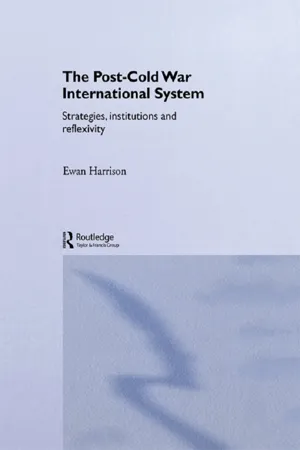
eBook - ePub
The Post-Cold War International System
Strategies, Institutions and Reflexivity
- 200 pages
- English
- ePUB (mobile friendly)
- Available on iOS & Android
eBook - ePub
About this book
Information
1 Introduction
The collapse of the Soviet Union provided an historic opportunity to examine how key states respond to large-scale change in the international system. Between the fall of the Berlin Wall in November 1989 and the aborted August coup that preceded the demise of the Soviet Union in 1991, the international system witnessed the disintegration of the bipolar structure of power that characterized the post-1945 international order. Few, including the majority of experts, anticipated the dramatic changes that took place during this period. Furthermore, the ‘systemic shock’ associated with the demise of the Cold War order provides a unique context within which to test and refine theories of international relations. The end of the Cold War has therefore opened up questions about the overall nature of international change at the turn of the twentieth century. The ‘real world laboratory’ provided by the end of the Cold War can now be used to assess the structural realist, institutionalist and liberal models of the international system. Since 1989, the preconditions for these theories to make a discrete set of predictions about the overall nature of post-Cold War change have been present. In line with the neorealist model, the collapse of the Soviet Union has brought about a major shift in the global balance of power. In line with the institutionalist model, there are variations in patterns of economic and institutional interdependence across the international system. In line with the liberal model, since 1989 a relatively stable core of liberal democratic states now dominates the international system. Moreover, over a decade has now passed since the end of the Cold War. States have been provided with a prolonged period to respond to the dramatic changes that began to take place in the late 1980s. If the system within which they interact with others affects the behaviour of states, the incentives and constraints this has generated ought to be beginning to exert their influence on outcomes observed. Using the opportunity presented by the close of the first ten years of the post-Cold War period, an examination is made of how major powers have responded to the changes which have taken place in the international system since the end of the Cold War. By applying general theories of international relations to the strategies of major states between 1989 and 1999, the aim is to identify the overall nature of change in the international system after the Cold War.
The decade following the end of the Cold War posed a particularly interesting puzzle for conventional wisdom regarding international relations. Unlike other major shifts in the balance of power, the end of the Cold War was not accompanied by a great power war. Moreover, peaceful adjustment extended through the first decade of the post-Cold War transition. Of course, in many parts of the world the power vacuum left by the end of the superpower conflict led to brutal outbursts of violence. Yet tragic though these wars were, unlike earlier historical periods they failed to generate a system-wide international conflict. It was only natural that the general public in the West would assume that the relatively benign situation they faced was the logical consequence of the crumbling of Soviet power. However, in the context of both international history and international relations theory, this outcome was highly unexpected. Historically, the twentieth century has been characterized by continuous great power conflict on an unprecedented scale. Theoretically, it is acknowledged that the international system has a powerful anti-hegemonial quality. The end of the Cold War left the United States in a position of unchallenged preeminence. However, contrary to established theory, this has not led to a period of instability and great power conflict. The Soviet Union acquiesced peacefully in the collapse of its empire without mounting a final counter-hegemonial backlash. Moreover, there has been an absence of great power security balancing against the US which conventional wisdom in the early post-Cold War period had anticipated. Indeed, it is only really in the first years of the new millennium – some twelve or so years after the end of the Cold War – that concerns about the significance of American power have re-emerged prominently in public and policy debates for the first time since prior to the Soviet collapse. Viewed in historical and theoretical perspective, that it has taken such an extended period for these questions to surface is truly remarkable. What explains this era of great power stability? Even approaching a decade and a half after the end of the Cold War, this question continues to present a major anomaly for established conceptions of international relations. Yet its importance for understanding the nature of the global order cannot be under-estimated. The close of the first decade of the post-Cold War period has presented a unique context in which to systematically examine this puzzle to shed light on both the character of the emerging international system, and the way its dynamics are best conceptualized.
In applying theories of the international system to understanding the strategies of major powers in the post-Cold War period, the template provided by two collaborative projects carried out at Harvard University during the 1990s is followed. The first is the Keohane et al. edited volume After the Cold War: International Institutions and State Strategies in Europe 1989–1991 (Keohane et al. 1993). This book, published shortly after the end of the Cold War, examines how the US and the major European powers used international institutions in adjusting to the changes taking place. The findings draw conclusions about the relative merits of the neorealist, institutionalist and liberal models in explaining international outcomes during this critical period. The second book is the more recent Unipolar Politics: Realism and State Strategies After the Cold War (Kapstein and Mastanduno 1999). This differs from the Keohane et al. volume in two ways. First, it examines realist theories rather than debates across competing schools. Hence it focuses on strategies of the major powers, rather than on the nexus between institutions and strategies. Second, it examines post-Cold War state strategies at a global level, rather than focusing on a European context. Following Keohane et al., evaluation of competing theoretical paradigms is provided, requiring examination of the nexus between international institutions and state strategies. Following Kapstein and Mastanduno, state strategies are analysed at a global level. Nevertheless, commonality exists with both the Keohane et al. and Kapstein and Mastanduno projects in that the aim is to use theories as frameworks to analyse how major states have responded to the changes in the international system since 1989.
To provide points of reference with the two projects discussed the definitions of ‘the end of the Cold War’, ‘state strategies’ and ‘international institutions’ are compatible with their use in these books. Following Keohane et al., ‘the end of the Cold War’ refers to the withdrawal of Soviet power from Central Europe, and the reunification of Germany that resulted (Keohane et al. 1993: 1–2). The end of the Cold War is therefore viewed as predating the collapse of the Soviet Union in 1991, referring to the period from 1989 during which the disintegration of the bipolar distribution of military power became apparent in the global international system. ‘State strategies’ refers to the ways whereby states deploy their material and diplomatic resources to pursue their national interests. Following the pattern set out in both the Keohane et al. and Kapstein and Mastanduno projects, the focus of the analysis is upon grand strategies, rather than detailed aspects of foreign policies. Finally, following the conventional definition of an international regime, ‘international institutions’ are understood as sets of principles, norms, rules and operating procedures around which states orient their expectations (Krasner 1983: 2). This provides a broad definition of an international institution, encompassing not only formal but also informal aspects of institutionalization.
The general aim is to investigate the overall nature of change in the post-Cold War international system. It is therefore necessary to specify the terms in which this change can be measured. The ‘overall nature of change’ in the international system is defined in terms of variation along three dimensions derived from the theories utilized. The theories generate radically different predictions about: (1) the key variable affecting great power behaviour; (2) the general pattern of institutionalized activity between major states; and (3) the foreign policy adjustments made by individual powers to the end of the Cold War. Following Kapstein and Mastanduno, the purpose of analysing the overall nature of international change is both theoretical and empirical (Kapstein and Mastanduno 1999: 1–2). At a theoretical level, an examination is made of whether it is possible to make any general statements about patterns of behaviour observed. At an empirical level, the grand strategies of important actors are analysed to account for how they have adjusted to the end of the Cold War. By so doing, a contribution will be made to the assessment of competing theoretical paradigms, and conclusions drawn about the trajectory of change as the international system enters the twenty-first century.
The introduction is organized into three sections. The first section sets out the theoretical framework by outlining the different models, and provides key definitions. It also identifies the predictions made by neorealism and institutionalism about the post-Cold War international system. However, because liberalism is the least developed of the three theories the first section of the introduction focuses solely on the redevelopment of the liberal model. It is left until the second section to deal with methodological questions relating to the operationalization of empirical hypotheses for the liberal model. This section draws upon the template provided by Unipolar Politics to develop two criteria to facilitate the measuring of liberal predictions. The final section of the introduction sets out the organization of the book, explaining the purpose of the theoretical chapter and its relationship to the case studies.
Theoretical framework
A theoretical approach to international relations is adopted in this book. The study seeks to be clear about the assumptions underpinning it, and to apply these to examining the nature of change in the post-Cold War international system. The promise of a theoretical approach is that it moves beyond a descriptive analysis by offering generalizable explanations of international behaviour (Waltz 1979). However, following Keohane et al. it is necessary to recognize that existing theories are too imprecisely specified to permit the rigorous testing of hypotheses. Keohane et al.'s prescription of using theories to devise frameworks for the construction of more sophisticated empirical investigations is therefore adopted (Keohane et al. 1993: 7).
Also following Keohane et al., the neorealist, institutionalist and liberal models are utilized (Keohane et al. 1993: 3–6). Kenneth Waltz (1979) systematically formulated the structural or neorealist model. Waltz distinguishes between the structure of domestic and international political systems. Domestic systems are hierarchical because they have a central agency capable of enforcing law and imposing political stability. By contrast the international system is decentralized and anarchic. States must make provisions for their own security to ensure survival. They will do so until equilibrium is reached in the balance of power. It follows that the distribution of material capabilities between states is the structural determinant of international behaviour, constraining the behaviour of actors regardless of their internal attributes or preferences. This material structure is provided by the system's polarity, which reflects the number of great powers. International systems can be unipolar (containing a single hegemon), bipolar (containing two superpowers) or multipolar (containing three or more great powers). Bipolar systems are likely to be the least prone to great power conflict. Under unipolarity, the anti-hegemonial nature of the international system will encourage other major states to balance against the dominant state to preserve their independence and autonomy. Multipolar systems are more complex and harder to manage than bipolar systems because there are a greater numbers of actors in the balance of power, and because states can switch allegiance within alliances (on collective action see Olson 1971; Sandler 1992). The emphasis on the international system as motivating state behaviour distinguishes neo-realism from earlier ‘classical’ realist approaches which account for war and the balance of power in terms of nature of particular states or policy makers (Keohane 1986a).
In the early 1990s, neorealists used their theory to make predictions about the emerging international system (Mearsheimer 1990; Layne 1993; Waltz 1993; for the most recent statement see Mearsheimer 2001). With the end of the Cold War, the system had shifted from bipolarity to uni-polarity. Neorealists predicted that this structural change would generate tensions in the alliance systems that had emerged under bipolarity. During the Cold War, the US developed a strong defence presence in both Western Europe and East Asia. This was reflected in its key alliances, namely NATO (1949) and the Mutual Security Treaty with Japan (1954). Through these institutions, America undertook security guarantees aimed at protecting the independence of Western Europe and Japan against a Soviet conventional or nuclear attack. The containment strategy pursued by the US also led to the emergence of a range of economic institutions in global trade (GATT) and finance (the IMF and the World Bank), and fostered the development of European reconstruction through the EEC. Neorealists argued that this system of cooperation would come under pressure after the Cold War because, regardless of the diplomatic face it presents, the US's pre-eminence would be perceived as undesirable. In the absence of a clear Soviet threat, conflicts of interest between the major powers would surface. Secondary states would be encouraged to engage in balancing strategies, targeted principally at America. Neorealists explicitly identified Germany or a unified European state, Japan and China as candidates for major power status. These countries had the potential capabilities to challenge American dominance, and for them to forgo the greater influence this promised would present a structural anomaly. The US would have strong incentives to roll back its security presence in both Europe and East Asia, and rely instead on offshore balancing in these key regions. The resurfacing of indigenous rivalries in Europe and East Asia would provide a more effective way of containing challenges to America's position in the absence of a common external threat. Overall, neorealists predicted that unipolarity would yield to a more complex and less stable multipolar balance of power reminiscent of that of the late nineteenth and early twentieth centuries. Positional competition and a concern with relative capabilities would increasingly characterize great power politics, and war between the major states would be more likely than during the Cold War.
By the end of the 1990s a consensus emerged among realists that the trends towards great power balancing against the US had not been the predominant feature of the international system since the end of the Cold War. This led to William Wohlforth's prominent attempt to salvage the structural realist framework by refining Waltz's argument about unipolarity (Wohlforth 1999). Wohlforth offered an elaboration of the structural realist model compatible with hegemonic stability theory. He argued that unipolarity is compatible with a stable structure of great power relations given the very high concentration of US capabilities within the international system. Wohlforth's claim about the stability of unipolarity had two central components. First, he argued that America's dominance in terms of its material resources is historically unprecedented, much greater even than Britain's lead in the nineteenth century. America's military and economic strength exceeds by a remarkably wide margin any other country or set of countries combined, and this makes the costs associated with balancing against its global hegemony prohibitive. The US is the only major state to maintain a genuinely global power projection capability after the Cold War, and by devoting only three per cent of its GDP to defence it greatly out-spends all the other powers combined. Second, Wohlforth points to the way in which local security dynamics in key strategic regions also lock in the stability of a unipolar world. In Europe and East Asia, serious attempts to balance against the US by countries such as Germany, Russia, Japan and China would first trigger regional security anxieties. These regional security dynamics would check local powers much more than they would the US. Thus attempts to balance US hegemony by secondary states would prove counterproductive and are unlikely to be attempted. By developing these various arguments for the stability of an international system overwhelmingly dominated by the US, Wohlforth has sought to modify the orthodox neorealist model whilst retaining its structuralist and materialist logic.
However, Wohlforth's modified formulation of neorealism shall not be evaluated for two related reasons. First, his argument runs against the basic logic of Waltz's theory. Wohlforth claims that a high concentration of capabilities on the part of the hegemon can foreclose the possibility of great power balancing within a unipolar international system. By contrast, conventional Waltzian neorealism indicates that a high concentration of capabilities with the hegemon will, if anything, increase the structural incentives that exist for secondary states to balance against their more powerful peer rival. Indeed, this explains why there was such a strong consensus among prominent neorealists so early on in the post-Cold War period about the shape of the emerging international order. Neorealists were drawing on the distinctive ability of structural theory to highlight general patterns of behaviour, and were using this powerful tool to cut through confusion by making strong predictive statements. A second and related reason why Wohlforth's variant of neorealism shall not be oper-ationalized is that this perspective is vulnerable to the criticism that it offers a post hoc rationalization of the predictive failures associated with the conventional neorealist model. Neorealists themselves have acknowledged that the emerging international system presents an ideal opportunity to test their predictions against patterns of behaviour as they emerge. For neorealists to subsequently move away from this position in such a way as to salvage their central theoretical analysis allows neorealism to compete against other perspectives on a playing field that is skewed heavily in its favour. Wohlforth's argument could become more coherent and persuasive if it was able to draw upon more comprehensive and rigorous epistemological foundations. In particular, it might benefit by being linked up more explicitly to an elaborated structural realist model which systematically integrates a continuum of capabilities-based elements into the conventional Waltzian framework (James 2002). However, the development of an elaborated structural realist model along these lines is a relatively recent occurrence, and not all theories can be accommodated and tested within the scope of a single study. For these reasons, the conventional Waltzian version of neorealism and its associated predictions are operationalized in the present analysis.
The institutionalist model identifies the distribution of interdependence and international institutions as a variable affecting state behaviour. Institutionalism asserts that cooperation between states is possible even in the absence of a centralized authority at the international level. Although the lack of an enforcement agency increases incentives for states to cheat on agreements, cooperation under anarchy is possible given pre-specified conditions. Where there is scope for joint gains, a small number of actors, and repeated interactions over a long-term time horizon, international institutions can take on instrumental value to states in pursuing their national interests. Institutions can facilitate cooperation by reducing the costs of diplomacy, decreasing uncertainty and shaping states' expectations. Institutionalists recognize that interdependent relations are an important precondition for international cooperation. Well-developed patterns of economic interdependence are crucial, because they increase scope for joint gains as well as the range and frequency of contacts between states. Thus institutionalists recognize that their framework best models patterns of cooperation between advanced industrialized states. Institutional interdependence can also help facilitate cooperation between states in the institutionalist framework. International institutions are difficult to set up in an anarchic environment. However, once in place they can become functional for states, and may persist even when structural conditions alter. Thus institutional inertia may lead to ‘path dependent’ change ...
Table of contents
- Cover
- Half Title
- Full Title
- Copyright
- Table of Contents
- List of illustrations
- Series editor's preface
- Preface
- Acknowledgements
- List of abbreviations
- 1 Introduction
- 2 Reassessing the logic of anarchy: rationality versus reflexivity
- 3 German foreign policy after the Cold War
- 4 Japanese foreign policy after the Cold War
- 5 Chinese foreign policy after the Cold War
- 6 Conclusions
- Postscript September 11, 2001 and its aftermath
- Bibliography
- Index
Trusted by 375,005 students
Access to over 1.5 million titles for a fair monthly price.
Study more efficiently using our study tools.
Frequently asked questions
Yes, you can cancel anytime from the Subscription tab in your account settings on the Perlego website. Your subscription will stay active until the end of your current billing period. Learn how to cancel your subscription
No, books cannot be downloaded as external files, such as PDFs, for use outside of Perlego. However, you can download books within the Perlego app for offline reading on mobile or tablet. Learn how to download books offline
Perlego offers two plans: Essential and Complete
- Essential is ideal for learners and professionals who enjoy exploring a wide range of subjects. Access the Essential Library with 800,000+ trusted titles and best-sellers across business, personal growth, and the humanities. Includes unlimited reading time and Standard Read Aloud voice.
- Complete: Perfect for advanced learners and researchers needing full, unrestricted access. Unlock 1.5M+ books across hundreds of subjects, including academic and specialized titles. The Complete Plan also includes advanced features like Premium Read Aloud and Research Assistant.
We are an online textbook subscription service, where you can get access to an entire online library for less than the price of a single book per month. With over 1.5 million books across 990+ topics, we’ve got you covered! Learn about our mission
Look out for the read-aloud symbol on your next book to see if you can listen to it. The read-aloud tool reads text aloud for you, highlighting the text as it is being read. You can pause it, speed it up and slow it down. Learn more about Read Aloud
Yes! You can use the Perlego app on both iOS and Android devices to read anytime, anywhere — even offline. Perfect for commutes or when you’re on the go.
Please note we cannot support devices running on iOS 13 and Android 7 or earlier. Learn more about using the app
Please note we cannot support devices running on iOS 13 and Android 7 or earlier. Learn more about using the app
Yes, you can access The Post-Cold War International System by Ewan Harrison in PDF and/or ePUB format, as well as other popular books in Politics & International Relations & International Relations. We have over 1.5 million books available in our catalogue for you to explore.