- 352 pages
- English
- ePUB (mobile friendly)
- Available on iOS & Android
eBook - ePub
About this book
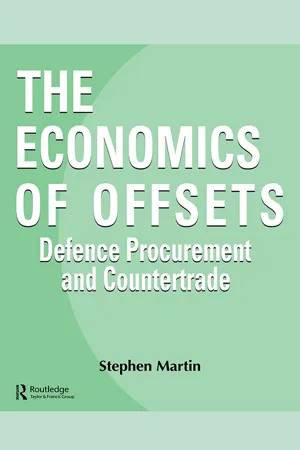
Despite their growth, outlined and analysed in this book, the claims and counter-claims that surround offsets have not been subjected to critical scrutiny by economists. This book fills that gap. It brings together a team of internationally renowned specialists to document and evaluate the economic impact of several countries' offset policies. In addition, the papers by industrialists and defence officials yield further insights which help to tease out which of the claims made for offsets do not stand critical scrutiny.
Chapter 1
Introduction and Overview
1.1 | Context |
Defence procurement can take a number of forms. From indigenous projects, through shared development and production, licensed production and offsets, to an off-the-shelf purchase of a foreign design. Each form of procurement offers the purchaser a different degree of industrial involvement with the development and production of the system being acquired. At one end of the spectrum lie off-the-shelf purchases of a foreign system: these yield neither development nor production work for the domestic defence industrial base (DIB). At the other extreme lies indigenous development and production where all work is allocated to domestic firms. Between these two extremes are procurement options where work is shared between vendor and purchaser.
When purchasing defence equipment, vote-sensitive governments face some difficult choices. Indigenous development and production will, theoretically, provide an independent capability, the required equipment, as well as the most benefit for the domestic economy in terms of jobs and technology acquisition. However, this is also likely to be the most expensive option. An off-the-shelf purchase might involve compromise over the system’s capability and will generate little domestic economic benefit. Moreover, there is always the risk that a vendor will not be willing/able to deliver further supplies as and when these are required. Yet this is likely to be the cheapest procurement option.
The ever-increasing costliness of defence equipment, limited defence budgets, as well as concerns about unemployment levels and the competitiveness of domestic industry, have all encouraged many states to eschew both indigenous development and off-the-shelf purchases. Instead, governments have favoured procurement forms which yield benefits for the domestic economy as well as being less costly than an indigenous programme. One option, which has been pursued by the larger Western European nations, has been to collaborate in the development and production of new equipment.1 This has been particularly common for aerospace products, such as aircraft and missiles, where collaboration, by eliminating the duplication of costly R&D, can offer substantial savings over an indigenous programme.2
For some products, collaboration is not possible (e.g. where no other state has a similar requirement) or is considered too costly relative to the usually much cheaper off-the-shelf import option. However, imports typically bring few industrial benefits to the purchaser’s economy. As a compromise, many countries have sought other procurement methods which ensure that each major defence procurement contract placed with a foreign supplier also provides substantial industrial benefits for the purchasing nation. These benefits are often discussed under the umbrella term ‘offsets’. To the uninitiated, this can be confusing because the term ‘offset’ is also used to describe one particular form of industrial benefit. In this book, the broad definition of offset is adopted and this is taken to include the following forms of industrial benefit: co-production, licensed production, direct offset and indirect offset.
Licensed production occurs where the purchaser obtains a share of the production work for its own order and, sometimes, for its own exports to third parties. The licence may cover the manufacture of the entire item or only specified parts. Sometimes the licence only covers final assembly. Both Italy (Agusta) and the UK (Westland) have frequently purchased licences to produce American-designed helicopters.
Similar to licensed production is co-production, where the nation buying a foreign design is given a share in manufacturing work for its own order, the designer’s order, and orders from third parties. For example, the General Dynamics F-16 European co-production contract in 1975 was based on sharing the manufacture of a 998 aircraft programme. The European consortium, which ordered 348 aircraft, was allocated work on the following basis: ten per cent of the initial US order (650 aircraft), forty per cent of their own order and fifteen per cent of export sales to other countries. Exports were estimated at 500 units and achievement of this figure would have meant that the Europeans would have obtained manufacturing business to the value of 80 per cent of their total order, namely 279 aircraft.3
While both co-production and licensed production provide employment and technological benefits for the domestic economy, the establishment of an indigenous production line is a costly business. As defence budgets have been cut and unemployment has risen, purchasers have sought a less costly form of procurement which still generates work for the domestic economy. Typically, this obliges the foreign vendor and its sub-contractors to buy goods and services over and above what it would have bought from firms in the purchaser’s economy. This offset is usually some percentage of the contract price and a time period is often set for its fulfilment. Restrictions are usually imposed on the type of goods eligible for inclusion towards the offset, and certain types of work (e.g. R&D) might be weighted more heavily than other purchases (e.g. off-the-shelf purchases of manufactured goods). These offsets might be for items to go into the equipment that the purchasing state’s defence ministry is buying, in which case they are known as direct offset, or for items totally unrelated to the actual equipment being purchased, which is termed indirect offset. If the industrial base in the country purchasing the equipment is relatively small and underdeveloped, there may be few goods that can be purchased and thus inward investment might constitute the major component of any offset programme (e.g. as in the recent A1 Yamamah sale of military aircraft by British Aerospace to Saudi Arabia).
Drawing hard and fast boundaries around the forms of work-sharing is not always either useful or easy. For example, there are obvious similarities between the licensed production of an aircraft part which is to be included in the aircraft to be purchased, and the production of the same part which is eligible towards a vendor’s (direct) offset obligation: in both cases the work is placed with the domestic manufacturer. There are, of course, also differences: the direct offset implies that domestic manufacturer already had access to the necessary technology whereas licensed production implies the transfer of new technology to the manufacturer.
1.2 | The Need for a Comparative Volume |
All governments purchase defence equipment and it is, therefore, hardly surprising that over 130 countries have some form of offset policy.4 Although commonplace, offset requirements vary considerably from one country to another (e.g. in terms of the type expenditure that is offset eligible). Moreover, states vary in terms of how long they have had an offset requirement and thus some policy differences will reflect their different experiences. Other policy differences will reflect different objectives (e.g. an emphasis on production or R&D work). This international diversity makes for an interesting comparative study.
Furthermore, as a specialism, economists have long neglected defence matters although the level of resources devoted to defence spending and indeed offsets is such as to warrant a substantially increased research effort. Certainly, there are very few economic evaluations of offset programs, not least because of the considerable problems associated with such an exercise. First, there is little, if any, routinely published data. Hence the analyst is reliant on the goodwill of those in industry and government to discuss such matters. Second, offsets are big business and are thus commercially sensitive. In an era of high unemployment, vote conscious governments are sensitive to the charge of spending large amounts of tax-payers’ money on products that generate few domestic jobs. One response to this is to cite the number of jobs created by offset work. Nevertheless, governments remain vulnerable to criticism of the efficacy of their offsets policy which is thus a politically sensitive issue. Third, those involved with offsets in both industry and government have vested interests. Consequently, it is sometimes difficult to disentangle fact from fiction. One of the advantages of a comparative volume is that, although the effect of offsets might be rather difficult to elucidate for any individual country, taken together, the experience of a number of states might more clearly reveal a number of common themes.
Finally, as defence budgets are cut and competition in the industry increases, offsets are likely to become more rather than less important. Firms will seek to compete for contracts by offering increasingly attractive offset packages and purchasers will increasingly demand domestic benefits for their defence expenditures. Thus a sound knowledge of the cost and impact of offsets becomes even more critical.
1.3 | The Approach |
The original aim of this volume was to provide an authoritative account of offset policy and experience across a representative cross-section of countries. The achievement of this objective was constrained by the availability of economists who were willing and able to write on offsets. However, an even more binding constraint proved to be the availability of appropriate information and, in particular, data on the cost and impact of offsets.
With regard to giving and receiving offset work, each country can be allocated to one of three groups. First, there is the USA that largely exports equipment and thus only gives offset. The chapter on this country examines the development of US offset policy over the past two decades. Second, there is the small number of states that both import and export armaments and thus who both give and receive offset work. France, Germany and the UK are three countries that fall into this category, two of which provide case studies for this book. Finally, there is the large number of states that largely import defence equipment and who thus typically only receive offset work.
The last group of countries offers a wide choice of case studies and an attempt has been made to select a representative sample in terms of geographical location, industrial base and defence policy. Four countries with a well-developed defence industry were selected: Australia, Belgium, Canada and Switzerland. Even within this group, however, there is a considerable diversity of offset experience and policy. In Belgium and Canada, for example, there are strong regional issues so that the Federal government is as concerned with the geographical distribution as well as the level of offset work. Similarly, the group is far from homogenous in terms of defence policy. Canada can, for example, free-ride on the USA for its defence while Switzerland pursues a policy of independent neutrality.
Two other European states were selected, both with developing defence industries. Greece provides an interesting case study because the Turkish invasion of Cyprus in 1974 prompted a re-evaluation of the importance of its indigenous defence capabilities. Similarly, over the past two decades, Spain has been seeking to modernise its defence forces and both nations have attempted to use offsets to improve their defence industrial bases. In addition, both countries have made substantial defence purchases and their respective offset policies have changed markedly from one purchase to another. This suggests that their experience can offer useful insights into the operation and effectiveness of offset programmes.
From the Far East, three countries are studied: Japan, South Korea and Taiwan. All three are similar in the sense that their offset policy has emphasised technology transfer rather than merely production work. Consequently, their preferred offset option has been to licence produce US-designed aerospace products. However, this is a particularly costly option and one which the US government has become increasingly reluctant to permit for fears that its competitive advantage in aerospace will disappear as these transfers create new competitors in world markets.
From the Middle East there are chapters on Israel and Saudi Arabia. The Israeli chapter is unique in the sense that it is written by practitioners rather than academics. The authors work for International Technology Sourcing (ITS), a US-based firm that specialises in identifying offset opportunities that are mutually beneficial to both the client country and the defence contractor. ITS has recently completed an offset campaign in Israel, and the authors discuss their experiences there. Three very large defence purchases over the past decade and a shift in offset policy make Saudi Arabia an interesting case study. In addition, the Saudi emphasis in its offset policy is not on providing work for domestic industry (which is very small) but rather on encouraging western companies to form joint ventures with Saudi partners to reduce the economy’s dependence on oil. Like Japan, South Korea and Taiwan, the emphasis is on technology transfer but in the Saudi case this is neither focused on the aerospace industry nor does it involve the licensed production of the item being procured.
Obvious gaps in this study are the omission of any countries from either South America or Africa. These were areas where the availability of authors constraint bit particularly hard.
1.4 | Overview |
Chapter 2 provides a theoretical and empirical overview of offsets associated with both civil and military purchases. This should enable the reader to place each of the subsequent country studies within the wider context of reciprocal sales agreements as a whole.
Stefan Markowski and Peter Hall (Chapter 3) provide an interesting historical perspective on, and critical evaluation of, Australian offset policy. Their chapter also admirably demonstrates the terminological minefield that bedevils any international comparative discussion of offsets! As noted above, offset can either be used as an umbrella term for several forms of work-sharing or as a form of work-sharing in its own right. With regard to the latter usage, typically two forms of offset are distinguished, direct and indirect offset. In Australia, the term offset refers to indirect offset whilst the Australian equivalent of direct offset is known as ‘local content’ (which is not discussed). The authors argue that:
- (indirect) offsets are not costless;
- the purchaser should seek quotes for various levels of offset;
- the evidence suggests that (indirect) offsets have had limited success in either enhancing the DIB or improving the competitiveness of Australian firms in world markets.
Hence Markowski and Hall welcome the very recent policy changes whereby (indirect) offsets become a mechanism of “last resort”. However, this should not be interpreted as signalling the demise of offsets in Australia. For as indirect offset is being downplayed, local content (direct offset) “will have an increasing impact on programs, with the emphasis on the use of local prime contractors”.5
Jim Fergus son (Chapter 5) argues that, for the student of defence matters, Canada provides an interesting case study. Security considerations are notably absent from defence-industrial policy deliberations, not least because there is an implicit understanding that, if attacked, the US would defend its weaker neighbour, and so competition between industrial and economic benefits is to the fore. One consequence of this has been that offsets have served to improve Canada’s technological capability and unemployment record but at the cost of its military capability. Again, semantics are important. Officially, Canada does not have an offset policy but rather a requirement for industrial and regional benefits; in other words, offsets by another name. Unlike Australia, political issues in Canada frequently have a strong regional theme and thus the successful vendor will have ensured the appropriate regional distribution of offsets. However, industry is concentrated in central Canada and this makes it difficult to place work with existing factories elsewhere. Moreover, the establishment of a new capability is costly and, without export markets, such capacity becomes dependent on domestic orders, thus constraining future procurement decisions. It is also interesting to note that both Canada and Australia have had a formal offset requirement for over two decades and that both have moved away from indirect and towards direct offset as their preferred policy.
Another country where regional considerations play an important role is Belgium. Like the Canadian case, this aspect of Belgian offset policy does not appear to be particularly successful in an industrial or economic sense but a political necessity. Wally Struys (Chapter 4) argues that overcapacity has been and remains one of the major problems facing the Belgian defence industry and that offsets, far...
Table of contents
- Cover
- Half Title
- Title Page
- Copyright Page
- Table of Contents
- Acknowledgements
- 1. Introduction and Overview
- 2. Countertrade and Offsets: An Overview of The Theory and Evidence
- 3. The Defence Offsets Policy in Australia
- 4. Offsets and Weapons Procurement: The Belgium Experience
- 5. In Search of a Strategy: The Evolution of Canadian Defence Industrial and Regional Benefits Policy
- 6. Offsets and French Arms Exports
- 7. Offset Benefits in Greek Defence Procurement Policy: Developments and Some Empirical Evidence
- 8. Defense Industrialisation Through Offsets: The Case of Japan
- 9. Saudi Arabia and Offsets
- 10. The Teeth of the Little Tigers: Offsets, Defense Production and Economic Development in South Korea and Taiwan
- 11. From Offsets to Industrial Cooperation: Spain’s Changing Strategies as an Arms Importer
- 12. US – Swiss F-5 Transaction and the Evolution of Swiss Offset Policy
- 13. The UK Experience with Offsets
- 14. US Offset Policy
- 15. The Business of Offset: A Practitioner’s Perspective Case Study: Israel
- 16. Concluding Remarks
- Index
Trusted by 375,005 students
Access to over 1.5 million titles for a fair monthly price.
Study more efficiently using our study tools.
Frequently asked questions
Yes, you can cancel anytime from the Subscription tab in your account settings on the Perlego website. Your subscription will stay active until the end of your current billing period. Learn how to cancel your subscription
No, books cannot be downloaded as external files, such as PDFs, for use outside of Perlego. However, you can download books within the Perlego app for offline reading on mobile or tablet. Learn how to download books offline
Perlego offers two plans: Essential and Complete
- Essential is ideal for learners and professionals who enjoy exploring a wide range of subjects. Access the Essential Library with 800,000+ trusted titles and best-sellers across business, personal growth, and the humanities. Includes unlimited reading time and Standard Read Aloud voice.
- Complete: Perfect for advanced learners and researchers needing full, unrestricted access. Unlock 1.5M+ books across hundreds of subjects, including academic and specialized titles. The Complete Plan also includes advanced features like Premium Read Aloud and Research Assistant.
We are an online textbook subscription service, where you can get access to an entire online library for less than the price of a single book per month. With over 1.5 million books across 990+ topics, we’ve got you covered! Learn about our mission
Look out for the read-aloud symbol on your next book to see if you can listen to it. The read-aloud tool reads text aloud for you, highlighting the text as it is being read. You can pause it, speed it up and slow it down. Learn more about Read Aloud
Yes! You can use the Perlego app on both iOS and Android devices to read anytime, anywhere — even offline. Perfect for commutes or when you’re on the go.
Please note we cannot support devices running on iOS 13 and Android 7 or earlier. Learn more about using the app
Please note we cannot support devices running on iOS 13 and Android 7 or earlier. Learn more about using the app
Yes, you can access The Economics of Offsets by Stephen Martin in PDF and/or ePUB format, as well as other popular books in Business & Business General. We have over 1.5 million books available in our catalogue for you to explore.