eBook - ePub
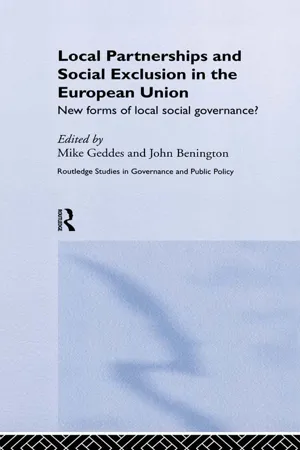
Local Partnership and Social Exclusion in the European Union
New Forms of Local Social Governance?
- 272 pages
- English
- ePUB (mobile friendly)
- Available on iOS & Android
eBook - ePub
Local Partnership and Social Exclusion in the European Union
New Forms of Local Social Governance?
About this book
This book explores local partnership-based initiatives to tackle European-wide problems of poverty and social exclusion. A major comparative study of the fast developing theme of social exclusion, the contributors look at its causes, effects and at the ways it might be combatted. Based on in-depth, cross-national research from areas across Europe it provides a uniquely authoritative account of the complexities of policy development in the EU, and will be invaluable to researchers in European studies, politics, and economics.
Trusted by 375,005 students
Access to over 1.5 million titles for a fair monthly price.
Study more efficiently using our study tools.
Information
1 Introduction
Social exclusion, partnership and local governance – new problems, new policy discourses in the European Union
Local Partnerships and Social Exclusion in the European Union discusses the local partnership-based initiatives that have been set up to tackle European-wide problems of poverty and social exclusion. In both the United Kingdom and the European Union today, social exclusion is one of the most pressing problems facing citizens and one of the ‘wicked’ cross-cutting issues of governance confronting politicians and policy-makers, while ‘partnership’ between public, private, voluntary and community organisations and interests is widely identified as an essential element in any solution. In the United Kingdom, one of the first acts of the New Labour government when it entered office in 1997 was to set up a Social Exclusion Unit (SEU) in the Cabinet Office at the heart of government. The SEU is a concrete symbol of the new government’s recognition of the severity of problems of poverty and social exclusion in the United Kingdom – in contrast to previous Conservative administrations, which reputedly banned the ‘p’ word from all government documents – and the adoption of the language of social exclusion, with its EU associations, seemed to signify Labour’s wish to be at the heart of European policy in this area. The SEU’s proposals for a National Strategy for Neighbourhood Renewal (NSNR), published in spring 2000 (Social Exclusion Unit 2000), have brought the problems of poor neighbourhoods and excluded communities into even sharper focus, and reinforced the commitment to partnership as a method of tackling them. Notably, strategic local partnerships are at the core of the policy package which the NSNR proposes.
In the EU, the period from 1995–9 saw issues of social exclusion slip down the policy agenda, after the British and German governments challenged the EU’s competence in this sphere, and other pressing issues (from enlargement to the single currency and the crisis in the Balkans) dominated the attention of the European Parliament, the Council of Ministers and the European Commission. But these very issues have themselves served to emphasise the new problems of exclusion facing the EU, as enlargement is set to massively widen economic and social disparities, and as migrations triggered by the Balkan conflict expose the exclusive tendencies in European society (Young 1999). These are reflected most acutely in the rise of far-right parties such as the Freedom Party in Austria, but more generally by media and political attitudes to asylum seekers and others on the margins of society. However, the EU’s Lisbon Summit in spring 2000 indicated that the logjam in EU policy on social exclusion may now be breaking up, with new proposals emerging from the Commission for the EU to co-ordinate and evaluate national and local policies to tackle exclusion, in a new policy partnership between the EU, member states, and regional and local actors.
This book is intended to contribute to both academic and policy debates around these developments by reviewing and evaluating recent experience in tackling poverty and social exclusion by local partnership-based initiatives across the EU. As the title suggests, the book revolves around four concepts, each of which is slippery, contested, and capable of a range of interpretations: partnership, social exclusion, ‘the local’, and governance. This book aims to contribute to a greater understanding of their complexities, interrelationships and policy implications.
Partnership
‘Partnership’ is a term which is now central to the policy discourses and practices of the EU and several member states, but which is still an ‘exotic species’ or foreign import in a number of other EU countries. One important aim of this book is to trace the evolution of this complex and rapidly developing concept and practice, to analyse its different meanings, and the ways in which they are shaped and translated by European, national, regional and more local histories and traditions.
‘Partnership’ has emerged as one of the homogenising concepts within the EU, supporting the notion of European integration by emphasising the possibilities for collaboration between a number of different stakeholders with potentially competing or conflicting interests. We identify the use of partnership as a concept to promote integration both vertically (between different tiers of government – European, national, regional, local and grass roots) and horizontally (between different spheres of society – public, private, voluntary and civil). We also argue, however, that the reality of partnership is a contradictory one in terms of the tension between forces for integration versus forces for disintegration within the EU. Local partnership may reflect the tendencies towards the fragmentation of the European policy arena as much as tendencies towards cohesion.
Partnership is not a phenomenon that can be wholly differentiated, conceptually or empirically, from other forms of policy collaboration and inter-organisational working. One way of conceptualising this is to think of partnership as one point on a continuum, with formally and tightly defined contractual relationships at one end, and looser and more fluid ‘network’ relationships at the other. The partnerships that are studied in this book share some characteristics with each of these other two related forms of organisation (contracts and networks), but also exhibit distinctive features. In the cross-national research project from which this book developed, we proposed a working definition of local partnership based on four key features:
• A formal organisational structure for policy-making and implementation
• The mobilisation of a coalition of interests and the commitment of a range of different partners
• A common agenda and multi-dimensional action programme
• A forum by which to combat unemployment, poverty and social exclusion, and promote social cohesion and inclusion.
Our intention was to differentiate these partnerships from the much wider field of joint working, inter-organisational collaboration and networking. However, one conclusion from the research is that, while more formal models of partnership are becoming increasingly prevalent, they do not reflect the full range of partnership-types or concepts emerging within the EU member states, and this book seeks to reflect this diversity. Nonetheless, the emergence of partnership does represent a distinctive development in the conceptual and operational frameworks for, and processes of, policymaking in the EU and in several of the member states. This new more pluralistic form of relationship between policy actors at different levels and in different sectors is clearly different from the formal corporatist relationships with the traditional ‘social partners’ (the peak organisations representing employers and trade unions), although the latter still have an important influence, in the Structural Funds for example.
The new partnerships reflect a growing recognition that traditional forms of governmental intervention are not capable of addressing the complex, cross-cutting problems facing citizens and communities in many parts of Europe (e.g. unemployment, poverty and social exclusion, crime and community safety), and which threaten the cohesion of the emerging European community. The new partnerships reflect a search for more flexible, participative forms of EU and governmental intervention, through the involvement (‘mobilisation’ in EU discourse) in the policy process of actors from three tiers (European, national and local) and three spheres (state, market and civil society) (Benington 1998).
One of the main areas in which partnership has been introduced as a new policy instrument is that of ‘social exclusion’.
Social exclusion
The idea of ‘social exclusion’, and its alter ego, ‘inclusion’, have come to dominate debate over the last decade in relation to contemporary patterns and processes of poverty, deprivation, disparity, marginalisation, fracture, précarité, and so on. The conception of social exclusion within the EU policy context is, however, complex and contested. In a simple but potentially quite radical sense, social exclusion stands for the notion that poverty and marginalisation are (at least partially) caused by processes of exclusion from the mainstream economy, polity and society. This concept of exclusion therefore emphasises the fundamental structural processes that cause poverty, rather than the consequent symptoms or ‘static state’ of poverty. In much EU discourse however, social exclusion has come to be used in a much less pointed way, as a portmanteau word for a wide range of poverty-related phenomena, often associated with the concept of multi-dimensional disadvantage, or multiple deprivation, in which poverty is often associated with a range of interrelated disadvantages, in relation to housing, health, education, transport, leisure etc., and with limited participation in the decisions affecting life chances.
In Chapter 2 we review some of the debates surrounding social exclusion, and their implications for policy, and show that an important theme in the literature is concerned with how patterns and processes of exclusion differ from country to country and locality to locality. Such differences are further explored in the chapters on each country, both in terms of national patterns and processes, and those in the localities where the specific partnership initiatives are located. However, it is important to emphasise that the research on which the book is based did not include primary research on patterns and processes of inclusion and exclusion. Thus, while the nature of exclusion is a key context in which local partnership is located, our primary concern is less with social exclusion per se, than with partnership as a policy response to social exclusion.
The ‘local’
While the ideology and practice of partnership is increasingly present in all spatial levels of policy, our focus is on partnership at the local level. A key concern of the book, therefore, is the role of ‘the local’ in an era of globalisation and complexity. We explore the extent to which partnership is associated with a ‘localisation’ (or glocalisation?) of social policy, in the context in which the nation state is seen by some commentators as too small to respond effectively to the macro-level issues (e.g. global warming, transnational corporations, international crime), but too big to respond flexibly to the micro-level concerns of citizens and communities (e.g. crime and safety, family pressures, job insecurity).
An important thread running through this book is the extent to which a localisation of policy implies a fragmentation of social policy and the welfare state, and an erosion of the principle of universalism in public services. Another is the complex relationship between the ‘local’ and other concepts with which it is commonly associated or counterpoised, as for example in the phrase ‘local community’, and in the traditional distinction between local and national government (with local often implying ‘lower’ in the pecking order). Some of the national studies show that such associations may have rather different connotations in different member states (e.g. ‘local’ can range in meaning from the regional/provincial to the neighbourhood level).
However, while a key objective of this book is to reflect, and reflect on, such differences across the EU member states, we also emphasise the common features of local partnerships that are in place to combat social exclusion – that is, as an organisational framework or arena in which a plural coalition of diverse interests may be negotiated and mobilised around some notion of a common ‘local’ interest, in this case to combat poverty and social exclusion. The nature of this ‘local’ coalition, the ways in which conflicting interests are ‘resolved’ or accommodated under the umbrella of a local partnership framework, and the extent to which such a coalition may be mobilised and maintained by defining an effective action space at the local level, are key issues which are explored in the chapters on individual countries and again in the closing chapters.
Governance
The fourth key concept within our framework is that of governance. This is as equally imprecise a notion as the other three, with a range of different definitions and usages in different contexts and different countries. In the United Kingdom, the notion of corporate governance has emerged in the private sector to indicate a concern with the accountability of companies to social values and a range of stakeholder interests, in addition to those of shareholders. In a recent exploration of urban governance, Le Galès seeks to link the concept of governance to that of regulation, while maintaining a distance between the two, and similarly to make connections between the governance of firms and the governance of regional and local territories (Le Galès 1998). In UK public policy (and particularly in local government) the concept of governance has come to encompass four main features:
• A conception of governing as an active political process, distinct from government as a set of institutions
• A consequent shift of emphasis towards the task of leading and governing the community (with its pluralistic and diverse networks of public, private and voluntary organisations, informal associations and grass roots movements), in addition to managing and administering the public bureaucracy (with its committees, budgets, services and staff)
• A recognition that actively leading and governing the community is not a matter for elected governments on their own, but requires joint ventures, coalitions and partnerships between a range of public, private, voluntary and grass roots organisations
• A shift in the core paradigm and discourse of governance away from its traditional locus in the ideas and practices of the state, and towards both ‘market’ principles of competition and efficiency, and towards civil society and the notion of citizen-centred government.
This is the language of ‘re-inventing’ and ‘modernising’ governance, the rhetoric of which at least has found expression on many public platforms, and in many policy documents, in the USA, the United Kingdom and increasingly in the EU and in several (but by no means all) of the member states. More critical commentators interpret these developments in discourses and practices as a rationalisation for continued cutbacks in public expenditure and services, and a shift of responsibility for tackling complex problems away from the state and on to individuals, families, voluntary organisations and informal associations, questioning both the capacity and the transparency of key aspects of new governance systems, including partnerships (see, for example, Healey 1998).
One of the key themes of this book, therefore, is that partnership is a defining element in new patterns of local governance, which are emerging as ways of regulating some of the tensions and contradictions within the political economy of the EU as it grapples with the complex and contradictory forces of fragmentation as well as of integration. Partnership reflects the shift in ideas and practices from ‘government’ to ‘governance’ through a crossing of the institutionalised boundaries between different levels of the state (local, regional, national, supranational), and between the state, the private market (both employers and trade unions), the voluntary sector and civil society. We discuss the ways in which these new models of partnership and of multi-level, multi-nodal local governance are emerging across the EU and within its institutions. One conclusion from this however, is to stress the provisional and unstable nature of current arrangements. In particular, we draw on theories of policy and welfare regimes to explore the ways in which the emergence of new forms of governance at the local level are related to the evolution of different regimes, and to the specific forms of convergence taking place within the EU under the hegemony of economic neo-liberalism and social democracy.
Drawing together our four concerns – partnership, social exclusion, the local and governance – we can say that any assessment of the capacity of partnership as a form of local governance needs to analyse three dimensions. First, the local capacity of partnerships as quasi-institutions (their cohesion, resources, structures and processes etc. as vehicles for effective governance); second, the capacity of the local level of governance in the context of the power of other tiers and spheres of political and economic decision-making; and third, the capacity of social policy as a potentially progressive force within a capitalist economy.
The evidence of this book is that the impact and outcomes of this new mode of local governance are extremely variable in terms of the ‘success’ claimed and achieved by the local initiatives that are discussed. Partnerships can improve collaboration and trust, and promote policy innovation and resource synergy, but they also frequently marginalise the excluded themselves, who remain largely the objects of policy, and may weaken the accountability of the policy processes, in terms of traditional representative democracy. The degree to which localised policy embodies greater responsiveness to diverse patterns of need or merely masks a withdrawal from ‘nationalised’ or universalised state policy, provision and responsibility, depends on the terms of engagement between local actors and the policy process. Social policy objectives may be strengthened by multidimensional local action which attempts to bridge the gulf between the economic and the social domains, but key economic decisions inevitably remain outside the control of local partnerships. We conclude, therefore, that the new model of local social governance reformulates rather than resolves the problem of a socially just path to European integration.
The research evidence
The contribution of this book to such questions is derived in large part from a major transnational research programme, which reviewed and evaluated the role of local partnerships in tackling social exclusion across the EU.1 The programme reflected an awareness that more needed to be known about the impact and outcomes of local partnerships, both in contributing to solutions to problems of unemployment, poverty and social exclusion, and in contributing to new policy approaches on the part of government, public authorities and other actors. To what extent have partnerships realised the expectations and objectives of the various organisations and interests involved? What kind of time horizons are needed for partnerships to be established and achieve results? How far have partnerships been able to develop and implement more effective multidimensional strategies by drawing together the contributions of different partners? How effectively have the activities undertaken by partnerships, and their outcomes, been evaluated? Many of the programmes that have supported local partnerships have been either experimental in nature or limited in timescale, scope and/or resources. There are important questions, therefore, about how the experiences gained in pilot and experimental programmes can be...
Table of contents
- Cover
- Half Title
- Title Page
- Copyright Page
- Table of Contents
- Notes on contributors
- Acknowledgements
- 1 Introduction: social exclusion, partnership and local governance – new problems, new policy discourses in the European Union
- 2 Social exclusion and partnership in the European Union
- 3 Partnerships against exclusion in a Nordic welfare state: a difficult mix?
- 4 Local partnerships and social exclusion in France: experiences and ambiguities
- 5 Grass roots local partnerships in the Federal Republic of Germany: instruments for social inclusion and economic integration?
- 6 Catalysts for change: public policy reform through local partnership in Ireland
- 7 Partnership and local development in Portugal: from ‘globalised localism’ to a new form of collective action
- 8 A new approach to partnership: the Spanish case
- 9 Local partnerships and social exclusion in the United Kingdom: a stake in the market?
- 10 Partnerships as networked governance? Legitimation, innovation, problem-solving and co-ordination
- 11 Local partnerships, welfare regimes and local governance: a process of regime restructuring?
- Index
Frequently asked questions
Yes, you can cancel anytime from the Subscription tab in your account settings on the Perlego website. Your subscription will stay active until the end of your current billing period. Learn how to cancel your subscription
No, books cannot be downloaded as external files, such as PDFs, for use outside of Perlego. However, you can download books within the Perlego app for offline reading on mobile or tablet. Learn how to download books offline
Perlego offers two plans: Essential and Complete
- Essential is ideal for learners and professionals who enjoy exploring a wide range of subjects. Access the Essential Library with 800,000+ trusted titles and best-sellers across business, personal growth, and the humanities. Includes unlimited reading time and Standard Read Aloud voice.
- Complete: Perfect for advanced learners and researchers needing full, unrestricted access. Unlock 1.5M+ books across hundreds of subjects, including academic and specialized titles. The Complete Plan also includes advanced features like Premium Read Aloud and Research Assistant.
We are an online textbook subscription service, where you can get access to an entire online library for less than the price of a single book per month. With over 1.5 million books across 990+ topics, we’ve got you covered! Learn about our mission
Look out for the read-aloud symbol on your next book to see if you can listen to it. The read-aloud tool reads text aloud for you, highlighting the text as it is being read. You can pause it, speed it up and slow it down. Learn more about Read Aloud
Yes! You can use the Perlego app on both iOS and Android devices to read anytime, anywhere — even offline. Perfect for commutes or when you’re on the go.
Please note we cannot support devices running on iOS 13 and Android 7 or earlier. Learn more about using the app
Please note we cannot support devices running on iOS 13 and Android 7 or earlier. Learn more about using the app
Yes, you can access Local Partnership and Social Exclusion in the European Union by John Benington,Mike Geddes in PDF and/or ePUB format, as well as other popular books in Politics & International Relations & Comparative Politics. We have over 1.5 million books available in our catalogue for you to explore.