![]()
Chapter 1
The Tawhidi Methodology
Abstract
The methodology of the Tawhidi worldview, the primordial and monotheistic law of Oneness of God in an Islamic epistemological context concerning socio-scientific reasoning, formalism, and application is distinctly contrary to mainstream economics in general and Islamic mainstream economics in particular. There is a fundamental flaw in all of this latter kind of reasoning. This is due to the ignorance of the Tawhidi epistemological moorings by those who profess Islamic mainstream economic reasoning. In the field of participatory financing, the consequences of such intellectual ambivalence have seen the complete misunderstanding of the extensively relational epistemological methodology of participation derived from the Qur’an and the sunnah in the development of the purpose and objective of the shari’ah, namely maqasid as-shari’ah. The result has been a demeaning position of Islamic economics and finance in new ideas that emerge from new epistemological and ontological foundations. The latter kind of challenging erudition can be enabled by the new and irreducible epistemic reasoning premised on the Tawhidi methodology and its functioning in the generality and particulars (e.g. Islamic participative financing) of the world-system of unity of knowledge. This chapter bridges this methodological gap and applies that analytical Tawhidi methodology to general and participatory financing instruments in light of the Tawhidi precept of inter-causal relational ‘pairing’ occurring in diversity as the sure worldly meaning and evidence of the Tawhidi epistemic oneness.
Allah sent down the Qur’an with the embodiment of Tawhid contained within it in its ontological and evident form to unravel the fact that, indeed, Truth is manifest. Yet complete knowledge of Truth remains with Allah to be unveiled in the Hereafter (Akhira). Thus learning from aye to eternity and through the Prophet’s sunnah (guidance) is the command of Allah; it also comprises the thought and practice of the learning world-system. Syed Qutb (Mousalli, 1990) talked about such a functional ontology of learning as the divine attribute to humankind and the world system. The Qur’an speaks of integration in the discursive experience emanating from the learning process of the shura (Qur’anic consultation and discourse) thereby, extracting the cognitive worshiping state of the world-system in ‘everything’. There is, thus, the complex embedded wrapping of everything in this world-system by the relational epistemology of learning in unity of knowledge and its construction of unity of the induced world-system.
Economics is a sub-system of such an embedded, complex, interrelated, and unified organic world-system. ‘Everything’ shares the solely universal and unique law of oneness without differentiation. The Qur’an revealed the same law to all the prophets of antiquity. The Qur’an says in its allegorical language that the worldview of monotheism and its explanatory law has been bestowed on all the prophets (Qur’an, 87:18–19). Thus Tawhid is true of all the divine revelations and the world-system comprising soul, mind, matter; human and jinn (abstraction).
Meaning of Tawhid as monotheistic functional ontology
What, then, is the extended meaning of Tawhid? Tawhid is the primordial reality of the Oneness of Allah. It is expressed in its epistemological sense by the law of monotheism. The order and scheme of all things comprise the signs of Allah (ayath Allah) and their unravelling in the resulting world-system called a’lameen.
The Tawhidi epistemology is the learning process forming a methodological order of reasoning, thought, formal construction, and action (application), followed by inferences and continuity. This whole system of recursive learning is continuously regenerated in the knowledge, space, and time dimensions. Such a domain of ‘everything’ is premised on unity of knowledge and its unifying deductive–inductive circularity of reasoning as the very meaning of continuity res extensa across continuums (Qur’an 2: 115; Bakar, 1991).
Islamic political economy (economics) shares in the same Tawhidi methodology as an embedded sub-system wrapped up in the organic interaction, integration, and evolutionary (IIE) relational world-system, made possible by the episteme of unity of knowledge. The resulting intellection is universal and unique in respect of all the diversity of being. Yet the analytical methods, but not the substantive Tawhidi methodology of investigation, can be pertinently diverse.
Here is an example: The mathematical method of calculus can be used to explain progressive learning via simulation of relational functions by the process of knowledge creation. Yet, the same method of calculus, when used for an optimization problem or to explain a resource scarcity problem in economic functions, is not pertinent to the Tawhidi methodology. The optimization character and the scarcity axiom of economics cannot logically exist in the pervasively learning knowledge, space, and time dimensions of relational functions caused and regenerated by the episteme of unity of knowledge premised on Tawhid.
This last situation is simply not possible; except for two distinct and special cases. First, a possibility for optimization can exist in the infinitesimally small, instantaneous sub-universe. Such a state manifests the atomism of classical and neoclassical economics and the scientific emanation from the monadology of Leibniz (Saville, 2000). Such a state forms a case of no importance in the learning universe of endogenously related events happening res extensa in the knowledge, space, and time dimensions. The second singular possibility of optimization is at the event of the Hereafter (Akhira), which the Qur’an (Chapter 78, Naba) declares as the Great Event. At this eventual case, knowledge is complete; truth is fully manifest; the supreme felicity is bestowed; and falsehood has vanished, drowned in its own illogical entropy (Qur’an, 16: 36).
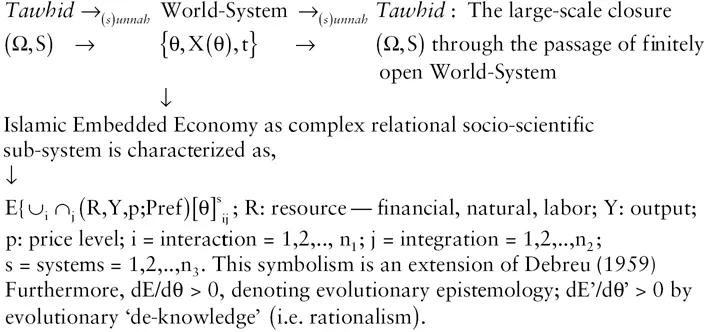
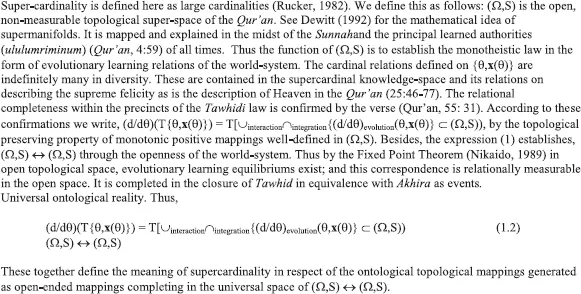
To formalize, define the Tawhidi episteme as the super-cardinal topology: (Ω,S); Ω: Qur’anic super-space; S: sunnah as mapping of the Qur’an to living experience. Knowledge flows from (Ω,S). This is denoted by {θ}∈(Ω,S). x(θ) denotes the knowledge-induced vector, matrices, tensor, all pertaining to the problems under investigation.
Consequently, {θ,x(θ),t} denotes the multidimensional triplet spanning the knowledge {θ}, space {x(θ)}, and time (t) dimensions. That is, the Tawhidi methodology spans the following extensive and rich system of interrelationships:
Tawhidi rich and complex world-system
Thus, the process of knowledge derivation from the Tawhidi epistemic core is represented by the inter-causal, inter-variables, intra-systemic, and inter-systemic Interaction (I), Integration (I), and Evolutionary (E), assuming the IIE evolutionary learning processes. This forms the permanent property of the Tawhidi epistemological construction of pairing by evolutionary learning in ‘everything’ (Barrow, 1991). The Qur’an explains all of this in the framework of reorigination (khalq in-jadid).
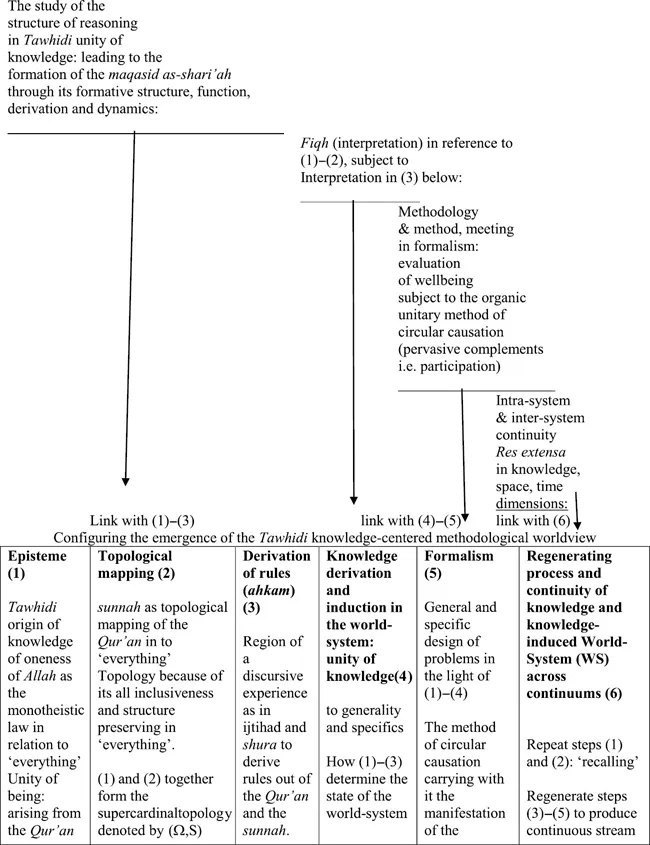
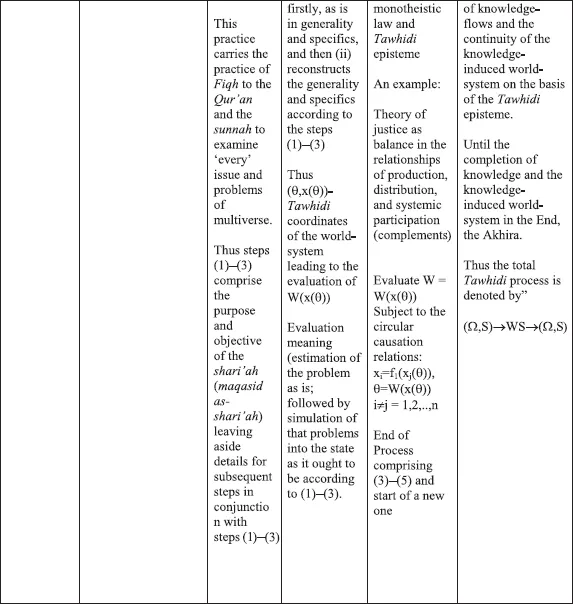
No quick, short and complete description can be given of such a comprehensive Tawhidi epistemological methodological worldview. The imminent project is a vastly detailed methodological investigation. It carries analytical, applied, inferential, and policy implications (Choudhury, 2006). We have pointed out examples of these implications below.
Configuring the steps of the Tawhidi methodology: problem-solving in the Tawhidi methodological worldview contra neoclassical economics
We take three examples here to understand the nature of political economy (economic and financial) in contrasting understanding between mainstream, Islamic neoclassical, and Tawhidi epistemological worldviews in theory and practice.
Example 1: The generalized worldview of causality intra-system and inter-system: trade versus interest1
| (1)–(3) | (4)–(5) | (6) |
| Axiomatic foundation in the generalized worldview problem of trade in the light of Qur’an, sunnah and learned discourse versus riba – as maqasid as-shari’ah (Qur’an, 4:59) process in the light the Qur’an, states that knowledge of Tawhidi unity of knowledge is intrinsic in the world-system of everything but is gained by contemplation and effort, which is the concept of evolutionary learning processes of knowledge formation according to the Tawhidi episteme of unity of knowledge (Qur’an, 29:19–20). On sunnah as epistemic explication of Qur’an, and thus the topological preservation of the Qur’an, the Qur’an statesin (42:52–53). These verses establish the endogenous nature of sunnah as the functional mapping of the Qur’an into itself and Reality. | Of evaluating wellbeing W(Trade, (1/Riba),θ) Subject to circular Causation continuum in the light of the Tawhidi premise res extensa. The formulation of the problem in this respect is to evaluate by processes of evolutionary learning, the objective functional system: W=W(x(θ)) subject to... |