eBook - ePub
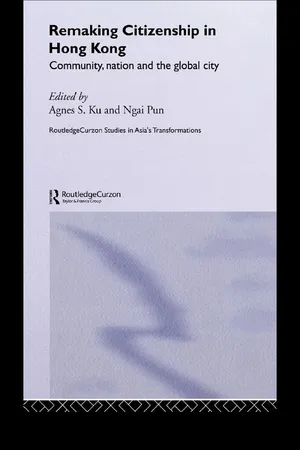
Remaking Citizenship in Hong Kong
Community, Nation and the Global City
- 288 pages
- English
- ePUB (mobile friendly)
- Available on iOS & Android
eBook - ePub
About this book
This book provides a detailed comparative account of the development of citizenship and civil society in Hong Kong from its time as a British colony to its current status as a special autonomous region of China.
Part I
State, institutions and ideologies
1
Citizenship as a form of governance
A historical overview
Denny Kwok-Leung Ho
Introduction
Citizenship can be regarded as a means of political rhetoric that helps in the search for a better social life for members of society within a given territory. At the time Marshall (1950) suggested a framework for the advocacy of this notion, the British style of Keynes-Beveridge welfare state was established and deemed to be a system having the potential to ensure each member a minimum level of well-being through the provision of social rights. While Marshall treated the notion as an analytical concept for the study of British social policy, the three components of the concept of citizenship, as suggested by Marshall—namely civil rights, political rights and social rights—had been employed by British politicians as the political yardstick by which the British government was appraised. While Hong Kong had been a Crown colony of Britain and citizenship as a kind of political rhetoric had seldom been put forward as the governing principle of the colonial government, in the 1990s scholars began to throw light on the degree of freedom Hong Kong people could enjoy after the city reverted to Chinese sovereignty. Basically, like the students of citizenship inspired by Marshall, scholars have employed citizenship as a yardstick to measure the extent to which citizenship has been realized (Baehr 2001; Leung 2001; Degolyer 2001; Scott 2001; Lo 2001). This chapter, however, focuses more on citizenship as a form of governance, showing the particular nature of the state-society relationship in Hong Kong.
The study of citizenship is in fact an analysis of political power. For this purpose, we draw on a discussion of the concept of governance in order to see the way in which citizenship is both the means for and the effect of governance carried out by the Hong Kong Government. To offer a general understanding of governance we can state that “[g] overnance is an analytical concept, giving rise to questions about what forms of power and authority, patterns of relationship and rights and obligations might typify a particular approach to governing” (Newman 2002). We follow Jessop (1999) and go further to refer to “governance” as “any form of coordination of interdependent social relations—ranging from simple dyadic interactions to complex social divisions of labour,” and we take a territory-wide level of analysis of coordination. We distinguish three forms of governance that constitute the institutional arrangements of Hong Kong. These three forms are, namely: (1) the anarchy of exchange (market forces); (2) the hierarchy of command (imperative coordination by the state); and (3) the heterarchy of self-organization (networks). These three forms of governance correspond to three domains-the anarchy of exchange is employed to sustain the economic system, the hierarchy of command to the political system and the heterarchy of self-organization to the social (or civic) system.
In our view, since the colonial government took a strong stand on economic development as the most important “political” task to accomplish, civic rights had long been enshrined as basic rights for Hong Kong people. By contrast, in order to protect its colonial rule, the colonial government did not promote or grant full political rights to the Hong Kong people. Regarding social rights, since the colonial government understood that social and welfare services could pacify social conflicts arising from the unequal distribution of resources and wealth—the unavoidable result of the capitalist mode of production—issues of social rights had to be tackled. However, rather than the advocacy of social rights, one of the strategies employed was the identification of social services and welfare as the residual means to assist people. On the other hand, the colonial government put emphasis on family support as a form of self-organization. One of the results was the relegation of “community” to a secondary position. This form of governance was maintained by the colonial government until the issue of the transfer of sovereignty emerged in the 1980s so that more political rights were granted. In the 1990s, the Hong Kong Special Administration Region (SAR) government encountered economic downturn and then community as a form of self-organization was advocated. These changes in the form of governance impact on the extent, contents, and depth of citizenship (Faulks 2000).
In this chapter, we examine how these three dimensions of citizenship have changed. Through a brief depiction of the trajectory of the development of the idea and practice of citizenship in Hong Kong since the 1950s, we attempt to unravel the factors for the under-development of the idea and practice of citizenship in Hong Kong in the pre-1980s and examine the difficulties in the realization of citizenship in the era after the retrocession of Hong Kong to Chinese sovereignty.
The political system and the hierarchy of control
Governance is certainly related to the need for the creation and maintenance of social order. For the colonial Hong Kong government, the tasks of state-making and legitimacycreation were necessary and the establish-ment of the political system was the institutional means for these ends. Any political act presupposes the existence of a “legitimate” political structure where political commands and principles of governance are established. The political structure is then constituted in the form of a hierarchy of control.
In modern societies, the state should define a boundary and claim that it has the right to rule those people within this delimited area. This is the first area of control pertaining to the extent of citizenship. As the colonial government found it impossible to grant citizenship in terms of nationality and ethnicity, residency became the main defining component of the legal status of Hongkongers. As a matter of fact, granting residence rather than citizenship to people was a strategic means for the colonial government to circumvent the issue of nationality, and moreover, it was strategically feasible to integrate people continuously coming from Mainland China.
In 1949, the government began to introduce immigration controls on the Chinese from the Mainland. The control measures had remained generally lenient until 1974 when the government introduced a “touchbase” policy. Full immigration control, alongside a daily quota system, was implemented when the policy was called off in 1980 (Leung, Chapter 5 in this volume). After 1997, the SAR government, in the name of stable governance, was likewise committed to a policy of (partial) exclusion vis-à-vis the Mainland-born children of Hong Kong residents (Ku 2001). From 1950 to the turn of the century, the issue of the right of abode was pertinent only to the right to stay in Hong Kong. There were few disputes about the implications of granting this right. Contrary to the understanding of citizenship in European countries where citizenship entails civil, political, and social rights, people who were granted the right of abode did not automatically obtain these kinds of rights. The colonial government had in fact exercised a different set of political means to restrict the contents of citizenship, particularly those related to the political rights.
Taking political stability as its primary concern, the colonial government restricted political rights so as to render itself autonomous in the face of a large Chinese population in Hong Kong. Between 1950 and 1980, political power remained concentrated in the hands of the official bureaucrats and there was no direct election for the Legislative and Executive Councils. The only relatively “democratic” institution that appeared in the post-war history of Hong Kong was the Urban Council, which contained elected members. However, its scope of authority was limited to issues arising from public health, recreation and amenities, management of public services and other miscellaneous matters. Political rights were undeveloped in this period.
In order to gain legitimacy, the advocacy of economic liberty then became a strong ideological pillar to strengthen the capitalist economy. In the early post-war era, although the significance of Hong Kong’s role as the link between Britain and China had declined, the British government had no intention of giving up Hong Kong, as Miners argued, although this was not due to any military strategic consideration as previously, nor to any moral obligation, but because “the very favourable balance on invisible trade, outweigh the only cost incurred by the British taxpayer, the colony’s defence bill” (1984:14). Therefore, Britain retained in this period its authority to rule Hong Kong mainly for the pursuit of commercial benefits. We could argue that it was the intention of the colonial government to construct its own image as an “a-political” ruler in the sense that the government itself was wary of political issues and matters. The Governor of Hong Kong in the period from 1947 to 1952, Sir Alexander Grantham, clearly revealed this tactic in his speech to the Legislative Council in 1950 saying that:
we cannot permit Hong Kong to be the battleground for contending political parties or ideologies. We are just simple traders who want to get on with our daily round and common task. This may not be very noble, but at any rate it does not disturb others.
(Lau 1982:36)
In order to protect the rule of the colonial government, officials suggested a very peculiar interpretation of the concept of democracy. The Deputy Secretary for Home Affairs said at a teach-in organized by a university student organization in 1969 that democracy was defined as “the measure of the effectiveness of channels open to the general body of members to show their approval or consent or disapproval or to influence decisions of the governing body.”1
Nevertheless, whereas the public were only allowed to express their political concerns outside the formal political institutions, there was a state-business alliance and, as Chiu argues, “the broad confluence of interests between the state elites and the bourgeoisie contributed to an overall policy of supporting private entrepreneurship” (1994:63). Given that the colonial government relied on the support of businessmen to ensure economic development and in turn maintain social order, opening up the political situation through granting more political rights to Hongkongers would entail the reduction of the political power of the state-business alliance. The colonial government attempted to avoid this as it would have jeopardized colonial rule.
Nonetheless, in the 1980s, unlike the situation in the 1970s, the polity was opened up, allowing more channels for representatives of different interest groups to influence the decision-making process. The District Boards scheme was established in 1982 which took the unprecedented step of electing a number of its board members on the basis of universal adult franchise. However, the monolithic and authoritarian political structure of Hong Kong had not been totally replaced by a pluralist one in which different interests were potentially represented. The core of the political structure, which comprises the Legislative Council and the Executive Council, was still dominated by conservative groups (Scott 1989).
The “pragmatic” ruling strategy of the colonial government was reflected in the introduction of the functional constituency into the political system. Davies (1989) argues that the middle class occupied critical positions in various sectors and were developing into an important social and economic force, and thus it would not have been advisable to exclude them from the political arena. Hence, this can be understood as the government’s strategy to make itself accountable while at the same time keeping political power safe from any threatening social forces.
The Sino-British negotiations over Hong Kong’s future after 1997 triggered off a series of campaigns demanding the introduction of direct elections to the Legislative Council (LegCo). In view of the PRC’s opposition to any drastic electoral reform, the British colonial government, against the majority’s expectations which were shown through public opinion polls and surveys, yielded to the PRC’s pressure and abandoned the introduction of direct election to LegCo in 1988 (Lo 2001:132). The Tiananmen Square crackdown in 1989 marked a turning point in that the colonial government, amidst the fears and demands of the people, set off a new phase of reform that resulted in more civic and political rights. In 1990, a Bill of Rights was enacted. In 1996, the Equal Opportunities Commission (EOC) was set up with the aim of eliminating discrimination because of sex, marital status, pregnancy, disability and family status. Moreover, upon Governor Patten’s arrival, the franchise arrangements governing LegCo’s functional constituencies were broadened; the voting age of the Hongkongers was reduced from 21 to 18 and pledges to monitor the performance of government departments were issued. While Hongkongers were empowered and allowed to enjoy more political as well as civil rights in the period between 1980 and 1997, these changes also reflected the British colonial government’s aim of an honorable “exit” by 1997.
Nonetheless, political rights remained confined to a small number of Hong Kong people as the PRC government did not expect any drastic change in the political domain. The hierarchy of control left by the colonial government was largely retained by the SAR government. This can be shown in the definition of right of abode that reveals the strategic move of the SAR government to ensure the integration and participation of those who “deserved” it. The move comes from the political calculation that pertains to the specific colonial nature of Hong Kong. Before 1997, the colonial government had created a cosmopolitan character for Hong Kong by allowing non-Chinese-nationals to be involved in running the territory. Expatriates occupied many key positions, both in the government and the economy. In order to keep the expatriates in Hong Kong, it was necessary for the SAR government to adopt a more “inclusionary” citizenship. However, from the political point of view, allowing too many non-Chinese nationals to occupy key social and political positions might be politically unwise. This became a dilemma that the SAR government had to resolve.
In order to understand the strategic aspect of citizenship, Ghai (2001) has pointed out that it is necessary to analyze the use of the status of “residents” rather than “citizens” under the jurisdiction of the Basic Law. The notion of “citizens” does not exist in the Basic Law. It is the residents, either permanent or non-permanent, who are guaranteed equality before the law, rights to vote and to be elected. The central concept used in the Basic Law to refer to community membership is “the right of ab...
Table of contents
- Cover Page
- Title Page
- Copyright Page
- Contributors
- Foreword: Making and Unmaking Citizenship In Neo-Liberal Times
- Acknowledgments
- Abbreviations
- Introduction: Remaking Citizenship In Hong Kong
- Part I: State, Institutions and Ideologies
- Part II: Migration, Belonging and Exclusion
- Part III: Civil Society, Resistance and Participation
Trusted by 375,005 students
Access to over 1.5 million titles for a fair monthly price.
Study more efficiently using our study tools.
Frequently asked questions
Yes, you can cancel anytime from the Subscription tab in your account settings on the Perlego website. Your subscription will stay active until the end of your current billing period. Learn how to cancel your subscription
No, books cannot be downloaded as external files, such as PDFs, for use outside of Perlego. However, you can download books within the Perlego app for offline reading on mobile or tablet. Learn how to download books offline
Perlego offers two plans: Essential and Complete
- Essential is ideal for learners and professionals who enjoy exploring a wide range of subjects. Access the Essential Library with 800,000+ trusted titles and best-sellers across business, personal growth, and the humanities. Includes unlimited reading time and Standard Read Aloud voice.
- Complete: Perfect for advanced learners and researchers needing full, unrestricted access. Unlock 1.5M+ books across hundreds of subjects, including academic and specialized titles. The Complete Plan also includes advanced features like Premium Read Aloud and Research Assistant.
We are an online textbook subscription service, where you can get access to an entire online library for less than the price of a single book per month. With over 1.5 million books across 990+ topics, we’ve got you covered! Learn about our mission
Look out for the read-aloud symbol on your next book to see if you can listen to it. The read-aloud tool reads text aloud for you, highlighting the text as it is being read. You can pause it, speed it up and slow it down. Learn more about Read Aloud
Yes! You can use the Perlego app on both iOS and Android devices to read anytime, anywhere — even offline. Perfect for commutes or when you’re on the go.
Please note we cannot support devices running on iOS 13 and Android 7 or earlier. Learn more about using the app
Please note we cannot support devices running on iOS 13 and Android 7 or earlier. Learn more about using the app
Yes, you can access Remaking Citizenship in Hong Kong by Agnes S. Ku,Ngai Pun in PDF and/or ePUB format, as well as other popular books in History & Chinese History. We have over 1.5 million books available in our catalogue for you to explore.