- 320 pages
- English
- ePUB (mobile friendly)
- Available on iOS & Android
eBook - ePub
About this book
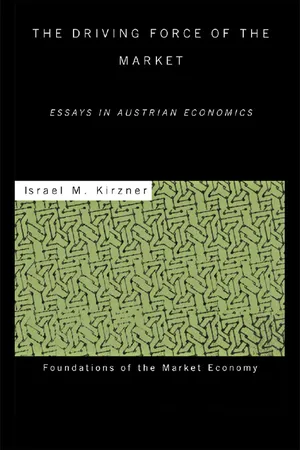
This book offers a unique insight into the character of Austrian economics. This work also collects the recent work of the leading authorities in this area, and will be an indispensible tool for all those interested in the implications of Austrian approach on economics. The author also examines *the market economy *theories of Competition and Entre
Part I: THE CHARACTER OF AUSTRIAN ECONOMICS
1 ENTREPRENEURIAL DISCOVERY AND THE COMPETITIVE MARKET PROCESS: An Austrian approach
I
The Austrian tradition is represented in modern economics by a “very vocal, feisty and dedicated subset of the economics profession” (Vaughn, 1994, p. xi). Much of the work of this group of scholars is devoted to the most fundamental problems of microeconomics.1 This Austrian work, therefore, differs in character and content from a good deal of neoclassical theory which, despite widespread and growing awareness of its limitations, continues to serve as the analytical core of mainstream economics. This paper sets forth the outlines of one important approach within modern Austrian economics, an approach offering a perspective on microeconomic theory which (while it has generated a considerable literature of its own) is not ordinarily well-represented either at the (mainstream) textbook level, or in the (mainstream) journal literature. Although the author subscribes to and has contributed to this approach, the purpose of this chapter is exposition, not advocacy. References to criticisms of mainstream microeconomics which have been discussed in the Austrian literature should be understood here not as arguments in favor of the Austrian approach, but as clues that may be helpful in understanding what the Austrians are saying, and how what they are saying is to be distinguished from the approach taken by other modern economists.
This chapter does not offer anything like a survey of modern Austrian economics. It does not deal at all with such major areas within it, such as cycle theory, monetary theory, capital theory. Within its chosen scope of microeconomics, it does not claim to represent a universally accepted Austrian position (or even to cover its entire range of topics). Nonetheless, the approach described here is arguably central to the reviving contemporary interest in Austrian ideas, and has been treated as such in a number of recent general surveys of modern Austrian economics (Littlechild, 1986; Caldwell and Boehm, 1992; Vaughn, 1994).2
During the past two decades modern Austrian economics has emerged out of the classic earlier “subjectivist” traditions3 (which began in the late nineteenth century with Carl Menger, Eugen von Boehm-Bawerk, and Friedrich von Wieser),4 particularly as that tradition came to be represented in the mid-century contributions of Ludwig von Mises and Friedrich Hayek.5 The early work of the Austrian School until the 1930s was correctly perceived as simply one variant of the dominant early twentieth century mainstream approach to economic understanding (often loosely referred to as “neoclassical”). But the work of Mises and Hayek from the 1930s on, steered the Austrian tradition in a direction sharply different from that being taken at that time by mainstream neoclassical microeconomics.6 By 1950 both Mises and Hayek had crystallized separate, definitive, statements of their disagreements with mainstream microeconomics, and of their own substantive approaches. These were indeed separate statements, differing from one another certainly in style and, no doubt, to some degree also in substance. But it can be argued that they are best understood as both overlapping and complementary, rather than as contrasting alternatives. It was these contributions of Mises and Hayek which, while almost entirely ignored by the mid-century mainstream of the profession, have nourished the Austrian revival of the past two decades, and which have generated the modern Austrian approach to understanding the competitive market process set forth in this chapter.
At the basis of this approach is the conviction that standard neoclassical microeconomics, for which the Walrasian general equilibrium model (in its modern Arrow-Debreu incarnation) is the analytical core, fails to offer a satisfying theoretical framework for understanding what happens in market economies. This conviction is rooted (a) in criticisms of the lack of relevance in models which seek to explain market phenomena as if they were, at each and every instant, strictly equilibrium phenomena, and (b) in the belief that it is a methodologically legitimate demand to be made of a theory of the market, that it not merely begin with the instrumentalist assumption of already-attained equilibrium, but also realistically offer a plausible explanation of how, from any given initial set of nonequilibrium conditions, equilibrating tendencies might be expected to be set into motion in the first place. As will be noted below, such criticisms are not (or, at any rate, no longer) exclusively “Austrian” criticisms. In fact, a good deal of recent non-Austrian work in microeconomics has in some fashion attempted to grapple with these difficulties. What stamps the entrepreneurial discovery approach as Austrian is not these criticisms themselves, but rather the specific positive elements of the approach.
These positive elements focus on the role of knowledge and discovery in the process of market equilibration. In particular this approach (a) sees equilibration as a systematic process in which market participants acquire more and more accurate and complete mutual knowledge of potential demand and supply attitudes, and (b) sees the driving force behind this systematic process in what will be described below as entrepreneurial discovery. Although, of course, much contemporary mainstream work in microeconomics takes its point of departure from the imperfection of knowledge (relaxing the older standard neoclassical assumption of complete, universal information), the Austrian approach set forth in this paper has little in common with this work.
For the mainstream, imperfect information is primarily a circumstance constraining the pattern of attained equilibrium (and introducing a new “production” cost, that of producing or searching for missing information). For the Austrian approach imperfect information is seen as involving an element which cannot be fitted at all into neoclassical models, that of “sheer” (i.e., unknown) ignorance. As will be developed below, sheer ignorance differs from imperfect information in that the discovery which reduces sheer ignorance is necessarily accompanied by the element of surprise—one had not hitherto realized one’s ignorance. Entrepreneurial discovery is seen as gradually but systematically pushing back the boundaries of sheer ignorance, in this way increasing mutual awareness among market participants and thus, in turn, driving prices, output and input quantities and qualities, toward the values consistent with equilibrium (seen as the complete absence of sheer ignorance).
What will emerge from this chapter is thus the exposition of an Austrian way of understanding the systematic character of markets which, while sharply differing from the mainstream competitive equilibrium model, does not necessarily see that model as totally irrelevant. (Many practical questions, such as those regarding the effects of price controls, minimum wage laws, and the like, can be answered quite adequately without going beyond simple competitivesupply-and-demand equilibrium models.) The dynamic competitive process of entrepreneurial discovery (which is the driving element in this Austrian approach) is one which is seen as tending systematically toward, rather than away from, the path to equilibrium. Therefore, the standard, competitive equilibrium model may be seen as more plausible as an approximate outcome, in the Austrian theory here presented.7 This aspect of the entrepreneurial discovery approach troubles a number of the Austrian economists who have not accepted it. In order to clearly locate the entrepreneurial discovery perspective within the range of modern Austrian theoretical points of view, it will be necessary briefly to identify more precisely the various disagreements which other Austrians have had with this approach.
Section II of this chapter will review the Austrian criticisms of the equilibrium emphasis of the neoclassical models. Section III will develop the Austrian understanding of the market process, based upon the twin concepts of sheer (i.e., unknown) ignorance and entrepreneurial discovery. Section IV will survey several areas of applied microeconomics (antitrust economics, welfare economics, the theory of justice, and the possibility of socialist economic calculation), taking special note of the significant differences which the Austrian approach entails in regard to policy recommendations in these areas. Section V will note the various criticisms to the entrepreneurial discovery theory developed in this chapter, offered by several contemporary Austrian economists. Section VI concludes the chapter by clearing up certain misunderstandings concerning the Austrian approach.
II
Mainstream microeconomics interprets the real world of markets as if observed phenomena represent the fulfilment of equilibrium conditions.8 Markets consist of successfully maximizing agents whose decisions are held to fit in together perfectly, in the sense that each maximizing decision being made correctly anticipates, in effect, at least, all the other maximizing decisions being made simultaneously. It is this latter condition which mathematically constrains the attained values of the key decision variables. For this condition to be fulfilled, only that set of input and output prices and quantities can prevail which simultaneously satisfies the relevant equations of supply and demand (themselves constructed by aggregating the selling and buying decisions consistent with maximizing under a range of hypothesized states of affairs). It is this aspect of modernneoclassical economics which accounts for its characteristic emphasis upon: (a) the constrained maximization pattern imposed by the theory upon individual decision making, and (b) the mathematics of simultaneous equation systems. Valiant attempts have been made to enrich the realism of these equilibrium microeconomic models by building into them assumptions acknowledging imperfections in competition. Nonetheless, the dominant trend has been to concentrate upon models of competitive equilibrium, that is upon models in which both prices and product/resource qualities are taken as given to each decision maker, and as being independent of the decisions made. Not only do these competitive models (like all equilibrium models) assume complete mutual knowledge (in the relevant sense), they also assume, in effect, that the crucial market variables of price and quality are somehow presented to each decision maker as an external fact of nature. Neoclassical economics operates on the assumption that the world reflects the relationships that would prevail in such equilibrium models—with the model of competitive equilibrium being the favorite one. While Austrians have not been alone in criticizing this approach to understanding markets, their criticisms have been both pioneering and trenchant.
Austrian dissatisfaction with this standard approach to understanding real world market phenomena emerged most clearly in the forties. Both Mises and Hayek expressed dismay at models labeled as competitive, in which market participants are forbidden, as it were, from competing (in the sense in which, in everyday discourse and experience, market participants compete by bidding higher prices or by offering to undersell competitors, by offering consumers better quality merchandise, better service, and the like; see Mises, 1949, p. 278fn; Hayek, 1948, pp. 92–118). Their unhappiness with models of so-called perfect competition ultimately stemmed from their unwillingness to surrender the economists’ insights into the dynamic character of active markets to equilibrium models, in which all decisions have somehow been pre-reconciled, held as at all times governing market phenomena. It seems accurate to understand their impatience with the neoclassical preoccupation with equilibrium models as arising from (a) the blatantly false nature of the assumption that market conditions are at all times in equilibrium, and (b) methodological unease with an instrumentalist mode of theorizing and empirical analysis that finds it useful to presume that equilibrium always prevails, while recognizing no obligation to account theoretically for any equilibrative process (from which equilibrium might be explained as emerging).
Modern presentations of the entrepreneurial discovery approach have echoed these criticisms of equilibrium economics, and have deployed these criticisms in seeking to demote the concept of perfect competition from its position of dominance in modern neoclassical theory, in order to replace it by notions of dynamic competition (in which market participants are, instead of exclusively price takers, competitive price—and quality—makers). Within the two broad bases for Austrian (as well as for non-Austrian) criticism, several strands of difficulty with the neoclassical competitive equilibrium paradigm may be distinguished. The clear identification of these strands will help us understand the Austrian character of the positive approach, based on entrepreneurial discovery, to be developed in Section III.
Criticisms of the unrealistic character of neoclassical theory relate both to the way in which individual decisions are modeled in that theory, and the way in which that theory sees real world market outcomes as satisfying the conditions for equilibrium.
At the individual level Austrians have taken sharp exception to the manner in which neoclassical theory has portrayed the individual decision as a mechanical exercise in constrained maximization. Such a portrayal robs human choice of its essentially open-ended character, in which imagination and boldness must inevitably play central roles. For neoclassical theory the only way human choice can be rendered analytically tractable, is for it to be modeled as if it were not made in open-ended fashion, as if there was no scope for qualities such as imagination and boldness. Even though standard neoclassical theory certainly deals extensively with decision making under (Knightian) risk,9 this is entirely consistent with absence of scope for the qualities of imagination and boldness, because such decision making is seen as being made in the context of known probability functions. In the neoclassical world, decision makers know what they are ignorant about. One is never surprised. For Austrians, however, to abstract from these qualities of imagination, boldness, and surprise is to denature human choice entirely.10
Now we should emphasize that a good deal of critical attention has been directed in recent years by non-Austrians at the neoclassical assumption of perfect information. A significant literature has shown how imperfect information may, as a consequence of entailed externalities, render the equilibrium outcomes of market economies inefficient in terms of Paretian criteria. It is however necessary to dispel a certain confusion which has arisen in this regard. Joseph Stiglitz (1994, pp. 24ff.) who has been a central contributor to this critical literature, has taken note of what he believes to be the parallel Austrian concern with imperfect information. He has also (1994, p. 43) drawn attention to what he understands as the contrary Austrian view, namely, that it claims informational efficiency for the price system. We should emphasize that, on both these points, he has missed the crucial element that sharply distinguishes the unknown ignorance (with which Austrians have been concerned) from the imperfect information (central to the critical literature in which Stiglitz himself has been a pioneer). For Stiglitz “imperfect information” refers to known-to-be-available information which it is costly to produce. But for Austrians the focus is upon what has been termed “previously unthought-of knowledge” (Thomsen, 1992, p. 61). In Section III we shall return to see how, as a consequence of this distinction, Austrian appreciation for the discovery potential of market processes does not at all imply that “informational efficiency” for market outcomes which Stiglitz has denied.
At the market level, Austrians have rebelled against a microeconomics which can find coherence in markets and can explain market phenomena only by asserting that markets are, at all times, to be treated as if already in the attained relevant state of equilibrium.
Such a picture of the world Austrians find simply false, not merely in the sense that an explanatory theoretical model may, obviously, not offer a photographic representation of the richly complex reality it is being used to explain, but in the sense that this picture falsely labels important features of reality. For Austrians it is unacceptable to claim that, at each and every instant, the configuration of production and consumption decisions currently made, is one which could, in the light of the relevant costs, not possibly have been improved upon. To claim that, at any given instant, all conceivably relevant available opportunities have been instantaneously grasped, is to fly in the face of what we know about real world economic systems. It is one thing to postulate rapid equilibrating processes as imposing systematic order upon markets; it is quite another thing (in the absence of any theory of equilibrative processes!) to treat the world as at all times already in the attained state of equilibrium.11
The basic methodological foundation for Austrian unhappiness with mainstream neoclassical preoccupation with equilibrium models, has not so much to do with the false and misleading picture of real markets, which standard deployment of these models entails, as with the instrumentalist view of theory which the neoclassicalequilibrium-preoccupation came to express. Austrians, in this version of their criticism, need have no quarrel with equilibrium models as such. No doubt significant features of real world market economies can indeed be illuminated by use of such models. But, the Austrian criticism runs, we are surely entitled to demand a theoretical basis for the claim that equilibrating processes systematically mold market variables in a direction consistent with the conditions postulated in the equilibrium models. If competitive markets are to be explained in terms of Marshallian supply and demand diagrams, surely we are entitled to a theoretical process—“story” which might account for the economists’ confidence in the special relevance of the intersection point in that supply and demand diagram. In our undergraduate freshman classes we do offer such stories: if above equilibrium prices prevail, this generates surplus of supply over demand; these surpluses force prices downwards, etc., etc. But strictly speaking, these plausible stories are, within the neoclassical framework, quite illegitimate. That framework requires us simply to accept equilibrium models as the only explanatory tool necessary for understanding prices and outputs. This, for Austrians, is methodologically unacceptable. What, we must ask, accounts for the powerful equilibrating tendencies which economists believe to be operating in markets? If, at any time, real world limitations upon the perfection of information possessed have prevented instantaneous attainment of equilibrium, why should we have confidence in any possible equilibrative process?12 And how, if we do observe such equilibrating processes, can we understand what has generated them?13
Kenneth Arrow’s well known paper of 1959 offers an excellent illustration of (a) how a foremost exponent of the neoclassical approach perceptively recognized one aspect of the problem upon which this latter Austrian criticism has focused, and (b) how this led him to develop an analytical dynamics from which the standard competitive equilibrium model emerges only as the outcome of a process. Arrow focused his attention upon the Marshallian perfectly competitive supply and deman...
Table of contents
- COVER PAGE
- FOUNDATIONS OF THE MARKET ECONOMY
- TITLE PAGE
- COPYRIGHT PAGE
- PREFACE
- ACKNOWLEDGEMENTS
- PART I: THE CHARACTER OF AUSTRIAN ECONOMICS
- PART II: THE MARKET PROCESS: SOME NORMATIVE PERSPECTIVES
- PART III: STUDIES IN THE MISES—HAYEK LEGACY
- PART IV: STUDIES IN THE THEORY OF COMPETITION AND ENTREPRENEURSHIP
- APPENDICES: THREE OBITUARIES
Trusted by 375,005 students
Access to over 1.5 million titles for a fair monthly price.
Study more efficiently using our study tools.
Frequently asked questions
Yes, you can cancel anytime from the Subscription tab in your account settings on the Perlego website. Your subscription will stay active until the end of your current billing period. Learn how to cancel your subscription
No, books cannot be downloaded as external files, such as PDFs, for use outside of Perlego. However, you can download books within the Perlego app for offline reading on mobile or tablet. Learn how to download books offline
Perlego offers two plans: Essential and Complete
- Essential is ideal for learners and professionals who enjoy exploring a wide range of subjects. Access the Essential Library with 800,000+ trusted titles and best-sellers across business, personal growth, and the humanities. Includes unlimited reading time and Standard Read Aloud voice.
- Complete: Perfect for advanced learners and researchers needing full, unrestricted access. Unlock 1.5M+ books across hundreds of subjects, including academic and specialized titles. The Complete Plan also includes advanced features like Premium Read Aloud and Research Assistant.
We are an online textbook subscription service, where you can get access to an entire online library for less than the price of a single book per month. With over 1.5 million books across 990+ topics, we’ve got you covered! Learn about our mission
Look out for the read-aloud symbol on your next book to see if you can listen to it. The read-aloud tool reads text aloud for you, highlighting the text as it is being read. You can pause it, speed it up and slow it down. Learn more about Read Aloud
Yes! You can use the Perlego app on both iOS and Android devices to read anytime, anywhere — even offline. Perfect for commutes or when you’re on the go.
Please note we cannot support devices running on iOS 13 and Android 7 or earlier. Learn more about using the app
Please note we cannot support devices running on iOS 13 and Android 7 or earlier. Learn more about using the app
Yes, you can access The Driving Force of the Market by Israel M Kirzner in PDF and/or ePUB format, as well as other popular books in Business & Business General. We have over 1.5 million books available in our catalogue for you to explore.