- 182 pages
- English
- ePUB (mobile friendly)
- Available on iOS & Android
eBook - ePub
About this book
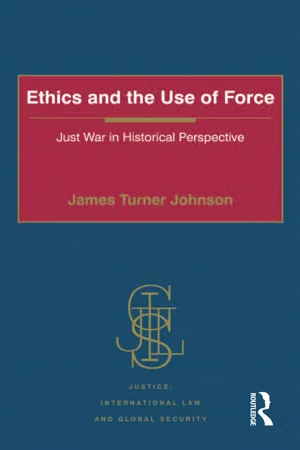
Highlighting the just war tradition in historical perspective, this valuable study looks at contemporary implications drawn out in the context of several important contemporary debates: within the field of religion, including both Christian and Islamic thought; within the field of debate related to the international law of armed conflicts; within the field of policy relating to the use of armed force where the issue is just war thinking vs. realism; and debates over pressing contemporary issues in the ethics of war which cross disciplinary lines. James Turner Johnson has been writing on just war tradition since 1975, developing the historical understanding of just war and seeking to draw out its implications for contemporary armed conflict. He is frequently asked to lecture on topics drawn from his work. This current book brings together a number of essays which reflect his recent thinking on understanding how and why just war tradition coalesced in the first place, how and why it has developed as it has, and relating contemporary just war reasoning to the historical tradition of just war.
Information
PART I Two Moral Traditions on the Use of Armed Force
DOI: 10.4324/9781315580388-2
Chapter 1 The Just War Idea in Historical Tradition and Current Debate
DOI: 10.4324/9781315580388-3
In the United States, and to a lesser but still significant degree in other Western countries, one of the most striking and important features of moral debate on the use of armed force over the last 50 years has been the recovery and practical use of the idea of just war to guide moral analysis and judgment—a phenomenon to which I have already alluded in the Introduction. This recovery may be said to have begun in the 1960s within the frame of Christian ethics with two books by Protestant theologian Paul Ramsey, War and the Christian Conscience (Ramsey 1961) and The Just War (Ramsey 1968). In the next decade Michael Walzer’s Just and Unjust Wars (Walzer 1977) carried the idea of just war into the arena of political philosophy and, with its mix of the use of historical examples with utilitarian and intuitionist moral reasoning, opened up the possibility of a non-religious contemporary form of just war discourse. In 1983, with the publication of the United States Catholic bishops’ pastoral letter, The Challenge of Peace (National Conference of Catholic Bishops 1983), a uniquely Catholic dimension was added, setting out the idea of just war in both an explicitly religious frame (as based in Catholic tradition) and in the form of an appeal to universally held natural law. My own contribution has been to seek to recover the idea of just war in its historical origins and development, where it takes shape as a historical tradition of thought and practice, expressed not only—or even mainly—in religious theory but also in law and in both political and military theory and practice, and to explore the implications of this still-developing tradition for contemporary uses of military force.
In the present chapter I begin with a summary examination of this historical tradition from its original coalescence to its classic form. Then I examine the effort to recover just war discourse for contemporary moral reflection on war, focusing on Ramsey and the United States Catholic bishops. Finally, I look at several thematic issues in recent just war discourse, analyzing them critically from a perspective based in the classic form of just war tradition.
Just War Tradition: From its Coalescence to its Classic Form
The deep roots of just war thinking in Western culture lie in the experiences and reflection on war and political life in classical Greece and Rome and in the Old Testament. Augustine of Hippo, writing in the fourth and early fifth centuries of the Christian era and reflecting these earlier sources as well as the New Testament, is often identified as the first Christian just war theorist. He did not, though, write a comprehensive treatise on just war comparable to those he wrote on sexuality and marriage (where he wrote three such treatises); his treatment of the idea of just war is found in a relatively small number of brief passages in various kinds of works on diverse topics. The text of these passages would occupy only a few typed pages today. Yet though brief and few in number, these were important, for they underscored the idea that a Christian’s life in the world in history implies responsibility for assisting in creating and maintaining public order for the sake of justice and peace.
Pacifist historians overstate the case when they claim that Augustine’s work marks a radical reorientation of the meaning of Christian life. The rejection of military service by first-century Christians was part of a broader phenomenon of separation from the life of “the world” that also extended to include a preference for celibacy and virginity over marriage and rejection of individual ownership of property. They sought to separate themselves in this way because they believed the end of the world was at hand and were seeking to prepare themselves for the life of the new age to come. Beginning in the second century, though, expectation waned for an imminent end of this world, and the early separatist impulse faded. In this changed context Christians began participating ever more broadly in ongoing social, political, and economic life, and as part of this participation significant evidence of Christian service in the Roman military began to appear. At the same time, and continuing over the next three centuries, a small number of Christian theologians and martyrs developed a variety of new arguments against Christian participation in military service: by calling it inherently idolatrous, by invoking the idea (brought over from Judaism) that shedding human blood made one ritually impure, by pointing to the immorality typical of soldiers, and by citing the words and example of Jesus. Just as the early Church took several centuries to reach a settled doctrine on marriage and eventually did so by accepting marriage for the laity while requiring celibacy for monks, nuns, and at least some clergy, so the Church gradually reached essentially the same position regarding war and military service, with involvement in military activity accepted for Christian laity while being prohibited for clergy and monks. Yet the words and example of Jesus remained. What Augustine, and also his mentor Ambrose before him, did was to argue that what these words mean is that Christians may not use force to defend themselves, but that Jesus did not forbid using force on behalf of the political community for the service of others in that community when threatened with injustice. This is the core conception on which Augustine’s idea of just war turned. (For fuller discussion of these early developments see Johnson 1987: 3–66.)
Pulling Augustine’s thoughts on war together, placing them alongside passages from other Christian thinkers who had addressed matters of war and military service, and organizing the whole systematically and coherently was the work of the canonist Gratian in his Decretum (Reichberg, Syse, and Begby 2006: 104–24), composed in the mid-twelfth century. The coalescence of just war tradition begins with this work (Johnson 1981: 121–24). Over the next hundred years subsequent generations of canonists added layers of reflection, analysis, and reasoned judgments, so that by the time of Thomas Aquinas, in the latter half of the thirteenth century, a settled conception of just war was in place. For Aquinas himself, this was essentially a jus ad bellum, defined by the need for sovereign authority, just cause, and right intention in two senses: negatively, avoidance of wrong intention as defined by Augustine in Contra Faustum; positively, the intention of securing peace in the sense of Augustine’s tranquillitas ordinis—the peace or tranquility ensured by good governance in the political realm (Reichberg, Syse, and Begby 2006: 176–78). The canon law in this period also included an extensive list of noncombatants not to be directly and intentionally attacked in war, as well as several efforts to limit the means of war (Johnson 1981: 124–31). Later, in the era of the Hundred Years War, the chivalric conception of right conduct in war was added to that already defined in the canon law (Johnson 1981: 131–50). This had two effects: first, reinforcement of the breadth of the consensus about moral use of force which just war tradition represented, and second, some elaboration of the concept of noncombatant immunity and of mitigation in treatment of the enemy. The churchly effort to limit the harm of war focused on the injustice of harming people not themselves personally involved in warring, while the chivalric effort focused instead on the virtuous warrior’s obligation toward the weak and the vanquished. Both these themes have remained in the tradition to the present day.
While subsequent development elaborated and focused this conception as indicated by contemporary circumstances, and while in particular during the modern period the consensual cultural consensus broke apart into separate sub-traditions within the religious, military, legal, and philosophical fields, the bedrock conceptions of just war as defined in this tradition are those we find in place by the end of this period of consolidation of the tradition, that is, the end of the Middle Ages. Early modern writers on the use of armed force, including such diverse thinkers as Francisco de Vitoria in Spain, Martin Luther in Germany, Hugo Grotius in the Netherlands, and the Puritan William Ames in England, all understood the idea of just war as defined by these bedrock conceptions. (For fuller discussion of these figures and their work on just war see Johnson 1975: 150–256.) These component ideas were expressed in terms of criteria for two types of moral decisions: that to resort to armed force in a particular instance and the myriad decisions having to do with right conduct in the use of such justified force. In the modern era these came to be designated as two types of law (jus): respectively, the jus ad bellum and the jus in bello.
So far as the resort to armed force was concerned, the settled classic form of just war tradition used the formulation found in Aquinas, that for such resort to be just it must be on sovereign authority, be for a just cause, not reflect wrong intention, and aim positively at creating peace.
The importance of the requirement of sovereign authority for the resort to force is that persons in such authority are responsible for the common good of their own political communities and, both individually and collectively, for maintaining the structure of relations among such communities that allows each to enjoy its own good. The right and responsibility to use force followed from this larger responsibility. This was expressed in two forms: by the literature on the good prince, which emphasized the sovereign’s obligation to create a just social order, which would thereby be peaceful, and by specific references to the sovereign’s responsibility to fight evildoing. The latter was focused by regular reference to Romans 13: 4, in which the sovereign is designated “minister of God to come in wrath to punish evildoers.” The use of force defined here is thus one of the tools of government, and only of government; individuals have no right of resort to force to settle disagreements, because they can always appeal to their superior, and on up to their sovereign, to adjudicate disputes. This difference in who might use force was carried over into the language used: bellum, “war,” was use of force by the sovereign, who might wage war on evildoers both internally and externally, while duellum, “duel,” was the word for uses of force by other persons. Bellum, use of force on sovereign authority, might be right or wrong, just or unjust, depending on whether the additional requirements were satisfied. (If they were not, then the sovereign was using power irresponsibly and, perhaps, tyrannically.) Duellum was, on the terms of just war tradition, always wrong. This emphasis on the requirement that the use of force be undertaken on public authority and seek to serve the common good first appears in Augustine; it is in fact the core of his conception of just war. It remained at the core of the coherent concept of just war elaborated by the beginning of the modern era. As suggested already in the Introduction and we shall see further below, recognition of the importance of this requirement has slipped in contemporary just war thought; I consider this a serious loss.
Just cause in classical just war thinking meant the need either to defend against some threat to the common good, to retake something of value wrongly taken, or (in accord with Romans 13: 4) to punish evildoers. The just cause of defense here was not “self-defense” as this term is used today but defense of the peace and order both of the immediate community and of the fundamental structure of order on which all communities depended. So a sovereign might justly respond in defense against an attack against his own political community, but he might also respond in force to defend persons in another such community who were being unjustly used by a tyrannical ruler, or join in collective action against an external power threatening another community. Further, the concern was focused on the threat of evil; it was not necessary to wait to respond until that threat had become actualized. So we find here a conception of defense as just cause which anticipated recent discussions of the right of preemption and the right of individual states or “coalitions of the willing” to use force against tyrannical rulers or states that threaten the overall fabric of international society. As for the other two forms just cause might take, they too describe elements of the responsibility of sovereigns: not to allow theft to go uncorrected, not to allow evildoers to go unpunished. These are common features of domestic law even today; the burning question in recent moral debate is how far—indeed, whether—they still hold for international uses of force by individual states.
Of the two components of right intention, the first, avoidance of wrong intention, correlates significantly with twentieth-century moral debates over aggression and over colonial domination. Its reference to avoiding uses of force motivated by “implacable animosity” also correlates directly with contemporary concerns over wars based in ethnic, religious or some similar difference. I will not explore these correlations here, but I will say that I think classic just war tradition got this matter right: when such reasons provide the rationale for uses of force, justice is never served but is always harmed. Thus the presence of such a motivation on the part of a party employing or threatening to employ force is itself a threat to justice and the broader common good; it justifies a defensive response in force, if necessary, to counter and remove it. As for the end of peace, the other aspect of the requirement of right intention, classic just war tradition understood this as ultimately the only reason for the sovereign’s resort to force. As noted above, the peace to be aimed at was that of Augustine’s tranquillitas ordinis, the peace of a society ordered so as to serve justice. While the implications of this requirement were not developed within the frame of discussions about the justifications and limits on the use of force itself, the requirement that justified force must aim at peace was underscored and developed by the same understanding of the obligations of good government that lie behind the requirement of sovereign authority. These two requirements for justified resort to force—sovereign authority and the end of peace—thus serve as bookends to a conception of justified force that is centrally about the needs of life in political community and the search for the common good that animates such life at its core. Just war is not something extrinsic or foreign to the life of such communities; it is one of the essential tools of good government in a world prone to injustice. This is a fundamental idea which at times, but not always, gets lost in recent uses of the idea of just war.
To anticipate briefly my later discussion of contemporary just war thinking, there are several ideas frequently used today that do not appear in just war tradition in its classic form: the prudential requirements of last resort, reasonable hope of success, and overall proportionality of good done by the use of force over both the evil done by it and the evil that would be expected without any resort to force. Arguably these are requirements of good statecraft in general, but classical just war tradition does not make them explicit requirements for just resort to force. To state them as explicit jus ad bellum requirements is a recent development, part of the effort to define a just war idea for contemporary use which has developed over the last 40 years.
As for the limitations to be observed in using justified force, just war tradition in its classic form approached the subject of noncombatant immunity by identifying classes of noncombatants—persons who, by reason of gender, strength, social function, or some other important characteristic do not normally take part in war and thus should not, in justice, have war made against them. The classic tradition approached the subject of limits on the means of war by attempting to outlaw certain kinds of weapons, ones which, in the context of the era, tended to be indiscriminate in their use and/or to cause untreatable wounds. These two lines of approach have been followed in the development of the law of armed conflicts, with the former spelled out in increasing detail in the Geneva Conventions and 1977 Protocols and the latter elaborated in various forms from the Hague Rules through recent efforts to ban weapons of mass destruction. Within religious and philosophical just war discourse, though, most just war thought on the limits of armed force revolves around two normative principles, discrimination and proportionality, first introduced as just war ideas by Paul Ramsey. I will have more to say about these two different approaches to limiting the conduct of war in a moment.
The Recent Recovery of the Just War Idea
While at the beginning of the modern period just war tradition was still a single body of thought incorporating elements from theology, philosophy, law, and both political and military theory and practice, it soon split into these component parts, and so for most of the modern era that tradition has been carried and developed distinctly within these several spheres. Within the frame of international law classical just war tradition metamorphosed into the idea of “the laws and customs of war” and then, over roughly the last 150 years, into the positive law of armed conflicts. Within the military sphere a similar pattern of development has led to positive conceptions of military discipline and training, to the emergence of conceptions of limited war, and to the creation and use of rules of engagement. (On these developments see further Johnson 1981: 121–326.) In the sphere of religion, however, the inherited idea of just war gradually stagnated after the mid-seventeenth century, and in the political sphere it essentially disappeared under the conceptions of Realpolitik and its A...
Table of contents
- Cover Page
- Half-Title Page
- Title Page
- Copyright Page
- Table of Contents
- Acknowledgements
- Introduction The Use of History for Thinking About Morality and War
- Part I: Two Moral Traditions on the use of Armed Force
- Part II: Just war and International Law
- Part III: Just War and Political Realism
- Part IV: Pressing Contemporary Problems
- Bibliography
- Index
Trusted by 375,005 students
Access to over 1.5 million titles for a fair monthly price.
Study more efficiently using our study tools.
Frequently asked questions
Yes, you can cancel anytime from the Subscription tab in your account settings on the Perlego website. Your subscription will stay active until the end of your current billing period. Learn how to cancel your subscription
No, books cannot be downloaded as external files, such as PDFs, for use outside of Perlego. However, you can download books within the Perlego app for offline reading on mobile or tablet. Learn how to download books offline
Perlego offers two plans: Essential and Complete
- Essential is ideal for learners and professionals who enjoy exploring a wide range of subjects. Access the Essential Library with 800,000+ trusted titles and best-sellers across business, personal growth, and the humanities. Includes unlimited reading time and Standard Read Aloud voice.
- Complete: Perfect for advanced learners and researchers needing full, unrestricted access. Unlock 1.5M+ books across hundreds of subjects, including academic and specialized titles. The Complete Plan also includes advanced features like Premium Read Aloud and Research Assistant.
We are an online textbook subscription service, where you can get access to an entire online library for less than the price of a single book per month. With over 1.5 million books across 990+ topics, we’ve got you covered! Learn about our mission
Look out for the read-aloud symbol on your next book to see if you can listen to it. The read-aloud tool reads text aloud for you, highlighting the text as it is being read. You can pause it, speed it up and slow it down. Learn more about Read Aloud
Yes! You can use the Perlego app on both iOS and Android devices to read anytime, anywhere — even offline. Perfect for commutes or when you’re on the go.
Please note we cannot support devices running on iOS 13 and Android 7 or earlier. Learn more about using the app
Please note we cannot support devices running on iOS 13 and Android 7 or earlier. Learn more about using the app
Yes, you can access Ethics and the Use of Force by James Turner Johnson in PDF and/or ePUB format, as well as other popular books in Politics & International Relations & Politics. We have over 1.5 million books available in our catalogue for you to explore.