eBook - ePub
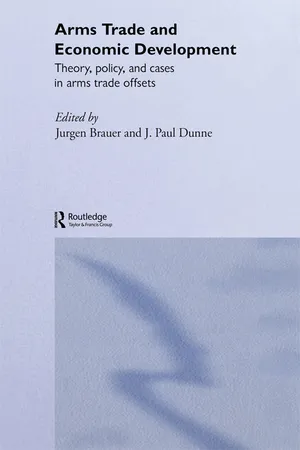
Arms Trade and Economic Development
Theory, Policy and Cases in Arms Trade Offsets
- 352 pages
- English
- ePUB (mobile friendly)
- Available on iOS & Android
eBook - ePub
Arms Trade and Economic Development
Theory, Policy and Cases in Arms Trade Offsets
About this book
Countries that spend scarce resources to import arms from abroad often require arms sellers to 'reinvest' part or all of the proceeds back into the arms-importing country. These so-called 'arms trade offsets' are therefore thought to enhance domestic economic development. But does this process actually succeed?
This book examines the theory and policy applications of arms trade offsets and looks at more than a dozen case studies drawn from across Europe, Africa, Asia, and the Americas. The chapters, based on original research and published here for the first time, are all written by leading experts.
That an impressive, lucid and cohesive volume such as this will interest defence economists can be taken almost for granted. The book will also be a useful and enlightening read for those interested in international development economics, military studies and policy-makers across the globe.
Part I
Theory and Policy
1
Do offsets mitigate or magnify the military burden?
Lloyd J.Dumas
Introduction
Weapons contractors, like other profit-making corporations, are not particularly interested in the general economic development of the countries in which they operate or to which they sell. They are not inherently antagonistic to encouraging economic development. But their primary interest and motivation is in selling their products and making money. That is what they are in business to do. Consequently, from the weapons contractors’ point of view, cost offsets are a marketing tool, a way of building enthusiasm for or overcoming resistance to buying their products. Whether offsets encourage development or not is quite beside the point.
From the point of view of weapons purchasing countries, there are a number of possible motives for demanding cost offsets as a condition of purchase. They might consider offsets a straightforward means of raising the benefit/cost ratio of their weapons purchases by lowering net costs, providing additional economic benefits, or both. Alternatively, the governments could believe that offsets will give them political cover for what amounts to providing hidden subsidies to indigenous military industrial firms (or other domestic producers) that they wish to artificially sustain or promote, for reasons that might not be politically popular. Government officials might also believe that offsets will make it easier to “sell” relatively unpopular weapons purchases to a skeptical public (or opponents internal to the government)—purchases that the officials want to make for a range of political, social, and economic reasons. If it can be made to convincingly appear that there are great economic benefits to the public as a result of the offsets— whether those benefits are real or simply “smoke and mirrors”—any political opposition to the weapons purchase can be more easily overcome.
That the motivations and perspectives of the buyers and sellers of weapons in the international arms trade are so different certainly does not preclude the possibility that offsets may be designed in a way that satisfies both sets of interests. For that matter, it also does not preclude the possibility that offsets can be designed and implemented in a way that does make a real contribution to the economic development of the purchasing nation.
To better understand the meaning of offsets and their impact on economic progress, it is useful to begin by looking at a few more basic issues. First, we distinguish between two different concepts of such progress, economic growth and economic development. Next, we consider the economic distinction between military spending and military production. That allows a clearer view of the nature of the impact of military-serving activity on economic progress in general, and on the progress of less developed countries in particular. We will then be in a better position to analyze the costs and benefits of offsets.
Economic growth and economic development
Although the terms are often used interchangeably, “economic growth” and “economic development” are two entirely different concepts, each grounded in a fundamentally different view of the economy itself. “Economic growth,” as the term is conventionally used, refers simply to expansion in the size of the money economy. It is typically measured by the rate of change in gross domestic product (GDP) or gross national product (GNP), both of which are incomplete yet reasonable and generally accepted measures of the aggregate volume of money-valued goods and services produced. In contrast, “economic development” is a much more complex concept referring to continuing improvement in the material conditions of life of the vast majority, if not all, of the individuals in the population. Unlike economic growth, gauging economic development inherently requires attention not just to how much money-valued output is produced, but also to what is produced, and to how it is distributed among the population.
If we are interested in understanding not so much what is happening to the impersonal abstract entity called “the economy” but whether or not the real people who give a nation life are becoming materially better off, then we must move beyond focusing on the expansion of the money economy to the broader issue of economic development. In order to see more clearly how productive human activity is actually affecting material well-being, we must also leave behind the common fixation on money value as the arbiter of economic value, and look instead at the underlying question of how much any particular good or service contributes to that material well-being. It is the contribution an activity makes to the material standard of living, and not its money value, that defines it as having economic value in the first place.
All over the world, and especially in less developed countries, many goods and services that add greatly to material well-being are not exchanged for money (such as home-grown food, home-made clothing, do-it-yourself repair, and parental child care services). It makes no sense to exclude them from our count of economic activity for that reason alone. Nor does it makes sense to include in economic activity the production of goods and services that do not add to material well-being (though they may serve other socially useful purposes), simply because money is paid for them. Examples include those specialized goods and services that support the activities of the criminal justice system or the activities of churches and other religious institutions. Because such goods and services do not contribute to the material standard of living, they are logically not part of the economic system, whose fundamental purpose is to provide material well-being. The specialized goods and services that support military activity (such as fighter planes, battle tanks, and light weaponry) most assuredly fall into this latter category (Dumas, 1986).
Many believe that military forces are meant to secure the conditions of order and stability in the international arena that allow economic activity to proceed, just as domestic police forces are meant to create an atmosphere of law and order within a country that serves as a necessary backdrop for a smoothly functioning economy. While that is a debatable proposition, even if it were true, the act of producing military-related goods and services itself would still not qualify as economic activity. Just as putting more locks on the doors does not add to the value of a house or its contents, military forces may protect what you have, but they do not and cannot themselves add to material well-being. Quite the contrary, spending resources on protection reduces the resources available to produce goods and services that do add to material well-being.
Goods and services that do not contribute to the material standard of living may have other forms of value, but they do not have economic value. It is logical that the output of goods and services that do not have economic value, should not be included in total measured economic output. But, as long as they are sold for money—as specialized military goods and services most certainly are—their production is included in GDP (GNP). As a result, the growth rate of GDP (GNP) is distorted as a measure of national economic progress.
It is admittedly much more difficult to measure economic development than to measure economic growth. Unlike growth, there is no single measure that can capture all the key dimensions of development.1 A complex of measures is required. That probably goes a long way toward explaining why there is such a strong tendency on the part of politicians and economists to use growth as a proxy for development. But the difficulty of measuring something has no particular relationship to how important that thing is. If economic development, rather than economic growth, is the concept most closely related to increasing the material well-being of the population, then it is development, and not growth, on which we should focus our attention.
Military spending and military production: the economic impacts
It is also important to distinguish between the economic impacts of military spending and those of military production. Military spending is the broader concept, ordinarily involving the use of financial assets, typically money, to purchase military goods (weapons, warning systems, etc.) and services (the expertise of commanders, the efforts of soldiers, etc.) from domestic or foreign suppliers. Military production involves the use of real productive resources (machinery, materials, factory buildings, engineering talent, skilled machinists, etc.), drawn from the pool of such resources available to the economy, for the purpose of actually producing specialized military goods and services.
For present purposes, it is useful to divide military spending into two broad categories: “operations and maintenance” (O&M), which includes the pay and operational support of the people who serve in the armed forces; and “procurement,” which includes the purchase from abroad or production at home of weapon systems and research and development (R&D) services.2 Both categories of military spending consume financial capital. But procurement has a much more powerful effect on the allocation of key types of industrial and technological labor and physical capital.
For the most part, the economic impact of spending on military O&M in the more developed countries (MDCs) is restricted to the tradeoff of that particular use of public funds against alternative uses, including the return of those funds to taxpayers in the form of reduced taxes. However, to the extent that it calls forth domestic military R&D and weapons production, military procurement spending has much larger and more telling impacts on MDC economies, especially in the long run. In the short run, as we learned from Keynes, increased spending of any sort—including military procurement spending—can stimulate a slack economy and help move it out of recession. But, as I have argued elsewhere, in the long run, domestic military production and R&D has enormously negative impacts on a nation’s ability to efficiently produce goods and services that contribute to material well-being, precisely because it tends to divert economically critical labor and physical capital resources (Dumas, 1986; 1995).
In many less developed countries (LDCs), O&M spending has a greater potential impact than it does in the MDCs, primarily because the officer corps of the military is often one of the most promising career paths in terms of financial reward, social status, and power. As a result, there is a potentially larger diversion of more skilled and talented labor into military service itself than in MDC societies, where there are a much greater variety of career opportunities. Since skilled labor, one of the most critical economic resources, tends to be in short supply in LDCs, this diversion is particularly damaging to their prospects for economic development. To this burden must be added the same kind of opportunity costs implicit in the tradeoff against alternative uses of public funds as in the MDCs. Of course, the greater economic and social need of LDC populations make the pain associated with these opportunity costs much stronger than in MDCs, especially in terms of development-oriented uses of public funds.
Since relatively few LDCs have substantial indigenous military production capability, the economic impacts of military procurement in most LDCs include mainly opportunity costs similar in kind to those of O&M spending just discussed, together with the opportunity costs of the use of hard currency reserves for weapon purchases from abroad. The vast majority of LDCs do not have extensive hard currency reserves, and while local currency can be used for much of O&M spending (especially for paying armed forces personnel), military procurement from abroad requires hard currency. Lacking an extensive indigenous R&D capability or well-developed machinery industries, LDCs must also import much of the agricultural and civilian industrial technology and equipment they need if they wish to modernize these sectors of the economy. That too requires hard currency, making the tradeoff of military spending against development-oriented spending still more severe.
Yet to the extent that LDCs try to build their own domestic military production capabilities to conserve on their stock of hard currencies, they face an even larger diversion of critical skilled labor and physical capital resources. Such a diversion can and does seriously damage the economies of more developed nations in the long run. It is likely to be crippling to LDC economies in which these critical resources are much shorter in supply. Beyond this, because most LDCs cannot build an indigenous military production capability without importing the requisite machinery, equipment and technology (if they are even available), it may well be that the drain of hard currency reserves will be increased, not reduced, by this strategy, at least in the short run. None of this bodes well for LDC prospects for development.
The nature and political economy of offsets
The magnitude and type of impact offset agreements have on economic development depend on a number of factors, the most basic of which is the likelihood that the weapons seller will fully meet their offset commitments, once the weapons and the money have actually changed hands. With the exception of barter, all types of direct and indirect offsets may be stretched over an extended period of time.3 That being so, it is legitimate to be concerned about the possibility that changing political or economic conditions in the weapons supplying country, or in political and economic relations between the weapons supplying and purchasing countries, might interfere with the completion of the deal as originally agreed. To this must be added the possibility that a change in the business fortunes of the weapons contractor, or even outright bad faith, might also prevent the full offset from being realized.
To the extent that a country decides to pursue offsets in the course of its weapons procurement, there is thus a premium on finding ways to structure offset agreements that maximize both transparency and incentives for fulfilling offset obligations. Transparency may be more than usually difficult to achieve in matters of weapons procurement, because of the tendency toward less than complete openness in international arms dealing. Except for the threat of the loss of follow-on business (which may be more or less persuasive depending on the weapons purchasing country involved), it is difficult to know what kind of enforcement mechanisms and/or incentive systems are both feasible and effective. This is particularly true in the case of arms purchases by LDCs from the major weapons producers in the MDCs, because of the imbalance of economic and political power between the contracting parties.4
There is also the question of whether offsets really represent new business, that is, business that would not have taken place anyway in the absence of an offset deal. For example, in the mid-to-late 1980s, the government of the United Kingdom agreed to buy seven airborne warning and control system (AWACS) aircraft from Boeing. The deal included the offer by Boeing of a 100 percent offset. Over 50 percent of the offset obligation was to be met by purchases of civilian aerospace products, including Rolls Royce engines to be used in civilian airliners. Since the civilian division of Boeing normally bought a substantial amount of aerospace products from UK suppliers anyway, there was considerable controversy as to whether the orders that ...
Table of contents
- Cover Page
- Title Page
- Copyright Page
- Studies in Defence Economics
- Figures and Tables
- Contributors
- Preface
- Introduction
- Abstracts
- Part I: Theory and Policy
- Part II: Cases
Trusted by 375,005 students
Access to over 1.5 million titles for a fair monthly price.
Study more efficiently using our study tools.
Frequently asked questions
Yes, you can cancel anytime from the Subscription tab in your account settings on the Perlego website. Your subscription will stay active until the end of your current billing period. Learn how to cancel your subscription
No, books cannot be downloaded as external files, such as PDFs, for use outside of Perlego. However, you can download books within the Perlego app for offline reading on mobile or tablet. Learn how to download books offline
Perlego offers two plans: Essential and Complete
- Essential is ideal for learners and professionals who enjoy exploring a wide range of subjects. Access the Essential Library with 800,000+ trusted titles and best-sellers across business, personal growth, and the humanities. Includes unlimited reading time and Standard Read Aloud voice.
- Complete: Perfect for advanced learners and researchers needing full, unrestricted access. Unlock 1.5M+ books across hundreds of subjects, including academic and specialized titles. The Complete Plan also includes advanced features like Premium Read Aloud and Research Assistant.
We are an online textbook subscription service, where you can get access to an entire online library for less than the price of a single book per month. With over 1.5 million books across 990+ topics, we’ve got you covered! Learn about our mission
Look out for the read-aloud symbol on your next book to see if you can listen to it. The read-aloud tool reads text aloud for you, highlighting the text as it is being read. You can pause it, speed it up and slow it down. Learn more about Read Aloud
Yes! You can use the Perlego app on both iOS and Android devices to read anytime, anywhere — even offline. Perfect for commutes or when you’re on the go.
Please note we cannot support devices running on iOS 13 and Android 7 or earlier. Learn more about using the app
Please note we cannot support devices running on iOS 13 and Android 7 or earlier. Learn more about using the app
Yes, you can access Arms Trade and Economic Development by Jurgen Brauer,Paul Dunne in PDF and/or ePUB format, as well as other popular books in Business & Business General. We have over 1.5 million books available in our catalogue for you to explore.