eBook - ePub
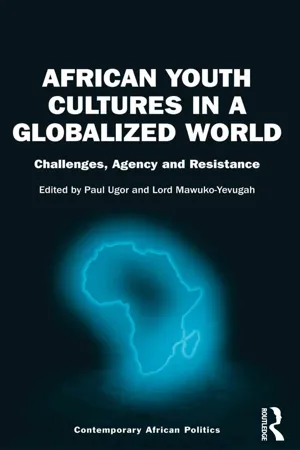
African Youth Cultures in a Globalized World
Challenges, Agency and Resistance
- 308 pages
- English
- ePUB (mobile friendly)
- Available on iOS & Android
eBook - ePub
African Youth Cultures in a Globalized World
Challenges, Agency and Resistance
About this book
All over the world, there is growing concern about the ramifications of globalization, late-modernity and general global social and economic restructuring on the lives and futures of young people. Bringing together a wide body of research to reflect on youth responses to social change in Africa, this volume shows that while young people in the region face extraordinary social challenges in their everyday lives, they also continue to devise unique ways to reinvent their difficult circumstances and prosper in the midst of seismic global and local social changes. Contributors from Africa and around the world cover a wide range of topics on African youth cultures, exploring the lives of young people not necessarily as victims, but as active social players in the face of a shifting, late-modernist civilization. With empirical cases and varied theoretical approaches, the book offers a timely scholarly contribution to debates around globalization and its implications and impacts for Africa's youth.
Information
Chapter 1
Introduction: Markets, States, and Generations: African Youth in the Age of Neoliberal Globalization
This edited volume interrogates the broader implications of our current neoliberal era by looking at the life experiences of young people in Africa. It does so by examining the social and cultural responses neoliberalism has elicited from the current generation of Africa’s youth. Commenting on the implications of neoliberal globalization on the lives of future generations, Anastasia Nesvetailova argued that so long as neoliberalism continues to impress its political-economic logic on the international economy, the nation-state and local communities, ‘the benefits of financial stability will accrue to the top layers of societies, poverty and unemployment will remain entrenched in the finance-centred mode of international integration, and future generations will have to bear the burden of today’s growing deficits of all major OECD economies’ (2004, p. 65, emphasis added). Although restricted to OECD countries, Nesvetailova’s critique unravels the frightening repercussions of contemporary global financial capitalism for young people transnationally. While the current neoliberal economic order grounded in global financial markets continues to heap stupendous wealth on a tiny class of global corporate elites, younger generations are inheriting a future of uncertainty and precarity. The global credit crunch in 2008 and the messy socio-economic aftermath worldwide – such as mass retrenchments, unemployment/underemployment, homelessness, huge cutbacks in education and training, lack of healthcare, the dearth of welfare services, the elimination of social safety nets, and other such cruel austerity measures now associated with a self-centred neoliberal democracy – are all indicative not only of the diminished social and economic opportunities for global youth generally, but also point to the sordid reality that the younger generations all over the world are the real victims of a transnational neoliberal regime that prioritizes the interests of the 1 per cent and compromises the fate of the 99 per cent, of which the youth are a majority. In short, as Henry Giroux (2012) has argued recently, under the neoliberal regime, youth all over the world are a disposable lot.
Given this unsavoury prognosis of the consequence of neoliberalism on a vast majority of youth globally, we are interested in problematizing the broader existential implications of modern-day credit-driven global finance regimes on the lives of young people in Africa. We broach the direct and indirect ramifications of a neoliberal political-economic order on Africa’s youth by reflecting not just on its brutal economic consequences, but also on the emerging liberating cultural politics that it has engendered among African youth in varied realms – domestic and public, rural and urban, and local and global. While governments have continued to cut social spending drastically, thus abandoning an increasing number of people that hitherto depended on the state, ordinary citizens have now been forced to rely more on their own ingenuity for survival. According to John Rapley, ‘the erosion in the state’s ability to distribute resources to its support base has eroded the loyalty of those at the bottom. Excluded altogether from the regime, or increasingly marginal within it, people have begun to look elsewhere in their search for resources’ (2004, p. 89). Although uninhibited market fundamentalism has concentrated benefits on a tiny minority, it has also catalysed a series of cultural practices and processes, indicating a strong link between markets, social order, and new power relations. In this collection, we examine and demonstrate multiple ways in which young people in Africa are living and/or coping under a dominant market mentality. While attending carefully to the pernicious effects of neoliberal globalization on the experiences of African youth, we also pay critical attention to the emerging survival moves among the marginalized but imaginative youth in the continent. Our ultimate aim, thus, is to triangulate the taut connections between neoliberal market globalization, precarity and youth agency in Africa’s postcolonial postmodernity. Given the treacherous nature of an international neoliberal economy, complicated by the political shenanigans of postcolonial ruling elite in the continent whose devious antics have compromised the whole project of futurity, our ambition is to track the multiple ways in which African youth, as I argued recently, are now living their lives in a world that has no guarantees (Ugor 2013b).
Neoliberalism, the current international economic regime between the late twentieth and twenty-first centuries, has created a new intercontinental financial sphere in which finance now not only plays ‘a much bigger role in the configuration of national economic systems and orientation of national policies’, but in addition one in which finance has also become ‘a major engine of capitalist expansion on a global level’ (Nesvetailova 2004, p. 62). Supposedly intended to protect the market from politics, especially beginning in the late 1970s, but perhaps more aggressively since the 1990s, neoliberal political-economic agendas have promoted a series of reforms in the global financial sector that have brought about unrestrained and inexorable economic liberalization and deregulation, the withdrawal of the state from economic activities, the degradation of democracy, the near abrogation of the public sphere and the dominance of private interests. As an ongoing global economic doctrine, neoliberalism is marked by intriguing paradoxes; while creating almost limitless access to finance capital through credit, it has also created new terrains of excruciating indigence and suffering through bondage to unrelenting debt at national, institutional and individual levels. And the real roots of the social crises now created by neoliberal globalization, John Rapley tells us, are traceable to a new regime of global economic policies that ‘have driven a certain type of globalization, one designed to strengthen the role of globalizing fractions of capital while eroding not only the state but also the regimes that operated to the benefit of the world’s subordinate classes, thereby raising profit rates and accumulation’ (2004, p. 8). While creating a historic era of express economic growth in selected regions of the world, it has inaugurated and nurtured a vicious culture of mindless accumulation that has inevitably led to what Rapley calls a ‘distributive crisis’, which has in turn undermined and precipitated a catastrophe within neoliberalism’s own exclusive camp. Although capitalist markets have now been allowed to operate unhindered and without any moral codes and values, legislative instruments and frameworks to ensure even distribution of the breathtaking profits now generated by the new markets have been difficult to install and enforce. One immediate outcome of this entrenched imbalance has not only been the eruption of political instability and anti-systemic movements all over the world, in many cases led by young people, but also a certain kind of uncertainty both within the esoteric worlds of the neoliberal economy itself and those outside of its unfair distributional networks.
The very fragility of the neoliberal economy, one in which there has been a fundamental shift from industrial production to finance capitalism, has meant that other social realms tied to the economic sector have also been impacted in very negative ways. As Nesvetailova puts it, the intrinsic financial innovation/expansion associated with neoliberalism ‘not only makes fragility an inherent element of today’s financial structures, it also disrupts the links between finance and other parts of the economic system, deepening the gulf between financial markets and non-financial spheres’ (2004, p. 63). It is the often ignored links between the economic and non-economic spheres in the neoliberal dispensation, and the tensions that emerge when those links rupture, especially as it affects young people in Africa, that this collection explores. While examining the new social threats now posed by a debt-driven, exploitative and pernicious international economic regime, we direct our critical lenses specifically on the social threats and losses that neoliberalism unleashes on young people in Africa, as well as the extraordinary responses of youth on the continent. This two-pronged approach has become imperative, for while both youth studies and African cultural studies in general have tended to mourn the relentless suffering brought upon Africa’s youth by both global and local political-economic systems, few attempts have been made to investigate the extraordinary ways in which African youth have processed and dealt with the dangers now associated with the global neoliberal political-economic system. While a fairly fascinating body of literature has begun to crystallize around the theme of youth agency in Africa, we feel compelled to dig deeper into this debate because the sheer breadth of the continent, its rising youth population and the varied constellation of cultural activities bursting forth from the continent demand more critical attention.
The links between the international economy and youth politics are not new. Indeed, the emergence of the discourse of youth in the 1950s was one implicated in global economic changes. The very term ‘Youth Culture’, first coined and used by the pre-eminent sociologist, Talcott Parsons in his book The Social System (1951), was a concept referring to emerging forms of counter-cultural movements among the working class youth of post-World War II economic boom in Britain and the United States. These new cultural formations by young people, conceived as being marked essentially by irresponsibility, sex and consumerism, had created a widespread moral panic among a conservative and prudish adult generation, who now saw young people as folk devils threatening the very moral foundations of a stable Western society and its social values.1 But the economic context of these beginnings of the youth culture debate in the 1950s is particularly interesting when contrasted with what we know of the situation of youth today. Post-World War II Britain and America, especially beginning in the late 1940s all through to the late 1960s, had witnessed phenomenal economic prosperity due to the leading role played by the United States and Britain in the reconstruction efforts (UNESCO 1981; Chawla and United Nations 1986; United Nations 1993). The absence from the world market, of major exporters such as Germany, France, Italy, and Japan created an environment of unprecedented economic growth in the British and American economies. Indeed, the postwar boom was not limited to Europe and North America only; it prompted a high demand for export goods in the newly independent nation-states in the developing world, leading to dramatic economic growth in the postcolonies too. The broader cultural effect of this spectacular economic prosperity, both at the metropolitan centre and the colonial periphery, especially for the working classes, was that consumerism, which was once an exclusive luxury for wealthier people began to take shape even among the poorest groups (Bocock 1993). According to Stanley Cohen (2002, p. 150), those years were a significant moment of social transformation where the basis for social change was facilitated by a potpourri of economic and demographic variables:
there was a large unmarried teenage generation (between ages 15–21) whose average real wage had increased at twice the rate of the adults. This relative economic emancipation created a group with few social responsibilities whose stage of development could not be coped with by the nuclear working-class family.
The direct cultural outcome of the material abundance of the postwar prosperous economy, particularly for young people, was that it brought about teenagers with high cultures of ‘consumption, style and leisure’ (Valentine et al. 1998, p. 4). This laissez-faire life of hedonism and excess materialism was a great contrast to the austere lifestyle of the earlier generation. Prosperity, accompanied by consumerism, had thus redefined the new generation of youth in the 1950s and 1960s from youth-as-innocent people to youth-as-fun.
The point here, then, is that the initial economic environment that gave impetus to the debates about young people in the 1950s and 1960s had to do more with questions of the cultural response and attitudinal reflection of prosperity than with the excruciating austerity that young people are facing today (Chawla and United Nations 1986, p. 9). It was a moment in which a national capitalism heavily devoted to collective interests and welfare and social services still reigned supreme. The pre-1970s, thus, was an era in which state capitalism not only catered for the interests of all, but also invested in creating opportunities and hope for its youth. This initial brand of political-economic ideology and practice is quite distinct from the ‘savage capitalism’ of the late 1970s that witnessed what Richard Robison (2006, p. 4) describes as the extension of ‘the values and relations of markets’ as an overarching model for ‘the broader organization of society and politics’. As Mark Olsen (2010, p. 8) puts it, the emergence of neoliberalism in the 1970s inaugurated ‘both a form of analysis by which public institutions could be appraised in economic terms, as well as a means by which all forms of voluntary behaviour could be subjected to economic cost-benefit analysis”. Thus, the triumph of neoliberalism as a political, legal, and economic doctrine since the late 1970s has led to the erosion of a telocracy or social democracy that values collective ends to a nomocracy that discards the state as an enterprise. This political-economic ideology prioritizes the supremacy of the rule of law that favours a doctrine and practice that focuses ‘on the idea of political institutions as providing a framework of general rules which facilitate the pursuit of private ends, however divergent those ends might be’ (Plant 2010, p. 6). And what is truly unsettling about neoliberalism besides entrenching a certain kind of radical redistribution of wealth that favours the very, very rich, is the reinvention of the state into a willing ally and ‘authoritarian tool’ for protecting the wealth of the well-to-do (Dean 2009, p. 9). Thus, according to Henry Giroux, neoliberalism essentially
supports a theater of cruelty that is scornful of any notion of compassion and concern for others. As a mode of governance, it produces identities, subjects, and ways of life driven by a survival of the fittest ethic, grounded in the idea of the free, possessive individual, and committed to the right of ruling groups and institutions to accrue wealth removed from matters of ethics and social costs. (Harper 2014)
With the onset of neoliberalism in the 1970s, the initial prosperous moments that shaped the discourses of youth culture have shifted from a concern with material abundance, as was the case between the late 1940s and 1960s, to one of chronic poverty. Since the 1980s especially, the consensus has been that the social conditions surrounding the lives of contemporary youth the world over are rough and dangerous. The United Nations reports on the global situation of youth offer a frightening prognosis for the future of the world’s youth. In earlier reports the key markers of youth were ‘confrontation-contest’, ‘counter-power’, ‘counter-culture’, and other such descriptors that designated youth at the forefront of the unfolding battles against marginalization and inequality, especially in the context of economic boom and de-colonization movements all over the Commonwealth (Acland 1995). But the landmarks of the new generation of young people from the 1980s onwards have been the sudden but urgent concerns with ‘survival’, ‘under-employment’, ‘defensiveness’, [and] ‘anxiety’ (UNESCO 1981, p. 17). These trends are evocative of an emerging social turbulence among youth at a global scale. In fact, UNESCO’s fatalistic prognosis in 1981 was that in comparative terms, ‘if the 1960s challenged certain categories of youth in certain parts of the world with crises of culture, ideas and institutions, the 1980s will confront a new generation with concrete, structural crises of chronic economic uncertainty and even deprivation’ (UNESCO 1981, p. 17). Youth now are not only considered to be endangered – ‘at risk’ – but also ‘a risk’ in itself (Macdonald et al. 1993; Wulff 1995; Cieslik and Pollock 2002). This problematizing viewpoint on youth has typically followed what Johanna Wyn and Rob White (1997) have called a ‘bio-centric’ perspective where the looming youth crisis is all over the world is located within the supposedly intrinsic capacities of young people for intransigence as a result of their unique physiological make-up at that phase of biophysical development. These social framings assume linear natural progression from infancy, through adolescence/youth, to adulthood, and each of these biophysical phases is supposedly marked by different psychological states externalized in the social character of the young people. Within the purview of this school, what Mills and Blossfeld (2000) call the external ‘multi-causal’ global forces, which have huge implications for the character of young people, are ignored. The much feared ‘global crises’ of youth is thus read as an externalization of the innate biophysical state of young people themselves: society is almost totally exonerated.
Neoliberal Globalization, Uncertainty, and Youth Cultures: The New Sociology of Youth
In general, neoliberalism powerfully impacts the lives of billions of people whether in relation to personal family income, national economy, international politics, global–local cultures, religion, or in other ways. It has permeated and now is entwined in the fabric of human lives worldwide such that it is impossible to assess its impact in one fell swoop. But emerging research in youth studies has begun to make particularly insightful connections between the new global economic regime – neoliberal globalization, late-capitalism, postmodernity – and the situation of young people all over the world (see UNESCO 1981; Miles 2000, 2002; Bradford Brown et al. 2002; Falk and Falk 2005; Maira and Soep 2005; Cole and Durham 2007, 2008; Dolby and Rizvi 2008; Poyntz et al. 2009; Tyyska 2009). These studies privilege a discursive shift from the perceived intrinsic capacities of young people for obduracy to focus on interconnectivity between young people’s restless behaviour and global economic issues. The central argument put forth by these new scholarships indicates that the so-called crises of youth beginning in the 1980s are intricately linked to global neoliberal economic, political, scientific/technological, and cultural trends. In advancing this argument, these studies trace the beginning of youth concerns in the 1960s and 1970s, illustrating how the youth of that period were more productively engaged with society owing to the general global optimism characterizing the period. In fact, UNESCO’s (1981, p. 14) own report attributes the global emphasis on institutional questioning, public accountability, and the need for direct honest communication between people as a lasting contribution of the pre-1970s generation of youth to the world.
Since the early 1980s however, the initial optimism of the 1960s has given way, spiralling precipitously into pessimism. And much of the uncertainty and pessimism now experienced by young people all over the world has been linked to the social, economic, and political transformations brought about by neoliberal policies. Neoliberalism, especially as ‘a particular organization of capitalism, which has evolved to protect capital(ism) and to reduce the power of labour’ (Saad-Filho and Johnson 2005, p. 3), has had brutal consequences across the globe. The real cost of this protectionist approach to finance capital, these authors argue, is not only that ‘corporate power has increased, while finance has acquired unravelled influence’, within the global political-economic firmament, there has also been a certain gravitation towards fiscal conservatism and neoliberal ideals, leading to the near death of left politics in some parts of the world, the erosion of mass organizations that are people-inclined, and even the weakening of trade unions which have literally been immobilized by high unemployment (2005, p. 3). Rising unemployment rates coupled with global economic downturns in both the industrialized/developed nations and the developing world have in turn not only precipitated huge unemployment rates among youth the world over, but have triggered a social crisis where a greater majority of youth and their families now have difficulty accessing good education, land and housing, food, security, medical care, drinking water, and other social and economic services. With the state now almost disabled as an active participant in the economy, dislocating the links between democracy, states, capitalism, and collective welfare, the private interests and gains of a tiny class of global elite have taken over, compromising the well-being of the majority, among whom are mostly women, children, and youth. The cultural consequence has been that the earlier utopias of a global El Dorado floated in the 1960s have given way to despondency and fear of survival. These unfortunate trends in the international economic domain have now kick-started major global unrest among the growing youth population of the world as seen in places like Greece, Spain, London, New York, the Middle-East, and North Africa. If the 1960s was a period of counter-culture, confrontation, revolution, and social justice for the youth, the 1980s onwards became a moment of scarcity, unemployment, nervousness, survival, dread, and political violence.
This trend for the current generation of youth means that social movements attractive to the youth of this period onwards will not be big ideological pursuits as seen in the prospering 1950 and 1960s but ‘movements made up of young people struggling for economic, political, and social rights on a broad front’ (UNESCO 1981, p. 22). While the concern about young people four decades ago was ‘a crisis primarily of culture, of ideas, of institutions’, the new anxiety about youth has to do with a ‘more concrete structural crisis that made inflation and unemployment household words, and rules rather than exceptions’ (...
Table of contents
- Cover Page
- Title Page
- Copyright Page
- Contents
- List of Figures
- Notes on Contributors
- Series Editor’s Preface
- Acknowledgements
- List of Abbreviations and Acronyms
- 1 Introduction: Markets, States, and Generations: African Youth in the Age of Neoliberal Globalization
- 2 African Youth and Global Resistance to Neoliberalism: Exploring the Dialectics between Cosmopolitan and Identity Politics
- 3 Power and Resistance: Tertiary Education Reform and Student Activism in Ghana
- 4 Individualization, Masculinities and Young Men in Mozambique
- 5 Youth Artivism in Uganda: Co-Creators of Our Own Becoming
- 6 Oil Capitalism, Precarity, and Youth Resistance to Slow Violence in Nigeria’s Oil Delta
- 7 Humble Living and Hustling: Youth Struggles in Mathare Constituency, Nairobi
- 8 Information and Communication Technologies and African Youth in a Globalized World
- 9 Dialectics of Subversion: Protest Art and Political Dissidence in West Africa
- 10 Coz Ov Moni: Hip-Life, Hybridity and Contemporary Youth Culture in Ghana
- 11 Singing Everyday Life: Placing the Limpopo Youth Experience in the Global Imaginary
- 12 African Popular Culture and the Path of Consciousness: Hip-Hop and the Culture of Resistance in Nigeria
- 13 Gendered Spaces: Opportunities and Challenges of African Youth in the Context of Neoliberal Globalization
- Bibliography
- Index
Trusted by 375,005 students
Access to over 1.5 million titles for a fair monthly price.
Study more efficiently using our study tools.
Frequently asked questions
Yes, you can cancel anytime from the Subscription tab in your account settings on the Perlego website. Your subscription will stay active until the end of your current billing period. Learn how to cancel your subscription
No, books cannot be downloaded as external files, such as PDFs, for use outside of Perlego. However, you can download books within the Perlego app for offline reading on mobile or tablet. Learn how to download books offline
Perlego offers two plans: Essential and Complete
- Essential is ideal for learners and professionals who enjoy exploring a wide range of subjects. Access the Essential Library with 800,000+ trusted titles and best-sellers across business, personal growth, and the humanities. Includes unlimited reading time and Standard Read Aloud voice.
- Complete: Perfect for advanced learners and researchers needing full, unrestricted access. Unlock 1.5M+ books across hundreds of subjects, including academic and specialized titles. The Complete Plan also includes advanced features like Premium Read Aloud and Research Assistant.
We are an online textbook subscription service, where you can get access to an entire online library for less than the price of a single book per month. With over 1.5 million books across 990+ topics, we’ve got you covered! Learn about our mission
Look out for the read-aloud symbol on your next book to see if you can listen to it. The read-aloud tool reads text aloud for you, highlighting the text as it is being read. You can pause it, speed it up and slow it down. Learn more about Read Aloud
Yes! You can use the Perlego app on both iOS and Android devices to read anytime, anywhere — even offline. Perfect for commutes or when you’re on the go.
Please note we cannot support devices running on iOS 13 and Android 7 or earlier. Learn more about using the app
Please note we cannot support devices running on iOS 13 and Android 7 or earlier. Learn more about using the app
Yes, you can access African Youth Cultures in a Globalized World by Paul Ugor,Lord Mawuko-Yevugah in PDF and/or ePUB format, as well as other popular books in Economía & Economía del desarrollo. We have over 1.5 million books available in our catalogue for you to explore.