- 256 pages
- English
- ePUB (mobile friendly)
- Available on iOS & Android
eBook - ePub
About this book
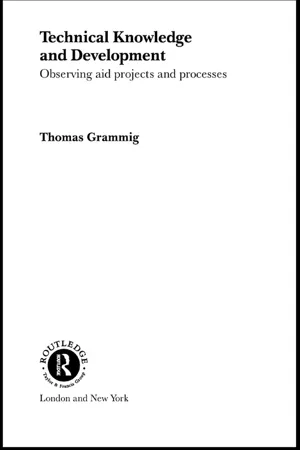
Development and aid projects often fail to improve technological capacity. Their reform has been a widely acknowledged challenge for three decades. This book demonstrates theoretically and empirically how aid practitioners shape the organizational, social and inter-cultural dynamics of development projects in industry.
Tools to learn more effectively

Saving Books

Keyword Search

Annotating Text

Listen to it instead
Information
1 Introduction
Beyond the common approach of examining development aid for its impact, we investigate its potential. In the area of technical assistance in particular, there is ample scope to explore the microlevel1 and use theory never considered before to demonstrate that potential. Rather than only criticizing what is going on in technical assistance, we explore how it could evolve.
Aid practitioners are submerged in project implementation problems, reacting passively while searching for explanations. The insider perspective of technical assistance remains far apart from the outsider perspective, where planners and the public use vague hypotheses to form opinions. This study renders the two perspectives mutually intelligible. Based on the idiosyncrasies of each situation, a theory of practice explains the practitioners’ daily efforts to understand each other and the resulting dynamics of an encounter between developers and developees. Throughout their careers, the developers and developees toil within the cultural dimensions of the economics, the technologies and the management on which their careers depend. Their dilemma is how to transfer technologies between societies. Without normative reactions, this research approach follows their intentions. Our premise is that modifying practitioners’ work conditions will have far-reaching consequences for management, evaluation and social science research about technical assistance.
1.1 Historical context
The term technology transfer appeared in the 1950s in post-war reconstruction plans. Many development agencies now use the broader terms of technical assistance, technical co-operation or building technological capacity. In general, these differ only stylistically, and technology transfer remains the most persistent conceptual blank spot in all development aid by the industrialized countries. Technology transfer still appears in most policy packages produced for developing countries. This is understandable since changes in technology were the prime factor behind industrial expansion in the twentieth century, and are possibly responsible for 80 per cent of gross domestic product (GDP) growth in the North.2 Actual technology transfer is accelerated by the economic logic of globalization. Nevertheless, little is known about how to influence, alter or orient such transfers.3 Only a handful of writers, such as Denis Goulet (1989), have taken the time to explain what we do not understand about technology before calling for greater control and a harnessing of technology transfer to developing countries.
There are approximately 370,000 consultants, experts, advisors and volunteers engaged in technical assistance programmes world wide (Fry and Thurber 1989: 4).4 There is constant experimentation with project planning, the type of technology, the origin and training of practitioners and the terms of their engagements. In 1960, four-fifths of the developers were English or French nationals, whereas today those countries account for only 8 per cent (ibid.). Japan, the USA, China, the Netherlands, Italy and Australia are similarly represented. Over time, there has also been a movement away from hardware to software transfers, i.e. from embodied to disembodied technology. The proverb ‘Teach someone how to fish and he can feed himself perhaps best summarizes the strategy behind that shift. Furthermore, the length of the engagements has changed significantly. While a few make careers in technical assistance, many others seek engagements for periods ranging from a few weeks to months. It often seems that every type of modification possible has been attempted, however little consensus has emerged on their respective merits.
Over the last two decades, social scientists have pursued new approaches to studying technology5 and intercultural relations. In both fields of research, there is an urgent need for conceptual innovation. The combination of the two fields, that is to say technological changes because of intercultural relations, remains futile to the point where even the scope of the issue is not clear. For example, within the private sector, the first car factory in the USA with Japanese technology (GM–Toyota joint venture) incurred losses and turned out faulty cars for the first 6 months of its operation.6 The plant achieved a reasonable level of efficiency only when most US staff in lower management were replaced by Japanese staff. Cars are undoubtedly American artefacts and Americans are accomplished car manufacturers. Why did Japanese technology require Japanese managers? Was it because of the assembly lines (the embodied technology) or the Toyota management style (the disembodied technology) or because of something outside the plant (general USA-Japanese relations)? It has been argued inconclusively which issue could explain the problems in operating the complex plant. The internationalization of business has created more research than development assistance. However, the simpler economic logic of business does not seem to lead to more effective research. Firms continue to seek competitive advantages in globalized markets through technology co-operations, and ‘cutural problems’ are blamed when most mergers and joint ventures fail.
As part of development aid, the US Peace Corps and the Canadian International Development Agency (CIDA) made significant efforts in the 1970s to evaluate technical assistance and improve project planning and the preparation of developers.7 However, the results obtained have not allowed us to predict, let alone alter, the performance of Peace Corps volunteers or CIDA experts. Other agencies, such as France’s Ministère de la Coopération, maintained an evaluation department for only 1 year (1986), finally concluding that their development aid did not require evaluation (Freud 1988). For a period, it seemed that non-governmental organizations (NGOs), which offered decentralized institutional support, might provide a solution. Governmental agencies appeared to be less effective than the NGO model of direct collaboration between local institutions. This model, however, has not flourished as governments have maintained a central role in economic growth. In some sectors of development aid, NGOs have appeared and they thrive, whereas in others, and especially in technical assistance, NGOs remain weak. Compared with bilateral aid, multilateral programmes have increased and subsequently decreased in importance over the past decades.
Analysing technology and intercultural relations in combination is an obstacle to filling the conceptual blank spot of ‘technology transfer’. Despite constant changes between 1960 and 2000, most attempted improvements have failed. In fact, on the contrary, the changes have brought and continue to bring diminishing results. While we now know more about intermediate technology, about appropriate technology and about industrial policy in successful technology-importing countries such as Japan, South Korea or Taiwan, for the majority of the 160 developing countries technical assistance remains an uncertain endeavour.
By submitting two projects as different as Appui Technique and Autogeneración to the same critical analysis, we uncover common mechanisms at work. Like many other institutional practices concerned with modernizing society, technical assistance is largely misunderstood and obscure. Thus, the first step in research, the definition of an object of study, is the most difficult and is given most attention. Can we speak of technical assistance as an objective enterprise despite the diversity of agencies and the plurality of discourses on development? Is there something in its enactment, in its style and form, that gives it a coherence beyond the goals attributed by the official jargon, i.e. aid, assistance and development? Elements common to several diverse projects, this study suggests, allow us to construct a viable object of study that is presently called technology transfer. The ultimate aim is to provide practitioners and researchers with a coherent theoretical model to understand technical assistance, moving from the particular to the general.
1.2 Development events observed
The following remarks introduce the context of the two case studies but they are not part of them. Because of the nature of the analysis to be undertaken, these circumstances do not reduce the significance of the case studies to a critique of technical assistance more generally. The particular sectors and organizations are not of significant interest so much in themselves, but rather as the events described are representative of innovative efforts undertaken by reputed specialists from the high-technology and the low-technology ends of technical assistance. Most conventional technical assistance is located in between these two ends. The case studies are therefore representative of the institutional and the technological dimensions of technical assistance but not of other dimensions.
1.2.1 Case study 1: Appui Technique8
Chad is one of the poorest countries in the world, situated just south of the Sahara desert. In 1989, after 15 years of civil war, the Chadian government had little institutional capacity outside the military and the police. The International Bank for Reconstruction and Development (IBRD or ‘World Bank’9) designed a typical structural adjustment programme (SAP) to give this government a financial base. Given the political instability, this SAP was accompanied by a soft loan of $US14 million to ease the immediate social impact.10 The IBRD sought advice on enabling the informal sector of the Chadian economy to supply new products, thereby creating employment opportunities and replacing imports. Other measures such as infrastructure investments and small-scale banking support were also chosen by the IBRD.
After comparing proposals from leading NGOs in different countries, the IBRD signed a contract with the Groupe de Recherche et d’Echanges Technologiques (GRET) in Paris to implement the project ‘Appui Technique’. The estimated budget was about $US1 million. GRET had a history of working closely with the official French aid agencies, following the 1981 election victory of the Socialist Party in France. Appui Technique was their first contract with the IBRD and was a chance to demonstrate their competence. The Chadian context presented an opportunity for a deliberately modest start in industrial policy. GRET assembled a team of Chadian and French experts to train artisans in the capital city, N’Djaména. Chadian artisans had failed in the past to compete with imported machinery. The experts invited the artisans to learn through welding prototypes of oxcarts, grain mills and other machinery with the tools and the raw materials available locally. The Chadian experts took this opportunity to enter terra incognita. The Chadian Ministère de la Fonction Publique et du Travail at least wanted to follow and understand what GRET’s experts were undertaking. But beyond participating in the paperwork, the Ministère did not interfere with Appui Technique.
Appui Technique was concluded in 1995. According to GRET’s evaluation report, the Chadian artisans had sold machinery worth $US140,000. GRET’s report provided a constructive assessment of Appui Technique. However, the IBRD never responded to the report, nor has it sought GRET’s advice since. The French and Chadian experts currently work in other fields of technical assistance, while the Chadian artisans continue struggling to make ends meet. As a part of Chad’s debt to the IBRD has since been written off, one cannot conclude that Appui Technique was a net loss to the country.
1.2.2 Case study 2: Autogeneración11
From the subsistence context of Chad, we move to the industrialized context of Mexico, where the engineering education and industrial corporations are similar to those in the USA, to compare the transfer of manufacturing knowledge with another similar objective in electric power generation. In 1990, the Mexican Energy Agency attempted to pursue President Salinas de Gotari’s ‘free market’ industrial policy guiding private sector investments, instead of the classic Mexican government’s policy of command and control. Cogeneration technology was deemed appropriate to demonstrate this shift. Indeed, other governments successfully implemented energy policies around cogeneration.12 Such a policy shift required sound knowledge of the economic parameters for energy investments. Thus, the Agency sought advice from a renowned consulting company specializing in cogeneration, Hagler, Bailly, Inc.
The IBRD has given financial assistance to the Mexican national utility company since the 1950s. This is the type of client that this bank was set up to deal with. Always keen to include technical assistance in a loan package, the bank suggested using $US600,000 for cogeneration feasibility studies through the Energy Agency out of a $US450 million loan package for the Mexican utility company. Hagler, Bailly, Inc. conceded favourable terms in the competitive bidding for the project ‘Autogeneración’, seeing this as an opportunity to produce ‘a landmark study’. The work was an extension of what Hagler, Bailly, Inc. was doing in the USA, and no particular problems for cogeneration investments were anticipated in Mexico. To intensify the transfer of technology, the Mexican Energy Agency assembled a team of Mexican experts to work with the team from Hagler, Bailly, Inc. For 2 years, up to twenty-five engineers and economists compiled and analysed data from steel mills, chemical plants and other energy-intensive industries, transforming the data into decision criteria for private investors. Their reports recommended, for example, an investment of $US196 million in the plant XY, using the gas turbine ABC, operating at 57 per cent thermal efficiency and producing 2,000 GWh of electricity annually, and concluded an internal rate of return of 28 per cent to the investor.
By the end of 1993, Autogeneración concluded. However, the Agency has yet to pay all of those who worked for it, and none of the Mexican experts have continued to work in the field of cogeneration. Of the forty feasibility studies produced, only four investments were pursued, but not by companies involved in Autogeneración. As is often the case in technical assistance, it is difficult to determine the impact of Autogeneración. Neither the Agency, the IBRD nor Hagler, Bailly, Inc. attempted to define the lessons learned. Although transfer of technology is an evasive objective, difficult to grasp empirically let alone to evaluate, such projects are repeated with different configurations, in Mexico and in many other countries, and all seek to fulfil goals similar to those sought within Autogeneración.
1.3 Basic questions
Basic questions are those without a definitive answer, such as ‘which are the appropriate research methods?’, ‘what are the roles of individual actors?’13 and ‘what influence do aid organizations have?’ We can produce elements of answers and add to related research on these basic questions.
Drawing upon related research, the following section will begin to point to answers to such questions. Technical assistance is a field of research that presents itself in the form of ‘projects’ that employ ‘experts’ to realize a transfer of knowledge between countries. A simplistic approach would begin with the idea that such projects are simply autogenerative and self-sufficient events14 with little substantial outcome. In such a simple analysis, jargon is offered by the experts, everything happens as it should ‘on paper’ and nothing changes. An observer witnesses yet another ‘non-event’. The events of Autogeneración and Appui Technique, however, were spaces of communication where the reflections of the actors were much more extensive than the reflection that went into conceiving them. Rather than focusing on project objectives, then, we examine the life-world that these objectives presented to the actors. The unique dynamics, born of the events themselves, are beyond recognition or control by the development agencies. By foregrounding the circumstantial context of the encounter, we demonstrate how much the professional relations were defined by the everyday interaction. The actors did not proceed blindly because the projects themselves were ill defined. The principle source of their confusion was the overwhelming complexity of the encounter. Thus, despite the limits of the predefined objectives, these projects were far from being non-events. Much took place within these events–within the everyday interactions–that requires a sustained analysis.
This study describes how developers (foreign experts, consultants and volunteers) and developees (local experts and target population) struggle with power and cultural distance.15 The contemporary relationships in technical assistance embed technical knowledge in power and cultural distance in specific ways. Even if foreign experts succeed in transmitting their knowledge, they cannot transfer the capacity to use this knowledge effectively to local experts, the beneficiaries of the formers’ development ambitions. The theoretical modification of the role of the foreign expert according, for example, to a model of exchange based on a collaborative, rather than a colonial model, has not sufficed to produce effective assistance and local autonomy in actual development projects.
Is it possible to draw out the significance that aid and assistance assume between industrial nations and countries said to be developing? This is the principal focus, and thus the tenets of development theory do not constitute the subject of this research as such. The analysis is not technological...
Table of contents
- Cover Page
- Title Page
- Copyright Page
- Technical Knowledge and Development
- Routledge studies in development and society
- Preface
- 1 Introduction
- 2 Development anthropology
- 3 Constructing the intelligibility of the events based on participant observation
- 4 Interpretation of the events
- 5 Latent processes in technical assistance
- 6 Technical assistance event management
- 7 Outlook
- Appendix 1 Presentation of Appui Technique and this research in a journal sponsored by the French ‘Ministère de la Coopération
- Appendix 2
- Notes
- Bibliography
Frequently asked questions
Yes, you can cancel anytime from the Subscription tab in your account settings on the Perlego website. Your subscription will stay active until the end of your current billing period. Learn how to cancel your subscription
No, books cannot be downloaded as external files, such as PDFs, for use outside of Perlego. However, you can download books within the Perlego app for offline reading on mobile or tablet. Learn how to download books offline
Perlego offers two plans: Essential and Complete
- Essential is ideal for learners and professionals who enjoy exploring a wide range of subjects. Access the Essential Library with 800,000+ trusted titles and best-sellers across business, personal growth, and the humanities. Includes unlimited reading time and Standard Read Aloud voice.
- Complete: Perfect for advanced learners and researchers needing full, unrestricted access. Unlock 1.4M+ books across hundreds of subjects, including academic and specialized titles. The Complete Plan also includes advanced features like Premium Read Aloud and Research Assistant.
We are an online textbook subscription service, where you can get access to an entire online library for less than the price of a single book per month. With over 1 million books across 990+ topics, we’ve got you covered! Learn about our mission
Look out for the read-aloud symbol on your next book to see if you can listen to it. The read-aloud tool reads text aloud for you, highlighting the text as it is being read. You can pause it, speed it up and slow it down. Learn more about Read Aloud
Yes! You can use the Perlego app on both iOS and Android devices to read anytime, anywhere — even offline. Perfect for commutes or when you’re on the go.
Please note we cannot support devices running on iOS 13 and Android 7 or earlier. Learn more about using the app
Please note we cannot support devices running on iOS 13 and Android 7 or earlier. Learn more about using the app
Yes, you can access Technical Knowledge and Development by Thomas Grammig in PDF and/or ePUB format, as well as other popular books in Physical Sciences & Geography. We have over one million books available in our catalogue for you to explore.