Culture and International Relations contextually re-examines the history of international relations in order to explore how the discipline has imported and employed the concept of culture. The author challenges the notion that IR has only been interested in culture since the end of the Cold War by tracing different understandings of culture throughout its history.
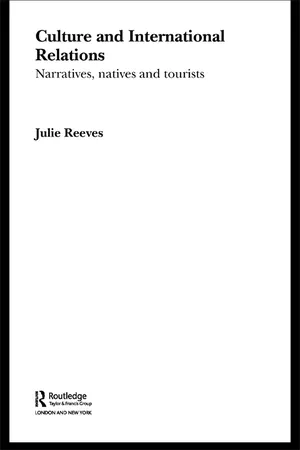
- 240 pages
- English
- ePUB (mobile friendly)
- Available on iOS & Android
eBook - ePub
About this book
Information
1 The civilizing mission of culture
The word ‘culture’ appears to have begun life as the Italian term, cultura and we find references occurring in thirteenth and fourteenth century literature.1 Cultura specifically means ‘to cultivate’ and, in its original sense, referred to cultivation of the soil and the tending of animals, from which sense we obtain the word ‘agriculture.’2 The French borrowed the term cultura from the Italians, first as couture and then as culture. ‘Culture’ quickly spread across Europe under the influence of the European aristocracies’ fascination with all things French, making its appearance in England during the fifteenth century. The word’s etymological root in the idea of ‘cultivation’ is crucial.
By the late eighteenth century, the idea of cultivation began to be applied to human beings in addition to the soil. The process that took the meaning of ‘culture,’ in Terry Eagleton’s wonderful phrase, from “pig-farming to Picasso” (Eagleton 2000:1), and, if you like, from ‘Picasso to the Pitjandjara,’ was a long and uneven one.3 We do not find all people employing the term in the same way, at the same time, even within the same regions. Nonetheless, certain trends can be discerned in an otherwise complex historiography, making it possible to tell a general story about the idea’s progress. Yet, it is important to note, as the anthropologist Adam Kuper has pointed out, that “[c]ulture is always defined in opposition to something else” (Kuper 1999:14). In establishing its meaning in opposition to other ideas, the meaning of culture has always contained a political element, which becomes apparent as the historiography of the idea unfolds. Although the progress of the idea of culture spanned several centuries, it is a story in which the perceived inadequacies of civilization and eventually evolutionary theory emerge as crucial components. This chapter only discusses the ‘pig-farming to Picasso’ stage; the process that takes us from Picasso to the Pitjandjara is discussed in the third chapter.
Civilité, culture and kultur
Initially, the word ‘culture’ referred to the cultivation of good manners, but gradually the meaning extended to include a whole range of intellectual and social activity and improvement. However, the idea of cultivating human behaviour pre-dates uses of the word ‘culture’ to describe the activity. According to the social historian Norbert Elias (1939/1978), the process begins in the Middle Ages and has its roots in courtly behaviour (this is the origin of the words courtoisie in French and curtesy in English). Codes of behaviour and strictures on manners became a growth industry in the fifteenth and sixteenth centuries. Whether it was polite for one to spit under the table rather than over or on it became a matter of great importance and one in which the concept of polite behaviour is central (Elias 1939/1978:153–60). Politeness is a constructed activity and people needed to know how to behave politely in public, so much so that, as Elias indicates, books of instructions flourished during this period.
Manners and etiquette (increasingly elaborate rituals of behaviour) exert control over individuals and the self, and they call for individual and collective restraint in the presence of persons more eminent than oneself. A growing awareness and interest in the habits of table manners, personal hygiene and social relations can all be seen taking place from the fifteenth century onwards. Elias links these kinds of developments in public behaviour to the growth in feelings of ‘delicacy and shame’ coupled with the increasingly private nature of life in large and affluent households. He sees these developments as part of the ‘civilizing process’ as he calls it, but it is not until the French words courtoisie and policé (politeness) are replaced by the word civilité in the seventeenth century that the civilizing process becomes more visible. It is with this development that the division between individual cultivation and general social, civilizing, development becomes distinct.
Civilité from the Latin term civilis (to make civil) is a broad notion, indicating acceptable social behaviour not simply at court but also between social classes.4 According to Elias, people begin, during the seventeenth century, to mould themselves, and others, more deliberately than they had previously. As this process acquires a self-conscious aspect, the idea of cultivation takes on additional appeal (in addition to pig farming, that is). And the French are among the first Europeans to employ the word ‘culture’ in respect of individual behavioural development. Culture has become a matter of art, literature and intellectual achievement (see Williams 1976/1988:90), as well as appreciation and knowledge of these things.
On the eve of the French Revolution a new term makes its appearance to describe growth and improvement in the larger social sense — civilization.5 In this context, ‘civilization’ is initially a generic term which describes the French, their national development and all the achievements that entailed; but given the wider European tendency to follow all things French, it did not remain solely their term for long.6
Napoleon reportedly told his troops in 1798 as they set off for Egypt, “[s]oldiers, you are undertaking a conquest with incalculable consequences for civilization” (cited in Elias 1939/1978:49–50). The rest of Europe sat up and took note. Set against the dramatic social changes that were taking place as a result of industrialization, the term civilization seemed most appropriate for distinguishing the achievers from the underachievers.
Europeans had concerned themselves with standards of manners, education and decency. As individuals, they had aspired to better themselves and to become ‘cultured,’ while the term civilization encapsulated, in their view, what was common to all. “Cultivation, could be taken as the highest observable state of men in society” (Williams 1958/1993:63) distinct from civilization which was “the ordinary progress of society” (Williams 1958/1993:63). ‘Civilization’ was the perfect term with which to set out deliberately and consciously to conquer others and thereby force a better standard on them; ‘culture,’ on the other hand, remained a personal matter. We can see this in the characters in Jane Austen’s novels, where “[e]ven the country squires — Mr Knightley, Mr d’Arcy, Edmond Bertram — were well read, appreciative of art and proud of both” (Parsons 1985:2).
It is important to grasp a sense of the ‘factory conditions’ of the time, and the context in which the idea of being cultured established itself, especially those things that the idea established itself in opposition to. The historical period of questioning identified as ‘the enlightenment’ embodied all that was rational, technical and in opposition to tradition, and had developed (during the eighteenth century) alongside civilité and the subsequent notion of civilization. Inevitably, the enlightenment was seen as indistinguishable from civilization because of its tendency to advance. The counter-enlightenment, conversely, rejected the universal and scientific basis of explanation, and attempted to return to tradition, nature and a simpler way of life. For some, the advance of civilization, especially its industrial aspect, was seen to be exerting a detrimental effect on people, society and the environment; nature was being destroyed by the factory blight.7 The aim was to recreate or reinvent some simpler and purer time; a time before the folks became the masses. These sentiments found romantic expression in poetry, literature and art, and developed across the eighteenth century and continued during the nineteenth. Veneration of natural purity, for example, can be found informing John Ruskin and the ‘arts and crafts movement’ in Britain, and would eventually make its way to ‘art nouveau.’
The influence of early German counter-enlightenment intellectuals, such as Johann Herder, helped to extend the meaning of culture from the cultivation of better habits to something slightly more spiritual in content. The idea moved from one involving self development to an idea that denoted community development and group destiny. It also opposed notions predicated entirely on the scientific and rational progress of humanity. In 1867, when Matthew Arnold wrote his classic text, Culture and Anarchy, he drew upon German thinkers and their counter-enlightenment ideas to bolster his critical observations of the state of British civilization; Gotthold Lessing, Johann Herder and Wilhem von Humboldt, are all acknowledged and admired by Arnold (see Arnold 1869/1994:48 and 85). In Culture and Anarchy, Arnold clearly drew on the German idea of Volksgeist or “an invisible Spirit that breathes through a whole people” (Coleridge 1978:94) as Samuel Taylor Coleridge had put it. Herder’s earlier connection between Volks (folks) and Geist (spirit) was an important one, because it signified that the idea of Kultur (German for culture) (kultur) had a spirit-like quality, or what anthropologists recognize as the humanist conception of culture.8 It is contextually important to note, however, that although Herder associated the word Volksgeist with a particular community of people and his studies of folk communities, he did not conceive of this ‘culture’ in a fixed and unchanging way, rather it contained an intangible aspect and the element of progression.9 For Arnold, it was the human spirit in the form of ‘sweetness and light’ (beauty and knowledge) that needed cultivating to a higher state. This was more than good manners; it concerned educating the mind and feeding the spirit.
Arnold began by telling his readers that:
The whole scope of the essay is to recommend culture as the great help out of our present difficulties; culture being a pursuit of our total perfection by means of getting to know, on all the matters which most concern us, the best which has been thought and said in the world, and, through this knowledge, turning a stream of fresh and free thought upon our stock notions and habits, which we now follow staunchly but mechanically, vainly imagining that there is a virtue in following them staunchly which makes up for the mischief of following them mechanically.
(Arnold 1869/1994:5)
Arnold was urging his readers to improve themselves. Not only was he criticizing the state of English society for being ‘philistine and commercial’ (as he saw it), but he was making a direct appeal to individual cultivation and spiritual development through the means of culture. Arnold saw culture as the tool for achieving a higher state individually and for effecting desirable social change. The source of the ‘present difficulties’ was civilization, and Arnold believed that culture would save society from its ugly influence. Civilization may have progressed enormously by Arnold’s time, but with its ‘vulgar masses’ and ‘dark satanic mills’ it had also created unpleasant social side effects.
Arnold pleaded the case for what anthropologists would later recognize as ‘high culture;’ the best of everything in the arts and humanities. But for Arnold, this simply was culture; there was nothing higher or lesser to be considered as part of the word’s meaning. The ‘mind and spirit’ versus all that is ‘mechanical and material.’ Industrialization may have brought technical benefits but it had undermined spiritual values and the quality of life in British society; in short, there was too much ‘low culture’ in Britain (although Arnold did not recognize it in these terms). A bad case of too many ‘vulgar’ and ‘philistine’ people, and not enough ‘pursuit of perfection.’ For Arnold, “[c]ulture is right knowing and right doing; a process and not an absolute” (Williams 1958/1993:125). Moreover, it is a process in which the idea of education plays a central and crucial role.10 Naturally, arguments involving qualitative distinctions, i.e. ‘the best of’ things, are susceptible to normative critique and accusations of ethnocentrism today. Yet, at the time, it would have been obvious to Arnold and his generation that William Wordsworth and Coleridge wrote ‘good’ poetry, which fed the mind and soul in a manner that Victorian music hall ditties would never achieve.
Several decades after Arnold, the British scholar F.R. Leavis worried that ‘mass civilization’ was “levelling-down” society (Leavis 1930:8) — culture was now in the minority.11 The debasing of society by mass social developments is a perennial fear in some circles — for example, are computer games bad for children, is violence on television or in song lyrics having a negative influence on people? All of these normative concerns are straight out of the Arnoldian view of things. Is culture improving society and helping us to pursue perfection, or is it being hampered by the crass development of civilization?
Nearly two decades after Leavis, T.S. Eliot tackled the same question. Instead of worrying about the effect cheap paperback novels were having on English culture, Eliot opened up the idea of culture by thoughtfully including a ‘boiled cabbage’ in his understanding of what constituted Englishness. In a move that seemingly points the way towards popular culture and the discipline of Cultural Studies, Eliot tells us that English culture:
. . . includes all the characteristic activities and interests of a people: Derby Day, Henley Regatta, Cowes, the twelfth of August, a cup final, the dog races, the pin table, the dart board, Wensleydale cheese, boiled cabbage cut into sections, beetroot in vinegar, nineteenth-century Gothic churches and the music of Elgar.
(Eliot 1948:31)
He appears to undermine Arnold’s elitist view of culture by including such vulgar events as ‘Derby Day’ and mundane artifacts as boiled cabbage, but Eliot could not quite bring himself to adopt Arnold’s egalitarian view of culture. For Eliot an aristocratic elite turns out to be the safe keepers of culture — high culture that is (see Eliot 1948:48). The English may eat Wensleydale cheese and go to the dogs, but the culture that matters, even for Eliot, is that of Elgar, not that of the bingo-players.12 At least Arnold considered the aristocracy as uncultured and reckless as the other English classes! It would not be until the English literature critics came along in the 1950s, notably Richard Hoggart and Raymond Williams, that ‘low’ culture would gain a respectable place in society and the elitism of the humanist concept would be challenged.
The distinction between ‘good’ and ‘bad’ or ‘high’ and ‘low’ culture is critical to Arnold’s view of the world, but whether this kind of distinction is necessary for the humanist concept itself is open to debate. Nonetheless, it has been a distinction that has generated considerable debate and interest in British academia, even spawning its own discipline of Cultural Studies.
The discipline of Cultural Studies that developed during the 1960s might be described as a working class backlash against the elitist proponents of ‘high culture.’ Scholars in this discipline would come to revel in the amount of ‘vulgarity’ that affronted Arnold, and Leavis unearthed, by arguably, ‘bringing the bingo players back in,’ and standing Arnoldian assumptions on their head. As John Storey has pointed out, “[a]lthough cultural studies cannot (or should not) be reduced to the study of popular culture, it is certainly the case that the study of popular culture is central to the project of cultural studies” (Storey 1996:1). This is a proposition that Arnold, Leavis and, to some extent, Eliot would have found an anathema. Remove the hierarchical thinking behind the humanist concept and everyone has culture in the Cultural Studies sense. Culture is not simply Baroque music it is also body-piercing and in this way, the discipline challenges the snobbery in the Arnoldian assumption that culture is solely certain kinds of art and literature and the ‘best of everything.’ At the same time, the discipline of Cultural Studies owes much to Marxist critique (particularly Antonio Gramsci’s notion of hegemony); although, as Storey has pointed out, it is not necessary to be a Marxist practitioner, “[a]ll the basic assumptions of cultural studies are Marxist” (Storey 1996:3).
It is obviously easy to criticize Arnold’s idea of culture for its ethnocentrism and elitism as some of his contemporaries and subsequent critics did.13 Proclaiming, for example, that the middle classes are philistine, the aristocracy barbarous and the populace vulgar, is unlikely to win friends. Besides, at the time Arnold wrote, the humanist idea of culture had already become somewhat of an embarrassment and something to be sneered at.14 Yet, there is a potential for universalism underwriting Arnold’s thought; a potential that the critics failed to either see or conveniently ignored.
All classes, according to Arnold, and therefore all human beings (although Arnold does not say this), given the right education and environment, would recognize the value and importance of ‘culture.’ ‘Culture’ speaks with a universal voice, from and to all human beings. “It seeks to do away with classes; to make all live in an atmosphere of sweetness and light . . .” (Arnold 1869/1994:48). Arnold would, as well, have poured equal scorn on the natives and the tourists if he found them to be ignorant and uneducated. The working classes may be vulgar and the aristocracy frivolous, but both could reap the benefits of culture if they put their minds to it. Indeed, the very same thesis can be located in Herder’s idea of Humanitat or ‘league of humanity.’15 The achievements...
Table of contents
- Cover Page
- Title Page
- Copyright Page
- Acknowledgements
- Introduction
- 1 The civilizing mission of culture
- 2 Cultural internationalism
- 3 The ever disappearing native
- 4 The nationalization of culture
- 5 International cultural society
- 6 Strategies, civilizations and difference
- Conclusion Fates and futures
- Notes
- Bibliography
Trusted by 375,005 students
Access to over 1.5 million titles for a fair monthly price.
Study more efficiently using our study tools.
Frequently asked questions
Yes, you can cancel anytime from the Subscription tab in your account settings on the Perlego website. Your subscription will stay active until the end of your current billing period. Learn how to cancel your subscription
No, books cannot be downloaded as external files, such as PDFs, for use outside of Perlego. However, you can download books within the Perlego app for offline reading on mobile or tablet. Learn how to download books offline
Perlego offers two plans: Essential and Complete
- Essential is ideal for learners and professionals who enjoy exploring a wide range of subjects. Access the Essential Library with 800,000+ trusted titles and best-sellers across business, personal growth, and the humanities. Includes unlimited reading time and Standard Read Aloud voice.
- Complete: Perfect for advanced learners and researchers needing full, unrestricted access. Unlock 1.5M+ books across hundreds of subjects, including academic and specialized titles. The Complete Plan also includes advanced features like Premium Read Aloud and Research Assistant.
We are an online textbook subscription service, where you can get access to an entire online library for less than the price of a single book per month. With over 1.5 million books across 990+ topics, we’ve got you covered! Learn about our mission
Look out for the read-aloud symbol on your next book to see if you can listen to it. The read-aloud tool reads text aloud for you, highlighting the text as it is being read. You can pause it, speed it up and slow it down. Learn more about Read Aloud
Yes! You can use the Perlego app on both iOS and Android devices to read anytime, anywhere — even offline. Perfect for commutes or when you’re on the go.
Please note we cannot support devices running on iOS 13 and Android 7 or earlier. Learn more about using the app
Please note we cannot support devices running on iOS 13 and Android 7 or earlier. Learn more about using the app
Yes, you can access Culture and International Relations by Julie Reeves in PDF and/or ePUB format, as well as other popular books in Politics & International Relations & International Relations. We have over 1.5 million books available in our catalogue for you to explore.