- 160 pages
- English
- ePUB (mobile friendly)
- Available on iOS & Android
eBook - ePub
About this book
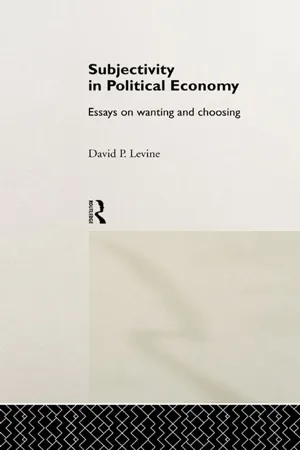
This book explores the way political economy understands human motivation. In it, the author argues that the assumptions typically made by economists regarding want and choice cannot adequately lay a foundation for answering important questions about the design of economic institutions and the appropriate use of markets.
This volume offers an exciting and unusual contribution to political economy, offering a novel integration of the insights of political economy, philosophy, and psychology, applying them to vital foundational issues in political economy.
1
INTRODUCTION
Political economy celebrates self-interest. Indeed, political economy contributes significantly to dispelling that distrust of self-seeking typical of premodern thinking, which sees in self-interest a danger to group connection, and to the domination of the community over the member. Yet, vital questions remain unanswered and unexplored: What is the self whose interests political economy celebrates? How do those interests relate to the self? And, in what does the entity we refer to as a self take an interest? Some would say the self's interests are what they are, that to say more is to destroy the freedom that makes self-interest meaningful. Others would insist that self-interest is driven by social norms, customs, habits; the self is a mere vehicle for social ends, not an end in itself.
All of this matters, though economists hardly act as if it does. Content to take self-interest for granted, economists insist normative judgments can be made without exploring the self and its interests, by assuming that those interests are in want satisfaction, and that gaining the means to satisfy our wants, whatever those wants might be, has normative significance. Some, of course, will advance judgments about wants that distinguish higher from lower, those that simply define individual pleasure from those that have interpersonal, or even public, significance. Yet, even here, the wants whose satisfaction provides pleasure remain unknown, unquestioned, unexplored.
This, I do not think is enough. Whatever significance distinguishing classes of want by their aesthetic or moral value might have, to make normative judgments about economic institutions, we must know more about individual want than a ranking of its objects provides. We must know more about want for a simple reason: Individuals do not always, or often, know what they want, truly want what they imagine they want, or gain satisfaction from acquiring what they think they want. This proposition is the premise and conclusion of this book, which seeks to explore its implications for political economy, especially political economy's normative goal: to offer guidance in shaping economic institutions conducive to individual freedom and meaningful satisfaction of individual want.
Few will find the proposition that individuals do not always know what they want novel or surprising. Problems in the interpretation of choice, and of behavior sometimes thought to involve choice, have been extensively discussed (see Gabriel and Lang 1995: Chapter 2). My purpose here is not to add either to the lament about the falsity of choice, or the celebration of freedom in choosing. That consumers sometimes know what they want, and sometimes do not, that they sometimes gain satisfaction from using or consuming the things they think they want, and sometimes do not, does, however, raise an important question: What qualities must an individual have to know what he or she wants, and to gain satisfaction in consumption? The answer to this question has less to do with information and opportunity than it does with the organization of mental life, and with the nature of the individual's relation to the world outside. What remains poorly understood is not choice as opportunity, the dependence of choice on information, the falsity of choice where differences are slight, and so on, but the nature of the subject who chooses. The meaning of choice ultimately derives from the meaning of subjective action, by which I mean action associated with agency. It is the presence or absence of agency that is vital, and which I explore here. It is in its understanding of agency that political economy fails us when it attempts to speak of wanting and choosing.
In questioning political economy's understanding of the agent or subject of economic activity, I do not mean to question the concern economists have had with the subjective dimension. This concern has been real, not only in the political economy shaped by the utilitarian philosophy at the end of the nineteenth century, but also for the founders of political economy, especially Adam Smith and Karl Marx. What political economy has had to offer on subjectivity should not be dismissed or belittled. Nonetheless, much, indeed too much, has been taken for granted. In political economy, thinking about the consequences of self-interest or of preference-driven choice does not ground itself in any real understanding of the agent whose self has interests, and who makes choices.
The problem, I suspect, stems from two sources. The first is a tendency to take what is most problematic for granted, as if saying the words want, need, preference, choice, were enough, and exploring their meaning and significance, except in a formal sense, unnecessary. This failing follows a lamentable lack of interest on the part of economists in the concepts and ideas with which they work. The desire to get on with the empirical, often policy-driven, exploration of the application of concepts poorly articulated in themselves leaves us knowing less about our own thinking than we must if our conclusions are to lead in directions we will ultimately find satisfying.
The second problem is a tendency toward splitting, which is typical of thinking not only in academic discussion, but more generally. By splitting, I have in mind the separation, indeed polarization, of the moments of a single idea until those moments stand opposed to each other, and we can only hold onto one if we give up the other. Subject to splitting, our thinking takes on an “either/or” quality: Wants are subjective or they are not; individuals have free choice and the outcome expresses their true desires, or they do not and outcomes are imposed; wanting is self-interested, or it is other-regarding; the subject matter of political economy is an objective material process of reproduction and growth, or it is a subjective process of constrained maximization; the world is unknowable, or it can be known “with certainty.” All of these examples attest to a failure in thinking, and, therefore, in theory, to grasp the truth as the whole: subjective and objective, knowable and uncertain, self and other.
This failure is nowhere more evident than in the so-called “schools,” “frameworks,” or “paradigms,” that many believe organize thinking in political economy. These schools and paradigms result from splitting apart and polarizing the aspects or moments of ideas. Schools form by concentrating attention on one or the other pole in the relationship, to the exclusion of its opposing moment. Thus, one school of economists makes price an attribute of an “objective” structure of material reproduction, including labor's reproduction through consumption of a subsistence. Demand is taken to be an objective datum, depending, for example, on class structure, custom, or the rate of growth of the employed labor force, thus excluding by assumption (for example concerning returns to scale) any role of subjectivity in determining price. A second school treats demand as a function of preferences taken to be purely subjective, therefore indeterminate, and ultimately arbitrary. One school assumes perfect markets, and thus perfect knowledge including certainty; another assumes radical uncertainty, excluding meaningful knowledge about the future on which action might be based. One school sees in private enterprise a “very Eden of the innate rights of man,” while another sees in it the antithesis of human freedom, a crucible for the most dehumanizing forms of exploitation. For one, wealth results from hard work and frugality, for another it results from legally sanctioned theft. Without these oppositions born of the either/or thinking referred to above, we would not have “schools” of political economy and the attendant distrust of theory that must arise with its division into irreconcilable and warring camps whose truths cancel each other out.
Once we fix on a single pole in a relationship, to the exclusion of its opposing moment, that pole becomes a caricature of itself. The subject becomes purely subjective, a locus of indeterminate desire: whim, impulse, caprice; or it becomes purely objective, a locus of external determination of desire in biological imperative, class position, or social custom. What gets lost in this is the idea of a subject acting in the world. After all, we are no more agents in our world if we are driven by whim or impulse than if we are driven by biological or social imperatives. Thus, the polarizing tendencies in thinking must have serious consequences for our understanding of those economic institutions suited to subjective action. What gets lost through splitting is the real autonomy of the subject, who not only acts, but is the agent of his or her action. Whether impulse-driven or the representative of a class, the individual does not, through action, express an autonomous self.
Autonomy poses special problems of interpretation. For some, it refers to an absence of external constraint; for others it refers to a loss of any social connectedness or mooring. Some reject autonomy altogether, considering it an illusion. They do so because they equate autonomy with isolation from any external influence. Others embrace autonomy, but assume it requires that we treat what is outside the individual as so many objects or instruments to be used in the pursuit of a satisfaction constituted as a wholly self-referential condition. Here, again, splitting plays the decisive role, separating the objective and subjective aspects of autonomy, and making it impossible for us to imagine an autonomy capable of incorporating rather than denying relatedness.
As I will argue below, wanting is a specific relation between the subject and a world outside. Wanting, then, connects subject and object. It is about the individual and his or her inner psychic state; but, this inner psychic state engages others in specific and important ways. We will not understand what it means to want if we assume that others play only the part of things, to be engaged as instruments for the gaining of pleasure through consumption. Nor will we understand wanting if we assume that the individual moment is of no consequence, since it disappears into the imperatives of social being enacted by observing customs and norms. The only way to attain a meaningful understanding of want is to understand the individual who wants, and the end to which wanting drives him (or her), as a unity of the subjective and objective. Understanding wanting and choosing in this way is the purpose of the essays brought together here.
The essays presented here consider the subjective side of political economy. While they can be read separately, and each takes up a distinct aspect of the problem, they are also meant to add up to an assessment of political economy, and a foundation for establishing political economy on a sounder footing regarding the matter of its subjective dimension.
I begin with the classical notion of subsistence, considering first the way the classical economists use the term, some modern interpretations of the subsistence idea, and the solution it offers to the problem of want, and of the agent who wants. Specifically, I suggest how problems with the idea of subsistence are linked to the matter of difference, and especially individuation. These problems have to do with the member's relation to the group, the individual's relation to society. Treating want's object as a subsistence attaches the individual to the group, making him or her a member rather than an individual.
The term subsistence tends to impede the development of an understanding of the economic organization of modernity. Yet, it also alludes to considerations about wanting relevant to modernity, considerations lost in later constructions that put aside any notion that being a person has preconditions and requirements, that our ability to want and choose is not a given, but an achievement. For this reason, even given its limitations, the subsistence idea has something to contribute to the development of a meaningful understanding of wanting and choosing.
In Chapter 3, I take up the idea of the agent in political economy, the subject who wants and chooses, as that is understood first in the classical theory, then in the neoclassical. I take this agent to be the possessor of the “self” whose interests and satisfactions are the ends of economic activity. The problem is to know what a self is, where to find it, and in what it takes an interest. It turns out that the classical economists have something of value to say on this subject, and that Adam Smith's thinking is not nearly so one-dimensional in this area as subsequent political economy might have us believe. In exploring Adam Smith's ideas, it becomes clear that the problem of integrating the aspects or moments of the self is central to a conception of self-interest. Smith considers this a matter of the relation, and possible opposition, between passion and reason. Integration is the essential moment in being a self, and the question of what needs to be integrated is the essential question.
In Section III of this chapter, I consider what post-classical late nineteenth-century political economy thinks about self-interest and the pursuit of happiness. There, I find that the problem is posed, but not addressed. The so-called neoclassical theory understands, as the classical often does not, that the self is an end in itself and not merely a means for furthering the group, especially for maximizing the growth of the national revenue or the wealth of the nation. Yet, having made the self an end in itself, the neoclassical economists assume that nothing more need be said, or perhaps can be said, without undermining normative conclusions that depend on the satisfaction assumed to result from the self's gaining its ends, whatever those happen to be.
In Chapter 4, I consider the problem of knowing as that bears on action. I consider both subjective and objective conditions for knowing, as well as the argument that knowing is not possible in an “uncertain world.” I locate the problem of uncertainty on the terrain of the opposition between traditional and modern modes of life. Certainty is connected to the givenness of behavior as dictated by customs, and by the attitude that what to do is not a matter of practical judgment rooted in reason, but of knowing customary behavior. Uncertainty arises with the breakdown of this more traditional mode of life, and the resulting elevation of the individual to the agent of his or her actions. Being the agent of conduct not already given, but shaped by deliberative thinking, makes us uncertain. It does not mean that we cannot find out what to do, or have any meaningful idea about the future. Understanding what it means to know and act, which is the topic of this chapter, is vital to any understanding of the subjective dimension in political economy.
While economics considers the problem of knowing as a purely objective matter, a matter of the way the world outside is for the subject, the problem also implicates the individual's internal life. That is, there are internal impediments to knowing as effective as, or more so, than those that face the individual as external constraints. These internal impediments have to do with the problem of self-knowledge, which I take up in the second section of Chapter 4.
In Chapter 5, I consider the weaknesses of the dominant notion of what it means to want and to choose. I introduce some considerations that lead toward a revision of our thinking in this area that involves not only the things we want and choose, but also what it means to want and to choose. In particular, I consider the difference between thinking that what we want is a “thing” whose objectivity for us is overcome in our consumption of it, and thinking that what we want is to establish a relation between our inner, subjective, life and the world outside. I emphasize the distinction between consumption and use as attitudes toward the outside world, and the importance of considering rationality, not as a matter of consistent ranking, but as a matter of establishing meaningful self-boundaries that separate what is internal to the self from what lies outside.
In the second section of this chapter, I explore the distinction between pleasure-seeking and the pursuit of happiness, with special concern for whether individual ends are finite and can be achieved. I emphasize the connection of happiness to the possibility of being a self, and being your self, in the world.
In the concluding chapter, I consider briefly some normative implications of the ideas developed in the preceding essays. I draw a distinction between taking the basis for normative judgment to be an already formed and determined individual understood as a locus of wants and resources concretely given and fully determined, and a process in which our wants are not known from the outset, but develop as we seek to satisfy them. If we interpret self-interest in this second way, wanting becomes a process of self-discovery, and the satisfaction of want a process of reality testing, especially testing the reality of the self. I consider what it might mean to take being and becoming a self, rather than gaining fixed means for the satisfaction of already given wants, as the normative end of economic arrangements.
2
SUBSISTENCE
I SUBSISTENCE IN THE CLASSICAL
THEORIES
1
The entire problem of the subjective character of want can be made to disappear if we can take the goods consumed to be already determined for the individual. Doing so assures that the individual plays no part in determining the ends to be achieved by using goods, and therefore in shaping his or her way of life. Suppressing the individual moment is the task of the concept of subsistence, most prominent in the classical theories.
The concept of subsistence contrasts sharply with later notions of want, where the individual aspect dominates. This contrast establishes an opposition between the objective and subjective aspects of want, which become isolated one from the other. As a result, we must either treat want as a purely objective matter, having nothing to do with subjective deliberation and choice, or, as purely subjective, having its source in the individual taken on his or her own. As I have argued elsewhere (Levine 1988a: Chapter 1), isolating the two moments of want is the fundamental problem of political economy, and introduces the most damaging weaknesses into its understanding of economic life. To begin to develop a more effective concept of want, we must first overcome this tendency to set the two moments in opposition. As a beginning, I explore the original construction provided for us by the classical economists.
For the classical economists, specifying a subsistence bundle of wage goods, determined independently of any subjective considerations, anchors the theoretical treatment of core issues such as price determination, income distribution, and capital accumulation.1
Once we know the composition of this bundle and the magnitudes of its components, we can calculate the rates of profit and accumulation using the technical rules governing commodity production and simple assumptions regarding investment (Walsh and Gram 1980: 300). Thus, the primary concerns we usually associate with classical theory become purely objective, or at least are made to seem as if they are. Distribution and growth depend on productivity, first the productivity of labor into output, and second the productivity of output into labor as expressed in the subsistence, which is the amount of output needed to produce a unit of labor.
Beyond its relevance to these core analytical concerns of the classical theory, the idea of a predetermined wage bundle speaks forcefully to contemporary issues having to do with the role and limits of the market in provisioning wants and needs. The idea of subsistence foreshadows the modern effort to understand problems of development and welfare using the concept of “basic ne...
Table of contents
- Cover
- Half Title
- Full Title
- Copyright
- CONTENTS
- Preface
- 1 INTRODUCTION
- 2 SUBSISTENCE
- 3 SELF-SEEKING AND THE PURSUIT OF HAPPINESS
- 4 KNOWING AND ACTING
- 5 WANTING AND CHOOSING
- 6 NORMATIVE CONSIDERATIONS
- Notes
- Bibliography
- Index
Trusted by 375,005 students
Access to over 1.5 million titles for a fair monthly price.
Study more efficiently using our study tools.
Frequently asked questions
Yes, you can cancel anytime from the Subscription tab in your account settings on the Perlego website. Your subscription will stay active until the end of your current billing period. Learn how to cancel your subscription
No, books cannot be downloaded as external files, such as PDFs, for use outside of Perlego. However, you can download books within the Perlego app for offline reading on mobile or tablet. Learn how to download books offline
Perlego offers two plans: Essential and Complete
- Essential is ideal for learners and professionals who enjoy exploring a wide range of subjects. Access the Essential Library with 800,000+ trusted titles and best-sellers across business, personal growth, and the humanities. Includes unlimited reading time and Standard Read Aloud voice.
- Complete: Perfect for advanced learners and researchers needing full, unrestricted access. Unlock 1.5M+ books across hundreds of subjects, including academic and specialized titles. The Complete Plan also includes advanced features like Premium Read Aloud and Research Assistant.
We are an online textbook subscription service, where you can get access to an entire online library for less than the price of a single book per month. With over 1.5 million books across 990+ topics, we’ve got you covered! Learn about our mission
Look out for the read-aloud symbol on your next book to see if you can listen to it. The read-aloud tool reads text aloud for you, highlighting the text as it is being read. You can pause it, speed it up and slow it down. Learn more about Read Aloud
Yes! You can use the Perlego app on both iOS and Android devices to read anytime, anywhere — even offline. Perfect for commutes or when you’re on the go.
Please note we cannot support devices running on iOS 13 and Android 7 or earlier. Learn more about using the app
Please note we cannot support devices running on iOS 13 and Android 7 or earlier. Learn more about using the app
Yes, you can access Subjectivity in Political Economy by David P. Levine in PDF and/or ePUB format, as well as other popular books in Business & Business General. We have over 1.5 million books available in our catalogue for you to explore.