![]()
1 Clusters and knowledge Transfer into the Indonesian Automotive Industry
Clusters are said to have the discreet charm of ambiguous objects of desire (Malmberg et al. 1996; Steiner 1998; Malmberg and Maskell 2004). This charm lies in the idea that regional specialisation around the interlinked activities of complementary firms in production and service sectors and their cooperation with public, semi-public and private research and development (R&D) institutions creates synergies, increases productivity, and leads to economic advantages. Therefore, regions should specialise, and policy should generate, develop, and support such clusters (Benneworth and Charles 2001; Caniëls and Romijn 2005; Feldman et al. 2005a; Asheim and Coenen 2006).
In recent times, therefore, clusters have grown to be an object of aspiration for many regions wanting to advance their knowledge and technology (e.g. Baden-Württemberg, the Third Italy, Silicon Valley, Route 128 – Boston and Cambridge). They may be based on different foundations, as Pavitt (1987a) explains: the obscurity of clusters stems from this multidimensionality, which means that clusters are based on different economic dimensions, take different forms, are measured and quantified by relatively different methods and empirical approaches, and are legitimated by a range of theories and hypotheses. Additionally, they have also become a desirable object of research: the still vague character of clusters poses problems of a theoretically sound definition, of empirical measurement, of policy recommendation, and of evaluation (Morgan and Nauwelaers 1999; Maskell 2001).
Nevertheless, little is known about the critical success factors that determine the economic development of cities and regions, and empirical studies that draw lessons for policy are scarce (Tichy 1998; Nijkamp 1999; Ernst 2000; Romjin 2002; Metcalfe and Ramlogan 2006). There is a lack of cluster studies in the automotive sector for developing countries in the Southeast Asian region, specifically for Indonesia (Kuncoro 2002; Gammeltoft and Aminullah 2004). Due to this lack of cluster-based literature in Indonesia, there is a need to investigate the development of clusters in this country, particularly to what extent a sectoral view (in this instance, the automotive industry) and knowledge transfer in the cluster is adequate to analyse regional economic growth and cluster-based policies in Indonesia. There are many indications that industrial economic growth increasingly emerges from fruitful cooperation between multinational enterprises (MNEs) in a vibrant region like Java.
Currently, based on data from the Indonesian Ministry of Industry and Trade (MOTIRI 2005), there are 40 industrial estates that have been labelled as clusters currently operating in Indonesia. Of these, 32 are located on the island of Java, the country’s most densely populated region. Alongside its cluster strategy, the Indonesian government initiated the setting up of industrial districts, later known as industrial clusters, to provide a suitable location for both domestic and international investors by providing all necessary infrastructure, facilities and housing in one safe location – at a reasonable cost – thus providing a secure base for industry and manufacturing (OECD 1999b), and specifically for the automotive industry as a key contributor to the economy (MOTIRI 2005).
The clustering of firms in the automotive industry to provide complementary webs of activity in the same sector can improve a region’s competitiveness and knowledge. Policies aimed at sustaining such clusters, thus promoting local-global cooperation, are necessary. Therefore, this research is aimed at global-local production, which accelerates the development of the Indonesian automotive cluster through the knowledge transfer processes between Toyota and Honda as the leading multinational enterprises (MNEs) and their local transplants and suppliers. The types and structures of relationships and networks covered by knowledge transfer in the automotive sector are complex because of the features of the knowledge base, the relevant learning processes, the basic technology, the characteristics of demand, the key links, and dynamic complementarities. Still, networks in the automotive sector are particularly significant with regard to innovation. Strong international competition and fast technological development push firms to constantly innovate in terms of products or services, processes, and markets. Consequently, involvement in a network helps a firm to focus on core capabilities, and provides access to resources (specific knowledge, technology, financial means, product, assets, market) in another organisation (Ernst 2000; Saxenian 2005; Breschi and Malerba 2005). This supports improvements to their competitive position.
The object of this research is the process of knowledge transfer in the automotive clusters in Indonesia, specifically looking at the case studies of Toyota and Honda, the leading MNEs in the clusters. This research is based on case study fieldwork involving semi-structured interviews with relevant actors. In addition, given that the process of automotive clustering involves the interrelatedness of networks among manufacturers and suppliers, this research also discusses the importance of the Japanese keiretsu in developing the Indonesian automotive cluster.
Research Background and Aims
In response to the Asian financial crisis in the late 1990s, the Indonesian government, through its industrial policy, has planned an initiative called Indonesia Bangun Industri 2025 (Indonesian Industrial Growth 2025), as a platform for reforming national policy. This is intended to support the emergence of the hi-tech manufacturing industry as the prime mover for the national economy; thus, this initiative is intended to alleviate not only industrial difficulties but also national economic difficulties. The automotive industry is one of the chosen sectors (MOTIRI 2005). It can be argued that none of the Indonesian manufacturing industries has received more policy and analytical attention than the automotive sector (Gunawan 2002; Tarmidi 2004; Wee 2005; MOTIRI 2005). It was one of the first industries to be established in Indonesia and triggered industrialisation from the late 1920s. It is one of the largest manufacturing sectors, and it has recorded rapid growth for most of the 40 years since 1967. However, in 1998–2001 the automotive industry experienced the effects of the economic crisis, as well as being the subject of intense policy intervention, and was variously regarded as a ‘spearhead’ for technological modernisation, and as a vehicle for the transfer of auto know-how, and production systems and shopfloor management (principally Japanese) knowledge (MOTIRI 2005; Tarmidi 2004).
More recently, Indonesia has missed out on the opportunity to become Southeast Asia’s leading automotive nation (MOTIRI 2005). That position is now occupied by Thailand, which in the early 1990s was able to switch more quickly from import substitution to export orientation, and to attract the automotive MNEs in anticipation of a more open Association of Southeast Asian Nations (ASEAN) market for the country. Nevertheless, a technological learning process has undoubtedly taken place in Indonesia behind high protective barriers. As a result, Indonesia has become more efficient in the production of commercial vehicles (notably the Toyota Kijang) and motorcycles compared to the early years of the industry, and a larger market and reduced model proliferation have resulted in higher productivity. The range and quality of components has increased immeasurably, and some component firms are efficient and export oriented, a trend that is likely to accelerate once the current global economic downturn comes to an end.
Research Questions
Looking at preliminary research and secondary data, there is a complexity between actors and the process of knowledge transfer in the automotive cluster, which influences the development of the automotive industry in Indonesia. This is due to the nature of the automotive industry specifically in the Japanese global-local integrated production system by keiretsu. However, to what extent those actors could provide a significant contribution to the Indonesian automotive cluster and how the interplay between them in the process of knowledge transfer comes about still remains unclear.
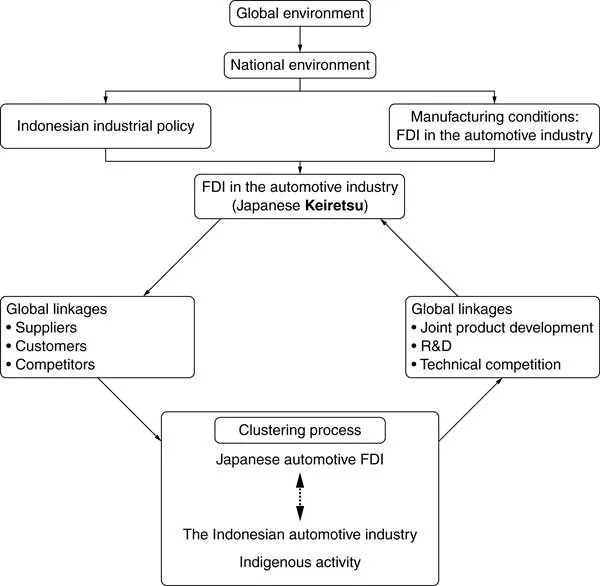
In order to understand the context, the research questions were based on the conceptual framework shown in Figure 1.1.
Figure 1.1 Conceptual framework before fieldwork.
This research aimed to study the automotive industrial cluster in Java in a qualitative way by investigating the involvement of MNEs, through knowledge transfer between subsidiary transplants and suppliers, in accelerating the development of the Indonesian automotive cluster. In this study, Japanese MNEs were chosen as models of exporter industrial organisations because the Japanese automotive industry still has considerable competitive strengths, despite financial difficulties and alliances with foreign partners. Additionally, the issues of technology transfer, skill transfer, and national policies in industrial development are attracting more widespread interest and the automotive industry remains a major global industry.
Indonesia, as part of the major Japanese automotive productive network based in the Southeast Asian region, has been chosen to offer a discussion about the flows of knowledge and technology in the automotive cluster where the Japanese firms have been dominant. Moreover, while numerous studies have been published about the influence of the Japanese automotive industry in other countries, few have appeared on the influence of the Japanese automotive firms in Indonesia.
Using this conceptual framework, I intend to understand the process and development of knowledge transfer in the Indonesian automotive cluster. Since the development of a cluster cannot be understood without a thorough insight into the characteristics of the region as a whole, it is therefore important to draw up a frame of analysis to consider several aspects and study their interrelations.
To investigate what is happening in Indonesian automotive cluster (i.e. the process of knowledge transfer) and in what way the global-local production system accelerates the Indonesian automotive cluster, the research questions are as follows:
- Context: How has the global-local network in the automotive industry impacted on the automotive cluster in Java?
- Process: How have the key actors (Toyota and Honda) been involved in fostering technological change and knowledge-technology transfer in the Indonesian automotive cluster (through localisation projects and suppliers)?
- Outcomes: Using two case studies of Toyota and Honda as MNEs in the automotive industry, how have they contributed to the development of the Indonesian automotive cluster (new knowledge, new skills)?
- Recommendation: How can the cluster policy be improved and what lessons can be learned?
Book Structure
This chapter has detailed the research background and aims, and listed the research questions. Chapter 2 provides a theoretical framework for the cluster theory literature. Chapter 3 provides the literature on Japanese automotive industry and its knowledge transfer. From the literature base in Chapter 2, the cluster strategy is discussed and subsequently used in Chapter 4, Chapter 6, Chapter 7 and Chapter 8 to analyse the development, implementation, and outcomes of the Indonesian automotive cluster. Additionally, the literature on knowledge transfer and the Japanese automotive sector in Chapter 3 is used in Chapter 5, Chapter 7, Chapter 8 and Chapter 9 to analyse the processes of Japanese MNEs in the automotive industry and the outcomes of the two case studies.
Chapter 4 outlines the literature on the Indonesian context mainly covering the Indonesian macroeconomy and industry along with cluster strategy as an important agenda in Indonesian government. This chapter is also linked with Chapter 6 whereby the discussion of industrial agglomeration in the Java region is elaborated alongside the role of industrial estates as the foundation for developing the cluster strategy.
Chapter 5 provides methodology based on the research questions that have arisen from literatures reviewed in Chapter 2 and Chapter 3 and breaks them down into their constituent parts. It also outlines how the research came about and discusses the methodological approach and research design, before looking at the methods utilised to answer the research questions. The chapter concludes by outlining the limits of the study and the nature of the results that are set out in the following chapters. This chapter will be wrapped up with reflections on the work undertaken, including the research process and limitations.
Industrial agglomeration and clusters in the Java region are the theme of Chapter 6. This chapter draws strongly on the literature outlined in Chapter 2 and Chapter 4. Chapter 6 is an extended explanation of cluster strategy in the context of manufacturing locations in the Java region as a prelude to the automotive cluster discussion in Chapter 7 and Chapter 8.
Chapter 7 and Chapter 8 detail case studies of the automotive cluster in the Java region. Chapter 7 analyses the case of four-wheeled vehicles at Toyota, along with the company’s networks for developing technology and knowledge through the manufacturer–supplier relationship. Also, this chapter explores the interrelatedness of government–industry–university in enhancing cluster growth in Java. Chapter 8 provides a case study for two-wheeled vehicles at Honda. It explores the technology and knowledge transfer between Honda’s local-global network and its supplier in Indonesia. Furthermore, this chapter also highlights the importance of linkages between Honda, government, and university.
Chapter 9 provides a thorough discussion and analysis based on the two case studies in a more global perspective. It links to Chapter 3 and the literature on the Japanese business network. The chapter examines the Japanese global production network and implications for the Indonesian automotive cluster. This chapter also explains the importance of fostering global-local alliances for the Indonesian automotive cluster in order to enhance innovation, learning and network. Furthermore, the explanation of the glo...