In addressing the political and theoretical debates between critical and post-Marxist theorists, this book discusses the politics of communication and rationality, subjectivity, sovereignty, ethics and deliberative democracy, considering questions such as:
* Does the theory of communicative action justify deliberative democracy?
* Is a theory of hegemony compatible with an account which relies upon an ideal of communicative success?
* Is autonomy a good which should be fostered?
* Can the ideal of democracy extend beyond the nation state?
* Does post-Marxism have anything interesting to say about ethics?
Analysing the work of Ernesto Laclau and Jürgen Habermas - as representatives of different choices made in regard to theory, politics and morality - Ethics and Politics in Contemporary Theory develops a critical response to the contrasting conclusions of these approaches.
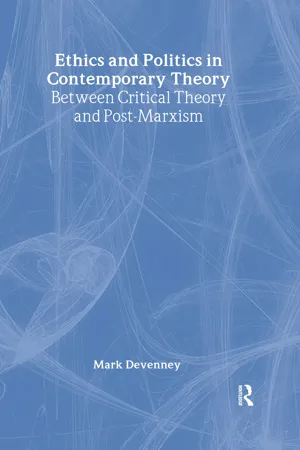
eBook - ePub
Ethics and Politics in Contemporary Theory Between Critical Theory and Post-Marxism
- 208 pages
- English
- ePUB (mobile friendly)
- Available on iOS & Android
eBook - ePub
Ethics and Politics in Contemporary Theory Between Critical Theory and Post-Marxism
About this book
Information
1 The ends of Marx(ism)?
Beyond Marxism?
Introduction
Marxism was, in some or other sense, in terminal crisis throughout the twentieth century. Events in the last two decades of the century seemed finally to seal its demise, once more laying to rest the spectre which had haunted capitalism since the failed revolutions of 1848. The inability of ‘communist’ regimes to develop a legitimate alternative to capitalist modernisation was demonstrated as protesters apportioned and sold the bricks of the Berlin wall to the newly available ‘free’ market. In the new millennium those few regimes that hold to the ‘faith’ belie their own rhetoric with gradual economic ‘liberalisation’ while upholding one-party domination of the political system.
The last decades of the twentieth century witnessed too the uneven spread of liberal democratic institutions across the world. In Eastern Europe, Latin America, Africa south of the Sahara and South East Asia recalcitrant dictatorships spluttered towards liberal democracy, while enshrining free market policies in thrall to imperatives established by the International Monetary Fund (IMF), World Bank and global corporations. Inspired by these changes writers such as Francis Fukuyama proclaimed the end of history, welcoming the realisation that there is no better alternative to the liberal democratic institutions of the ‘free world’ (Fukuyama 1992). These developments have been interpreted in radically different ways however. The positive spin of Fukuyama, among others, is rejected by Hardt and Negri in their description of a new global Empire (Hardt and Negri 2000) whilst Badiou, critical of the liberal consensus concerning human rights, contends that the affirmation of universal human rights is only the latest version of an egoistic nihilism characteristic of the smug West, which is implicated in a global system of economic and political inequality (Badiou 2001).
These radically different views suggest that endings are far more complex than any simple minded historical narrative of liberal democracy permits. Antagonisms repressed or marginalised under socialist regimes take on altered forms, while those plastered over by the ideological veil of Cold War antagonism in the West are no longer so easily hidden. Marx's claim that capitalism would become the dominant form of social organisation is validated by a global economic system built on high rates of consumption in ‘developed’ countries, and low consumption allied with cheap production in other countries. Rather than the extension of equality and liberty, the twin poles of liberal democratic enlightenment, the closing years of the twentieth century witnessed the deepening of some of the most perverse inequalities ever in the life of democracy. The threads linking indentured and slave labour to the labels on clothing and the food the privileged eat are all too apparent. Whatever rights liberal democratic regimes have entrenched must be viewed, as Marx once claimed, in light of the institutional exploitation which is their other face. In this new global economy, developed since the 1970s, the margins are at the centre, and the proclamation of freedom in one place is implicated in repression elsewhere. After the demise of Communism various forms of fundamentalism market themselves as the only plausible alternative to capitalist liberal democracy.
Any understanding of this ‘empirical’ end to Communism must abjure the rationalisations of apologists such as Fukuyama. The end of the Cold War did not resolve the crisis tendencies which beset capitalist modernisation and liberal democracy. Many of these were acutely diagnosed by Marxist critics of monopoly capitalism. Crises of legitimation and motivation (Habermas 1976), systemic crises effecting accumulation, and crises concerning the remit of sovereign authority all plague the capitalist state. The indices of social progress defended by liberal democracies themselves – poverty, levels of education, protection from arbitrary exercise of force inter alia – indicate the failure of these societies to meet even their own minimal ideals. Average indices of social wealth, which indicate rising living standards in the developed west, shroud the vast inequalities within nation states. Inequalities prevalent in the highly developed capitalist societies are exacerbated in so-called third and fourth world conditions. Moreover, the global deregulation of financial capital has resulted in the extension of new forms of risk invisible to apologists for the new global market. As preposterous as Fukuyama's thesis is however there is one grain of truth which nags. While resistance to the newly deregulated global financial system has increased, no equivalent to Marxism, either as theory or as ideology, commands the allegiance of all groups opposed to the terms of the deregulated global market. Expressed simply there is no viable alternative to the liberal democracy that Fukuyama encourages us to welcome. Any reform is designed to maintain the system; revolution seems a forlorn hope.
Given this the task of any critical theory and politics has two potentially conflictual strands. On the one hand critique should keep in sight the normative idealism which underpins one spirit of Marx, the insistence that things ought to be otherwise. This demands the positive formulation of alternatives to the dominant order: alternatives which draw inspiration from multiple points of resistance and a critique which goes beyond the limitations of the present, in an immanent engagement with its contradictions. On the other hand post-Marxist accounts cannot retain intact the rationalist and deterministic limitations of the western Marxist tradition. These limitations have been denounced time and time again by historians of the Russian revolution and in the plethora of theoretical texts which now parody Marxism whilst affirming a post-modern simplification of the political. There is a new opportunity to reread and to rework Marx after the demise of Marxism as an alternative imaginary to liberal democracy. The extension of capitalist liberal democracy across the globe requires a revaluation of the politics of the left as well as a revaluation of the politics of interpretation on the left.
The last decade of the twentieth century witnessed unprecedented resistance to global corporate and capitalist power. This intensification of anti-corporate activity coincides with a fundamental restructuring of capitalism, and the emergence of what Castells terms a network society (Castells 1997). Post-Marxist and critical theories have been tardy in responding to these developments. The globalisation of neo-liberal economic policies, and hegemony of free market solutions to a wide variety of systemic and lifeworld crises, suggests that left political and cultural thought must retain a universal or global sense of political change inspired in part by the legacies of Marx. Multi-cultural identity politics is an ineffective response to crises which are systemically though contingently linked. The left has to negotiate two apparently conflicting imperatives: a global politics which cuts across all previously established borders, and the fragmentation of identity politics, sometimes as a response to these imperatives, sometimes as a consequence of the slow decomposition of previously dominant forms of identification such as the nation state and nuclear family.
The universal pretensions of such an ideal seems patently absurd, a remnant of the romanticism which inspired the Jacobin threads of Marxist revolutionary theory.1 The link between universal and particular in political theory must not be lost, despite the fragmentation of the left into a variety of different theoretical and political perspectives. The elements of such a framework, a common imaginary, have to be painfully constructed, but cannot be presupposed.
For many post-Marxism has meant the abandonment of the critical impulse which underpinned Marxism altogether. Terry Eagleton, for example, asks of Derrida's Specters of Marx:
How is a deconstructed Marxism different from what Raymond Williams taught? If on the other hand deconstruction is to be more than some familiar marxisant revisionism or boring brand of left liberalism, then it has to press its anti-metaphysical, anti-systemic, anti-rationalist claims to flamboyantly anarchic extremes, thus gaining a certain brio and panache at the risk of a drastic loss of intellectual credibility.
(Eagleton 1999: 84)
Despite Eagleton's wilful misreading his anxiety is common. These fears do an injustice to the set of discourses which are the starting point of a post-Marxist account. This book sets out to dispel these reservations, both theoretically and politically. In order to do so however, a revisiting of the various criticisms of Marxism is required.
The theoretical limits of Marxism are well rehearsed, and all too quickly invoked to dismiss the suggestion that Marxist thought is a valuable reference point for a critical theory of modern society. In the rest of this chapter I reconstruct these criticisms not to dismiss but to trace a debt, which any critical politics has to pay. This debt is both political and theoretical. I address three themes: (i) determinism and essentialism, (ii) complexity, (iii) and the question of whether or not a science of society is possible. Many of these criticisms were foreshadowed in the work of Adorno. The last section of this chapter retraces his critique of reification. I contend that his work offers a good starting point for consideration of an alternative political imaginary, an imaginary which is explored through the work of Habermas and Laclau in the chapters which follow.
Determinism and essentialism
The questions of determinism and essentialism have plagued Marxism and the social sciences throughout the twentieth century. Debates centred on the extent to which the economy could be said to be determinate of all social relations, and if so how this causality might be formulated, giving due weight to the influence of ideological and other factors on identity formation and political action.2 In an oft-quoted passage Marx makes a universal claim for the ultimate determination of economic relations on all forms of human life, describing the economic structure of society as:
the real foundation on which rise legal and political superstructures and to which correspond definite forms of social consciousness. The mode of production in material life determines the general character of the social, political and spiritual processes of life.
(Marx 2000b: 182)
In Capital this version of determinism is allied with a distinction between essence and appearance. Marx writes:
... what is true of all forms of appearance and their hidden background is also true of the form of appearance ‘value and price of labour-power’. The forms of appearance are reproduced directly and spontaneously, as current and usual modes of thought; the essential relation must first be discovered by science. Classical political economy stumbles approximately onto the true state of affairs without consciously formulating it. It is unable to do this as long as it stays within its bourgeois skin.
(Marx 1976: 682)
These forms of appearance are reproduced as current modes of thought, but their essential relation is hidden by the bourgeois skin which is the phenomenal form of a real content. Marxists struggled throughout the twentieth century to marry such claims with a materialist account of history and politics. The alternatives ran from the claim that the distinction between essence and the forms of its appearance was a necessary effect of the capitalist relations of production, to more sophisticated versions of abstract determinism or determination in the last instance, most deriving support from a variety of Marx's own texts. Ernest Mandel attempting to give substance to Marx's use of the distinction unwittingly points towards the many difficulties it gives rise to:
The distinction between essence and appearance which Marx inherited from Hegel and which is part and parcel of the dialectical method of investigation, is nothing but a constant attempt to pierce farther and farther through successive layers of phenomena, towards laws of motion which explain why these phenomena evolve in a certain direction and in certain ways. (emphasis added) ... But the distinction between essence and appearance in no way implies that appearance is any less real than essence ... The distinction between essence and appearance refers to different levels of determination, that is in the last instance to the process of cognition, not to different degrees of reality. To explain the capitalist mode of production in its totality it is wholly insufficient to understand simply the basic essence of the law of value. It is necessary to integrate appearance and essence through all their integrating intermediate links to explain how and why a given essence appears in given concrete forms and not in others.
(Mandel 1976: 20)
For Mandel the distinction involves the attempt to find ‘through’ the phenomenal layers certain laws of motion which explain this phenomenal appearance. Yet Mandel insists that the phenomenal appearance of these laws is not thereby rendered any less real than their essence. The distinction is one of cognition, not different degrees of reality. In reality, he contends, essence and appearance are integrated with intermediating links which must be explained. Mandel though is still concerned to question why it is that a given essence takes on a certain concrete form. For a writer determined to defend a science of historical materialism, as Mandel often claimed to do, this ludicrous explanation cannot be acceptable. Why should the cognitive distinction hold any merit if it is not to do with different degrees of ‘reality’? If this cognitive claim seeks to explain the appearance of essence then it must of necessity penetrate through the phenomenal to grasp that which is more real. In this case it can inform the decisions that class actors might make about their political role in the world. Yet Mandel disclaims just this link at precisely the moment when he needs it. In fact there should not be any problem making the claim that certain actions, events or structures take an appearance which is at odds with their reality. The problem is, and this is a problem inherited from a certain reading of Marx, when this distinction is overlain with that between essence and appearance, or between the phenomenal and the real. It may well be the case that what is experienced at first hand is only one aspect of an overdetermined reality. For example we can certainly accept that an experience of the commodity in an exchange relation is an abstraction from the social conditions of the commodity's production, and that this abstraction has effects on the knowledge claims we may make. It is quite another thing to claim that below the phenomenal appearance we discover an essence, where there is to be located the laws of motion of the capitalist economy. Indeed one might read the short history of post-Marxism as an attempt to account for these metaphysical propositions in the Marxist tradition.
This distinction between essence and appearance entails, as Laclau and Mouffe note,
the abstraction of the economy as a universal object, [along with] another equally abstract object (conditions of existence) whose forms may vary historically, but which are unified by the pre-established essential role of assuring the reproduction of the economy.
(Laclau and Mouffe 1985: 99)
If other elements, such as political and ideological practices, are necessary to the functioning of any economy then they cannot, except as a methodological abstraction, be deemed secondary to economic practices.3 But, in this case, as noted in the discussion of Mandel earlier, the relation between this abstraction and the phenomenal experience thereof requires adequate explication.
It is the later work of Raymond Williams, particularly Marxism and Literature, which best explores these extraordinarily complex debates. Williams rejected the simplistic reflection model which in a variety of sophisticated, and not so sophisticated, versions had come to constitute western Marxism. He is particularly concerned to repudiate abstract determinism, the establishment of ahistorical determining principles which afflict all social structures in differently mediated ways. Williams criticises Marx for reading the economy back in time, rather than heeding his own advice that such abstraction repeats the idealism of the political economy from which he so decisively broke. He thus disavows the determinism and the essentialism implied by the base–superstructure model and begins with another of Marx's assertions, that social being determines consciousness. For Williams determinism is best seen as the setting of limits and the exertion of pressures. He writes:
Determination of this whole kind – a complex and interrelated process of limits and pressures – is in the whole social process itself and nowhere else: not in an abstracted mode of production nor in an abstract psychology.
(Williams 1977: 87)
On this account Marxism is not a nomological theory which posits abstract laws for all social formations, but a dynamic account of the relations between active consciousness and a petrified second nature which is itself the outcome of long processes of political and economic struggle. He thus rejects a number of different accounts of the relation between economy and polity: the ideas of mediation, reflection and determination in the last instance. In the case of determination in the last instance he rightly notes that it abstracts structural limits on human action, without an account of the limits of such a structuralism or an account of social structures as the outcome of human praxis and struggle. Instead he argues that overdetermination is the most useful concept for understanding the complexities of any social activity, and that it is closest in spirit to Marx's own writing. Williams thus refuses the categorical language of base and superstructure, noting that the so-called base is characterised by ‘dynamic and internally contradictory processes’ (Williams 1977: 82), which means that it can never be abstracted from social practice and process. As he writes:
The social and political order which maintains a capitalist market, like the social and political struggles which created it, is necessarily a material production. From castles and palaces and churches to prisons and wor...
Table of contents
- Front Cover
- Ethics and Politics in Contemporary Theory
- Title Page
- Copyright
- Contents
- Preface
- Acknowledgements
- Introduction
- 1 The ends of Marx(ism)?
- 2 Language, communication, performativity
- 3 Performativity and politics: from Habermas to Laclau
- 4 Politics, idealisation and performativity
- 5 Quasi-transcendentalism and critical theory
- 6 The politics of subjectivity
- 7 Deliberative or radical democracy? the politics of performativity
- 8 Post-structuralism and democratic theory
- 9 Ethics and politics in discourse theory
- Notes
- Bibliography
- Index
Trusted by 375,005 students
Access to over 1.5 million titles for a fair monthly price.
Study more efficiently using our study tools.
Frequently asked questions
Yes, you can cancel anytime from the Subscription tab in your account settings on the Perlego website. Your subscription will stay active until the end of your current billing period. Learn how to cancel your subscription
No, books cannot be downloaded as external files, such as PDFs, for use outside of Perlego. However, you can download books within the Perlego app for offline reading on mobile or tablet. Learn how to download books offline
Perlego offers two plans: Essential and Complete
- Essential is ideal for learners and professionals who enjoy exploring a wide range of subjects. Access the Essential Library with 800,000+ trusted titles and best-sellers across business, personal growth, and the humanities. Includes unlimited reading time and Standard Read Aloud voice.
- Complete: Perfect for advanced learners and researchers needing full, unrestricted access. Unlock 1.5M+ books across hundreds of subjects, including academic and specialized titles. The Complete Plan also includes advanced features like Premium Read Aloud and Research Assistant.
We are an online textbook subscription service, where you can get access to an entire online library for less than the price of a single book per month. With over 1.5 million books across 990+ topics, we’ve got you covered! Learn about our mission
Look out for the read-aloud symbol on your next book to see if you can listen to it. The read-aloud tool reads text aloud for you, highlighting the text as it is being read. You can pause it, speed it up and slow it down. Learn more about Read Aloud
Yes! You can use the Perlego app on both iOS and Android devices to read anytime, anywhere — even offline. Perfect for commutes or when you’re on the go.
Please note we cannot support devices running on iOS 13 and Android 7 or earlier. Learn more about using the app
Please note we cannot support devices running on iOS 13 and Android 7 or earlier. Learn more about using the app
Yes, you can access Ethics and Politics in Contemporary Theory Between Critical Theory and Post-Marxism by Mark Devenney in PDF and/or ePUB format, as well as other popular books in Philosophy & Ethics & Moral Philosophy. We have over 1.5 million books available in our catalogue for you to explore.