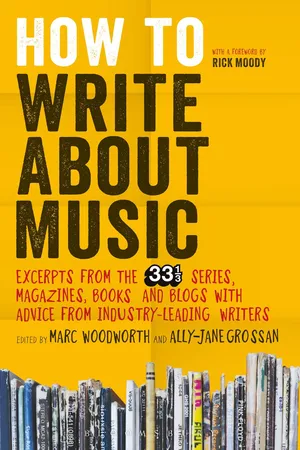
If writing about music is like dancing about architecture, you'd do best to hone your chops and avoid clichés (like the one that begins this sentence) by learning from the prime movers. How to Write About Music offers a selection of the best writers on what is perhaps our most universally beloved art form. Selections from the critically-acclaimed 33 1/3 series appear alongside new interviews and insights from authors like Lester Bangs, Chuck Klosterman, Owen Pallet, Ann Powers and Alex Ross.
How to Write About Music includes primary sources of inspiration from a variety of go-to genres such as the album review, the personal essay, the blog post and the interview along with tips, writing prompts and advice from the writers themselves.
Music critics of the past and the present offer inspiration through their work on artists like Black Sabbath, Daft Punk, J Dilla, Joy Division, Kanye West, Neutral Milk Hotel, Radiohead, Pussy Riot and countless others. How to Write About Music is an invaluable text for all those who have ever dreamed of getting their music writing published and a pleasure for everyone who loves to read about music.
- 432 pages
- English
- ePUB (mobile friendly)
- Available on iOS & Android
eBook - ePub
About this book
Information
CHAPTER 1
THE ALBUM REVIEW
INTRODUCTION
EXPERT ADVICE FROM OUR WRITERS
ANN POWERS ON DAFT PUNK’S RANDOM ACCESS MEMORIES
JIM DEROGATIS ON SIMON & GARFUNKEL’S BOOKENDS
LAURIE ANDERSON ON ANIMAL COLLECTIVE’S CENTIPEDE HZ
LOU REED ON KANYE WEST’S YEEZUS
WRITING PROMPT: THE BLIND REVIEW
WRITING PROMPT: MAKE IT BETTER
INTRODUCTION
How do writers show up in their reviews? Ann Powers’ keen eye for the gender politics of rock gives her review of Daft Punk’s Random Access Memories a characteristic perspective: “There is one glaring omission from Daft Punk’s foray into vintage pleasures. Where is the female voice representing those who truly defined that liberatory spirit?” (She’s just limned out the album’s relationship to the music of the 70s, its hedonistic nature and “promiscuous eclecticism.”) The lack of a “feminine presence,” she concludes, makes “the satisfactions RAM offers … incomplete.” It’s a fair and telling point. Powers identifies a shortcoming to which another reviewer might have been blind. How the critic sees and hears a record, Powers’ caveat reminds us, isn’t neutral or objective, but determined by their own experience, passion, and focus.
We often learn more when we come across a knee-jerk review that strikes us the wrong way than from one we agree with, learn more not only about the record under consideration but about some aspect of our own response to music, especially if that aspect isn’t yet entirely clear to us. The “Dean of American Rock Critics,” Robert Christgau first published his “Consumer Guide” capsule reviews in 1969. They’ve served to define the nature of record reviews ever since even as they remain largely inimitable, marked by a fiery critical intelligence and an immediately identifiable style. For all the critical stances he takes that are utterly convincing however, an important aspect of reading his reviews is the way the ones you disagree with get under your skin.
His B– for Guided By Voices’ Bee Thousand isn’t a particularly low mark in the pre-grade-inflation reckonings of the Dean even if the grade itself doesn’t entirely jibe with the damning consonance-rich sentence that caps the review: “this is pop for perverts—pomo smarty-pants too prudish and/or alienated to take their pleasure without a touch of pain to remind them that they’re still alive.”
Even if you’re invested in the record or the band, those over the top ῾p’s are fun to hear coming from the lips of the master reviewer but they tend to leave sticky traces of his spittle on your face. Taking a second to wipe them off gives you pause to think about whether or not you are a prudish, perverted pomo smarty-pants and whether that’s why you like the record after all. Once you decide you’re not really any of those things, you become almost grateful for the fact that the critic has given you a chance to confirm what you know about yourself and the music you love.
Reading that sentence reminds me of Christgau’s early reviews of Sonic Youth. The fact that there was an audience out there which liked this stuff seemed more of a disincentive to the critic than the music itself: he sends up the preciosity of the kind of store where you can by an EP like Death Valley ’69 by calling it a ‘shoppe’ and suggests that if you actually pay for such bootless product you might as well be sexually servicing (his language is less polite) the “Boho poseurs” in the band. Are the Boho poseurs who constitute Sonic Youth (a band that consistently received As from Christgau for much of its later career) and its fan base predecessors of the Guided by Voices listeners he imagines to be perverted pomo smarty-pants? They must be. The critic’s allergy to the image of the fawning hipster makes his eyes swell up so quickly that he can’t see the music isn’t postmodern or enervated at all but an example of brilliant, even lovingly rendered songs made by regular guys—OK, so one of them’s a regular guy who happens to be a genius—with a full-blooded love of rock and very limited recording equipment. Christgau may have identified accurately a portion of the band’s audience in New York who lionized Guided by Voices for the wrong reasons and found this demographic as repellent as early Sonic Youth fans, but once he has these cardboard cutouts in his sights, he can only dismiss the music without really taking it in.
I’m not dwelling on this review merely to settle scores with a famous critic about a beloved record (though there’s that), but to suggest a couple of things that might prove useful to a writer of album reviews. First, the critic both uses and is sometimes blind to his prejudices and ideals—the more you know about yourself and how you process what you’re writing about given that self-knowledge, the better. Second, don’t write as someone who doesn’t care about what you care about. Don’t be hipper or more sanguine, less cranky or suspicious than you are. Show up on the page as yourself. There’s nothing cautious or second-guessing about Christgau’s GBV and Sonic Youth reviews—and that’s the pleasure of reading them: his verbal intelligence, desire to sniff out a bad deal for the “consumer,” and concern that what he’s hearing may not be authentic are all palpably real aspects of his response to music. You, on the other hand, might be more inclined to draw out nuance than spit fire—or even praise—so use what you’ve got. And as Rob Sheffield writes about what proved to be a dead wrong review he wrote of a Radiohead album (The Bends) that became one of his favorite records by one of his favorite bands, “getting things wrong is part of a music critic’s life … That’s probably the most crucial advice I could give a young critic—plan on getting a lot of things wrong.” Just make sure when you’re wrong, you’re wrong on your own terms.—MW
EXPERT ADVICE FROM OUR WRITERS
With album reviews, there was a time when writers got advance albums two or three months before the general public ever heard it. So you could spend some time crafting a meaningful argument that was really unaffected by the fan reception of a record, or by the promotional campaign of that record. That landscape has changed so dramatically that writers don’t have much of an advantage over anyone else. Everyone has an opinion the moment an album is leaked or released, and editors are going to (understandably) demand that their writers join that chorus as quickly as possible so their outlet’s coverage doesn’t feel stale. When you’re under that kind of deadline pressure, as a writer, I think it’s much harder to write something personal and meaningful and structurally sound, so readers often get something half-cooked or something that pretty much repeats the safe status quo opinion that’s floating around out there. The democratization of this stuff is a lot better than the old “gatekeeper” system in so many ways, but I think serious criticism is really struggling right now, because even the stalwart voices have the ability to see what everyone else is saying, and we wind up in a weird feedback loop.—Casey Jarman, Managing Editor, the Believer
I listen to music as I would “in the wild” before I approach it critically. That means listening to it regularly on headphones to and from work usually.—Matt LeMay, senior contributor, Pitchfork
I begin by listening to the disc in question several times. Even as a young sprog reading magazines like Crawdaddy! and Fusion, I could tell when the reviewer had only listened to something once, especially if I already owned and enjoyed the record. There’s research for record reviews, too. Most reviewers, at least the majority of those I’ve read, seem to think that the music to which they’re listening and the accompanying liner notes are sufficient data from which to build a review. A little research, especially beyond the immediate realm of music, goes a long way towards enriching both one’s opinion of a record and the ability to express that opinion with allure.—Richard Henderson, music writer and 33⅓ author
When I reviewed Oneohtrix Point Never’s R Plus Seven, which was voted Tiny Mix Tapes’ favorite album of 2013, I already knew the album intimately, since I had listened to it many times before knowing that I’d be writing about it. But in general, it’s crucial for me to immerse myself in the music first, then, depending on the artist, do as much research as possible by reading interviews and articles. This research is not only for fact-gathering purposes, but also to understand how meaning is created and reinforced throughout the media, how publicity might have affected how people are writing about the music in question, and whether or not any of it aligns with my personal beliefs.—Marvin Lin, Editor-in-Chief, Tiny Mix Tapes
I’ve realized that I try to make everything I write, even reviews, into some sort of narrative—there has to be a story or I don’t know what to say. And then I just smooth it all together into a legible story.—Michael Azerrad, author, journalist and Editor-in-Chief of the Talkhouse
I wrote a 1500-word review about the Slint boxset (multiple LPs, book, and DVD) in the Wire magazine. I listened to the music, watched the film several times, and started by simply thinking about exactly what struck me as most significant about the band, their reputation, their album Spiderland and the historical gap between the time of its creation and the present. Once I had a lot of sentences more or less worked out in my head, I wrote a preliminary draft. Then I revised it many times, adding and expanding and cutting back and reshuffling certain key points. Then I sent it to the editor and we had several back-and-forth edits and changes. He wanted me to add some things and I thought about how I would do that effectively. It’s not just about “your voice” or “inspiration”—to write is to work with editors, to revise, and to sometimes change your mind and your emphasis.—Drew Daniel, Assistant Professor, Department of English, Johns Hopkins University
The short form is hard for me—especially the really short form. Like I don’t know what I’d do if I had to write one of those 200-word album reviews. I guess I’d adapt. Short for me would be in the 2,500-word range. And even then things spill over. But I like revising and editing a lot. Those are my favorite things about writing.—Bryan Charles, writer and 33⅓ author
When I’m assigned an album for review, the first thing I do is contact the publicist to try and track down a promo copy of the album (if I don’t have one already; sometimes my editor will provide me with a promo, or I’ll have pitched the album for review having already listened to it).
Then, I listen. A lot of people ask me how many times I try and listen to an album before reviewing it, and the truth is that there is no magic number. It really depends on how far in advance I’m given a record; sometimes I’ll live with a promo copy of a record for months before I have to sit down and organize my thoughts about it, and in other cases—especially with bigger, major label releases—I’ll hear an album for the first time a day or two before I have to file the review. I prefer situations between these two extremes. If you have too long to marinate on an album, you can sometimes overthink your opinion and second-guess your gut reaction—specifically if you see a lot of people arguing about it a lot on the internet. But of course, you don’t want to feel rushed, either. A lot of my favorite albums are “growers” that didn’t immediately grab me on first listen, but I came to appreciate them over many consecutive listens, and I try to consider this when listening and writing.
One thing I try to do consistently, though, is listen to an album I’m reviewing in a variety of contexts. A lot of people might think of a music critic pensively listening to a record alone in a silent room and through huge, state-of-the-art headphones … and true, sometimes I do that. But that’s not the only way people listen to music, and I try to remember that when I’m writing about a record. I want to take it out for a test-drive—to try it out in real life. I try to listen on speakers and on headphones. I try to give it a few spins (pen and notebook in hand, usually) focused specifically on the music and when I’m playing it in the background of doing something else. Sometimes I’ll listen alone and sometimes with other people. Music filters into our lives in a variety of ways, and I try to keep this in mind when I’m evaluating it.
Then, once I feel like I’m ready to say what I want to say (or when my deadline is unavoidably looming), I’ll sit down at my computer and write. Usually I’ll have already jotted down some phrases or observations on a napkin, or my hand, or the notebook I’m always carrying with me, and I’ll consult these notes if I have them, but sometimes I like to start the review as a blank slate. Even when I think I have a handle on how I feel about an album, I don’t really know exactly what I’m going to say until I sit down to write, and I think the trick is finding that uncertainty exhilarating rather than terrifying.—Lindsay Zoladz, Associate Editor, Pitchfork
I would make it illegal to review a record sooner than a month after release. I think it’s impossible to have the proper perspective on a record when you’ve sat with it for just a few weeks—sometimes even a few days for bigger records. There are so many reviews I’ve written that I would change almost completely because how I felt about the rec...
Table of contents
- Cover
- Dedication
- Contents
- Foreword By Rick Moody
- Acknowledgments
- Introduction By Marc Woodworth
- How To Use This Book
- The Writers
- Overture: Expert Advice From Our Writers
- Chapter 1
- Chapter 2
- Chapter 3
- Chapter 4
- Chapter 5
- Chapter 6
- Chapter 7
- Chapter 8
- Chapter 9
- Chapter 10
- Chapter 11
- Chapter 12
- Chapter 33⅓
- Companion Website
- Also Available In The 33⅓ Series
- Index
- eCopyright
Trusted by 375,005 students
Access to over 1.5 million titles for a fair monthly price.
Study more efficiently using our study tools.
Frequently asked questions
Yes, you can cancel anytime from the Subscription tab in your account settings on the Perlego website. Your subscription will stay active until the end of your current billing period. Learn how to cancel your subscription
No, books cannot be downloaded as external files, such as PDFs, for use outside of Perlego. However, you can download books within the Perlego app for offline reading on mobile or tablet. Learn how to download books offline
Perlego offers two plans: Essential and Complete
- Essential is ideal for learners and professionals who enjoy exploring a wide range of subjects. Access the Essential Library with 800,000+ trusted titles and best-sellers across business, personal growth, and the humanities. Includes unlimited reading time and Standard Read Aloud voice.
- Complete: Perfect for advanced learners and researchers needing full, unrestricted access. Unlock 1.5M+ books across hundreds of subjects, including academic and specialized titles. The Complete Plan also includes advanced features like Premium Read Aloud and Research Assistant.
We are an online textbook subscription service, where you can get access to an entire online library for less than the price of a single book per month. With over 1.5 million books across 990+ topics, we’ve got you covered! Learn about our mission
Look out for the read-aloud symbol on your next book to see if you can listen to it. The read-aloud tool reads text aloud for you, highlighting the text as it is being read. You can pause it, speed it up and slow it down. Learn more about Read Aloud
Yes! You can use the Perlego app on both iOS and Android devices to read anytime, anywhere — even offline. Perfect for commutes or when you’re on the go.
Please note we cannot support devices running on iOS 13 and Android 7 or earlier. Learn more about using the app
Please note we cannot support devices running on iOS 13 and Android 7 or earlier. Learn more about using the app
Yes, you can access How to Write About Music by in PDF and/or ePUB format, as well as other popular books in Languages & Linguistics & Creative Writing. We have over 1.5 million books available in our catalogue for you to explore.