Market-specific insurance and risk control information on Contractors. This is part of the Target Market Series. Includes print and online components. Packaged as a book with accompanying online checklists and 75 page safety guide. This combined print-online format provides easy-to-use material that can easily be taken into the field. Includes information such as :* Industry background* Market profile and key industry groups* Underwriting concerns* Coverage considerations* Industry classification codes* Applicable endorsements* Glossary of common industry terms* Risk control considerations* Coverage checklists* Common policy provisions
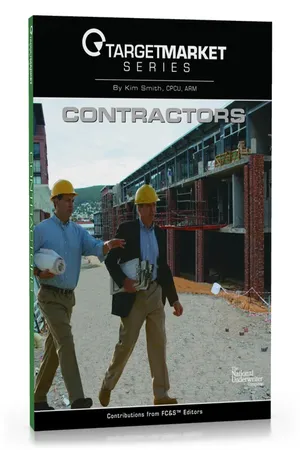
- 216 pages
- English
- ePUB (mobile friendly)
- Available on iOS & Android
eBook - ePub
About this book
Information
Chapter 1: Building Trade Contractors
INDUSTRY BACKGROUND
Building trade contractors can be defined as companies that build, fabricate, install or perform related services for others under a contract. In the United States, the construction industry may vie with the food industry as the largest business sector.
Although there are a number of ways of dividing the construction industry, there are three generally recognized classifications:
- General Contractors – who act as primary builders of new construction projects. Their activities can be broken down into three basic methods of operation: (1) building for an owner according to existing plans, (2) contracting with an owner to provide design as well as construction work and (3) acting as a package builder in which the owner is provided with complete turnkey services (i.e., the purchase of land, financing, design, and construction).
You will find that most general contractors will do at least a portion of a job themselves (usually concrete, masonry, or carpentry), although many act as brokers and utilize subcontractors to complete all phases of a project. This second type, often referred to as “paper” contractors, tend to maintain very small staffs to keep their overhead low. Other firms may engage in general construction activities but are not usually considered true general contactors. This includes developers who build for themselves; and project management companies, that supervise projects without assuming responsibility for their completion.
- Heavy Construction Contractors – who limit themselves to specialized construction activities that fall outside the scope of traditional building construction. Some common examples of such contractors might include road building or paving contractors, demolition contractors, utility contractors (gas/water mains, power lines), dam and bridge builders, logging contactors, oil and gas contractors, and asbestos abatement or other environmentally-related operation. Since many of these companies provide highly specialized work, it is not uncommon for them to act as both general contractor and subcontractor, depending on the job.
- Building Trade or Artisan Contractors – who provide a specialized type of new construction work (usually as a subcontractor); or who engage in remodeling, repair or installation services directly with an owner for a specific job involving their specialty trade. Most are locally owned with many being second or third generation family run companies. Of these, over 95% are small to medium size establishments employing fewer than 100 employees. Consequently, this category is the largest type of contracting company operating in the United States today and is the subject of this manual.
Chapter 2: Building Trade Sic Classifications
The Standard Industrial Classification manual (SIC) classifies most building trade contractors under major Group 17 – Construction – Special Trade Contractors. Most insurance carriers follow this listing as a basis for eligibility for their respective contractor’s package programs. The following is a brief description of those business types that fall under this heading.


Please note that many carriers consider one or more of the above SIC classifications as “high risk” exposures and will not write such contractors under their artisan contractor programs. Common exceptions include roofing, demolition, welding, scaffolding, excavation and water well contractors. Conversely, some contractors may routinely be considered as an artisan contractor by many carriers yet may fall under another SIC listing, such as landscapers (SIC classification 0782).
SUGGESTED TRADE CONTRACTORS CLASSIFICATION CODES
The following is a summation of the various class codes commonly used for building trade contractors. Often, specific accounts may “mix and match” these classifications depending on the activities they are involved in.


Chapter 3: Market Profile
There are more than 3,000,000 companies in business today that can be classified as construction contractors. The average premium for these accounts is approximately $9,497 per year, making them prime candidates for most agencies’ target marketing efforts. Below is a work up for the NAICS list...
Table of contents
- Chapter 1: Building Trade Contractors
- Chapter 2: Building Trade Sic Classifications
- Chapter 3: Market Profile
- Chapter 4: Insurance And Surety Markets
- Chapter 5: Underwriting Concerns
- Chapter 6: Coverage Considerations
- Chapter 7: Noninsurance Considerations
- Chapter 8: Common Artisan Contractor Terms
- Chapter 9: Standard and Manuscript Endorsements
- Chapter 10: Building Trade Contractors Coverage Checklist
- Chapter 11: Insurance Problem Issues for Building Trade Contractors
Trusted by 375,005 students
Access to over 1.5 million titles for a fair monthly price.
Study more efficiently using our study tools.
Frequently asked questions
Yes, you can cancel anytime from the Subscription tab in your account settings on the Perlego website. Your subscription will stay active until the end of your current billing period. Learn how to cancel your subscription
No, books cannot be downloaded as external files, such as PDFs, for use outside of Perlego. However, you can download books within the Perlego app for offline reading on mobile or tablet. Learn how to download books offline
Perlego offers two plans: Essential and Complete
- Essential is ideal for learners and professionals who enjoy exploring a wide range of subjects. Access the Essential Library with 800,000+ trusted titles and best-sellers across business, personal growth, and the humanities. Includes unlimited reading time and Standard Read Aloud voice.
- Complete: Perfect for advanced learners and researchers needing full, unrestricted access. Unlock 1.5M+ books across hundreds of subjects, including academic and specialized titles. The Complete Plan also includes advanced features like Premium Read Aloud and Research Assistant.
We are an online textbook subscription service, where you can get access to an entire online library for less than the price of a single book per month. With over 1.5 million books across 990+ topics, we’ve got you covered! Learn about our mission
Look out for the read-aloud symbol on your next book to see if you can listen to it. The read-aloud tool reads text aloud for you, highlighting the text as it is being read. You can pause it, speed it up and slow it down. Learn more about Read Aloud
Yes! You can use the Perlego app on both iOS and Android devices to read anytime, anywhere — even offline. Perfect for commutes or when you’re on the go.
Please note we cannot support devices running on iOS 13 and Android 7 or earlier. Learn more about using the app
Please note we cannot support devices running on iOS 13 and Android 7 or earlier. Learn more about using the app
Yes, you can access Target Market Series: Contractors by Kim Smith ,Kim Smith ,Kim Smith in PDF and/or ePUB format, as well as other popular books in Commerce & Assurance. We have over 1.5 million books available in our catalogue for you to explore.