Using an analysis of imperialism and case studies of Syria, Iran, Iraq, Bosnia, Russia and Ukraine, Global Democracy and the Crisis of Anti-Imperialism shows that the purported anti-imperialism of many self-professed socialists amounts to explicit or implicit support for totalitarianism, fascism, Islamist theocracy and imperialism. The analysis shows that the Russian revolution was followed by a counter-revolution, and resulted in state capitalism and the revival of Russian imperialism under cover of the Soviet Union. Thus the Cold War was actually a prolonged period of inter-imperialist rivalry between the United States and Russia. A large section of socialists who call themselves anti-imperialists oppose only Western imperialism and the despots it supports, not Russian imperialism and despots like Bashar al-Assad who are supported by it. As Russia has moved further and further to the right under Putin, they have effectively defected to the far right. They and other socialists also mistakenly believe that political democracy is organically connected to capitalism and therefore need not be defended, whereas, on the contrary, democracy is only established by mass struggles, and is an indispensable resource in the fight against exploitation and oppression. Finally, these socialists fail to understand that without internationalism, it is impossible to defeat global capitalism and its neoliberal policies. All the case studies in this book represent attempts to carry out democratic revolutions, which are supported by genuine socialist internationalists but opposed by pseudo-anti-imperialists. The book ends by suggesting steps that can be taken to promote democracy and end mass slaughter.
eBook - ePub
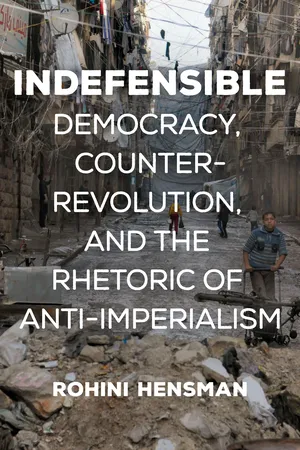
Indefensible
Democracy, Counterrevolution, and the Rhetoric of Anti-Imperialism
- 400 pages
- English
- ePUB (mobile friendly)
- Available on iOS & Android
eBook - ePub
About this book
Information
1. The Politics
of Anti-imperialism
of Anti-imperialism
Lenin’s analysis of imperialism, written during World War I, has the merit of opposing all imperialisms, including Russian imperialism, and of supporting the oppressed classes and democracy in all countries. However, it conflates two distinct phases of capitalism – imperialism and finance capital – and this has created immense confusion on the left. The idea that finance capital and foreign investments constitute imperialism would lead to absurd conclusions; for example, that China is an imperialist power in the US, or India in the UK. Instead, imperialism should be defined as political, and sometimes military, intervention in another country in order to install or keep in power a regime that acts more in the interests of the imperialist power than in the interests of any class – even capitalists – in its own country. Its driving force is nationalism in the imperialist country. Imperialism is opposed by struggles for national liberation,1 which constitutes one element in a democratic revolution – the people cannot rule themselves so long as they are ruled by another nation-state – but not the only one. Genuine anti-imperialists oppose all imperialisms, while pseudo-anti-imperialists oppose some while supporting others.
Theories of Imperialism
The main argument in pacifist-liberal economist J. A. Hobson’s Imperialism: A Study, first published in 1902, is that imperialism is directed by the search of investors, backed by the great financial houses, for profitable investment opportunities. For Marxist Rudolf Hilferding, too, in Finance Capital: A Study of the Latest Phase of Capitalist Development, written in 1910, the ‘export of capital’ is what marks imperialism (1981). Drawing on both of these works, V. I. Lenin’s Imperialism, the Highest Stage of Capitalism (1917) defined imperialism as (a) the dominance of international capitalist monopolies, (b) the merging of bank capital with industrial capital to create ‘finance capital’, (c) the export of capital rather than the export of commodities, and (d) the territorial division of the world among the biggest capitalist powers. Taking off from Marx’s analysis of the tendency of the rate of profit to fall,2 he identified the driving force of imperialism as the fact that
an enormous ‘surplus of capital’ has arisen in the advanced countries. … As long as capitalism remains what it is, surplus capital will be utilised not for the purpose of raising the standard of living of the masses in a given country, for this would mean a decline in profits for the capitalists, but for the purpose of increasing profits by exporting capital abroad to the backward countries. In these backward countries profits are usually high, because capital is scarce, the price of land is relatively low, wages are low and raw materials are cheap. (Lenin 1917)
According to Otto Bauer, ‘Imperialism increases the number of workers who are forced to sell their labour power to capital. It accomplishes this by destroying the old modes of production in colonial areas and thereby forcing millions either to emigrate to capitalist areas or to serve European or American capital in their native land’ (Bauer 1913, 873–74; cit. Luxemburg 1972 [1921], 141). As in Lenin’s account, imperialism involves the destruction of the old modes of production in the colonies and their replacement with capitalist relations through the export of capital.
Rosa Luxemburg’s theory of imperialism in The Accumulation of Capital, first published in 1913, locates the drive for imperialist expansion in capital’s need for constantly expanding markets (Luxemburg 2003). Similarly, Leon Trotsky thought that capitalist states were being driven into compulsory competition with one another for markets; hence, ‘The future development of the world economy on capitalist foundations will mean an uninterrupted struggle for newer and newer divisions of the same world surface as an object of capitalist exploitation’ (Trotsky 1923, 76).
Although Marx refers to ‘the colonial system’ rather than imperialism, he too wrote about the struggle for markets as well as the draining of wealth from the colonies to the ‘mother country’: ‘The colonies provided a market for the budding manufactures, and a vast increase in accumulation which was guaranteed by the mother country’s monopoly of the market. The treasures captured outside Europe by undisguised looting, enslavement and murder flowed back to the mother country and were turned into capital there’ (Marx 1976 [1867], 918). He also pointed out that ‘by ruining handicraft production of finished articles in other countries, machinery forcibly converts them into fields for the production of its raw material’, making India, for example, a producer of cotton and market for textiles, whereas it had formerly been a major producer of textiles (Marx 1976, 579).
We have here two very different conceptions of the relationship between the imperial power and its colonies. In the latter conception, the colonies are treated as captive markets and sources of raw materials, their wealth drained and their production of finished articles ruined; the flow of wealth is unambiguously from the colonies to the imperial power, leading to the impoverishment of the colonies. In the former, imperialism is identified as monopoly or finance capital exporting capital to the colonies by way of foreign investments. What was actually happening at the time Lenin was writing, in 1916?
In fact, income from overseas investment by Britain, then the dominant imperialist power, exceeded the outflow of capital throughout most of the nineteenth century and up to 1914; furthermore, the emergence of monopolistic firms was slow before the 1920s (Barratt Brown 1972, 54). While praising the ‘vision and incisiveness’ of Marx’s analysis of British imperialism in India and accepting that the concerns of industrialists did play a role, Cain and Hopkins (2002, 277) felt that ‘it overstates the role of the forces associated with industrialisation’. According to them, the main beneficiaries of British imperialism were a ‘gentlemanly capitalist class’: ‘As the world economy expanded and opportunities for foreign investment grew, the numbers of socially acceptable investment outlets multiplied and the vast flows of returning income which resulted helped first to reproduce this gentlemanly elite and then, slowly, to recreate it in a new form’ (Cain and Hopkins 2002, 182–83).
Classic imperialism of the British type seems to conform more closely to the analyses of Luxemburg, Trotsky and Marx, where the colonies constitute markets, and sources of wealth and raw materials for the ‘mother country’. Indeed, this also helps to explain what Lenin was mainly preoccupied with in Imperialism – the support of supposedly working-class social-democratic parties for their respective bourgeoisies in World War I – if we conclude that the inflow of wealth from their empires allowed these bourgeoisies to make concessions to sections of the working class (‘the labour aristocracy’) in their countries.
However, export of capital was indeed beginning to take place. Hilferding (1981, 426n) cites a typical example: the combination, in 1906, of the four largest British sewing thread firms into J. & P. Coats Ltd., which absorbed many smaller British companies and roughly fifteen American ones, and set up factories in the United States to bypass US tariffs. This pattern of capital exports had started in the mid-1860s, with the German Friedrich Bayer taking a share in an aniline plant in New York State in 1865, the Swedish Alfred Nobel setting up an explosives plant in Hamburg in 1866, and the US Singer sewing machine company building its first overseas factory in Glasgow in 1867 (Tugendhat 1973, 33). There were various reasons why these companies chose to invest abroad, but the main one was to overcome tariff barriers created by the spread of protectionism. The rationale for this strategy was outlined by William Lever, founder of the Lever Brothers soap empire: ‘When the duty exceeds the cost of separate managers and separate plants, then it will be an economy to erect works in the country that our customers can more cheaply be supplied by them’ (Tugendhat 1973, 35). By 1914, the two principal Dutch margarine companies each had seven factories in Germany, and Bayer had dyestuff factories in Moscow, Flers (France) and Schoonaarde (Belgium); the American emphasis on research and innovation, along with the high cost of American labour, put them at the forefront of this movement, with the American-owned Westinghouse factory becoming the largest single industrial plant in Britain, Standard Oil becoming the largest oil company in Europe, and Ford producing a quarter of its cars in Britain (Tugendhat 1973, 35–36).
This was certainly export of capital, but to advanced capitalist countries rather than the colonies; and it was a struggle for markets waged not between imperialist powers but between capitalist firms on the basis of their competitiveness. If ‘the territorial division of the world among the biggest capitalist powers’ is seen as a defining feature of imperialism, as it was by Lenin, then there is no reason to label this ‘imperialism’ at all. Lenin’s mistake was to conflate two different phases of capitalism: an older phase, where imperialist powers were striving to bring as much territory as possible under their own control, and a newer phase of foreign investments by firms, which did not depend on the state to exercise territorial control over the countries in which they invested. Lenin can hardly be blamed, given that he was writing in conditions of exile and war, and had very limited access to research materials; it is his doctrinal followers who are to blame for perpetuating the notion that foreign investments constitute imperialism. This was already questionable at the time Lenin was writing, when most export of capital was to other advanced capitalist countries; in the twenty-first century, with Chinese investments in the US and Indian investments in Britain, it becomes downright absurd.
One obvious challenge faced by imperialism was the set of national liberation struggles of colonised peoples. Less obviously, once the capitalist economy encompassed more or less the entire globe, imperialism itself became a problem for capital. Geared as it was to accumulation in the ‘mother’ countries, its treatment of Third World countries predominantly as markets and sources of cheap raw materials and consumption goods led it to distort many of their economies into primary-product ones (Fuentes 1963). Even where this fate was avoided, as in India, imperialism blocked the development of heavy industry (Bagchi 1972, 44). Such policies contradicted the most potent means of counteracting the tendency of the rate of profit to fall, namely the full-scale development of capitalism in these countries where the rate of profit was high. Even the aim of using them as markets was stymied by the impoverishment of their populations: starving peasants are not a promising market for manufactured goods. Furthermore, the division of the world into empires, insulated from each other by protective barriers, became an obstacle to the global reach of multinational corporations and finance capital.
The interests of nascent capitalists in Third World countries and those of capitalists in imperialist countries overlapped in one respect: both would benefit from industrialisation in the Third World. Where they differed was on the question of protectionism, with capitalists in imperialist countries wanting access to markets and investment opportunities in former colonies, while local capitalists wished to protect their domestic markets and infant industries. However, as the examples cited by Tugendhat show, that was no reason why they could not reach a modus vivendi. Logically, as national liberation struggles and independence movements succeeded in decolonising the Third World, imperialism should have shrunk and disappeared. So why did it persist?
Imperialism During the Cold War
An indispensable requirement for the spread of multinationals and finance capital was that countries should be open to foreign investment, and this was to become the driving force of US imperialism. US firms could prevail against other firms by virtue of their competitiveness, but this was possible only if they were able to invest in countries throughout the world. Given the existence of the Soviet Union and later China as alternative models and sources of support for Third World countries at a time of rapid decolonisation, ‘communism’ became the foremost enemy. Any government, no matter how willing to be friendly with the US, was suspected of the dreaded disease if it tried to escape the control of US corporations backed by the US government. It had to be overthrown and replaced with one more subservient to the US.
There are numerous examples, but a few will suffice to illustrate the way this operated. In Iran, nationalist feeling since the end of World War I had been directed against foreign ownership of the country’s oil; there was opposition not just to British ownership of the Anglo-Iranian Oil Company, but also to a proposed oil concession demanded by the Soviet Union in the north. The leader of the oil protest movement, Mohammad Mossadegh, was elected prime minister in 1951, leading a coalition called the National Front, which enjoyed wide support in Tehran and other cities. ‘The oil industry was nationalized soon after Mossadeq became premier and within a few months his government was in direct conflict with the Shah and through the Shah with the USA, despite Mossadeq’s initial attempts to win the latter over … There is now no doubt that the US government, and specifically the CIA, played an active part in organizing the coup on 19 August 1953 that ousted Mossadeq’ (Halliday 1979, 25). Thus ‘a nationalist and secular democratic movement led by Prime Minister Muhammad Mossadegh had established constitutionalism, until it was crushed by a coup engineered by the CIA and the British secret service in 1953’ and replaced with a brutal dictatorship (Bayat 2010, 6).
In Guatemala, Juan José Arévalo was elected president in 1944, and a democratic constitution, which made many references to the US Declaration of Independence, Constitution and Four Freedoms, was passed. However, the United Fruit Company (which owned millions of acres of land, the only port on Guatemala’s Atlantic coast, and all the railways) had outlawed workers’ and peasants’ unions and strikes and made extensive use of forced labour, and it was not happy. There were several coup attempts during Arévalo’s six years in office. Jacobo Árbenz, who succeeded him in 1950, went a step further, attempting to carry out land reform by redistribut...
Table of contents
- Abbreviations
- Introduction
- 1. The Politics of Anti-imperialism
- 2. Russia and Ukraine
- 3. Bosnia and Kosovo
- 4. Iran
- 5. Iraq
- 6. Syria: The Assad Regime
- 7. The Syrian Uprising
- 8. What Can We Do?
- Acknowledgements
- Notes
- References
- About the Author
Trusted by 375,005 students
Access to over 1.5 million titles for a fair monthly price.
Study more efficiently using our study tools.
Frequently asked questions
Yes, you can cancel anytime from the Subscription tab in your account settings on the Perlego website. Your subscription will stay active until the end of your current billing period. Learn how to cancel your subscription
No, books cannot be downloaded as external files, such as PDFs, for use outside of Perlego. However, you can download books within the Perlego app for offline reading on mobile or tablet. Learn how to download books offline
Perlego offers two plans: Essential and Complete
- Essential is ideal for learners and professionals who enjoy exploring a wide range of subjects. Access the Essential Library with 800,000+ trusted titles and best-sellers across business, personal growth, and the humanities. Includes unlimited reading time and Standard Read Aloud voice.
- Complete: Perfect for advanced learners and researchers needing full, unrestricted access. Unlock 1.5M+ books across hundreds of subjects, including academic and specialized titles. The Complete Plan also includes advanced features like Premium Read Aloud and Research Assistant.
We are an online textbook subscription service, where you can get access to an entire online library for less than the price of a single book per month. With over 1.5 million books across 990+ topics, we’ve got you covered! Learn about our mission
Look out for the read-aloud symbol on your next book to see if you can listen to it. The read-aloud tool reads text aloud for you, highlighting the text as it is being read. You can pause it, speed it up and slow it down. Learn more about Read Aloud
Yes! You can use the Perlego app on both iOS and Android devices to read anytime, anywhere — even offline. Perfect for commutes or when you’re on the go.
Please note we cannot support devices running on iOS 13 and Android 7 or earlier. Learn more about using the app
Please note we cannot support devices running on iOS 13 and Android 7 or earlier. Learn more about using the app
Yes, you can access Indefensible by Rohini Hensman in PDF and/or ePUB format, as well as other popular books in Politique et relations internationales & Communisme, post-communisme et socialisme. We have over 1.5 million books available in our catalogue for you to explore.