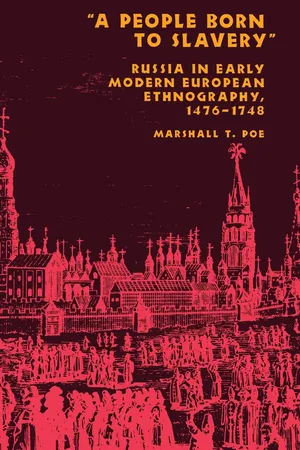
A People Born to Slavery"
eBook - PDF

A People Born to Slavery"

Russia in Early Modern European Ethnography, 1476–1748

  1. 312 pages
  2. English
  3. PDF
  4. Available on iOS & Android
eBook - PDF

A People Born to Slavery"

Russia in Early Modern European Ethnography, 1476–1748

About this book

Many Americans and Europeans have for centuries viewed Russia as a despotic country in which people are inclined to accept suffering and oppression. What are the origins of this stereotype of Russia as a society fundamentally apart from nations in the West, and how accurate is it?

In the first book devoted to answering these questions, Marshall T. Poe traces the roots of today's perception of Russia and its people to the eyewitness descriptions of sixteenth- and seventeenth-century European travelers. His fascinating account—the most complete review of early modern European writings about Russia ever undertaken—explores how the image of "Russian tyranny" took hold in the popular imagination and eventually became the basis for the notion of "Oriental Despotism" first set forth by Montesquieu.

Poe, the preeminent scholar of these valuable primary sources, carefully assesses their reliability. He argues convincingly that although the foreigners exaggerated the degree of Russian "slavery," they accurately described their encounters and correctly concluded that the political culture of Muscovite autocracy was unlike that of European kingship. With his findings, Poe challenges the notion that all Europeans projected their own fantasies onto Russia. Instead, his evidence suggests that many early travelers produced, in essence, reliable ethnographies, not works of exotic "Orientalism."

Frequently asked questions

Yes, you can cancel anytime from the Subscription tab in your account settings on the Perlego website. Your subscription will stay active until the end of your current billing period. Learn how to cancel your subscription.
No, books cannot be downloaded as external files, such as PDFs, for use outside of Perlego. However, you can download books within the Perlego app for offline reading on mobile or tablet. Learn more here.
Perlego offers two plans: Essential and Complete
  • Essential is ideal for learners and professionals who enjoy exploring a wide range of subjects. Access the Essential Library with 800,000+ trusted titles and best-sellers across business, personal growth, and the humanities. Includes unlimited reading time and Standard Read Aloud voice.
  • Complete: Perfect for advanced learners and researchers needing full, unrestricted access. Unlock 1.4M+ books across hundreds of subjects, including academic and specialized titles. The Complete Plan also includes advanced features like Premium Read Aloud and Research Assistant.
Both plans are available with monthly, semester, or annual billing cycles.
We are an online textbook subscription service, where you can get access to an entire online library for less than the price of a single book per month. With over 1 million books across 1000+ topics, we’ve got you covered! Learn more here.
Look out for the read-aloud symbol on your next book to see if you can listen to it. The read-aloud tool reads text aloud for you, highlighting the text as it is being read. You can pause it, speed it up and slow it down. Learn more here.
Yes! You can use the Perlego app on both iOS or Android devices to read anytime, anywhere — even offline. Perfect for commutes or when you’re on the go.
Please note we cannot support devices running on iOS 13 and Android 7 or earlier. Learn more about using the app.
Yes, you can access A People Born to Slavery" by Marshall T. Poe in PDF and/or ePUB format, as well as other popular books in History & Russian History. We have over one million books available in our catalogue for you to explore.

Information

Table of contents

  1. Cover
  2. Contents
  3. Acknowledgments
  4. A Note on Abbreviations
  5. INTRODUCTION The History of "Russian Tyranny"
  6. CHAPTER I TERRA INCOGNITA The Earliest European Descriptions of Muscovy
  7. CHAPTER 2 LEGATUS AD MOSCOVIAM European Ambassadors and the Origin of "Russian Tyranny"
  8. CHAPTER 3 NECESSARIUM MALUM European Residents and the Origin of "Russian Tyranny"
  9. CHAPTER 4 RERUM MOSCOVITICARUM Herberstein and the Origin of "Russian Tyranny"
  10. CHAPTER 5 TYRANNIS SINE TYRANNO Political Categories and the Origin of “Russian Tyranny”
  11. CHAPTER 6 SIMPLEX DOMINATUS Russian Government in European Political Science
  12. CHAPTER 7 WAS MUSCOVY A DESPOTISM?
  13. APPENDIX Folkloric Stories about Ivan IV in European Ethnographies, 1555–1700
  14. BIBLIOGRAPHIES
  15. Index